


View full specs
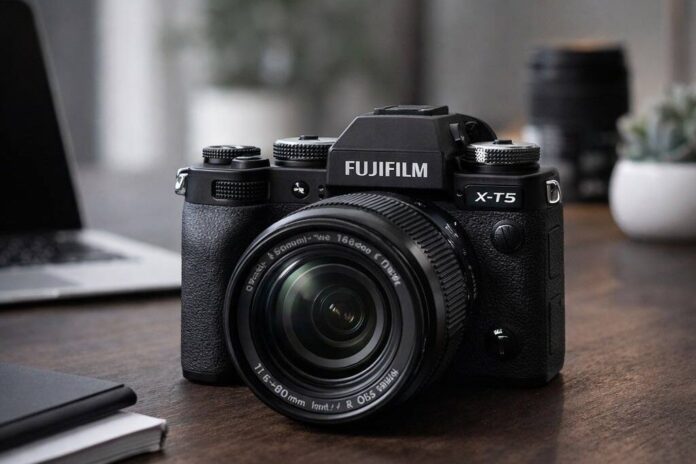
This Fujifilm X-T5 review starts with the thing that matters most: the X-T5 feels like a camera made for photographers who still enjoy operating a camera. It is not the smallest Fuji, not the best video body, and not full frame. It is a stills-first APS-C camera with excellent files and a very deliberate personality.
- Best for: travel, landscape, street, editorial, portraits, and photographers who want tactile control with serious resolution.
- Skip if: you need full-frame depth of field, the fastest sports AF, a video-first body, or the smallest Fuji kit.
- Price discipline: compare against X-T50 and X-H2 before buying; the X-T5 wins on feel, not only specs.
- Main appeal: 40MP sensor, IBIS, weather-resistant body, dual UHS-II card slots, three-way tilt screen, and classic dials.
Fujifilm’s official X-T5 specifications confirm the stills-focused hardware: a 40.2MP X-Trans CMOS 5 HR sensor, X-Processor 5, Fujifilm X mount, dual UHS-II SD slots, 7-stop IBIS, 6.2K video, NP-W235 battery, and a 557g shooting weight.
Who the Fujifilm X-T5 is really for
The X-T5 is for photographers who want involvement. In my experience, that is its real advantage over many technically excellent but bland cameras. You see the shutter-speed dial, ISO dial, exposure compensation dial, aperture ring on the lens, and you are invited into the exposure decision.
This matters for travel, street, editorial work, landscapes, portraits, and personal projects. The X-T5 makes the process visible. It does not hide photography behind a generic mode dial and a menu system. Some people will find that slower. I find it more connected.
The X-T5 is not the Fuji I would choose for serious sports or heavy video production. It can do both to a point, but the X-H2S and X-S20 make more sense for those priorities. If you are still deciding across the lineup, our best Fujifilm camera guide lays out the current bodies by use case. The X-T5 is best when still photographs are the reason you are buying the camera.
Handling, build, and daily use
Hands-on, the X-T5 has the right density. It feels serious without becoming a burden. The grip is not as deep as the X-H bodies, but it is better suited to long days than the smaller X-T50 or X-E bodies when you use larger lenses.
The three-way tilt screen is exactly the kind of detail still photographers appreciate. It is faster and cleaner for waist-level, low-angle, and vertical stills than a fully articulating screen. Video shooters may disagree, but that only proves the camera’s priorities.
Weather-resistant construction and dual UHS-II card slots make the X-T5 feel like a proper working stills body. If I were traveling somewhere important, shooting paid editorial work, or photographing in unpredictable weather, I would trust it more than the smaller compact Fuji bodies.
Image quality from the 40MP sensor
The 40.2MP sensor is the headline, and it is genuinely useful. You get crop room, detailed landscapes, cleaner composition recovery, and files that hold up for larger prints. The X-T5 can produce images that feel far beyond what many people still expect from APS-C.
There is a catch: technique matters. A 40MP APS-C sensor shows weak lenses, sloppy shutter speeds, and missed focus more clearly than a 26MP body. I do not see that as a problem. It simply means the X-T5 rewards careful shooting.
Fujifilm color remains a major reason to choose the system. The X-T5’s JPEGs can be beautiful, and RAW files give enough flexibility for serious work. I would use film simulations as creative starting points, not as a substitute for good light.
Autofocus, IBIS, and performance
The X-T5 autofocus is good for people, travel, portraits, street, family, and general movement. It is much better than older Fuji bodies, with subject detection that makes the camera easier to trust. It is still not the first body I would choose for high-pressure sports.
IBIS is a major practical strength. It helps with handheld travel, interiors, dusk landscapes, and unstabilized primes. Combined with small Fuji lenses, it makes the X-T5 a powerful stills kit without full-frame weight.
Burst shooting is strong enough for many photographers, but this is not a stacked-sensor action body. If wildlife and sports are your main work, the Fujifilm X-H2S is the more honest Fuji choice.
Video is good, but not the reason I would buy it
The X-T5 has serious video specifications: 6.2K, 4K60, F-Log2, and high-speed Full HD. The files can look excellent. But the camera’s handling, tilt screen, and overall design tell me it is still built around photographers first.
If video is equal to stills in your work, the Fujifilm X-S20 may be more convenient, and the X-H line is more production-friendly. I would use the X-T5 for occasional high-quality video, not as a rig-first hybrid platform.
X-T5 vs X-T50, X-S20, and X-H2
The Fujifilm X-T50 gives you much of the 40MP appeal in a smaller body. It is easier to carry, but it lacks the X-T5’s weather resistance, dual card slots, larger battery, and more serious handling.
The X-S20 is the more rational hybrid body. It has a deep grip, excellent battery life, IBIS, and video-friendly ergonomics. It is less satisfying if your heart is in still photography.
The X-H2 is the larger 40MP workhorse. It is more modern in control philosophy and more comfortable with bigger lenses. The X-T5 is the one I would choose if tactile stills shooting is part of the pleasure.
Best lenses for the X-T5
The X-T5 deserves good glass. The 40MP sensor pairs well with Fujifilm’s sharper primes and newer zooms. The XF 33mm f/1.4, XF 18mm f/1.4, XF 23mm f/1.4 LM WR, XF 56mm f/1.2 WR, XF 16-55mm f/2.8, and XF 70-300mm all make sense depending on your work.
For travel, I would build around the XF 16-50mm or XF 16-80mm if convenience matters, then add one strong prime. For portraits, the 56mm or 90mm options are more interesting. Our best Fujifilm X lenses guide is the natural companion to this body.
What to check before buying used
Check the IBIS, EVF, three-way tilt screen, dual card slots, shutter button, top dials, USB-C port, hot shoe, sensor, and weather-seal condition. The X-T5 is a camera people actually take outside, so inspect the base plate, strap lugs, and corners carefully.
I would also check whether the seller used it for heavy video work. That does not make it bad, but it changes how closely I inspect ports, heat history, and the screen hinge.
Final verdict
This Fujifilm X-T5 review lands strongly positive for photographers. The Fujifilm X-T5 review verdict is strongest when you judge it as a stills camera, not as a spec-sheet hybrid. I like the X-T5 because it gives excellent image quality in a body that still feels intentional. It makes the process of photographing visible, tactile, and satisfying.
I would buy it for stills-first travel, landscapes, street, portraits, and editorial work. I would not buy it as a pure video camera or sports specialist. The X-T5 is best for photographers who want modern files without giving up the feeling of using a real camera.
Fujifilm X-T5 alternatives
The main alternatives to the Fujifilm X-T5 are Fujifilm X-T50, Fujifilm X-H2, Fujifilm X-S20, Sony A6700, Canon R7, Nikon Zf. Compare autofocus, stabilization, video limits, lens choice and current price before deciding which camera fits you best.
Frequently asked questions
Is the Fujifilm X-T5 still worth buying?
Yes. The X-T5 remains one of Fujifilm’s strongest stills-first cameras, especially for photographers who want 40MP files, IBIS, weather resistance, and classic controls.
Is the Fujifilm X-T5 good for video?
Yes, but video is not the main reason I would buy it. The X-S20 and X-H bodies are more convenient if hybrid or production work is the priority.
Is the Fujifilm X-T5 better than the X-T50?
For serious stills work, yes. The X-T5 adds weather resistance, dual card slots, better battery life, and stronger handling. The X-T50 is smaller and easier to carry.
Travel, landscape, street, editorial, portraits, and photographers who want tactile stills-first control.
You need full-frame depth of field, the fastest sports AF, a video-first body, or the smallest Fuji kit.
Medium; rewarding, but the dials and 40MP sensor favor careful technique.
X-H2 for a larger 40MP workhorse, X-H2S for speed/video, X-T50 for smaller carry, X-S20 for hybrid convenience.
Very capable specs, but the handling, screen, and body philosophy are still photo-first rather than cinema-first.
Yes; it remains one of Fujifilmu2019s best cameras for photographers who value the shooting experience.