

View full specs
This Fujifilm X-S20 review is about the most practical kind of Fujifilm camera: not the prettiest, not the most nostalgic, and not the flagship, but maybe the body that makes the most sense for people who actually shoot both photos and video while traveling.
- Best for: travel, hybrid shooting, family work, solo creators, and photographers who want Fuji color with modern convenience.
- Skip if: you need weather sealing, dual card slots, classic Fuji exposure dials, or 40MP stills.
- Price discipline: compare carefully against the X-T50 if stills matter more, and against X-M5 if size matters more.
- Main appeal: IBIS, large battery, deep grip, strong video, and a body that works with more lenses than tiny Fuji bodies do.
Fujifilm’s official X-S20 specifications confirm the practical hybrid core: a 26.1MP X-Trans CMOS 4 sensor, X-Processor 5, Fujifilm X mount, UHS-II SD support, NP-W235 battery, 7-stop IBIS, and 6.2K open-gate video.
Who the Fujifilm X-S20 is really for
The X-S20 is for photographers who want fewer excuses. In my experience, the combination of grip, IBIS, battery life, and video tools matters more in daily use than whether the body has the most romantic Fujifilm design.
This is the Fuji I would hand to someone who shoots travel stills in the morning, family video in the afternoon, and handheld low-light clips at night. It is not the most beautiful camera in the lineup, but it is one of the easiest to trust.
The X-S20 also suits people moving up from a beginner body. It has enough automation to stay friendly, but enough depth to grow into. The Vlog mode is there if you want it, but the camera is much more than a vlogging shortcut.
Handling and travel use
Hands-on, the X-S20 feels more secure than the small retro Fujis. The grip is deep, the NP-W235 battery lasts longer, and the body balances better with zooms. That makes it less charming in a style sense, but much better as a travel workhorse.
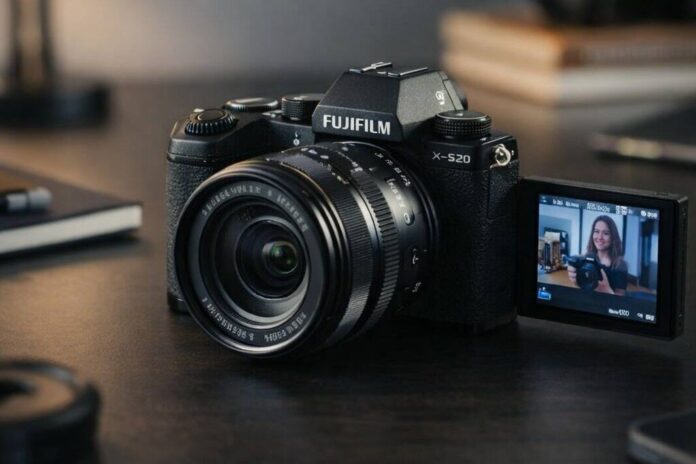
The vari-angle screen is useful for video, low angles, vertical social clips, and awkward travel framing. Stills photographers who prefer tilt screens may disagree, but for a hybrid body, the fully articulating design makes sense.
The missing weather sealing is the main body-level disappointment. I would not treat the X-S20 like a rough documentary camera in bad weather. For normal travel, family, and creator work, it is more than sturdy enough if handled sensibly.
Image quality and Fujifilm color
The X-S20 uses the familiar 26.1MP X-Trans CMOS 4 sensor, and that is not a weakness. The files are detailed, the colors are pleasing, and the resolution is plenty for travel, portraits, family, web, and moderate prints. The newer X-T50 gives more pixels, but not everyone needs them.
Fujifilm’s film simulations remain one of the system’s strongest reasons to buy. The X-S20 lets you build a JPEG workflow that feels creative without sacrificing RAW flexibility. For travel, that matters because you may want good files quickly rather than a week of editing when you get home.
IBIS is the practical upgrade that changes the camera. With small primes, interiors, dusk scenes, and handheld video, stabilization turns the X-S20 into a more forgiving tool than older 26MP Fuji bodies.
Autofocus and video
The X-S20 benefits from X-Processor 5 and modern subject detection. It is not an X-H2S action camera, but it is confident for people, animals, family movement, travel moments, and casual action. For most users, autofocus will not be the limiting factor.
Video is where the X-S20 separates itself from many stills-first Fujis. Open-gate 6.2K, 4K60, F-Log2, IBIS, a vari-angle screen, mic input, headphone support through USB-C, and the larger battery make it a very credible compact hybrid body.
The limits are still real. One card slot, no weather sealing, micro-HDMI, and a small body keep it below a true production camera. But for travel creators and hybrid photographers, the X-S20 is unusually balanced.
If you are comparing the X-S20 against the rest of the system, our best Fujifilm camera guide puts the current Fuji bodies in a cleaner use-case order.
X-S20 vs X-T50, X-M5, and X-T5
The X-T50 is the more attractive stills camera if you want 40MP files and a traditional Fujifilm feel. It is also less comfortable for larger lenses and less video-practical in some ways.
The X-M5 is smaller and cheaper, but gives up the EVF, IBIS, bigger battery, and deeper grip. I like the X-M5 as a tiny carry camera. I trust the X-S20 more as a main travel body.
The X-T5 is the more serious stills camera, with weather sealing, dual card slots, and 40MP files. If you shoot paid stills or want a more robust body, it is the better choice. If hybrid travel is the mission, the X-S20 may be the more sensible one.
Best lenses for the X-S20
The X-S20 handles more lens weight than the tiny Fuji bodies. The XF 18-55mm, XF 16-50mm, XF 16-80mm, and XF 18-120mm all make sense depending on whether you prioritize compactness, sharpness, range, or video behavior.
For primes, the XF 23mm f/2, XF 35mm f/2, and Sigma 18-50mm f/2.8 are practical choices. The body’s IBIS makes unstabilized primes easier to live with. Our best Fujifilm X lenses guide is worth using before you lock in the kit.
What to check before buying
Used X-S20 bodies should be checked around the screen hinge, USB-C port, mic port, hot shoe, IBIS behavior, sensor, and grip wear. Hybrid cameras often spend time on tripods, cages, and gimbals, so inspect the base plate and ports carefully.
I would also ask how much video work the camera has done. Heavy video use is not automatically a problem, but it changes what I inspect first. A clean, discounted X-S20 is one of the better Fuji buys; an abused creator body is not.
How I would set up the X-S20
The Fujifilm X-S20 review experience improves a lot once the camera is configured like a hybrid tool instead of a casual auto camera. I would set a custom stills setup for everyday photography, a video setup for 4K or open-gate work, and a quick-access menu for film simulation, AF mode, face/eye detection, stabilization, and audio levels.
For stills, I would usually leave mechanical shutter active unless silent shooting matters. For travel video, I would build around 4K rather than chasing maximum 6.2K all the time. The camera can do the bigger files, but travel work is often about reliability, storage, and battery life, not just maximum resolution.
Where the X-S20 can replace two cameras
The reason this body is commercially interesting is simple: it can replace a dedicated travel stills camera and a small creator camera for many people. The grip is secure enough for longer lenses, the battery is far better than the tiny Fuji bodies, and the video feature set is strong enough that you do not immediately feel boxed in.
That does not make it perfect. A professional event shooter still wants dual card slots. A bad-weather travel photographer still wants weather sealing. But for the skilled enthusiast or compact hybrid shooter, the X-S20 covers a wide range with fewer awkward compromises than most Fujifilm bodies in this size class.
Final verdict
This Fujifilm X-S20 review is strongly positive because the camera is so rational. It may not have the visual romance of an X100 or X-E body, but it solves real problems: battery life, grip, stabilization, autofocus, and video flexibility.
I would buy the X-S20 as a travel and hybrid camera before many more stylish Fujis. If your work is mostly stills and you want 40MP, look at the X-T50 or X-T5. If you want one compact Fuji body that handles a wide range of real-world work, the X-S20 remains one of the smartest choices in the system.
Fujifilm X-S20 alternatives
The main alternatives to the Fujifilm X-S20 are Fujifilm X-T50, Fujifilm X-M5, Sony A6700, Canon R7, Canon R50 V, Nikon Z50 II. Compare autofocus, stabilization, video limits, lens choice and current price before deciding which camera fits you best.
Frequently asked questions
Is the Fujifilm X-S20 good for photography?
Yes. The X-S20 has excellent 26MP image quality, Fujifilm color, IBIS, and strong autofocus for everyday stills, travel, and portraits.
Is the Fujifilm X-S20 good for video?
Yes. It offers 6.2K open-gate recording, 4K60, F-Log2, IBIS, and a vari-angle screen, making it one of Fujifilm’s strongest compact hybrid bodies.
Does the Fujifilm X-S20 have weather sealing?
No. The X-S20 is not weather sealed. If that matters, compare it with the X-T5 or X-H series.
Travel, hybrid shooters, family work, solo creators, and photographers who want Fuji color with modern convenience.
You want weather sealing, dual card slots, classic exposure dials, or a stills-first 40MP body.
Low-medium; the grip and modes are friendly, but the feature depth rewards learning.
X-T50 for 40MP stills, X-H2S for action/video, X-T5 for a more serious stills body.
Very strong for the size, but single card slot, no weather sealing, and micro-HDMI keep it below pro bodies.
Yes; it remains one of Fujifilmu2019s most rational all-around hybrid buys.