

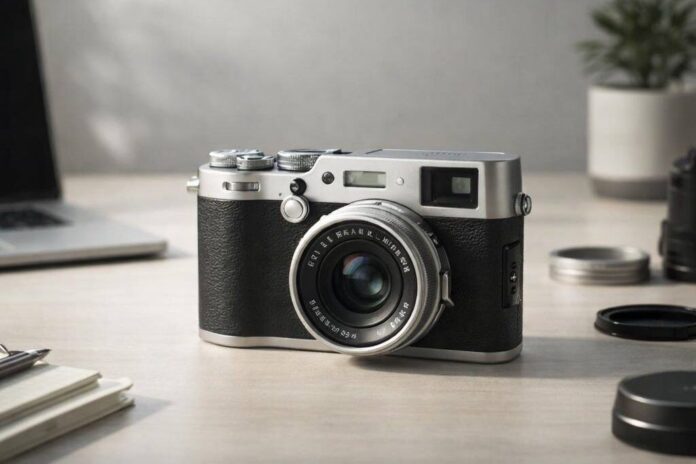

View full specs
In this Fujifilm X100F review, the camera is not being judged as a new compact. It is being judged as a used classic in a market where X100 prices can become irrational very quickly. The X100F is still a beautiful street camera, but it only makes sense when the price respects its age.
- Best for: street, travel, everyday documentary work, and photographers who want one fixed 35mm-equivalent view.
- Skip if: you need 4K video, IBIS, weather sealing, modern tracking AF, or interchangeable lenses.
- Price discipline: avoid hype pricing; compare against X100V, X100VI, and X-E bodies with compact primes.
- Main appeal: hybrid finder, leaf shutter, built-in ND, Fuji color, and a camera that rewards slower seeing.
Fujifilm’s official X100F specifications confirm the fundamentals: a 24.3MP APS-C X-Trans CMOS III sensor, fixed 23mm f/2 lens, hybrid finder, NP-W126S battery, Full HD video, and a 469g shooting weight.
Who the Fujifilm X100F is really for
The X100F is for photographers who understand that a fixed lens can be a feature, not a limitation. In my experience, one focal length changes the way you move. You stop zooming with your hand and start composing with your feet, timing, and distance.
That is why the X100F still works for street and travel. The 23mm f/2 lens gives a 35mm-equivalent field of view, which is wide enough for context and tight enough for people. It is not perfect for everything, but it is perfect for learning a consistent way of seeing.
The buyer who should avoid it is just as clear. If you want flexibility, buy an X-E or X-T body. If you want modern autofocus and video, buy newer. The X100F is not a bargain vlogging camera. It is a stills camera with a strong point of view.
Handling and the fixed-lens experience
Hands-on, the X100F feels like a camera that slows you down in a useful way. The shutter-speed dial, aperture ring, exposure compensation dial, and hybrid viewfinder all pull you into the act of photographing. It feels less like operating a device and more like carrying a small instrument.
The hybrid finder is still special. The optical viewfinder gives you a looser, rangefinder-like way of seeing outside the frame, while the EVF gives more precision when exposure and focus need confirmation. Newer cameras have better screens and AF systems, but few feel quite like this.
The leaf shutter and built-in ND filter are not trivia. They matter for daylight portraits, quiet shooting, and flash work. Being able to shoot wide open in bright light or sync flash at high shutter speeds gives the X100F a creative advantage that many interchangeable-lens cameras do not share.
Image quality in 2026
The 24.3MP X-Trans III sensor is older, but it still produces strong still files. Color is the reason many people stay with Fujifilm, and the X100F gives you that familiar Fuji look in a compact body. JPEGs can be lovely with a good film simulation recipe, while RAW files still tolerate serious editing.
The fixed 23mm f/2 lens is sharp enough for the camera’s purpose, though it is not flawless wide open at close focus. I would not obsess over that. This is not a lab camera. It is a camera for timing, light, gesture, and memory.
Low light is acceptable, but this is where age shows. There is no IBIS, no modern high-ISO miracle, and autofocus is not as confident as newer bodies. If you shoot a lot at night, the X100VI or an IBIS-equipped interchangeable-lens body is easier.
Autofocus, video, and real limitations
The X100F autofocus is good enough for deliberate street, travel, family, and documentary stills. It is not the camera I would choose for fast children running toward me, sports, or unpredictable action. Skilled readers will understand this: the camera rewards anticipation more than tracking.
Video is dated. Full HD only, no 4K, no IBIS, and older handling mean it should not be bought for creator work. Occasional clips are fine. Serious video is not the point.
The other limitation is used-market risk. X100 cameras get carried daily, tossed in bags, and sometimes loved hard. Inspect the lens, finder, dials, battery door, flash, and sensor condition before paying premium money.
X100F vs X100V, X100VI, and X-E4
The X100V improves the lens, body design, weather-resistance option, screen, and video. The X100VI adds IBIS, 40MP, and a much more modern feature set. If prices are close, the newer cameras are better buys.
The X-E4 comparison is about flexibility. An X-E4 with a small prime can feel similar in spirit, while letting you change lenses. It lacks the X100F’s leaf shutter, built-in ND, and hybrid finder. That tradeoff is personal.
I would choose the X100F when I specifically want the X100 shooting experience. I would choose an X-E body when I want a small Fujifilm system camera.
What to check before buying used
Check the lens for dust, haze, focus noise, and close-focus behavior. Test the hybrid finder, EVF, rear screen, command dials, flash, leaf shutter, battery door, and hot shoe. Also check that the camera has not been abused by rough filter or adapter use.
I would be careful with listings that price the X100F like a rare collectible. It is a desirable camera, but it is not new technology. The right X100F is a joy. The wrong-priced X100F is a trap.
How I would shoot the X100F today
The Fujifilm X100F review experience improves when you stop treating it like a general compact and lean into its fixed-lens identity. I would set it up for aperture-priority street work, use Auto ISO with sensible minimum shutter speeds, and keep a film simulation recipe ready for JPEGs that already feel close to finished.
The built-in ND filter is worth using. It lets you keep the lens wider in bright light, and the leaf shutter makes fill flash more interesting than on many interchangeable-lens bodies. That combination is part of why the X100F still feels different rather than merely old.
When the X100F is the wrong romantic choice
The X100F becomes the wrong choice when you secretly want flexibility. If you keep wishing for portraits at 50mm, wide travel interiors, or longer detail shots, an X-E body with two compact primes will make more sense. The fixed lens is only liberating if you actually want the discipline.
I would also avoid the X100F for video-first work, fast family action, or bad-weather travel. The newer X100V and X100VI solve some of those issues, and interchangeable-lens Fujifilm bodies solve others. Buy the X100F for the shooting experience, not because it is the cheapest way into the X100 hype.
If you are trying to decide between fixed-lens discipline and a small interchangeable kit, our best Fujifilm X lenses guide gives useful context for what an X-E or X-T body can do differently.
Final verdict
This Fujifilm X100F review lands on yes for stills-first photographers who want a compact camera with discipline and personality. I still understand the appeal completely. The X100F encourages a way of working that phones and general mirrorless kits rarely do.
But the price has to be right. I would buy an X100F for street and travel if it is clean and sensibly priced. I would not chase it at inflated prices just because the X100 series is fashionable. At that point, newer Fujifilm options make more sense.
Fujifilm X100F alternatives
The main alternatives to the Fujifilm X100F are Fujifilm X100V, Fujifilm X100VI, Ricoh GR III, Ricoh GR IIIx, Fujifilm X-E4 with 27mm. Compare autofocus, stabilization, video limits, lens choice and current price before deciding which camera fits you best.
Frequently asked questions
Is the Fujifilm X100F still worth buying?
Yes, if you want a stills-first fixed-lens camera and find a clean body at a sane used price. It is not worth overpaying for hype.
Does the Fujifilm X100F shoot 4K video?
No. The X100F records Full HD video, not 4K. It is best treated as a still photography camera.
What lens is on the Fujifilm X100F?
The X100F has a fixed 23mm f/2 lens, giving roughly a 35mm-equivalent field of view on APS-C.
Street, travel, documentary-style everyday photography, and people who want one fixed 35mm-equivalent view.
You need interchangeable lenses, 4K video, IBIS, weather sealing, or modern tracking autofocus.
Medium; the fixed lens teaches discipline but can frustrate people who expect zoom flexibility.
X100V/X100VI for newer AF/video/weather options, or X-E5/X-T50 if lens flexibility matters.
Full HD only and dated video handling; buy it for stills, not creator work.
Yes for the right used price and stills-first mindset; no if hype pricing makes newer options smarter.