
View full specs
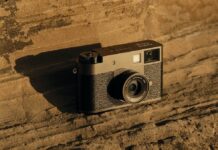
In this Fujifilm X-E4 review, the camera has to be judged as both a photographic tool and a used-market object. The X-E4 is charming, compact, and capable, but it is also discontinued, often overpriced, and easy to romanticize because Fujifilm has made small bodies fashionable again.
- Best for: street, travel, daily carry, and photographers who want a tiny interchangeable-lens Fuji.
- Skip if: you need IBIS, weather sealing, a deep grip, or modern subject detection.
- Price discipline: do not pay collector money when the X-E5, X-T50, and X-S20 exist.
- Lens pairing: keep it compact; the XF 27mm f/2.8 is the lens that makes the X-E4 make sense.
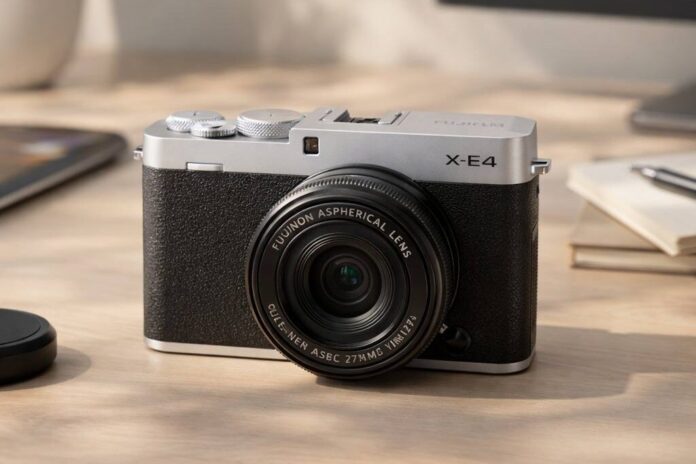
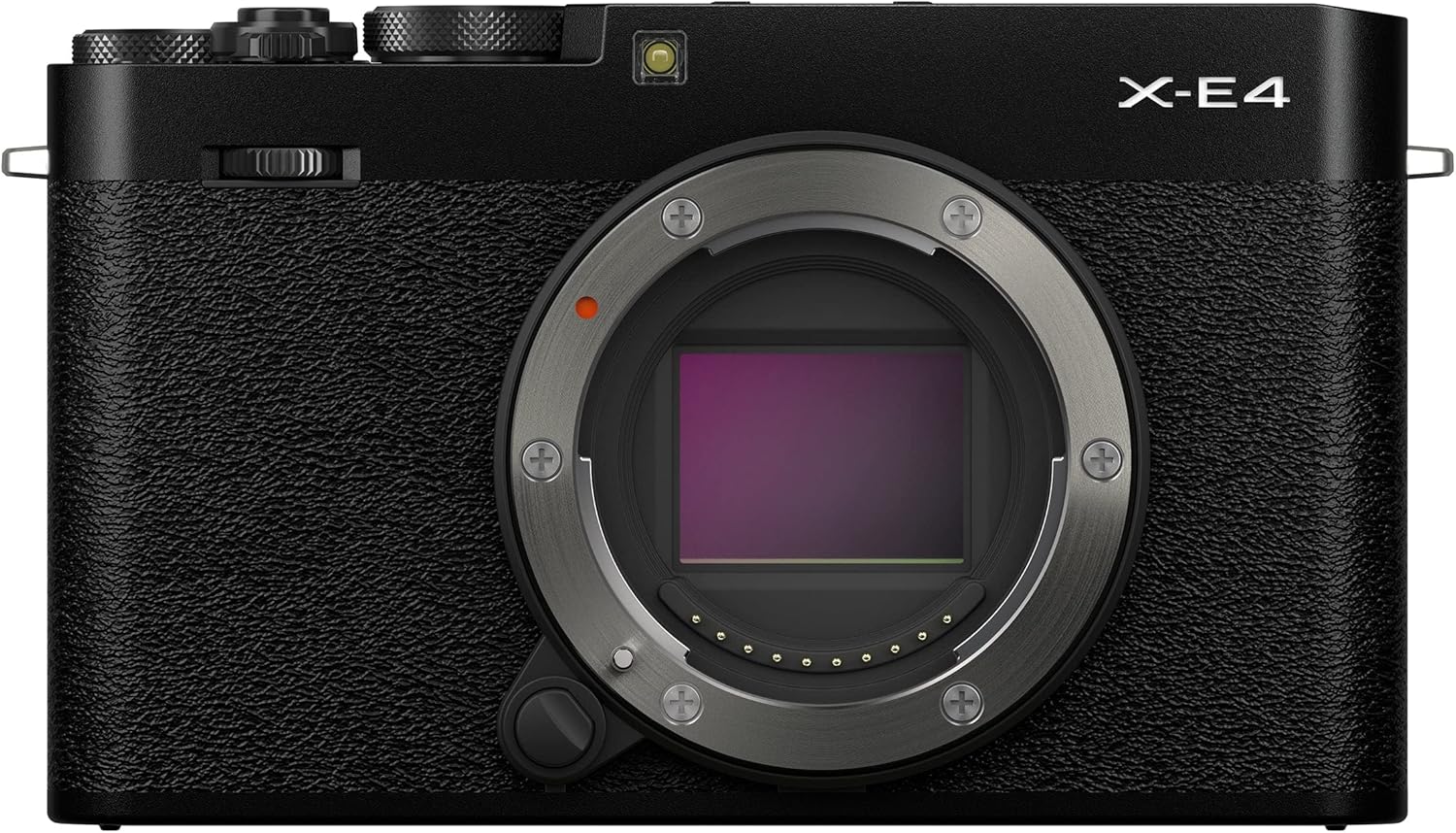
Fujifilm’s official X-E4 specifications confirm the core hardware: a 26.1MP X-Trans CMOS 4 sensor, X-Processor 4, Fujifilm X mount, UHS-I SD slot, NP-W126S battery, 4K video up to 30p, and a 364g shooting weight.
Who the Fujifilm X-E4 is really for
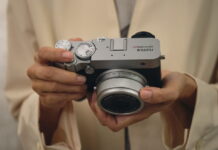
The X-E4 is for photographers who want a camera that feels barely there. In my experience, that matters more than the usual spec-sheet argument. A small camera changes behavior. You carry it more, shoot more casually, and stop treating every walk as a production.
That is why the X-E4 still has a following. With a pancake prime, it becomes a quiet street and travel camera with real Fujifilm files. It is not as complete as newer bodies, but it has a lightness that bigger cameras cannot imitate.
The problem is price. The X-E4 became desirable after discontinuation, and some used prices now make very little sense. At the right price, it is a lovely camera. Near X-E5 or X-T50 money, it becomes nostalgia with a shutter button. Our best Fujifilm camera guide is the safer starting point if you are comparing current bodies.
Handling and daily shooting
Hands-on, the X-E4 is beautifully minimal and occasionally too minimal. The flat body is elegant, but it is not built for heavy zooms or long shooting days with large lenses. I like it most with the XF 27mm f/2.8, XF 23mm f/2, or XF 35mm f/2.
The EVF is useful, the rear screen tilts, and the camera feels discreet in public. That is the point. If you want a deeper grip, more buttons, and faster direct control, the X-T30 II, X-T50, or X-S20 is easier to live with.
There is no IBIS and no weather sealing. For a daily street camera, that is manageable. For low-light primes, bad weather, or travel where you cannot baby the kit, it is a real limitation.
Image quality and color
The 26.1MP X-Trans CMOS 4 sensor remains excellent. It gives you enough resolution for serious everyday work, attractive JPEGs, and RAW files that hold up well if you expose carefully. You do not buy the X-E4 because it has the newest sensor. You buy it because the older sensor still looks good in a body you want to carry.
Fujifilm color is a major part of the appeal. Classic Chrome, Acros, Eterna, and Classic Neg can make quick daily work feel more finished. I would still shoot RAW+JPEG, but the JPEGs are good enough that you can let them shape the edit.
Lens choice matters. The X-E4 rewards compact, sharp lenses and punishes lazy kit-building. Our best Fujifilm X lenses guide is the more important next read if you are trying to build a small X-E4 kit.
Autofocus, video, and limitations
The X-E4 autofocus is fine for street, travel, portraits, and casual family use. It is not a modern subject-detection body, and it is not the Fuji I would choose for birds, sports, or erratic action. Use it with realistic expectations and it behaves well.
Video is useful but secondary. You get 4K up to 30p and high-speed Full HD, but no IBIS, older video handling, and a small body keep it from being a creator-first camera. I would use it for short clips, not as a serious hybrid platform.
The X-E4’s main limitation is that it asks for taste and discipline. If you build a small kit and accept the minimal controls, it is satisfying. If you want one camera for every job, it is too narrow.
X-E4 vs X-E5, X-T50, and X100F
The X-E5 is the obvious upgrade: 40MP, IBIS, newer autofocus, and a more complete body. It is also much more expensive. The X-E4 remains attractive only when the price gap is real.
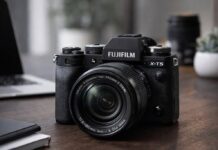
The X-T50 is the more practical stills camera. It gives you IBIS, a viewfinder, 40MP files, and more comfortable controls for mixed lenses. The X-E4 wins only when smallness and simplicity matter most.
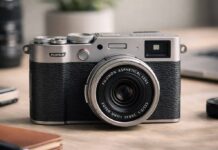
The X100F is the fixed-lens alternative. It is more self-contained, but less flexible. If you want lens choice, the X-E4 is the better idea. If you want one 35mm-equivalent view and no lens decisions, the X100 series has its own appeal.
What to check before buying used
Check the screen hinge, EVF, shutter button, command dials, USB-C port, hot shoe, sensor cleanliness, and battery door. Small daily cameras get carried everywhere, and body edges often tell you more than the listing description.
I would also check whether the seller includes the thumb rest or grip accessories. Many X-E4 owners added them because the body is so flat. They are not mandatory, but they can make the camera much nicer to use.
How I would build an X-E4 kit
The Fujifilm X-E4 review recommendation depends almost entirely on lens restraint. I would build around the XF 27mm f/2.8 first, then consider the XF 23mm f/2 or XF 35mm f/2. Those lenses protect the small-body character that makes the X-E4 valuable.
I would not buy the X-E4 as a platform for large zooms. It can use them, but the body becomes awkward and the whole idea weakens. If you know you want bigger lenses, the X-S20, X-T50, or X-T5 is the better starting point.
Why photographers still chase the X-E4
The X-E4 has stayed desirable because it gives Fujifilm shooters something rare: a very compact body with an EVF and interchangeable lenses. That sounds simple, but the current market proves how much photographers still want small cameras that feel serious.
The danger is mistaking desirability for value. A clean X-E4 can be wonderful. An overpriced X-E4 is a poor substitute for an X-E5 or X-T50. I would buy the camera for the way it changes my daily carry, not because the internet decided it is special.
Final verdict
This Fujifilm X-E4 review lands on yes only at the right price. I like the X-E4 a lot. It is small, quiet, stylish, and capable of excellent photographs. It has the kind of charm that makes you want to go for a walk with a camera.
I would not overpay for it. The X-E4 is best as a used-value compact Fuji, not a collector trophy. If the price is sane and you want a discreet X-mount street camera, it still makes sense. If sellers ask near-new X-E5 or X-T50 money, move on.
Fujifilm X-E4 alternatives
The main alternatives to the Fujifilm X-E4 are Fujifilm X-E5, Fujifilm X-T30 II, Fujifilm X-T50, Ricoh GR IIIx, Fujifilm X100V/X100VI. Compare autofocus, stabilization, video limits, lens choice and current price before deciding which camera fits you best.
Frequently asked questions
Is the Fujifilm X-E4 still worth buying?
Yes, if the used price is reasonable and you want a compact stills-first Fujifilm body. It is harder to recommend when priced close to newer Fuji models.
Does the Fujifilm X-E4 have IBIS?
No. The X-E4 does not have in-body stabilization, so lens OIS and shutter speed discipline matter.
Is the Fujifilm X-E4 good for street photography?
Yes. Its small body, EVF, quiet presence, and compact prime lens options make it a strong street photography camera.
Street, travel, everyday carry, and photographers who want a tiny interchangeable-lens Fuji.
You need IBIS, weather sealing, a deep grip, modern subject detection, or good value at inflated used prices.
Medium; simple once configured, but the minimal body rewards photographers who know what they want.
X-E5 for IBIS/40MP, X-T50 for a more complete small body, X-S20 for grip/video/battery.
Good casual 4K, but no IBIS, older AF, and compact ergonomics make it a stills-first camera.
Yes at sane used prices; no when nostalgia pushes it near newer Fuji bodies.