
View full specs
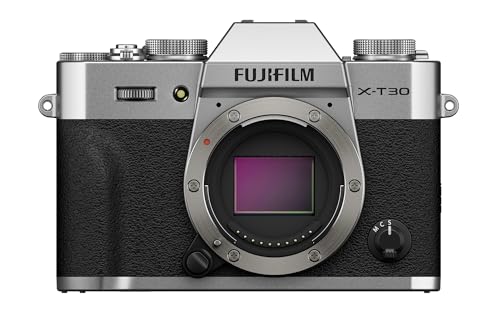
This Fujifilm X-T30 III review comes down to a simple judgment: Fujifilm kept the compact body and familiar 26.1MP sensor, then gave the camera the processor, autofocus and video tools the X-T30 II was missing. It is not a miniature X-T5. There is still no IBIS, weather sealing or large grip. What you get is a fast, photographically engaging X-mount camera that is much easier to recommend as a current model.
- Best for: travel, street, family photography and first-time Fujifilm buyers who want an EVF and classic controls.
- Biggest upgrade: X-Processor 5 brings current subject detection, a deeper buffer and dramatically stronger video options.
- Main compromise: no IBIS, no weather sealing and a small grip that works best with compact lenses.
- Buying verdict: a strong choice at its $999 body price, but compare it carefully with discounted X-S20 and X-T50 bodies.
Fujifilm’s official X-T30 III specifications confirm the important changes: X-Processor 5, AI subject detection, 6.2K/30p 10-bit recording, 4K/60p, Full HD at 240fps and battery life of up to 425 frames in Economy mode. Those are meaningful upgrades. The 26.1MP X-Trans CMOS 4 sensor, 2.36M-dot EVF and 378g shooting weight remain familiar.
Fujifilm X-T30 III review verdict
The X-T30 III is the X-T30 concept brought up to date without changing its personality. It is small enough to carry when a larger camera would stay home, yet it still gives you a central viewfinder, exposure dials, a focus joystick and access to Fujifilm’s complete X-mount lens system. That combination is why the camera makes sense.
The sensor is not new, and I do not consider that a serious weakness. Twenty-six megapixels is enough for detailed prints, moderate cropping and professional-looking online work. It also keeps file sizes manageable and places less stress on inexpensive lenses than Fujifilm’s 40MP sensor. The improvement is not a miraculous leap in RAW image quality. It is that the camera surrounding the sensor now focuses, processes and records like a current Fujifilm body.
My reservation is price. At $999 body-only, the X-T30 III is not a cheap beginner camera. It earns that price through its small size, control layout, lens ecosystem and JPEG experience rather than through stabilization or premium construction. If you value those things, the package feels coherent. If you only compare specifications per dollar, other cameras can look more generous.
What changed from the Fujifilm X-T30 II?
| Feature | X-T30 III | X-T30 II |
|---|---|---|
| Sensor | 26.1MP X-Trans CMOS 4 | 26.1MP X-Trans CMOS 4 |
| Processor | X-Processor 5 | X-Processor 4 |
| Subject detection | People, animals, birds, vehicles, trains and aircraft | Face and eye detection; no current AI subject recognition |
| Video | 6.2K/30p 10-bit, 4K/60p, FHD/240p | 4K/30p, FHD/240p |
| Film Simulations | 20, with dedicated dial and three recipe positions | 18, selected through menus or custom controls |
| Battery rating | Up to 425 frames in Economy mode | Up to about 390 frames in Economy mode |
| Size and weight | 118.4 x 82.8 x 46.8mm; 378g | Essentially identical; 378g |
| IBIS/weather sealing | No / no | No / no |
The processor is the real upgrade. The newer camera does not transform a daylight RAW file from the same sensor, but it changes autofocus behavior, video, power efficiency and buffer depth. That is more valuable in use than another small increase in resolution would have been.
Owners of the Fujifilm X-T30 II should not upgrade automatically. If you mostly photograph static scenes, portraits and travel in single-shot AF, the files will remain very similar. Upgrade when subject detection, 4K/60p, open-gate video or the deeper burst buffer solves a real limitation. Otherwise, spend the money on a lens.
Design and handling: small for a reason
The X-T30 III weighs approximately 378g with its battery and card. With the XF 23mm f/2, XF 27mm f/2.8 or XF 35mm f/2, it feels like the camera Fujifilm intended: quick, discreet and easy to keep over one shoulder all afternoon. It does not announce itself, and that matters for street photography and family work.
The shutter-speed and exposure-compensation dials make exposure visible before you raise the camera. Pair the body with a lens that has an aperture ring and the shooting process becomes immediate. This is not decorative retro styling. Once you know the controls, you can change exposure without diving into a mode screen.
The new Film Simulation dial is more subjective. It is useful if you genuinely change looks while shooting, especially because the FS1-FS3 positions can hold custom recipes. I like it for moving between a restrained color recipe, Acros and a warmer family look. If you shoot RAW only, the dial occupies valuable top-plate space without changing much. It is a creative control, not a performance feature.
The body also preserves the old annoyances. The grip is shallow, and the rear Q button remains close to the thumb. Large lenses make the camera feel front-heavy. The 0.39-inch, 2.36M-dot EVF is perfectly usable, but it is not expansive, especially for photographers wearing glasses. The two-way tilting screen is excellent for waist-level stills and awkward for self-recording.
There is no official weather sealing. A weather-resistant lens does not make the body weather resistant, so I would use a cover in sustained rain. This is a travel camera, but not a camera I would casually leave exposed in bad conditions.
Image quality: the familiar sensor is not bad news
The 26.1MP X-Trans CMOS 4 sensor has been used widely enough that its character is well understood. At base ISO, detail is strong and dynamic range gives you sensible recovery room in RAW files. At ISO 3200 and 6400, the files retain useful color and texture when exposure is handled properly. It is not full-frame low-light performance, but the results are more than credible for travel, documentary work and available-light portraits.
The practical advantage over a phone is not merely resolution. It is control over focal length, aperture, timing and rendering. Put the XF 35mm f/2 on the camera and photograph a person near a window; the separation and tonal control are immediately different from computational blur. Put the 23mm f/2 on it and you have a responsive documentary camera that can follow a day without becoming the subject of the day.
Fujifilm’s JPEG engine remains part of the appeal. Reala Ace is a useful neutral starting point, Classic Chrome suits restrained documentary color, and Nostalgic Neg gives warm highlights without requiring an editing session after every walk. I would not call Film Simulations magic. Bad light and poor timing remain bad light and poor timing. They do, however, make it easier to establish a consistent visual voice in-camera.
The missing IBIS matters most with unstabilized primes after sunset. With a static subject, an X-T50 or X-S20 can use a slower shutter speed. The X-T30 III asks you to raise ISO, use a wider aperture or support the camera. Stabilized zooms help, but they cannot freeze a moving person. Good shutter-speed judgment still matters more than stabilization for street movement.
Autofocus and performance
X-Processor 5 gives the X-T30 III the subject-detection system expected from a current Fujifilm camera. It can recognize animals, birds, cars, motorcycles, bicycles, aircraft and trains, alongside face and eye detection for people. This is the clearest everyday difference from the X-T30 II.
For portraits and family photography, eye detection reduces the number of almost-sharp frames. For birds or vehicles, subject recognition helps the camera decide what deserves attention before tracking begins. It does not turn the small body into an X-H2S. Lens focus speed, subject contrast and AF settings still influence the result, but the camera is far less dependent on the photographer steering a focus box for every moving subject.
Continuous shooting reaches 8fps with the mechanical shutter, 20fps with the electronic shutter at full width and 30fps with a 1.25x crop. The deeper buffer is welcome: Fujifilm quotes up to 173 JPEGs at 8fps with the electronic shutter. For children, street sequences and occasional wildlife, that is plenty.
I would still use the mechanical shutter around fast lateral motion or artificial lighting. The electronic shutter is silent and fast, but the sensor is not stacked; rolling-shutter distortion and banding have not disappeared because the processor is newer. A skilled photographer chooses the shutter for the scene rather than leaving the camera on its highest number.
Video is much better, but the body is still photo-first
It is easy to underestimate the video system if you remember the X-T30 II. The X-T30 III records 6.2K/30p in a 3:2 open-gate format and can capture 10-bit HEVC internally. It also offers cropped 4K/60p and Full HD up to 240fps. Open-gate recording is especially useful when one clip needs to serve horizontal and vertical edits.
The camera also supports F-Log, F-Log2 and HLG recording for photographers who intend to grade rather than rely on a Film Simulation. That gives the files more room than the body design initially suggests, although F-Log2 starts at a relatively high ISO 1250.
This is a major upgrade from the X-T30 II, but it does not make the body the best Fujifilm choice for a serious hybrid workflow. There is no IBIS. Digital stabilization can steady walking footage, but it crops the image and cannot reproduce the natural result of a stabilized sensor. The screen tilts rather than facing forward, the card slot is UHS-I, HDMI is Micro Type D, and the microphone/remote socket is the less common 2.5mm size.
For tripod interviews, travel B-roll and short handheld clips with an OIS lens, the quality can be excellent. For long handheld productions, self-filming or work that depends on a deep grip and large battery, the X-S20 is the more rational tool. The X-T30 III is a stills camera with surprisingly serious video files, not a miniature cinema body.
The XC 13-33mm kit lens and better lens pairings
The new XC 13-33mm f/3.5-6.3 OIS kit zoom covers approximately 20-50mm in full-frame terms. That unusually wide starting point is useful for travel interiors, architecture and handheld video. It is also compact enough to preserve the reason for buying this body.
The compromise is the short telephoto end and slow maximum aperture. Fifty millimeters equivalent is normal rather than portrait-telephoto territory, and f/6.3 limits subject separation and low-light flexibility. I see the 13-33mm as a very good daylight travel lens and a sensible first lens, not the final word on what the camera can produce.
For street photography, the XF 23mm f/2 is the most natural pairing. The XF 27mm f/2.8 makes the camera genuinely small. The XF 35mm f/2 gives portraits and everyday details more separation without overwhelming the grip. A compact stabilized zoom makes sense for travel, while heavy f/2.8 zooms work technically but undermine the balance.
Our best Fujifilm X lenses guide covers the strongest small primes, zooms and third-party choices. On the X-T30 III, I would prioritize balance before chasing the fastest specification.
X-T30 III vs X-M5, X-S20 and X-T50
Choose the X-T30 III over the X-M5 if you need a viewfinder
The Fujifilm X-M5 uses the same sensor and processor but is cheaper, lighter and more creator-oriented. It has no EVF and uses a fully articulating screen. The X-M5 is better for self-filming; the X-T30 III is the stronger everyday photography camera.
Choose the X-S20 for stabilization and hybrid ergonomics
The Fujifilm X-S20 adds IBIS, a deeper grip, a larger NP-W235 battery and a more video-friendly screen. It feels less like a traditional Fuji and more like a modern hybrid. If stills and video matter equally, I would pay for the X-S20.
Choose the X-T50 for 40MP and IBIS
The Fujifilm X-T50 is the stills upgrade. Its 40.2MP sensor gives more cropping room, and IBIS helps with static low-light subjects. The X-T30 III is lighter, less expensive and less demanding of lenses and storage. The X-T50 is better when detail and stabilization justify the price.
For a wider view of the system, our best Fujifilm camera guide places these bodies alongside the X-T5, X-E5 and fixed-lens options.
How it compares outside Fujifilm
The Canon EOS R50 is cheaper and has excellent subject detection, a fully articulating screen and very friendly controls. It is the easier recommendation for a beginner who does not care about exposure dials or Fujifilm JPEG color. Its RF-S lens selection is less mature, however, and the body feels more entry-level.
The Nikon Z50 II has the best grip of this group and a straightforward interface. It is a strong choice for sports, family and photographers who expect to use larger lenses. The X-T30 III is smaller, offers more resolution and has the richer compact-prime ecosystem.
The Sony A6700 is the more capable hybrid body. It adds IBIS, a deep grip, a larger battery and stronger video tools, but it also costs more and feels less immediate as a walk-around stills camera. The Fujifilm wins when compact lenses, visible controls and JPEG character matter more than maximum specification coverage.
Who should buy the Fujifilm X-T30 III?
Buy it if:
- You want a small, current Fujifilm body with an EVF and traditional exposure controls.
- You photograph travel, streets, family, portraits or everyday life with compact lenses.
- You value strong JPEG color and want quick access to Film Simulations and recipes.
- You want better autofocus and video than the X-T30 II without moving to a larger body.
- You are entering X-mount and want a camera that leaves room to grow into better lenses.
Skip it if:
- You need IBIS for low-light stills or frequent handheld video.
- You regularly use large telephotos or heavy professional zooms.
- You need weather sealing, dual cards or a larger professional viewfinder.
- You primarily self-film and need a forward-facing screen.
- An X-S20 or X-T50 is available for only a small premium.
Final verdict
The Fujifilm X-T30 III is not exciting because Fujifilm reinvented the small camera. It is good because the company resisted making it larger and fixed the technology that had started to age. The same 26.1MP sensor now sits behind current autofocus, a deeper buffer and video specifications that are genuinely useful in 2026.
With a small prime, the camera has a quality that specification tables rarely capture: it gets out of the way. You see the light, turn a dial, frame through the EVF and make the photograph. The shallow grip, modest finder and missing IBIS are real compromises, but they are understandable consequences of the size rather than surprises hidden after purchase.
My verdict is positive with one condition: compare prices. At $999, it is a strong first Fujifilm camera and a convincing compact second body. If an X-S20 or X-T50 sits only slightly above it, decide whether stabilization is worth carrying a little more camera. Do not buy the X-T30 III because it looks retro. Buy it because its size and controls match how you actually photograph.
Fujifilm X-T30 III alternatives
The main alternatives to the Fujifilm X-T30 III are Fujifilm X-M5, Fujifilm X-S20, Fujifilm X-T50, Nikon Z50 II, Canon EOS R50, Sony A6700. Compare autofocus, stabilization, video limits, lens choice and current price before deciding which camera fits you best.
Frequently asked questions
Is the Fujifilm X-T30 III worth buying?
Yes, particularly for travel, street and everyday still photography. It combines a compact 378g body with current autofocus, an EVF and a broad X-mount lens system. It is less compelling for buyers who need IBIS or video-first ergonomics.
Does the Fujifilm X-T30 III have IBIS?
No. The X-T30 III does not have in-body image stabilization. It supports lens-based OIS and digital stabilization for video.
Is the Fujifilm X-T30 III weather sealed?
No. Fujifilm does not describe the X-T30 III body as weather resistant. Use appropriate protection in sustained rain, even with a WR lens.
What is the main difference between the X-T30 III and X-T30 II?
The X-T30 III keeps the same 26.1MP sensor and body dimensions but adds X-Processor 5, AI subject detection, a deeper buffer, 6.2K/30p 10-bit video, 4K/60p and a dedicated Film Simulation dial.
Is the Fujifilm X-T30 III good for beginners?
Yes. Its Auto lever can handle exposure and subject recognition while the physical dials provide a clear path into manual control. The camera is approachable without becoming disposable once the photographer improves.
What are the best lenses for the Fujifilm X-T30 III?
The XF 23mm f/2 is excellent for travel and street photography, the XF 27mm f/2.8 keeps the kit extremely small, and the XF 35mm f/2 suits portraits and everyday details. The XC 13-33mm kit zoom is a practical wide-angle travel starter.
Travel, street, family and everyday photographers who want a compact Fuji with an EVF and classic controls.
You need IBIS, weather sealing, dual cards, a deep grip or a forward-facing screen.
Low-medium; Auto mode is easy, while the exposure dials reward photographers who want to learn.
X-S20 for IBIS and hybrid ergonomics, X-T50 for 40MP stills, X-T5 for a more durable working body.
Strong 6.2K and 4K files, but no IBIS, a tilting screen, UHS-I storage and a small battery keep it photo-first.
Yes. It is one of the strongest compact entry points into the current Fujifilm X system.