

View full specs
In this Fujifilm X-T50 review, the camera needs to prove more than image quality. The 40MP sensor is excellent, but the real question is whether the X-T50 is the right small Fuji to buy when the X-S20, X-T5, X-E5, and X-M5 all pull in different directions.
- Best for: travel, street, everyday stills, and photographers who want 40MP and IBIS in a smaller Fujifilm body.
- Skip if: you need weather sealing, dual card slots, long battery life, or a deep hybrid grip.
- Price discipline: compare carefully against the X-T5; the X-T50 should not be an automatic buy at any price.
- Main appeal: 40MP files, IBIS, newer autofocus, film simulation dial, and classic compact Fuji handling.
Fujifilm’s official X-T50 specifications confirm the headline features: a 40.2MP X-Trans CMOS 5 HR sensor, X-Processor 5, Fujifilm X mount, UHS-II SD slot, 7-stop IBIS, 6.2K video, and a 438g shooting weight.
Who the Fujifilm X-T50 is really for
The X-T50 is for photographers who want high-end Fuji image quality in a body they will actually carry. In my experience, that is a real sweet spot. The X-T5 is the more serious camera, but the X-T50 is easier to bring on ordinary days.
This is not the cheapest Fuji and not the most rugged Fuji. It is the compact stills body with modern resolution, stabilization, and autofocus. That makes it very appealing for travel, street, family, and personal work where size matters but image quality still matters more.
The buyer who should hesitate is the one expecting an X-T5 in a smaller shell. The X-T50 gives you a lot, but not weather sealing, dual card slots, the same battery confidence, or the same handling with heavier lenses. For the broader lineup decision, see our best Fujifilm camera guide.
Design, controls, and film simulation dial
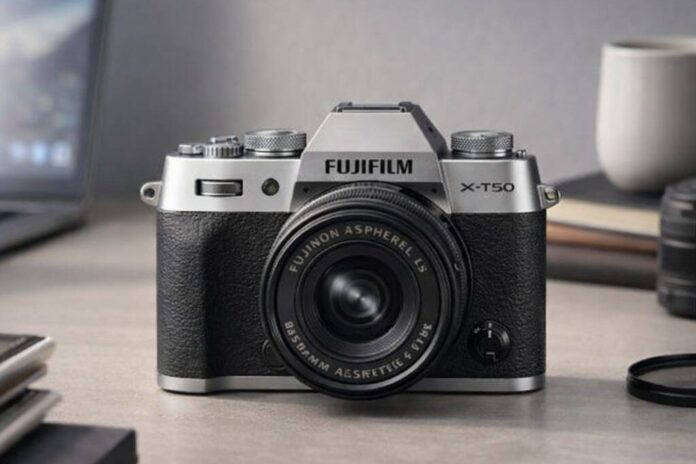
Hands-on, the X-T50 feels like a small Fuji first and a spec monster second. That is good. The body is light, the controls are familiar, and the shooting experience encourages you to work deliberately without slowing you down too much.
The film simulation dial is divisive. I understand why Fujifilm added it: color is one of the system’s main emotional hooks. For newer Fuji users, it makes the camera more inviting. For experienced shooters who would rather have another exposure control, it may feel like wasted top-plate space.
I do not hate it. I just think buyers should understand what kind of camera this is. The X-T50 is designed to make Fujifilm color more visible and immediate, not to be the most utilitarian control layout possible.
Image quality from the 40MP sensor
The 40.2MP X-Trans CMOS 5 HR sensor is the strongest reason to choose the X-T50 over older small Fujis. It gives you meaningful crop room, better detail for travel and landscape work, and files that feel more flexible when the lens and technique are good.
That last phrase matters. A 40MP APS-C sensor asks more from shutter speed, focusing accuracy, and lens quality. The X-T50 can produce excellent files, but it will show sloppy technique more clearly than a 26MP body.
Fujifilm color remains excellent. JPEGs are a pleasure, RAW files are flexible, and the film simulation workflow makes the camera feel more creative than most clinical midrange bodies.
IBIS, autofocus, and video
IBIS changes the X-T50 compared with older X-T30-style bodies. With small primes, evening street light, interiors, and travel details, stabilization gives you more margin. It also makes the camera feel more complete as a modern stills body.
Autofocus is strong for people, travel, family, portraits, and casual action. It is not the X-H2S for serious sports, but it is much more convincing than older compact Fujis. For the way most people will use the X-T50, the AF is good enough.
Video specs are capable: 6.2K, 4K60, FHD high speed, and current Fujifilm color profiles. Still, I see the X-T50 as a stills-first camera. Battery life, heat, grip, and the single card slot all make the X-S20 a more sensible hybrid choice.
X-T50 vs X-S20, X-T5, and X-E5
The X-S20 is better if video and handling comfort matter more. It has the larger NP-W235 battery, deeper grip, and a more hybrid-friendly design. It does not give you the same 40MP stills files.
The X-T5 is the better serious stills body. Weather sealing, dual card slots, better controls, and a more robust build make it the safer choice for paid work or rougher travel. The X-T50 wins on size and casual carry.
The X-E5 is the rangefinder-style alternative. It shares the compact premium Fuji idea but feels more specialized. The X-T50 is the more conventional all-around choice.
Best lenses for the X-T50
The X-T50 deserves lenses that can keep up with the 40MP sensor. The XF 16-50mm kit option makes sense if you want a modern lightweight zoom. Compact primes like the XF 23mm f/2, XF 35mm f/2, XF 27mm f/2.8, and newer small Fujifilm primes keep the body balanced.
I would be careful with older soft zooms or careless bargain glass. This sensor makes lens quality more visible. Our best Fujifilm X lenses guide is the practical companion to this camera review.
What to check before buying
If buying used or open-box, check IBIS behavior, the EVF, rear screen, dials, USB-C port, hot shoe, sensor, and card slot. Also check whether the previous owner used it heavily for video, because heat and port wear matter more on compact hybrid-capable bodies.
For new buyers, the main check is price. If the X-T50 sits too close to an X-T5 deal, I would think carefully. If you know you want the smaller body and will actually carry it more, the X-T50 earns its premium.
How I would build an X-T50 kit
The Fujifilm X-T50 review decision becomes much clearer once you build the kit. I would start with the XF 16-50mm if you want a modern travel zoom that matches the sensor better than older budget glass. For a smaller stills kit, I would add the XF 27mm f/2.8 or XF 35mm f/2 and keep the camera light.
The 40MP sensor is the reason not to be careless with lenses. A soft or poorly matched lens will still make photographs, but it wastes the camera’s main advantage. If you are buying the X-T50 for detail and cropping, lens quality is part of the body purchase.
Where the X-T50 feels better than the spec sheet
What I like most about the X-T50 is that it gives a small camera more margin. IBIS gives more confidence in low light, the 40MP sensor gives room to crop, and the autofocus is more relaxed than older compact Fuji bodies. These are not romantic features, but they make the camera easier to live with.
The tension is price. The X-T50 is no longer the inexpensive little sibling. It is a premium compact stills body. That is fine if you understand what you are buying, but it means the X-T5 comparison should always be in the room.
Final verdict
This Fujifilm X-T50 review lands positive, but not blindly. I like the X-T50 because it gives small-body shooters access to excellent 40MP files, IBIS, modern autofocus, and the Fujifilm color experience without moving to a larger body.
I would buy it for travel, street, everyday stills, and personal photography when size matters. I would not buy it as a rugged professional body or the best hybrid Fuji. The X-T50 is at its best when you want serious still-image quality in a camera that still feels easy to carry.
Fujifilm X-T50 alternatives
The main alternatives to the Fujifilm X-T50 are Fujifilm X-S20, Fujifilm X-T5, Fujifilm X-E5, Sony A6700, Canon R7. Compare autofocus, stabilization, video limits, lens choice and current price before deciding which camera fits you best.
Frequently asked questions
Is the Fujifilm X-T50 worth buying?
Yes, if you want a compact Fujifilm body with 40MP files, IBIS, and modern autofocus. It is less compelling if the price approaches an X-T5 deal.
Does the Fujifilm X-T50 have IBIS?
Yes. The X-T50 has 5-axis in-body stabilization rated up to 7 stops under Fujifilm’s test conditions.
Is the Fujifilm X-T50 better than the X-S20?
For stills resolution and classic Fuji handling, yes. For hybrid video, battery life, and grip comfort, the X-S20 is often better.
Travel, street, everyday stills, and Fuji shooters who want 40MP and IBIS in a smaller body.
You need weather sealing, dual card slots, long battery life, a deep grip, or the best hybrid ergonomics.
Medium; approachable, but the 40MP sensor and control layout reward careful technique.
X-T5 for weather sealing/dual slots, X-S20 for hybrid grip/battery, X-H2 for a larger 40MP workhorse.
Capable specs, but battery, heat, grip, and single-slot design make it less video-focused than X-S20.
Yes if you want small-body 40MP Fuji stills; less so if the price overlaps too much with X-T5.