

View full specs
In this Fujifilm GFX100RF review, the decisive question is not whether 102MP medium format files can look exceptional. They can. The question is whether a fixed 35mm f/4 lens, equivalent to 28mm on full frame, and a body without stills stabilization make sense for the way you photograph.
My short verdict: the GFX100RF is a remarkable landscape, travel, architecture and documentary camera for photographers who already understand 28mm. It is not a universal luxury compact, a low-light specialist or a shortcut to dramatic background blur. At this price, that distinction matters more than the sensor headline.
- Best for: deliberate travel, landscape, architecture, environmental portraiture, editorial work and large prints.
- Think twice if: you depend on stabilization, fast action autofocus, shallow-depth portraits or interchangeable lenses.
- The real attraction: 102MP files, excellent tonal flexibility, useful crop modes and unusually thoughtful photographic controls.
- The real compromise: a 28mm-equivalent f/4 lens and no optical or in-body stabilization.
Fujifilm GFX100RF specifications that matter
| Feature | Specification | Why it matters |
|---|---|---|
| Sensor | 102MP, 43.8 x 32.9mm GFX CMOS II | Exceptional detail, cropping room and large-print potential |
| Lens | Fixed 35mm f/4, equivalent to 28mm | Excellent for context-rich photographs, but neither fast nor interchangeable |
| Stabilization | No IBIS or optical stabilization | Shutter-speed discipline matters with 102MP files |
| Shutter and ND | Leaf shutter plus built-in four-stop ND filter | Quiet shooting, flexible flash synchronization and easier daylight control |
| Autofocus | Phase detection with face, eye and subject recognition | Modern enough for people and documentary work, not a sports flagship |
| Burst | Up to 6 fps | Useful for brief moments, but not sustained action |
| Viewfinder | 5.76M-dot OLED EVF, 0.84x magnification | Large, detailed and appropriate for careful composition |
| Storage | Dual UHS-II SD card slots | Redundancy matters on a camera aimed at serious work |
| Battery | NP-W235, rated around 820 frames | Unusually reassuring endurance for a high-resolution compact |
| Weight | 735g with battery and card | Compact for GFX, but emphatically not pocketable |
What kind of camera is the GFX100RF?
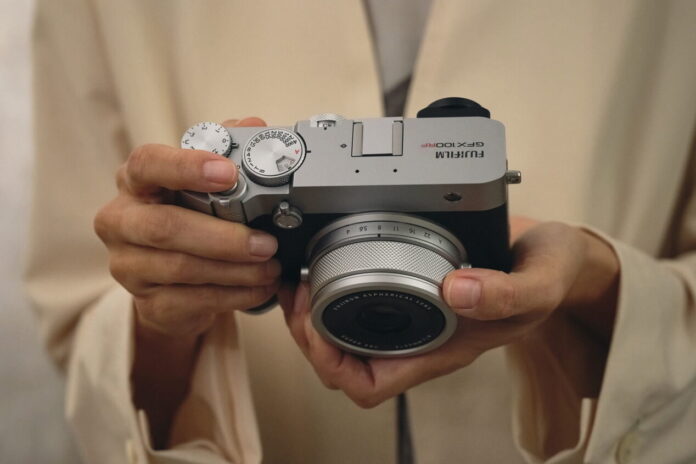
The GFX100RF is Fujifilm’s first fixed-lens GFX camera. It combines the 102MP sensor and X-Processor 5 approach found in the company’s current high-resolution medium format bodies with an X100-style, rangefinder-shaped design. The result is smaller than a GFX body and GF lens combination, but it is still a substantial camera.
That distinction is important. “Compact medium format” describes the engineering achievement; it does not mean pocket camera. At 735g, the GFX100RF weighs roughly as much as several premium full-frame fixed-lens cameras and considerably more than the Fujifilm X100VI. It belongs in a small shoulder bag, not a jacket pocket.
The concept works only if you accept one perspective. The lens is 35mm in actual focal length and gives a 28mm-equivalent field of view. That is excellent for landscapes, architecture, interiors, travel narratives and environmental portraits. Photographers who naturally see at 35mm or 50mm equivalent should not assume the digital crop lever completely replaces the lens they prefer.
Handling: more than an oversized X100
The aspect-ratio dial is genuinely useful
The dedicated aspect-ratio dial could have been decorative nostalgia. Instead, it is one of the camera’s most intelligent controls. Nine formats include 4:3, 3:2, 16:9, 1:1, 5:4, 3:4 and the panoramic 65:24 and 17:6 options. Seeing those boundaries while composing changes where you stand and what you exclude.
I like this because cropping after the fact is not the same creative act. Choosing 65:24 before pressing the shutter forces you to read a scene horizontally. Choosing 5:4 encourages a calmer, more formal frame. Raw files retain the full sensor data, while the viewfinder gives the photograph an intended shape at capture.
I also understand the opposite reaction. The dial is deliberately stiff, and a photographer who always delivers 3:2 may see expensive metal devoted to something Lightroom already does. That criticism is fair. Leave it at 4:3 or assign the C position if the ratios do not change how you compose; the control earns its space only when it changes the photograph before capture.
Digital crops are useful, but they remain crops
A front lever switches between the native 28mm-equivalent view and 36mm, 50mm and 63mm-equivalent crops. The resulting JPEGs are roughly 61MP, 31MP and 20MP, so even the tightest setting remains useful for normal publication and prints. JPEG crops are permanent, while raw files retain the full image area and record the intended crop as metadata that compatible software can revise.
I often hear that 102MP makes the fixed lens irrelevant because you can crop later. That is only half true. Perspective does not change when the camera stays in the same place, and a tighter crop cannot reproduce the viewpoint created by changing position with a longer lens. Treat the lever as a compositional convenience, not four lenses hidden in one body.
EVF, screen and build
The 5.76M-dot, 0.84x EVF is large enough for precise framing and focus checking. The 3.15-inch, 2.1M-dot touchscreen tilts up and down, which suits waist-level horizontal work. It does not fully articulate, and it is less convenient for vertical low-angle compositions or filming yourself.
Machined aluminum components and direct exposure controls give the camera the tactile seriousness its price demands. The grip is modest, however, and 735g becomes noticeable during a long walk. A wrist strap may look elegant; a supportive shoulder strap is the more sensible working choice.
Fujifilm specifies weather resistance only when the included adapter ring and protective filter are fitted. That is a small but important qualification. Do not assume the exposed lens assembly offers the same protection without them.
Image quality: detail is the story, not mystical bokeh
What the 102MP sensor gives you
The 43.8 x 32.9mm sensor offers 102MP, a native ISO 80 setting and 16-bit raw capture for deliberate shooting. At the maximum 6 fps burst rate, raw files drop to 14-bit. That is a sensible trade, but it reinforces the camera’s character: maximum file quality belongs to single frames and measured sequences, not prolonged action.
The practical benefits are fine texture, smooth tonal transitions, aggressive crop latitude and files that can support very large prints. Landscapes, architecture, still life and carefully lit editorial work are where that advantage is easiest to see.
There is also a cost. These files expose weak technique. Slight camera movement, missed focus, atmospheric haze and an indifferent shutter speed are all easier to see at 100 percent. From working with high-resolution files, I have learned not to trust the rear screen’s cheerful first impression: a frame can look perfect at fit-to-screen and reveal a small focus or movement error later. Resolution raises the ceiling only when the lens, light, focus and photographer all cooperate.
Fujifilm’s 20 Film Simulation modes, including Reala Ace, Classic Chrome, Classic Negative and Acros, make the JPEG and HEIF workflow unusually appealing. For travel, I would still record raw alongside JPEG. The finished color can be excellent, while the raw file protects a $4,899 decision from becoming an irreversible white-balance choice.
The 35mm f/4 lens is sharp, but it defines the limits
The fixed lens uses 10 elements in eight groups, focuses as close as 20cm from the front element and includes a four-stop ND filter. Its 28mm-equivalent angle of view is broad without becoming an ultra-wide special effect. This is a strong focal length for building layers and showing subjects in context.
The f/4 aperture deserves a sober explanation. Exposure is still f/4, and there is no stabilization for still photographs. In depth-of-field terms, it behaves roughly like a 28mm f/3.2 lens on full frame when framing is matched. That can separate a nearby subject from the background, especially near minimum focus, but this is not a bokeh-first portrait camera. A Leica Q3’s 28mm f/1.7 lens has a major advantage for low light and shallow depth of field.
The GFX100RF’s visual strength is disciplined detail and tonality across the frame. It is a mistake to reduce medium format to a vague “look” that appears automatically. The better reason to buy this camera is that its sensor and lens give a skilled photographer an unusually rich file from a portable, self-contained tool.
No IBIS changes how you should shoot
The absence of in-body or optical stabilization is the camera’s most consequential omission. A 102MP sensor rewards faster shutter speeds than photographers may use on a lower-resolution stabilized body. In dim interiors or at blue hour, expect to raise ISO, brace carefully or use a tripod.
The leaf shutter helps in other ways. It is quiet, reaches 1/4000 second mechanically and supports flash synchronization across its shutter-speed range. The built-in four-stop ND filter is useful for balancing daylight flash, controlling reflections with slower exposures or keeping an intended aperture in bright conditions. There is no built-in flash, so exploiting high-speed daylight sync requires an external flash or trigger on the hot shoe.
Autofocus and performance
X-Processor 5 brings face and eye detection plus subject recognition for animals, birds and vehicles. For portraits, travel and documentary scenes, the system is far more practical than the slow-medium-format stereotype suggests. The camera can react to ordinary movement without turning every photograph into a formal production.
That does not make it an action body. Continuous shooting tops out at 6 fps, raw files are enormous, and the electronic shutter can distort fast movement. Subject recognition is also not the same as class-leading AF-C tracking; erratic movement and subjects approaching the camera quickly will produce a lower hit rate than current Sony or Canon action bodies. The leaf shutter and deliberate handling suit quiet events, environmental portraiture and street scenes better than unpredictable sports or birds in flight.
Dual UHS-II card slots are exactly the right choice. They provide backup recording for paid work and enough throughput for large files. The NP-W235 battery is rated for roughly 820 frames, which is one of the more reassuring specifications on the camera. I would still carry a spare for travel or assignments, but battery anxiety should not define the experience.
The purchase price is only the first expense. A busy day can generate hundreds of large raw files, and every copy should exist on working storage and at least one backup. Fast UHS-II cards, larger drives, cloud or off-site backup and a computer that can move 102MP layers comfortably belong in the budget.
This is where I would challenge the purchase most aggressively. If the final work is social media, modest web use or small prints, the sensor is solving a problem you may not have. If you crop hard, retouch commercial files or print large enough to inspect closely, the workflow burden buys something visible rather than merely impressive on a specification page.
Video: capable, clearly secondary
The GFX100RF records DCI 4K or UHD 4K up to 30p, including 4:2:2 10-bit options and F-Log2. Digital stabilization is available for video, and microphone and headphone connections are present. Those specifications are respectable for short interviews, locked-off clips and occasional travel footage.
It remains a stills-first camera. There is no mechanical stabilization, digital stabilization applies a 1.32x crop, the screen is not fully articulated, and the high-resolution sensor shows rolling shutter when the camera or subject moves quickly. Buyers who primarily make video can spend far less on a more useful hybrid body.
Fujifilm GFX100RF comparisons
GFX100RF vs Fujifilm X100VI
The X100VI is smaller, lighter and dramatically less expensive. Its 35mm-equivalent f/2 lens is narrower and faster, it has IBIS, and its hybrid optical/electronic finder is unique. The GFX100RF counters with a much larger 102MP sensor, a wider 28mm-equivalent view, dual card slots and considerably more crop latitude.
For everyday family, street and travel photography, the X100VI is the rational choice for most people. Choose the GFX100RF when large prints, commercial files, tonal flexibility and the 28mm perspective are central to the work rather than pleasant extras. Our Fujifilm camera guide places both within the wider lineup.
GFX100RF vs Leica Q3
Both cameras frame like a 28mm lens and occupy a similar premium fixed-lens category. The Leica Q3 uses a 60MP full-frame sensor, a much faster 28mm f/1.7 lens, optical stabilization and a macro mode. The Fujifilm offers more resolution, a larger sensor, dual cards, stronger battery life and a lower original US launch price.
The choice is less about brand prestige than light. For dim interiors, evening street work and shallow-focus people pictures, the Leica lens is more useful. For landscapes, architecture, cropping and large detailed prints, the GFX100RF has the stronger underlying file.
GFX100RF vs GFX100S II
The GFX100S II makes more sense when professional flexibility matters. It adds in-body stabilization, Pixel Shift Multi-Shot and access to the interchangeable GF system, including specialist portrait, zoom, macro and tilt-shift options. Our guide to the best Fujifilm GFX lenses shows how quickly that system can expand in both capability and cost.
The GFX100RF is the better carry when a 28mm-equivalent lens already matches the assignment. It removes lens decisions and keeps the complete package smaller. The GFX100S II is the safer only camera; the GFX100RF is the more focused second camera or specialist tool.
GFX100RF vs Sony RX1R III
The Sony RX1R III takes a different route: a smaller 61MP full-frame sensor paired with a faster 35mm f/2 lens in a lighter body. Sony’s 35mm perspective and brighter aperture suit general documentary work and environmental portraits, while Fujifilm’s wider view and 102MP files favor architecture, landscapes and deep crops.
Who should buy the Fujifilm GFX100RF?
Buy it when:
- You already know that 28mm is a focal length you can live with for years.
- You print large, crop heavily or deliver detailed commercial and editorial files.
- You value aspect ratios, direct controls and a quiet leaf shutter as creative tools.
- You want GFX image quality without building an interchangeable-lens kit.
- You photograph landscapes, architecture, travel stories, interiors or environmental portraits.
Skip it when:
- You expect medium format to create shallow backgrounds at any distance.
- You often work in dim light without a tripod and depend on stabilization.
- You need fast telephoto, macro, sports or wildlife capability.
- Video is a primary part of your work.
- You are still discovering which focal lengths suit you.
Price and buying advice
Fujifilm launched the GFX100RF in the United States at $4,899.95. Retail availability and advertised prices can move, so compare authorized dealers and avoid paying a scarcity premium simply because one finish is difficult to find. At this level, a clean return policy matters more than saving a token amount from an unknown seller.
For a used copy, inspect the fixed lens carefully because it cannot be replaced like a GF lens. Check focus consistency, the leaf shutter, filter threads, EVF, tilting screen, both card slots, USB-C port and sensor cleanliness. Confirm that the adapter ring, protective filter, hood, caps, strap and NP-W235 battery are included; replacing the proprietary accessories erodes an apparent bargain.
Final verdict
The Fujifilm GFX100RF is exceptional precisely because it is specific. It gives a photographer 102MP medium format files, a refined 28mm-equivalent lens, a quiet leaf shutter and controls that encourage deliberate framing. It also refuses to hide its compromises: f/4, no stills stabilization, one focal length and a price that demands certainty.
I would not recommend it as a first serious camera or as a status-driven upgrade from an X100VI. I would recommend it to an experienced photographer who already sees in 28mm and knows exactly why a high-resolution, self-contained camera would improve the work. For that person, the limitations are not surprises to tolerate. They are the shape of the tool.
Fujifilm GFX100RF alternatives
The main alternatives to the Fujifilm GFX100RF are Leica Q3, Fujifilm GFX100S II, Sony RX1R III, Fujifilm X100VI. Compare autofocus, stabilization, video limits, lens choice and current price before deciding which camera fits you best.
Frequently asked questions
Is the Fujifilm GFX100RF a medium format camera?
Yes. It uses a 43.8 x 32.9mm, 102MP sensor that is larger than a full-frame sensor. Fujifilm calls this GFX large format, while the broader camera market generally describes it as digital medium format.
What is the GFX100RF lens equivalent?
Its fixed 35mm f/4 lens gives approximately the same angle of view as a 28mm lens on a full-frame camera. Digital crop modes provide 36mm, 50mm and 63mm-equivalent framing.
Does the Fujifilm GFX100RF have IBIS?
No. It has neither in-body stabilization nor optical stills stabilization. Digital stabilization is available for video only.
Is the GFX100RF weather sealed?
Fujifilm describes the camera as weather resistant when the included adapter ring and protective filter are fitted. Use both pieces before exposing it to dust or light rain.
Can you change lenses on the GFX100RF?
No. The 35mm f/4 lens is permanently attached. Choose a GFX100S II or another interchangeable-lens GFX body if you need different focal lengths or specialist lenses.
Is the Fujifilm GFX100RF worth the price?
It can be worth the price for photographers who need 102MP files, favor a 28mm-equivalent view and want a smaller alternative to a GFX body plus lens. It is poor value if you need IBIS, a fast aperture or focal-length flexibility.