

View full specs
In this Fujifilm X100VI review, I am not treating the camera like a normal compact. The X100VI is a cultural object now, which makes the buying decision harder. It is technically excellent, genuinely enjoyable, and often overpriced by the market around it.
- Best for: street, travel, documentary, daily carry, and photographers who want one 35mm-equivalent way of seeing.
- Skip if: you need lens flexibility, long reach, weather resistance without accessories, or rational availability.
- Price discipline: buy at retail or a sane used price; do not reward hype pricing.
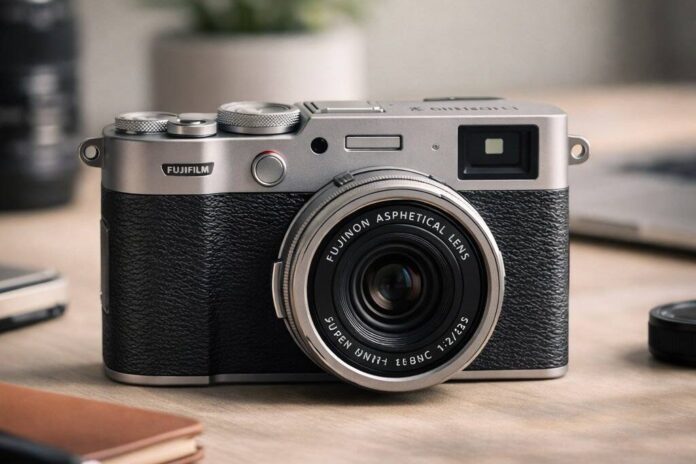
- Main appeal: fixed 23mm f/2 lens, hybrid finder, 40MP sensor, IBIS, leaf shutter, built-in ND, and Fujifilm color.
Fujifilm’s official X100VI specifications confirm the major upgrades: a 40.2MP X-Trans CMOS 5 HR sensor, fixed 23mm f/2 lens, 4-stop ND filter, 5-axis IBIS rated up to 6 stops, 6.2K video, UHS-I SD support, and a 521g shooting weight.
Who the Fujifilm X100VI is really for
The X100VI is for photographers who want the camera to simplify the decision before the photograph. One body, one lens, one field of view. In my experience, that constraint is the whole point. If you keep wishing for a zoom, you are fighting the camera.
The 35mm-equivalent view is wide enough for environment and close enough for people. It rewards moving your feet, waiting for gesture, and thinking about the edge of the frame. That is why street photographers keep coming back to the X100 series.
The X100VI is not for everyone. If you photograph wildlife, sports, events, compressed portraits, or anything that regularly needs focal-length flexibility, an X-E5 or X-T50 with compact primes is a better idea. For a wider lineup view, our best Fujifilm camera guide is the better place to compare the current bodies. The X100VI is brilliant only when you want its limits.
Handling and street shooting
Hands-on, the X100VI feels more complete than the X100F and X100V because IBIS changes how confidently you can shoot in low light. It still feels like an X100, though: small, dense, quiet, and built around the experience of walking with a camera rather than carrying a kit.
The hybrid finder remains the signature feature. The optical finder keeps you connected to the world outside the frame, while the EVF gives exposure and focus precision. I use the OVF when I want rhythm and awareness; I use the EVF when the light or focus point needs tighter confirmation.
The leaf shutter and built-in ND filter are practical advantages, not nostalgia. They let you shoot quietly, use flash in ways focal-plane shutters complicate, and keep wider apertures in bright light. That is a real photographic advantage for street, travel, and environmental portraits.
Image quality and the fixed 23mm lens
The 40.2MP sensor gives the X100VI much more cropping headroom than older X100 bodies. That matters because the lens is fixed. You can crop to a tighter composition when needed, but you should not treat that as a substitute for being in the right place.
The fixed 23mm f/2 lens is part of the character. It is not a universal lens, and it will never make the camera behave like a portrait telephoto. But for everyday documentary work, travel scenes, tables, alleys, people in context, and quiet street frames, it is exactly the right kind of limitation.
Fujifilm color remains a huge part of the experience. The X100VI is a camera I would happily shoot in JPEG+RAW, letting film simulations guide the mood while keeping RAW files for difficult light. Reala Ace, Classic Chrome, Acros, and Classic Neg all suit this body.
Autofocus, IBIS, and video
Autofocus is much more modern than older X100 bodies. Subject detection makes the camera more reliable for people, family movement, travel, and everyday documentary work. It is still not a sports camera, and the fixed lens makes that obvious.
IBIS is the upgrade that makes the X100VI feel more forgiving. It helps in dim interiors, evening streets, museums, restaurants, and handheld travel work. It also makes the camera feel less fragile as an everyday companion.
Video specs look strong, with 6.2K and 4K options, but I would still treat the X100VI as a stills-first camera. The fixed lens, UHS-I card slot, small body, battery limits, and heat considerations make it less comfortable for serious video than an X-S20 or X-H body.
Fujifilm X100VI alternatives
Compared with the Fujifilm X100F, the X100VI is a major step forward: 40MP, IBIS, better AF, better video, and a more modern shooting envelope. If prices are even remotely close, the X100VI is the better camera.
The Fujifilm X-E5 is the interchangeable-lens alternative. It gives you more flexibility and a similar modern Fuji sensor generation, but it loses the X100VI’s fixed-lens purity, leaf shutter, built-in ND, and hybrid finder.
The Ricoh GR IIIx is smaller and more pocketable, but it lacks the Fuji hybrid finder and X100 handling experience. I see the Ricoh as the pocket camera and the X100VI as the deliberate walking camera.
The Sony RX1R III is the full-frame luxury alternative for photographers committed to the same 35mm view. Its 61MP files and autofocus are formidable, but the fixed screen, lack of stills stabilization, and $5,099 price make the X100VI the more rational recommendation for most people.
The Fujifilm GFX100RF is the wider medium-format alternative. Its 28mm-equivalent f/4 lens and 102MP files favor landscapes, architecture, and environmental work, but the 735g body and lack of stills stabilization make it less relaxed as an everyday street camera. It is an upgrade in file quality, not a better X100VI for everyone.
Buying traps and availability
The biggest X100VI problem is not the camera. It is the market. High demand can turn a great camera into a bad buy if you pay inflated prices. I would rather wait, buy from a reputable retailer, or choose an X-E5/X-T50 kit than pay a silly premium.
If buying used, inspect the lens, EVF/OVF, rear screen, IBIS behavior, USB-C port, battery door, hot shoe, sensor, and control dials. X100 bodies get carried daily, which is exactly why they are lovely and exactly why condition matters.
How I would use it
I would set the X100VI for aperture-priority street work, Auto ISO with sensible minimum shutter speeds, and a small set of film simulations I actually use. I would avoid over-customizing it. This camera is best when it stays fast and instinctive.
I would also use the digital teleconverter sparingly. It is useful for framing discipline and quick JPEG output, but I would not buy the X100VI expecting it to replace real lens choices. The best photographs from this camera usually come from accepting 35mm-equivalent vision.
Final verdict
This Fujifilm X100VI review lands strongly positive on the camera and cautious on the buying situation. The Fujifilm X100VI review verdict is simple: the camera is excellent, but the market around it can be ridiculous. The X100VI is one of the most satisfying modern compact cameras for photographers who understand exactly what a fixed 35mm-equivalent lens can do.
I would buy it for street, travel, daily documentary work, and personal photography at retail or sane pricing. I would not buy it at hype prices, and I would not recommend it to anyone secretly wanting a zoom or interchangeable-lens system. The X100VI is excellent because it is specific.
Frequently asked questions
Is the Fujifilm X100VI worth buying?
Yes, if you want a fixed-lens stills-first camera and can buy it at a rational price. It becomes much harder to recommend at inflated resale prices.
Does the Fujifilm X100VI have IBIS?
Yes. The X100VI has 5-axis in-body stabilization rated up to 6 stops under Fujifilm’s test conditions.
Is the Fujifilm X100VI weather sealed?
It is weather-resistant only when used with the proper adapter ring and protection filter. I would not treat the bare camera as fully sealed.
Street, travel, documentary, daily carry, and photographers who want one disciplined 35mm-equivalent view.
You need interchangeable lenses, long reach, weather sealing without accessories, strong video ergonomics, or rational pricing.
Medium; easy to enjoy, but the fixed lens rewards photographers who understand movement and framing.
X-E5 or X-T50 for lens flexibility, X-T5 for serious stills work, Ricoh GR IIIx for a pocketable alternative.
Capable specs, but fixed lens, small body, UHS-I card slot, and heat/battery limits keep it stills-first.
Yes at retail or sane pricing; no when hype pushes it far above better-value alternatives.