

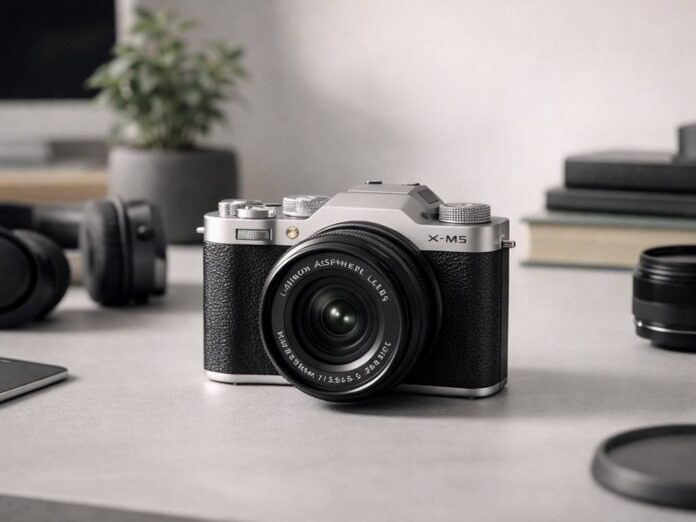

View full specs
In this Fujifilm X-M5 review, the useful question is not whether the X-M5 is the most complete Fujifilm body. It is not. The useful question is whether this tiny X-mount camera gives photographers and hybrid creators enough image quality, autofocus, video flexibility, and Fuji color to justify living without an EVF or IBIS.
- Best for: travel, street, family, social video, and people who want a real Fujifilm camera that actually leaves the house.
- Skip if: you need a viewfinder, weather sealing, in-body stabilization, or a stills-first body with deeper physical controls.
- Price discipline: the X-M5 is strongest when it stays clearly below X-S20 and X-T50 money.
- Lens pairing: keep it small. The whole point weakens if you immediately hang oversized glass on it.
Fujifilm’s official X-M5 specifications confirm the core recipe: a 26.1MP X-Trans CMOS 4 sensor, X-Processor 5, Fujifilm X mount, open-gate 6.2K/30p video, 4K up to 60p, subject detection AF, and a 355g shooting weight.
Who the Fujifilm X-M5 is really for
The X-M5 makes sense for photographers who already know that the best camera is not always the most serious camera. In my experience, small Fujifilm bodies earn their place by reducing friction. You do not need to plan a shoot around them. You put one in a small bag, pair it with a compact prime or the XC 15-45mm, and suddenly you are carrying a real APS-C camera on days when a larger kit would stay home.
That is the X-M5’s advantage. It is not trying to be an X-T5, X-H2S, or even an X-S20. It is trying to be the light, responsive, color-rich camera you keep near you. For travel and street work, that matters. A compact Fuji with good JPEG profiles often gets used more than a technically better body that feels like an assignment.
The obvious catch is the missing viewfinder. If you compose through an EVF, shoot in harsh sun, or like bracing the camera against your face, the X-M5 will feel compromised. If you are comfortable with rear-screen shooting and want strong video tools in a stills-capable body, the compromise is much easier to accept. For a wider comparison, see our best Fujifilm camera guide.
Design and handling
Hands-on, the X-M5 feels closer to a serious creator compact than a traditional enthusiast camera. The body is small, the screen is central to the experience, and the Film Simulation dial pushes you to think about look and output before you start editing. I like that approach for casual work. It makes the camera feel immediate without reducing it to a phone accessory.
For stills, the handling is good as long as you respect the body size. A small prime such as the XF 27mm f/2.8 or XF 23mm f/2 keeps the kit balanced. A larger zoom works, but it changes the character completely. If you are planning to use heavier lenses often, the X-S20 or X-T50 is the more comfortable choice.
The lack of IBIS is more important than the spec sheet makes it sound. With stabilized zooms, the X-M5 is fine. With small unstabilized primes, you need steadier technique in low light. This is not a dealbreaker, but it is the line between a charming daily camera and a more serious all-condition tool.
Image quality and Fujifilm color
The 26.1MP X-Trans CMOS 4 sensor is familiar in the best way. It has enough resolution for travel prints, editorial web use, family work, and moderate cropping. More importantly, the files have the Fujifilm color response people buy into the system for. Classic Chrome, Reala Ace, Acros, and Classic Neg are not magic, but they do make everyday files feel more finished straight out of camera.
My preferred way to use a camera like this is JPEG plus RAW. Let the JPEG carry the mood, but keep the RAW file when mixed light or high contrast gets ugly. The X-M5 rewards that workflow because its JPEG engine is fun without locking you into a single look.
Low-light quality is good for APS-C, but the body does not give you IBIS to rescue slow shutter speeds. For night streets, restaurants, interiors, and travel evenings, lens choice matters. This is where a compact fast prime changes the camera more than any menu setting. Our best Fujifilm X lenses guide is the natural next stop if you are building a small X-M5 kit.
Autofocus and video
This is where the X-M5 is more modern than its size suggests. X-Processor 5 gives it Fujifilm’s current subject detection logic, including people, animals, birds, vehicles, trains, insects, and drones. It is not an X-H2S for action, but it is much more confident than older small Fuji bodies.
For family movement, street moments, casual sports, and travel video, the autofocus is strong enough that I would not hesitate to use it. For birds in flight, paid sports, or unpredictable action with long lenses, I would step up. The body shape, card slot, and lack of EVF are telling you the same thing.
Video is the pleasant surprise. Open-gate 6.2K, 4K60, F-Log2, a fully articulated screen, headphone and mic connections, and Fujifilm’s three-mic direction modes make the X-M5 unusually serious for its size. The limit is not the spec sheet. The limit is stabilization, heat management in demanding use, UHS-I media, and the fact that a tiny body is less pleasant on a rig.
Fujifilm X-M5 vs X-S20 and X-T50
The X-S20 is the more complete hybrid camera. It gives you IBIS, a better grip, stronger battery life, and a body that feels more confident with larger lenses. If you shoot a lot of video or use primes in low light, the X-S20 earns its extra size.
The X-T50 is the more satisfying stills camera for many photographers. You get a viewfinder, 40MP files, IBIS, and a more traditional Fujifilm shooting experience. It is less pocketable, but more complete as a photo body.
The X-M5 wins when compactness is the point. If you are buying it because you want the smallest current X body with serious output, it makes sense. If you are buying it because it is simply the cheapest route into Fujifilm, be careful. Cheap only matters if the camera fits your shooting style. The Fujifilm X half is smaller and more playful, but its fixed lens, JPEG-only files, and basic video make the X-M5 the far more flexible main camera.
What I would actually buy with the X-M5
The Fujifilm X-M5 review decision becomes much clearer once you choose a lens. With the XC 15-45mm, it is a tiny travel kit that covers the basics and keeps the price sane. With the XF 27mm f/2.8, it becomes a pocketable street camera with a proper APS-C sensor. With the XF 23mm f/2 or XF 35mm f/2, it feels more like a classic Fujifilm walkaround body.
I would avoid building an X-M5 kit around large zooms unless video is the main reason. The body can mount them, obviously, but the balance stops feeling special. The X-M5 works best when the whole kit stays small enough that you do not think twice before bringing it.
What to check before buying
If you are buying new, the decision is mostly about price versus the X-S20 and X-T50. If you are buying used or open-box, check the screen hinge, USB-C port, hot shoe, sensor cleanliness, and whether the kit lens operates smoothly. I would also make sure the seller includes the original battery or a reputable spare, because tiny travel cameras get used hard.
The X-M5 is still young, so used pricing may not save enough to justify risk. If a used body is only slightly cheaper than new, I would buy new or refurbished. If the gap is meaningful, it becomes more interesting.
What makes it different from a phone
The X-M5 is not trying to beat a phone at computational convenience. It beats a phone by giving you a larger sensor, real lenses, Fujifilm color, more control over depth of field, and files that respond better when you edit them seriously. That distinction matters for readers who already know how to see light and want a small camera that still behaves like a camera.
This is why I like the X-M5 more as a photographer’s daily companion than as a generic creator gadget. It is modern enough for video, but the real pleasure is carrying something small that still gives you lens choice and a real photographic file.
Final verdict
This Fujifilm X-M5 review lands positively, but with a narrow recommendation. The Fujifilm X-M5 review bottom line is that this camera understands the value of being present. It is small, creative, modern, and good enough to become the camera you actually bring.
I would buy it for travel, street, family, light creator work, and everyday photography with compact lenses. I would not buy it as a serious action camera, a low-light prime body, or a replacement for an X-S20 or X-T50. The X-M5 is best when you stop asking it to be everything and let it be a small Fuji that makes you want to shoot more often.
Fujifilm X-M5 alternatives
The main alternatives to the Fujifilm X-M5 are Fujifilm X-S20, Fujifilm X-T50, Sony ZV-E10 II, Canon R50 V, Nikon Z30. Compare autofocus, stabilization, video limits, lens choice and current price before deciding which camera fits you best.
Frequently asked questions
Is the Fujifilm X-M5 good for photography?
Yes. As this Fujifilm X-M5 review makes clear, the X-M5 has a proven 26.1MP APS-C X-Trans sensor and excellent Fujifilm color. It is strongest for travel, street, family, and everyday photography, but the lack of EVF and IBIS matters for some stills shooters.
Does the Fujifilm X-M5 have a viewfinder?
No. The X-M5 does not have a built-in electronic viewfinder. If an EVF is important, look at the X-T50, X-S20, or X-T30-series bodies instead.
Is the Fujifilm X-M5 good for video?
Yes, especially for its size. It records open-gate 6.2K/30p, 4K up to 60p, and FHD up to 240p. It also has strong audio features, but lacks IBIS.
Travel, street, family, social video, and photographers who want Fujifilm color in the smallest current X body.
You need an EVF, IBIS, weather sealing, dual card slots, or a stills-first body with deeper controls.
Low for touchscreen/video users; medium for photographers who expect a viewfinder.
X-S20 for IBIS and grip, X-T50 for EVF/40MP stills, X-H2S for action and serious video.
Excellent for its size, but no IBIS, no EVF, and UHS-I storage keep it below the serious hybrid bodies.
Yes, if size and carry-everywhere use matter more than traditional enthusiast controls.