

View full specs
In this Fujifilm X-T30 II review, the real question is no longer whether the camera was good when it launched. It was. The question in 2026 is whether this older compact Fuji is still worth buying now that the X-T30 III, X-S20, and X-T50 have changed the value equation.
- Best for: travel, street, everyday photography, and photographers who want classic Fuji controls in a small body.
- Skip if: you need IBIS, weather sealing, the newest autofocus, or a video-first camera.
- Price discipline: buy it only when it is priced like an older model, not like a current one.
- Lens pairing: the X-T30 II shines with small primes and light zooms.
Fujifilm’s official X-T30 II specifications confirm the familiar strengths: a 26.1MP X-Trans sensor, 2.36M-dot EVF, tilting touchscreen, 4K up to 30p, FHD up to 240p, NP-W126S battery, and a 378g shooting weight.
Who the Fujifilm X-T30 II is really for now
The X-T30 II is for photographers who want the classic Fujifilm shooting experience without carrying a large body. It gives you a viewfinder, proper exposure dials, pleasing JPEG color, and access to the full X-mount lens system. That combination still matters.
But this Fujifilm X-T30 II review has to be honest about timing. The camera is no longer the fresh compact Fuji. The newer X-T30 III has arrived, the X-S20 is a stronger hybrid body, and the X-T50 gives stills shooters a 40MP sensor with IBIS. The X-T30 II now wins on price and feel, not on being the obvious default choice.
In my experience, older Fujifilm bodies stay attractive when they are bought for the right reason. If you want a small, tactile photo camera and find a clean X-T30 II at the right price, it can still be delightful. If you are paying nearly new-generation money, the charm stops being enough.
Design and handling
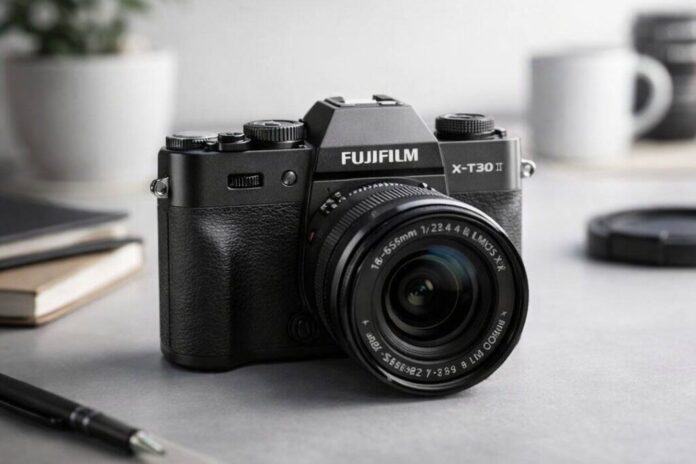
The X-T30 II remains one of Fujifilm’s better small-body designs. It is light, direct, and more photographer-oriented than many entry-level mirrorless cameras. The shutter-speed dial, exposure compensation dial, and aperture-ring lens pairing give you that Fuji rhythm: look, adjust, shoot.
Hands-on, I prefer it with compact lenses. The XF 27mm f/2.8, XF 23mm f/2, XF 35mm f/2, and small kit zooms make the body feel balanced. Larger lenses work, but the grip starts to feel like the limiting factor. If your kit includes heavy zooms, the X-S20, X-T5, or X-H bodies make more physical sense.
The EVF is modest by current standards, but it is still valuable. I would rather have this finder than rely entirely on a rear screen in bright travel light. The tilting touchscreen is also better for stills than for self-filming, which matches the camera’s personality.
Image quality and Fujifilm color
The 26.1MP X-Trans CMOS 4 sensor is the reason the X-T30 II has aged better than many small cameras. It produces detailed files, attractive JPEGs, and RAW images with enough flexibility for serious travel and everyday work. You do not need 40MP for most of the situations this camera is meant to handle.
Fujifilm’s film simulations are a major part of the appeal. Classic Chrome, Classic Neg, Acros, Eterna, and the standard Provia look all give you distinct starting points. I would not call them a substitute for good light or good timing, but they absolutely make the camera more enjoyable to use.
The main image-quality limitation is stabilization. There is no IBIS, so lens choice and shutter speed discipline matter. With an OIS zoom, the camera is forgiving. With an unstabilized prime in low light, you need to know what you are doing.
Autofocus and performance
The X-T30 II autofocus is good for travel, street, portraits, family, and casual movement. It is not as sticky or intelligent as Fujifilm’s newest subject-detection bodies. That difference becomes obvious with birds, sports, and erratic action.
For everyday shooting, I still find it perfectly usable. Configure the AF modes, avoid expecting miracles from wide/tracking in every situation, and the camera rewards good timing. It is not a point-and-pray action body. It is a small photographer’s camera with enough AF to support the way most people will actually use it.
Burst shooting is respectable, with 8 fps mechanical and faster electronic options. The electronic shutter can be useful, but rolling shutter and subject movement still require judgment. Again, this is where newer stacked or faster-readout bodies separate themselves.
Video and creator use
Video is the weakest part of the 2026 argument. The X-T30 II can record good-looking 4K up to 30p and high-speed Full HD, and the image quality is still pleasant. But no IBIS, older autofocus behavior, a small body, micro-HDMI, and limited creator ergonomics make it less compelling now.
If video matters as much as stills, I would look at the X-S20 or X-M5 first. If video is occasional travel clips, family footage, or a simple tripod setup, the X-T30 II is fine. The key is not pretending it is a modern creator-first camera.
X-T30 II vs X-T30 III, X-S20, and X-T50
The X-T30 III is the obvious successor and should be checked first if prices are close. It gives you newer processing and a more current buying path. The X-T30 II becomes interesting when used or leftover pricing creates a real gap.
The X-S20 is better for hybrid shooters because it adds IBIS, a deeper grip, stronger battery life, and more video confidence. It is less charming in the classic Fuji sense, but more practical for many people.
The X-T50 is the stronger stills upgrade. A 40MP sensor and IBIS make it more future-proof, especially if you like cropping or using small primes in low light. The X-T30 II wins only if you want to spend less and keep the kit small.
Lens choices that make sense
The X-T30 II needs compact lenses to feel right. The XF 35mm f/2 is a beautiful everyday pairing. The XF 23mm f/2 works for street and travel. The XF 27mm f/2.8 makes the camera nearly jacket-pocketable. For general use, the XC 15-45mm or XF 18-55mm keeps things practical.
If you are building a small kit around this body, lens choice is the whole game. Our best Fujifilm X lenses guide will be more useful than chasing another body comparison.
What I would pay attention to on the used market
The Fujifilm X-T30 II review buying decision is mostly a used-market decision now. Check the rear screen, EVF, shutter button, command dials, exposure compensation dial, USB-C port, hot shoe, and sensor. Small travel cameras often live in bags without much protection, so cosmetic wear can tell you how carefully the body was handled.
I would be cautious with overpriced bundles. A kit lens, off-brand batteries, and a bag do not automatically make a deal good. The X-T30 II is attractive when the body price leaves room for one genuinely useful lens. Otherwise, you may be better off buying a newer Fujifilm body with warranty coverage.
Best lenses for the X-T30 II
The best X-T30 II kits stay light. The XF 35mm f/2 is the one-lens answer for many photographers. The XF 23mm f/2 is better for travel and street. The XF 27mm f/2.8 makes the body feel almost compact-camera small. The XF 18-55mm is still a strong travel zoom if you want flexibility without making the camera awkward.
I would avoid buying the X-T30 II and then immediately pairing it with a heavy pro zoom as the default setup. It can work, but it misses the point. This camera is at its best when it feels agile. The more you protect that quality, the more sense the body makes.
Where the X-T30 II still beats newer cameras emotionally
Newer cameras may beat it on autofocus intelligence, stabilization, and video features, but the X-T30 II still has a simple photographic charm. You see the exposure controls, you set the aperture, you choose a film simulation, and you go make pictures. For skilled readers, that directness is not nostalgia. It is a workflow.
That is why I would not dismiss the X-T30 II just because the spec sheet is older. The danger is paying too much for it. At the right price, it remains a satisfying stills camera. At the wrong price, the newer bodies are simply better decisions.
Final verdict
This Fujifilm X-T30 II review lands on yes, but only with price discipline. The Fujifilm X-T30 II review conclusion is that I still like the camera. It is small, responsive, good-looking, and capable of excellent photographs. It has the classic Fuji feel in a body that does not ask much from your shoulder.
I would buy it used or discounted for travel, street, family, and everyday stills. I would not buy it near the price of an X-T30 III, X-S20, or X-T50. The X-T30 II is still a lovely camera, but in 2026 it has to be a value buy, not an emotional overpay.
Fujifilm X-T30 II alternatives
The main alternatives to the Fujifilm X-T30 II are Fujifilm X-T30 III, Fujifilm X-S20, Fujifilm X-T50, Sony A6400, Canon R50. Compare autofocus, stabilization, video limits, lens choice and current price before deciding which camera fits you best.
Frequently asked questions
Is the Fujifilm X-T30 II still worth buying?
Yes, if the price is clearly lower than newer Fujifilm bodies. It is still excellent for stills, travel, and everyday photography, but less compelling for video and action.
Does the Fujifilm X-T30 II have IBIS?
No. The X-T30 II does not have in-body stabilization. Use stabilized lenses or keep shutter speeds high in low light.
Is the Fujifilm X-T30 II discontinued?
It is an older model and has effectively been succeeded by newer options such as the X-T30 III. That makes current pricing especially important.
Travel, street, everyday photography, and Fujifilm shooters who want classic controls in a light body.
You need IBIS, weather sealing, the newest subject detection, stronger video tools, or a deep grip.
Medium-low; friendly once configured, but the dials reward people who want to learn exposure.
X-T30 III for newer processing, X-S20 for IBIS/video, X-T50 for 40MP stills, X-T5 for a serious stills body.
Good casual 4K, but older codec/AF limits and no IBIS make it less compelling for creators now.
Yes, if priced like an older camera; no, if sellers ask new-generation money.