


Canon’s EOS R8 Mark II puts in-body stabilization into a relatively small full-frame body. Sony’s RX10 V packs a 24-600mm-equivalent zoom into one camera. Both deserve a closer look if you want to carry less, but they solve very different photographic problems.
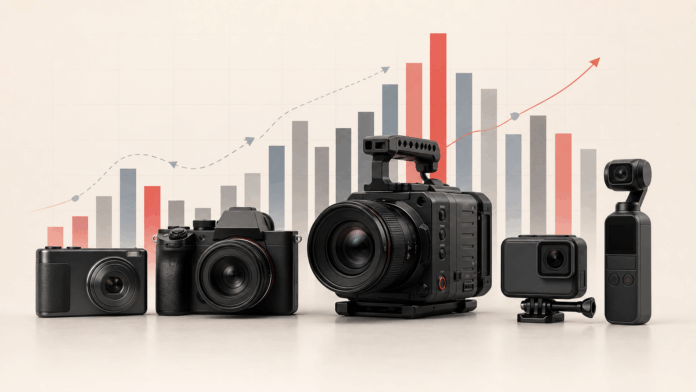
Among the camera-model searches we track in the US, the DJI Osmo Pocket 3, Fujifilm X100VI and Kodak FZ55 lead the latest available figures. Below are the new cameras worth watching, the search-interest table and the differences that matter when choosing between them.
New cameras worth watching
Canon EOS R8 Mark II: an upgrade for the way you shoot
Announced on September 15, the R8 Mark II adds five-axis IBIS and an autofocus joystick while retaining 24.2MP resolution. Canon expects US deliveries in late October.
Small, unstabilized RF primes are the reason this interests me. You keep the compact lens and gain more flexibility with shutter speed for interiors or an evening street scene. Stabilization will not freeze a person walking through the picture. Our R8 Mark II launch review weighs those benefits against the battery and single-card-slot compromises.
Sony RX10 V: wide views and distant subjects without a lens change
Sony combines a 24-600mm-equivalent lens, a 1.0-type sensor and updated subject-recognition autofocus in the RX10 V. The attraction is straightforward: photograph the whole scene, then a distant detail, without opening a camera bag.
That makes it worth considering for travel with frequent long-distance shots. The lens stays attached, though, and the sensor is smaller than APS-C or full frame. For an RX10 IV owner, the decision should turn on the handling and autofocus improvements rather than extra reach. Our RX10 V assessment covers the upgrade; the zoom camera guide compares the alternatives.
Popular digital cameras in US searches
Estimated US Google searches, August 2026. This is the latest available month, compared with July. The table measures search interest among the models we track, not sales or review scores.
| Camera | August searches | Vs. July | What to consider |
|---|---|---|---|
| DJI Osmo Pocket 3 | 246,000 | Unchanged | Pocket video; compare the newer generations |
| Fujifilm X100VI | 201,000 | Unchanged | Fixed 35mm-equivalent lens, no optical zoom |
| Kodak PIXPRO FZ55 | 165,000 | -18% | Simple point-and-shoot with a 5x zoom |
| DJI Osmo Pocket 4 | 110,000 | -19% | Check the exact version and US warranty |
| Canon PowerShot ELPH 360 HS | 90,500 | -33% | Pocket zoom; compare version, condition and price |
| Sony FX3 | 74,000 | Unchanged | Filmmaking body; allow for lenses and audio |
| Sony RX100 VII | 74,000 | Unchanged | 24-200mm-equivalent zoom in a small body |
| Canon PowerShot G7 X Mark II | 60,500 | -55% | Older enthusiast compact; condition matters |
| Kodak PIXPRO FZ45 | 60,500 | -18% | Compare the zoom and battery setup with FZ55 |
| Sony a6000 | 60,500 | Unchanged | Older APS-C body; budget for the right lens |
| Sony a6400 | 60,500 | Unchanged | APS-C mirrorless; no in-body stabilization |
| Sony a6700 | 60,500 | Unchanged | APS-C mirrorless with in-body stabilization |
Which of these cameras would I actually consider?
For a small stills camera: choose the lens first
The X100VI’s fixed 35mm-equivalent lens is the decision. If you enjoy that view, it can keep the whole kit refreshingly simple. If you spend a trip wishing you could zoom into a distant detail, the camera’s popularity will be no consolation. Our X100VI review is the place to assess that commitment.
The RX100 VII offers a different bargain: a 24-200mm-equivalent lens in a small camera. I would put it on a travel shortlist when changing lenses is not part of the plan. Small controls and the lens’s f/4.5 maximum aperture at the long end still deserve thought. Read the RX100 VII review before deciding that a broad zoom range settles everything.
The G7 X Mark III trades some of that reach for a 24-100mm-equivalent f/1.8-2.8 lens. That matters if your photographs tend to happen around a table or indoors, rather than across a valley. At the wide end, f/1.8 gives you more shutter-speed or ISO flexibility than f/2.8. Our G7 X Mark III review covers the rest of the choice.
For an uncomplicated camera: Kodak FZ55
A small camera with a shutter button and a 5x optical zoom may be exactly what someone wants. The FZ55 makes sense for that straightforward, separate-camera experience. For dim interiors or more control over the finished image, look closely at its limitations before choosing it over an enthusiast compact. Our FZ55 review covers where it fits.
Long reach is a different requirement. The AZ528 offers a 52x zoom, useful for exploring distant subjects without assembling a lens kit. I would pay attention to light, shutter speed and support at the long end before worrying about the headline zoom number. More magnification also magnifies shake.
For moving video: DJI’s Pocket cameras
A gimbal camera is worth considering when your footage involves walking, following someone or filming yourself without a larger rig. The Osmo Pocket 3 serves that purpose; it is a different purchase from a camera chosen mainly for still photographs.
DJI has also introduced Pocket 4 and 4P models. Compare the exact version, included microphones and US support before choosing an older package on price alone. A useful audio kit can matter more to the finished video than a specification you rarely use.
For learning photography: leave room for a lens
The Canon Rebel T7 and Nikon D3500 also attract substantial interest, with 40,500 and 22,200 estimated August searches respectively. A complete DSLR kit can be worth considering for learning exposure and photographing mostly stationary subjects. Check condition and autofocus requirements, then price the lenses you will want next. A body that uses up the entire budget is not much of a saving.
Before placing an order
Compare the exact generation, body or lens kit, new or renewed condition, seller and warranty. With a bundle, price the useful parts separately. I would rather pay for the lens, battery and card I need than a bag of extras I will leave at home.
A short note on the figures
Source: DataForSEO, retrieved October 1, 2026. Figures are US Google estimates for one selected keyword per model, not an exhaustive market survey. August is compared with July; percentages are rounded and equal volumes are ties. Broad series terms and models without August data are excluded.