

View full specs
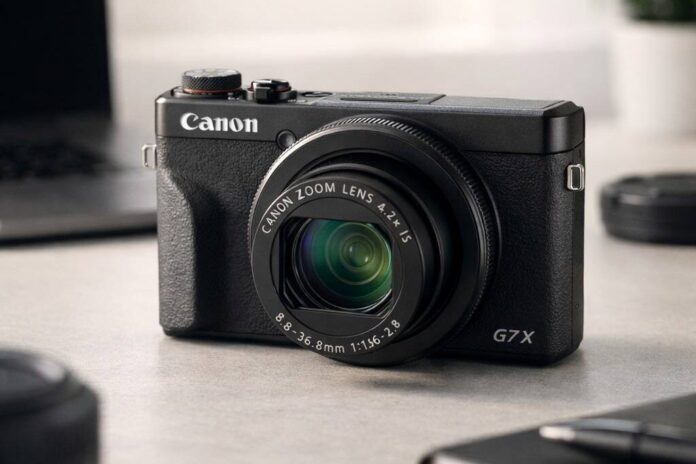
This Canon G7X Mark III review starts with the camera’s strange position in 2026: the Canon PowerShot G7 X Mark III is not new, not the most technically advanced compact camera, and can be overpriced when stock is thin. Yet people still search for it constantly because it solves a very specific problem: it gives you a real pocket camera with a bright zoom lens, Canon color, 4K video, a flip screen, and a casual look that does not feel like a production rig.
This Canon Powershot G7X Mark III review is written for buyers trying to decide whether the hype still makes sense. My short answer: yes, but only at the right price and for the right kind of shooter. It is still one of the most enjoyable compact cameras for travel, everyday photos, creator clips, and social shooting. It is not the camera I would buy for serious action, long-form video, or inflated resale prices.
Canon G7 X Mark III at a glance
| Best for | Travel, street, everyday photography, casual vlogging, social content, and people who want a real camera smaller than a mirrorless kit. |
|---|---|
| Skip it if | You need an EVF, modern subject-tracking autofocus, weather sealing, long battery life, or stable walking video without extra support. |
| Sensor | 20.1MP 1.0-type stacked CMOS sensor with DIGIC 8 processing. |
| Lens | 24-100mm equivalent f/1.8-2.8 optical zoom. |
| Video | 4K up to 30p, Full HD up to 120p, 3.5mm microphone input, vertical video support. |
| Battery | NB-13L battery; around 235 shots by CIPA with screen on, more in Eco mode. |
| Big caution | Do not overpay just because it is trendy. The camera is good; scarcity pricing is not. |
Who the Canon PowerShot G7 X Mark III is really for
The G7 X Mark III makes the most sense for someone who wants a camera that feels casual but still gives real photographic control. That is its charm. You can put it in a jacket pocket, walk into a restaurant, pull it out on a street corner, or use it for a quick travel clip without looking like you brought a serious camera setup.
For photography, I see it as a compact daily camera rather than a replacement for a mirrorless body. The 1-inch sensor is meaningfully larger than most phone sensors, and the 24-100mm equivalent lens gives you real optical framing instead of depending on phone-style digital zoom. That matters for portraits, food, travel details, city scenes, and family photos where you want a more natural file.
For creators, the appeal is different. The flip-up screen, mic input, compact body, and Canon color make it easy to use. The camera also has the low-pressure feeling that has made compact cameras popular again. It looks less intense than an EOS R50 V, Sony ZV-E10 II, or small cinema-style setup. That can be useful if you film in public or simply want a camera that does not turn every moment into a production.
It is not ideal for everyone. If you mostly shoot sports, wildlife, fast children indoors, or long handheld walking videos, the limitations show quickly. The autofocus is contrast-detect rather than Canon Dual Pixel AF, battery life is modest, and there is no viewfinder. Those are not small details. They are the difference between a delightful pocket camera and the wrong tool.
Why the G7 X Mark III became popular again
The renewed demand is not only about specifications. Canon’s own PowerShot G7 X Mark III specifications already cover the sensor, lens, and video modes in detail. The more interesting 2026 story is that the G7 X Mark III sits between two worlds: better image quality and handling than a phone, but less bulk and friction than an interchangeable-lens camera.
That middle ground is valuable. A phone is always with you, but it also looks like a phone image unless lighting is kind and computational processing behaves. A mirrorless camera gives better files, but you have to carry a lens, think about dust, and accept more attention. The G7 X Mark III lives in the pocket-camera space where you can still react quickly and make deliberate photos.
This is also why I would not judge it only by lab rankings. The Sony RX100 VII is more advanced. Canon’s newer PowerShot V1 is a more modern creator compact. The EOS R50 V is better if you want interchangeable lenses and stronger video growth. But none of those cameras has exactly the same combination of pocket size, fast 24-100mm lens, Canon JPEGs, and casual handling.
The demand is real enough that Canon brought the camera back into the spotlight with a PowerShot 30th Anniversary limited edition in 2026. That does not make the G7 X Mark III technically new, and I would not pay collector pricing just for a different finish. But it does confirm the buyer behavior we can see in search: this camera has become a TikTok-era compact as much as a traditional enthusiast point-and-shoot.
Design, build quality, and everyday handling
The body is small without feeling toy-like. Canon lists it at roughly 105.5 x 60.9 x 41.4 mm and about 304 g with battery and card, which is exactly why people still want it. It is not jeans-pocket tiny for everyone, but it is jacket-pocket and small-bag friendly in a way most mirrorless kits are not.
The grip is shallow, but the body shape works. You do not get the security of a larger camera, and I would use a wrist strap, but the controls are better than the size suggests. The top mode dial, exposure compensation dial, touchscreen, and lens control ring give the camera enough tactile control to feel like a real photographic tool.
The 3-inch touchscreen is one of the practical strengths. It tilts up 180 degrees for self-framing and also tilts downward for overhead shooting. The earlier draft of this article understated that; the downward tilt is genuinely useful if you shoot over a table, over a small crowd, or from high angles while traveling.
The biggest handling compromise is the missing EVF. In bright sun, composing on the rear screen is never as comfortable as using a viewfinder. That is one reason the Sony RX100 VII and Canon G5 X Mark II remain relevant alternatives. If you are used to working through a finder, the G7 X Mark III will feel more like a premium phone/camera hybrid than a traditional enthusiast compact.
Lens performance and image quality in real shooting
The built-in lens is the reason this camera still matters. A 24-100mm equivalent zoom with an f/1.8-2.8 aperture is a very useful range in a small body. At 24mm, it works for travel scenes, interiors, tables, and casual self-recording. Around the middle of the zoom, it becomes a good everyday documentary lens. At the long end, it gives enough compression for portraits and details.
The lens is strongest at the wide and middle focal lengths. At 100mm equivalent, I would not expect the crispness of a larger camera with a dedicated portrait lens, especially wide open. But the files look good for the purpose. The lens has enough character and flexibility to make the camera feel creative rather than merely convenient.
The 20.1MP 1-inch stacked sensor produces pleasant files in good light. Canon JPEG color is still part of the appeal: skin tones are flattering, blues and greens are easy to like, and the images often need less work before sharing. RAW files give you more room to recover highlights and shadows, though you should not expect APS-C or full-frame latitude.
Low light is where expectations matter. The bright aperture helps a lot, especially at the wide end, and ISO 800 or 1600 can be usable for web and social sharing. Above that, the small sensor starts to show noise and softer detail. A modern phone may sometimes look cleaner at first glance because of computational processing, but the Canon file often looks more natural and less smeared when light is decent.
Autofocus, burst shooting, and responsiveness
Autofocus is the part I would red-team hardest. The G7 X Mark III does not have Canon’s Dual Pixel CMOS AF, and that matters. For still subjects, portraits, food, street details, and general travel scenes, focus is usually quick enough. Touch AF is simple and accurate in good light.
For moving subjects, the camera feels older. It can track people casually, but it does not stick to faces or eyes the way newer mirrorless cameras do. If you are photographing kids running toward you indoors, pets moving unpredictably, or fast street action, you will miss frames. That does not make the camera bad. It just means you should buy it for compact spontaneity, not for modern action performance.
Burst shooting is strong on paper, with up to 20 fps in fixed-focus situations and a dedicated RAW burst mode. In real use, the more useful question is whether the camera is ready when you see something. Startup, touch operation, and shot-to-shot response are good enough that the G7 X Mark III feels quick for travel and daily photography. That responsiveness is part of why people enjoy it.
Video and vlogging performance
The G7 X Mark III was clearly built with creators in mind. It records 4K up to 30p, Full HD up to 120p, has a 3.5mm microphone input, and supports vertical video. Canon also promoted live streaming to YouTube, though that workflow is more conditional and account-dependent than simply plugging in a modern webcam-style camera.
The video image is attractive. Canon color looks good without much grading, the fast lens helps indoors, and the flip screen makes framing easy. For seated clips, travel details, short creator segments, and casual YouTube work, the camera still has a pleasing look.
The problems are stabilization and autofocus. Video stabilization is not a substitute for a gimbal or a camera with stronger active stabilization. Walking footage can wobble. Autofocus can pulse or hesitate, especially in low light or when the background is busy. If your content is mostly walking-and-talking vlogs, a newer creator camera may save frustration.
Still, I understand why people like the footage. It does not look overprocessed in the same way many phones can. It gives you a small-camera, real-lens look that is easy to use and easy to carry. For short-form creators who want simplicity more than technical perfection, that is enough.
Battery life, cards, and travel practicality
Battery life is average at best. Canon’s own specifications list about 235 shots with the screen on, with Eco mode extending that figure. Video drains the battery faster. For travel, I would treat a spare NB-13L battery as mandatory, not optional.
The camera charges over USB, which helps on the road. Being able to top up from a power bank is a real advantage for a compact travel camera. I would still carry a spare battery because USB charging does not help while you are actively shooting and the battery is already low.
Memory is simple: one SD/SDHC/SDXC card slot. Use a reliable UHS-I card from a known brand. You do not need to overbuy extreme cards, but I would avoid bargain-bin media because card problems ruin the entire point of carrying a small reliable camera.
There is no weather sealing. That matters less for city trips and everyday shooting, but it matters a lot around beaches, rain, dust, and winter conditions. Keep a small pouch or plastic bag in your travel kit. This is a pocketable camera, not a rugged camera.
What price makes sense in 2026?
This is where my opinion becomes stricter. The G7 X Mark III is worth buying when the price reflects what it is: an older premium compact with a still-excellent lens and strong creator appeal. It is not worth buying at a panic price just because social media made it trendy again.
If the price climbs close to newer interchangeable-lens options, pause. At that point, compare the Canon PowerShot V1, Canon EOS R50 V, Sony ZV-1 II, Sony RX100 VII, and Fujifilm X-M5 depending on your priorities. The G7 X Mark III should win because you specifically want pocketability and the 24-100mm bright zoom, not because it is the only camera you have heard of.
Used copies can make sense, but inspect them carefully. Check lens extension, dust inside the lens area, touchscreen hinge condition, battery door, USB port, and whether the zoom moves smoothly. This is a camera people often carry loose in bags, so cosmetic wear is less important than mechanical condition.
Canon G7 X Mark III vs PowerShot V1, RX100 VII, and phones
Against a modern phone, the Canon still wins when you want optical zoom, a more natural camera feel, RAW files, and less computational processing. A phone wins for instant sharing, stabilization, night modes, and convenience. The G7 X Mark III is for people who enjoy the act of using a camera.
Against the Sony RX100 VII, the Canon is simpler and has a faster lens, while the Sony gives you better autofocus, a longer zoom, and a pop-up viewfinder. If you photograph action or want one of the most capable pocket cameras ever made, the RX100 VII is stronger. If you want Canon color, a brighter lens, and easier creator handling, the G7 X Mark III still has an argument.
Against the Canon PowerShot V1, the decision is about age versus direction. The V1 is the more modern creator compact and deserves a look if video is central to your work. The G7 X Mark III is more of a pocket stills-and-vlogging hybrid. Read our Canon PowerShot V1 review if you are deciding between Canon’s older social-media favorite and its newer creator direction.
The older Canon G7 X Mark II review is also useful if you want broader series context. This page is specifically about the Mark III, which is the model most buyers are searching for today.
Pros and cons
What I like
- Truly compact body with a useful 24-100mm equivalent zoom.
- Bright f/1.8-2.8 lens gives it more creative flexibility than most tiny cameras.
- Canon JPEG color remains easy to like for people, travel, and everyday scenes.
- 4K video, flip screen, vertical video, and microphone input still suit casual creators.
- USB charging makes travel simpler.
- It feels less intrusive than a mirrorless camera in public.
What would make me hesitate
- Autofocus is behind modern Canon mirrorless bodies and newer creator cameras.
- No EVF, which hurts in bright outdoor light.
- Battery life is modest, especially for video.
- Video stabilization is not ideal for walking clips.
- No weather sealing.
- Current demand can push prices beyond what the camera deserves.
To place the Mark III beside Canon’s other premium, creator and long-zoom compacts, see our Canon PowerShot cameras comparison.
Final verdict
The Canon PowerShot G7 X Mark III is still worth buying in 2026 if you understand why you want it. Buy it for pocketability, Canon color, the bright 24-100mm lens, simple creator features, and the feeling of carrying a real camera without building a kit around it.
Do not buy it because it is trendy. Do not overpay for it. Do not expect modern mirrorless autofocus or stabilized walking video. The camera is best when you treat it as a compact creative companion: quick, discreet, attractive-looking, and good enough to make you want to bring it everywhere.
For travel, street, everyday photography, and casual creator work, the G7 X Mark III still has a clear place. Its biggest enemy is not age. Its biggest enemy is unrealistic pricing.
Canon PowerShot G7 X Mark III alternatives
The main alternatives to the Canon PowerShot G7 X Mark III are Sony RX100 VII, Canon PowerShot V1, Sony ZV-1 II, Canon EOS R50 V, Fujifilm X-M5. Compare autofocus, stabilization, video limits, lens choice and current price before deciding which camera fits you best.
Frequently asked questions
Is the Canon G7 X Mark III still worth buying in 2026?
Yes, if you want a pocketable compact camera with a bright zoom lens, Canon color, 4K video, and simple creator features. It is less compelling if the price is inflated or if you need modern autofocus.
Is the Canon G7 X Mark III good for photography?
Yes. It is especially good for travel, street, everyday photos, food, family moments, and casual portraits. The 1-inch sensor and 24-100mm equivalent lens give it more photographic flexibility than a phone.
Is the Canon G7 X Mark III good for vlogging?
It is good for casual vlogging, talking-head clips, and travel videos thanks to 4K recording, a flip screen, and a microphone input. Walking footage and autofocus tracking are weaker than newer creator cameras.
Does the Canon G7 X Mark III have a viewfinder?
No. Composition is done through the rear touchscreen. If you often shoot in bright sun and want an EVF, consider alternatives such as the Sony RX100 VII or Canon G5 X Mark II.
What is the biggest drawback of the Canon G7 X Mark III?
The biggest drawback is the older autofocus system, followed by modest battery life and weak walking-video stabilization. The camera is excellent for compact everyday shooting, but not for demanding action or production video.
Travel, street, everyday photos, casual vlogging, and creators who want a pocket camera
You need modern autofocus, an EVF, long battery life, weather sealing, or stabilized walking video
Low; simple controls, touchscreen, and friendly Canon color
PowerShot V1 for newer creator features, RX100 VII for EVF/AF/zoom, EOS R50 V for lens flexibility
Good casual 4K, but older AF and digital stabilization limit walking footage
Yes at the right price; no if scarcity pricing makes newer alternatives smarter