
View full specs
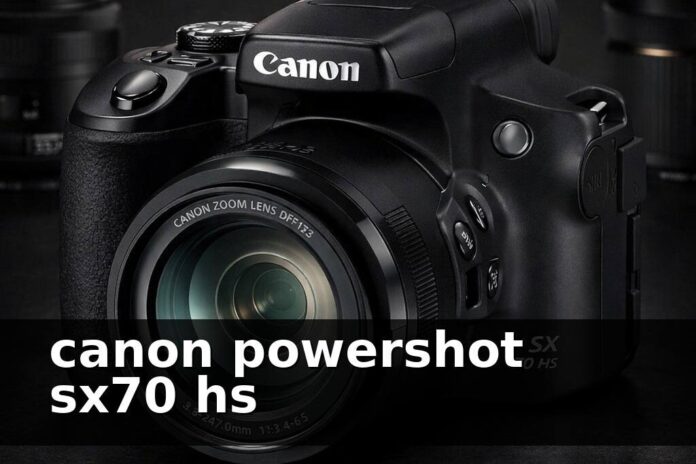
The Canon PowerShot SX70 HS is still one of the most searched long-zoom bridge cameras because it answers a very specific problem: you want real telephoto reach without buying a camera body, adapters, and a bag full of lenses. Its 65x optical zoom covers a 21-1365mm equivalent range, which makes it unusually useful for travel, birding, daylight wildlife, family sports, and distant details that a phone simply cannot frame cleanly. For the broader buying context, compare it with the other bridge and mirrorless picks in our best camera for wildlife photography guide.
The important 2026 question is not only whether the SX70 HS is a good camera. It is whether it is still a good buy. New stock is inconsistent, used prices can be inflated, and Nikon’s P1000/P1100 line has changed what superzoom buyers expect. This review focuses on the practical buying decision: where the SX70 HS still makes sense, where it falls behind, and what price is too much.
Canon PowerShot SX70 HS at a glance
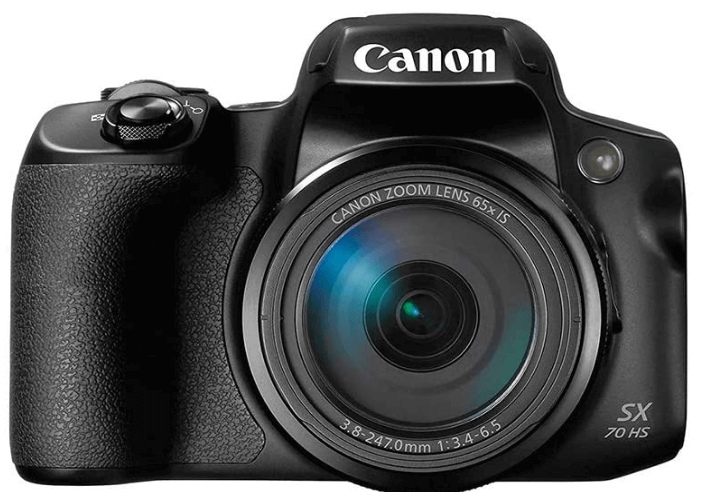
The Canon PowerShot SX70 HS is a fixed-lens bridge camera built around a 20.3-megapixel 1/2.3-inch CMOS sensor, Canon’s DIGIC 8 processor, and a 65x stabilized zoom lens. The lens is the headline feature: 21mm at the wide end for landscapes and interiors, stretching to 1365mm equivalent for birds, wildlife, aircraft, moon shots, and faraway travel details.
- Sensor: 20.3MP 1/2.3-inch CMOS
- Lens: fixed 65x optical zoom, 21-1365mm equivalent
- Video: 4K up to 30p, plus Full HD options
- Viewfinder: built-in OLED EVF, useful in bright sun
- Screen: 3.0-inch vari-angle LCD, not a touchscreen
- Stabilization: optical image stabilization, essential at the long end
- Audio: built-in stereo microphone only; no 3.5mm external microphone input
- Important limitation: no hot shoe, no mic input, no weather sealing, small sensor
The SX70 HS replaced the older SX60 HS and kept the same extreme 21-1365mm equivalent zoom range while adding a newer sensor, DIGIC 8 processing, 4K video, a higher-resolution EVF, Bluetooth, and faster headline burst shooting. It did not become a large-sensor camera, and it did not become a mirrorless-style action camera. Its appeal is still reach, portability, and simplicity.
What changed in 2026: availability and used prices matter
The SX70 HS is no longer just competing against its original launch price. It is competing against the used market, Canon refurbished stock when available, renewed Amazon listings, and newer alternatives. That matters because some SX70 HS listings now appear at prices that make very little sense. A compact bridge camera can be a smart buy; a heavily inflated bridge-camera listing can be a trap.
At its original US launch, the SX70 HS sat around the mid-$500 range. In 2026, the best value is usually a clean used, renewed, or Canon refurbished copy at a sensible price. If the camera is priced below about $650 and the condition is good, it can still be compelling. If a listing pushes toward four figures, the buyer should slow down and compare it against the Nikon Coolpix P1000, the newer Nikon P1100, and even used mirrorless kits.
That pricing context should shape the whole review. The SX70 HS is not a luxury camera. It is a practical long-zoom tool. Its value is highest when the price reflects that.
Design, handling, and real-world comfort
The SX70 HS looks and handles like a small DSLR, but it is much simpler than building an interchangeable-lens wildlife kit. The grip is deep enough to make the camera feel secure, the body is light enough for travel, and the vari-angle screen helps with awkward framing from low or high angles.
At about 610g with battery and card, it is light compared with a mirrorless camera plus a long telephoto lens. That is the point. A photographer who would leave a heavier kit in the hotel room might actually carry the SX70 HS all day.
There are two handling details buyers should understand before ordering. First, the screen is not touch-sensitive, which feels dated if you are used to modern phones or recent mirrorless cameras. Second, the camera has no 3.5mm external microphone input and no hot shoe. You cannot plug a mic directly into the SX70 HS, and there is no shoe for mounting a flash or microphone on top.
The 65x zoom is the reason to buy it
The SX70 HS lives or dies by its lens. The 21-1365mm equivalent zoom range is genuinely useful: wide enough for travel scenes and landscapes, long enough for perched birds, zoo animals, distant architecture, boats, aircraft, and casual wildlife. It gives a beginner access to compositions that would otherwise require large, expensive lenses.
In good light, the middle of the zoom range is the sweet spot. Detail is respectable, Canon color is pleasant, and the camera feels responsive enough for travel and family use. At the longest end, technique matters. You need steadier hands, faster shutter speeds, and realistic expectations. The lens is slower at telephoto, the sensor is small, and atmospheric haze can soften distant subjects before the camera even gets a chance to record them.
For bird photography, the SX70 HS is best treated as a daylight reach camera rather than a serious bird-in-flight body. It can frame birds that a phone cannot touch. It can be satisfying for perched birds, large birds, backyard wildlife, and travel wildlife. But it does not have modern animal-detection autofocus, and it is not as forgiving as a current mirrorless camera when the subject is small, fast, or backlit.
Image quality: strong in daylight, limited in low light
The 1/2.3-inch sensor is the biggest reason to keep expectations grounded. In bright outdoor light, the SX70 HS can produce attractive JPEGs with good color and enough detail for web sharing, family albums, and modest prints. RAW support is also useful because it gives you more room to recover highlights, tune color, and reduce noise carefully.
Low light is different. Indoors, at dusk, or under heavy shade, the small sensor shows noise and smeared fine detail faster than an APS-C or full-frame camera. Modern phones can also look better in some low-light scenes because computational processing stacks multiple exposures. The SX70 HS wins on optical reach, not night photography.
The practical rule is simple: if your main subjects are outdoors in daylight, the SX70 HS makes sense. If your main subjects are indoor events, night streets, concerts, or fast action under poor light, it is the wrong camera.
Autofocus, burst shooting, and video
Autofocus is adequate for the class but not modern-mirrorless fast. In good light and with clear subjects, the SX70 HS locks reliably enough for travel, family, and casual wildlife. At long focal lengths, on low-contrast subjects, or when trying to track unpredictable action, it can hunt. That is normal for this type of bridge camera, but it should be part of the buying decision.
Canon lists up to 10 fps burst shooting, but the strongest headline speed does not mean unlimited action performance. If you want continuous focus, RAW bursts, or long sequences, the real experience slows down. Short, timed bursts work better than holding the shutter and hoping.
Video is useful but not the main reason to buy the SX70 HS. 4K 30p is a welcome feature for travel clips and wildlife documentation, but audio is limited to the built-in microphone. The limitations are the 4K crop, small-sensor low-light performance, modest stabilization at extreme telephoto, no external mic input, and the lack of modern creator features. If video is your priority, compare it with newer creator-focused compacts and mirrorless bodies. If video is secondary to zoom reach, it is good enough.
Best settings for birds, wildlife, and travel
For birds and wildlife, start with shutter speed rather than maximum zoom. The SX70 HS can reach 1365mm equivalent, but a blurry full-zoom image is less useful than a sharper image at a slightly shorter focal length.
- Use good light: early morning and late afternoon look nice, but the camera focuses and resolves detail best when there is enough light for fast shutter speeds.
- Raise shutter speed for wildlife: use faster speeds for birds and moving subjects, especially near the long end of the zoom.
- Use short bursts: fire controlled bursts instead of holding the shutter for long sequences.
- Use the EVF: the viewfinder makes it easier to brace the camera at long focal lengths.
- Avoid unnecessary digital zoom: optical zoom is the strength; digital zoom quickly reduces quality.
- Shoot RAW for difficult light: RAW helps with highlights, shadows, and noise control.
Canon SX70 HS vs SX740 HS
The Canon PowerShot SX740 HS is the pocketable option. It has a strong zoom range for its size, slips into a small bag, and makes more sense for casual travel when portability matters most. The SX70 HS is the better choice when viewfinder shooting, grip comfort, and maximum reach matter more than pocket size.
Pick the SX740 HS if you want a compact travel zoom. Pick the SX70 HS if you are buying specifically for birds, wildlife, airshows, the moon, or distant details.
Canon SX70 HS vs Nikon P1000 and P1100
The Nikon P1000 and P1100 are more extreme superzooms. They reach much farther than the SX70 HS, and that matters if maximum telephoto range is the whole point. The tradeoff is size, weight, and specialization. The Canon is easier to carry and less intimidating. The Nikons are better telescope-like tools.
If you are choosing between them, be honest about how you shoot. A traveler who wants one light camera for cities, landscapes, family, and occasional wildlife may prefer the SX70 HS. A dedicated moon, aircraft, or distant-wildlife shooter should read our Nikon P1100 vs P1000 comparison and consider whether the larger Nikon body is worth carrying.
Other alternatives to consider
If you like bridge cameras but do not need the longest possible zoom, Panasonic’s options deserve a look. The Panasonic Lumix FZ80 is another budget-friendly long-zoom bridge camera, while the Lumix FZ300 trades some reach for a brighter constant-aperture lens and more enthusiast handling.
If you want to compare the category more broadly, our best bridge cameras guide is the better supporting page. This SX70 review should be treated as the single-camera buying decision; the roundup is where the broader category comparison belongs.
Who should buy the Canon PowerShot SX70 HS?
The SX70 HS is best for someone who values reach and convenience more than ultimate image quality. It is a practical camera for travel, birdwatching, family sports from the sidelines, cruise and safari-style trips, backyard wildlife, and people who simply enjoy photographing distant subjects without changing lenses.
It is not the right choice for serious low-light work, fast indoor sports, professional wildlife tracking, or anyone expecting large-sensor dynamic range. It is also not a great buy at inflated prices. The camera makes sense when the price is grounded in reality.
Buying advice: when the SX70 HS is a good deal
The best SX70 HS deal is a clean used or refurbished copy from a reputable seller, with battery, charger, lens cap, and a return window. Because the market can be distorted, condition and seller reliability matter more than chasing the lowest sticker price.
- Good buy: clean used or refurbished copy at a sensible mid-hundreds price.
- Be careful: listings with missing charger, unclear condition, stock photos only, or no return window.
- Usually avoid: four-figure listings unless there is a very unusual reason and you have compared alternatives.
If the SX70 HS is priced fairly, it remains a useful and enjoyable camera. If it is priced like a modern mirrorless kit, it stops making sense.
If you are deciding between bridge zoom, pocket zoom and premium compact models, compare the full range in our Canon PowerShot cameras comparison.
Final verdict
The Canon PowerShot SX70 HS is still worth considering in 2026 because the formula remains useful: a light bridge camera, real viewfinder, RAW support, 4K video and a 65x optical zoom that phones cannot realistically replace, while accepting that there is no external mic input. Its best role is as a daylight travel and wildlife camera for people who want reach without complexity.
The weaknesses are just as clear. The small sensor limits low-light quality, autofocus is not in the same class as newer mirrorless cameras, the screen is not touch-sensitive, there is no hot shoe, and current prices can be irrational. Buy it for the zoom and convenience. Do not overpay for it.
Frequently asked questions
Is the Canon PowerShot SX70 HS still worth buying in 2026?
Yes, if you want a lightweight bridge camera with a real 65x optical zoom and you can buy it at a sensible used or refurbished price. It is less attractive when listings climb close to modern mirrorless-camera money.
Is the Canon PowerShot SX70 HS good for bird photography?
It can be very useful for casual bird photography because the 21-1365mm equivalent lens gives much more reach than a phone or normal kit zoom. The tradeoff is that autofocus and image quality are best in good light, and small fast birds are still challenging.
Does the Canon PowerShot SX70 HS have a hot shoe?
No. The SX70 HS has a built-in flash, but it does not have a hot shoe or a 3.5mm external microphone input. You cannot mount or plug in a microphone directly without using a separate recorder setup.
What is a fair used price for the Canon PowerShot SX70 HS?
Pricing changes quickly because long-zoom bridge cameras are scarce. In practical terms, the SX70 HS is most compelling below about $650 for a clean used or refurbished copy. Four-figure listings should usually push buyers toward alternatives.
Canon PowerShot SX70 HS or Nikon P1000/P1100: which is better?
The Canon SX70 HS is lighter, simpler, and easier to carry. The Nikon P1000 and P1100 offer much longer zoom reach, but they are larger and more specialized. Pick the Canon for travel convenience; pick the Nikon if maximum reach is the priority.
{“@context”:”https://schema.org”,”@type”:”FAQPage”,”mainEntity”:[{“@type”:”Question”,”name”:”Is the Canon PowerShot SX70 HS still worth buying in 2026?”,”acceptedAnswer”:{“@type”:”Answer”,”text”:”Yes, if you want a lightweight bridge camera with a real 65x optical zoom and you can buy it at a sensible used or refurbished price. It is less attractive when listings climb close to modern mirrorless-camera money.”}},{“@type”:”Question”,”name”:”Is the Canon PowerShot SX70 HS good for bird photography?”,”acceptedAnswer”:{“@type”:”Answer”,”text”:”It can be very useful for casual bird photography because the 21-1365mm equivalent lens gives much more reach than a phone or normal kit zoom. The tradeoff is that autofocus and image quality are best in good light, and small fast birds are still challenging.”}},{“@type”:”Question”,”name”:”Does the Canon PowerShot SX70 HS have a hot shoe?”,”acceptedAnswer”:{“@type”:”Answer”,”text”:”No. The SX70 HS has a built-in flash, but it does not have a hot shoe or a 3.5mm external microphone input. You cannot mount or plug in a microphone directly without using a separate recorder setup.”}},{“@type”:”Question”,”name”:”What is a fair used price for the Canon PowerShot SX70 HS?”,”acceptedAnswer”:{“@type”:”Answer”,”text”:”Pricing changes quickly because long-zoom bridge cameras are scarce. In practical terms, the SX70 HS is most compelling below about $650 for a clean used or refurbished copy. Four-figure listings should usually push buyers toward alternatives.”}},{“@type”:”Question”,”name”:”Canon PowerShot SX70 HS or Nikon P1000/P1100: which is better?”,”acceptedAnswer”:{“@type”:”Answer”,”text”:”The Canon SX70 HS is lighter, simpler, and easier to carry. The Nikon P1000 and P1100 offer much longer zoom reach, but they are larger and more specialized. Pick the Canon for travel convenience; pick the Nikon if maximum reach is the priority.”}}]}