
View full specs
The Canon EOS R6 V has a narrow but convincing purpose: full-frame 7K, Open Gate, in-body stabilization, and active cooling for people whose main job is video. This Canon EOS R6 V review also explains why photographers should choose the EOS R6 Mark III instead. The R6 V has no viewfinder or mechanical shutter, and neither omission is minor in a stills workflow.
The name is potentially confusing. This is not an upgrade to the original EOS R6, nor is it a cheaper R6 Mark III with a fan. It is Canon’s first full-frame EOS V-series camera, built around solo filmmaking, vertical capture, streaming, and long recording sessions. Its 32.5MP sensor and capable autofocus also make good stills, but photography is the secondary role.
Canon EOS R6 V at a glance
| Feature | What it means in practice |
|---|---|
| 32.5MP full-frame sensor | Detailed stills and enough resolution for 7K recording |
| 7K 60p RAW Light | Serious grading latitude, with heavy media and storage demands |
| 7K 30p Open Gate | One 3:2 capture can be reframed for horizontal or vertical delivery |
| Active cooling | Better suited to long takes than an uncooled photo-first hybrid |
| 7.5-stop rated IBIS | Useful for handheld video, though it does not replace a gimbal |
| No EVF or mechanical shutter | A major reason not to buy it primarily for photography |
| CFexpress Type B + UHS-II SD | Flexible main, proxy, and backup recording with unequal media |
| $2,499 launch price | $300 below the photo-first EOS R6 Mark III at launch |
The body reached US stores in late June 2026. Canon’s official EOS R6 V product page lists the body at $2,499. That price is attractive only if the camera’s video-first design removes equipment or friction from your actual work.
Who should buy the EOS R6 V?
The strongest buyer is a solo operator who records interviews, documentaries, branded content, podcasts, events, or social video. The front record button, tally lamp, vertical tripod socket, rotating interface, and body-mounted power-zoom lever all serve that person. Active cooling matters when a missed take costs more than carrying a slightly deeper body.
It also makes sense for a small studio already using Canon RF lenses. Full-size HDMI is safer than a micro connector on a rig. The microphone and headphone ports cover a basic audio setup, while the multi-function shoe supports more advanced accessories. USB-C can handle charging, power, transfer, and streaming duties with compatible equipment.
Skip it if stills pay most of the bills. A wedding photographer, wildlife shooter, or photojournalist should not accept an LCD-only composition workflow merely to save $300. Bright sun, long lenses, and fast subjects all make an EVF valuable. The EOS R6 Mark III keeps the same resolution class while adding a viewfinder and mechanical shutter.
The body makes its video priority obvious
Good controls for a solo filmmaker
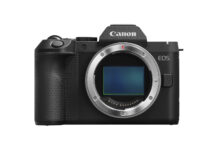
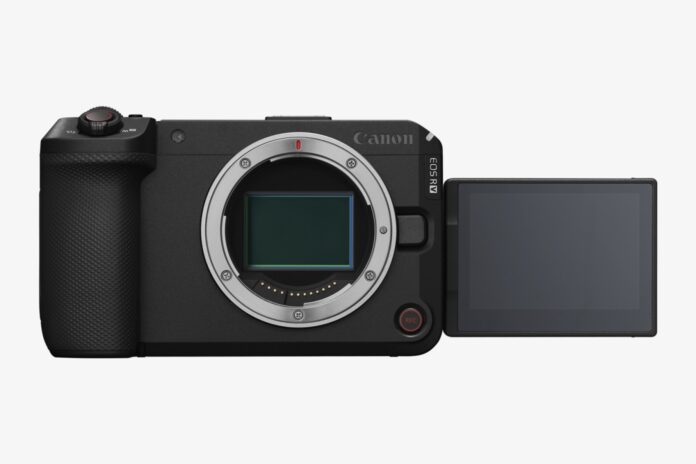
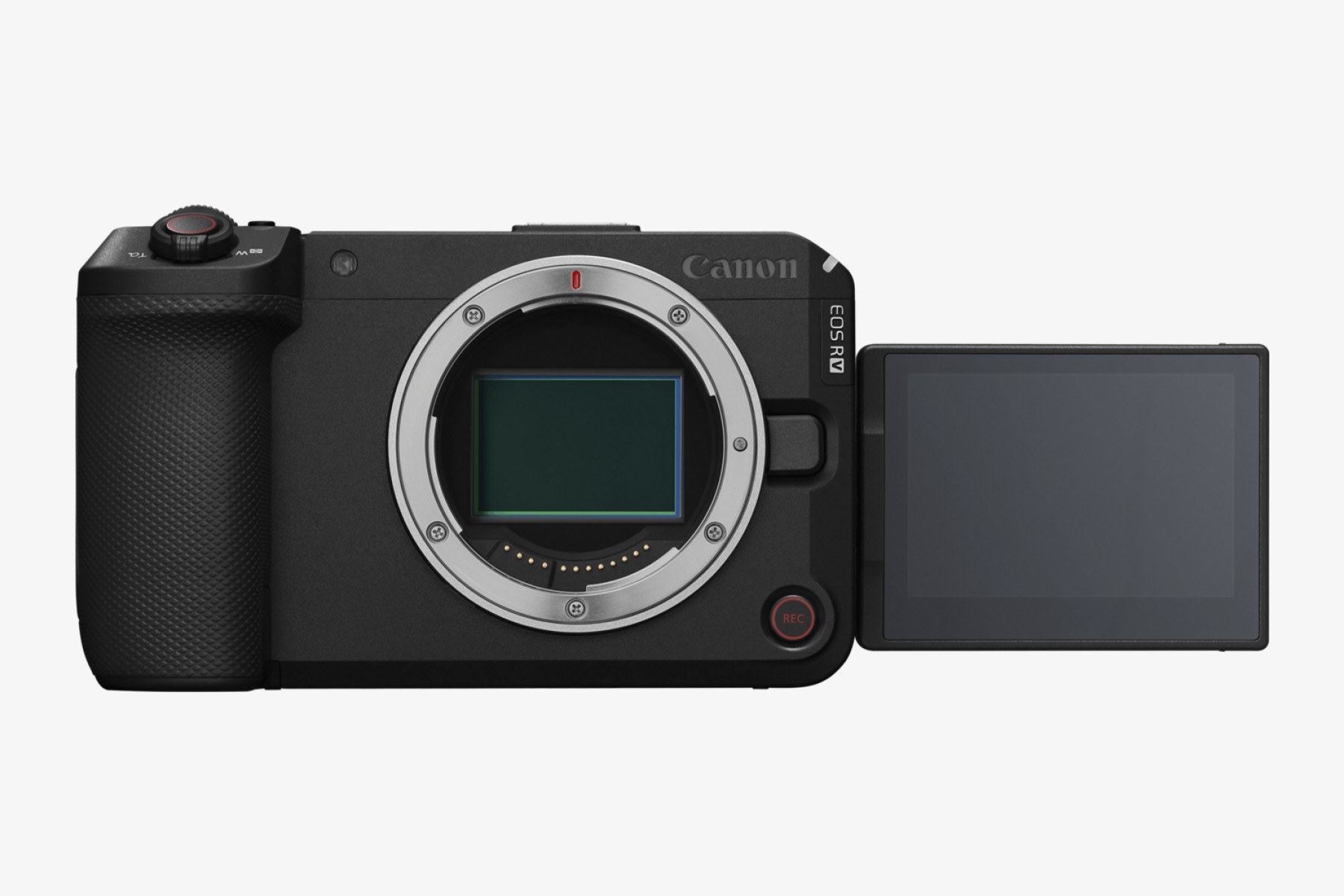
The EOS R6 V is shorter than a conventional R6 because there is no viewfinder hump. At 688 g with an LP-E6P battery and CFexpress card, it is not unusually light. The grip and flat top should balance better than a tiny vlogging body with fast RF glass, while the vertical socket avoids an L-bracket for portrait-orientation video.
Twelve customizable buttons give the camera room to separate exposure, focus aids, audio status, and recording functions. A front record button is useful when the operator is also the subject. The zoom rocker controls compatible RF power-zoom lenses. It does not motorize ordinary RF zooms, so do not price the body without checking the lens you intend to use.
The missing EVF changes stills work
The 3.0-inch, 1.62-million-dot vari-angle screen is the only viewfinder. It is flexible for low angles, self-recording, and gimbal work. Outdoors, it cannot offer the isolation or stability of an eye-level finder. Canon also states that its clip-on EVF-DC1 and EVF-DC2 units cannot be attached, so there is no later EVF upgrade.
The sensor remains exposed when a lens is removed because there is no mechanical shutter unit. That calls for more care during lens changes. The camera’s fan intake and exhaust also deserve space in a cage or packed bag. A cooling system only helps when air can move.
Video quality is the reason to buy it
The headline mode is internal 12-bit 7K RAW Light at up to 59.94p. Open Gate records the full 3:2 sensor area at up to 29.97p, in RAW or MP4. It is genuinely useful when a client wants a landscape master, a vertical cut, and a square crop from the same performance. Oversampled 4K Fine reaches 60p, while uncropped 4K reaches 119.8p for slow motion.
Canon includes Log 2 and Log 3, false color, waveform, zebras, and proxy recording. Those are production tools, not spec-sheet decorations. A lightweight proxy on the SD card can keep an edit moving while the CFexpress card holds the main 7K file. The full-size HDMI port is another welcome decision for monitors and streaming hardware.
Cooling improves recording confidence, but it does not make runtime unlimited. Canon sets a six-hour per-clip ceiling below 100 fps and two hours at higher rates. Battery, card capacity, ambient temperature, and heat can stop a take earlier. For uninterrupted work, test the exact codec, card, power source, fan setting, and room temperature before the assignment.
The Workflow Cost Beyond the Camera Body
Slot 1 takes CFexpress Type B cards and supports CFexpress 2.0 and VPG400. Slot 2 takes UHS-II SD cards. The slots can record the same material in some modes, but they are not equal. High-data-rate RAW belongs on CFexpress, while SD is often better used for proxies, sub-recording, or less demanding formats.
That mixed-card design means two readers, two card pools, and a deliberate backup plan. Open Gate and 7K RAW also increase ingest time, storage, and computer load. If delivery is always 4K and reframing is rare, oversampled 4K may be the more professional choice because it keeps the entire workflow faster.
The proper battery is the LP-E6P. Canon rates it for about 640 stills in power-saving display mode or 510 in smooth mode at 73°F with the fan off. LP-E6NH and LP-E6N packs work with restrictions and lower endurance. The original LP-E6 does not work at all. Budget for genuine LP-E6P spares or tested USB Power Delivery before a long day.
Stills are capable, but the compromises are real
The 32.5MP sensor offers useful crop room and a normal ISO range of 100–64,000. Dual Pixel CMOS AF recognizes people, animals, and vehicles. Register People Priority can keep a chosen person ahead of other faces in a crowded frame. For occasional portraits, thumbnails, product stills, or behind-the-scenes coverage, the R6 V is more than adequate.
It can shoot at up to 40 fps and buffer roughly half a second of pre-continuous capture. Yet every still is made with a rolling electronic shutter. Fast motion can bend, and some artificial lights can produce banding. Flash sync is only 1/60 second at full-frame coverage. Those limitations matter for sports, events, studio flash, and any subject where electronic-shutter artifacts are unacceptable.
Firmware also belongs on the setup checklist. Canon’s firmware 1.1.0 notice adds external flash support along with other fixes. Update before evaluating a flash or remote problem. Even after the update, photographers gain more from the R6 Mark III’s conventional controls.
Autofocus and stabilization are strong, not magical
Autofocus covers almost the full frame and includes eye selection plus subject modes for people, animals, and vehicles. Video users also get focus tools aimed at close-up demonstrations and smooth transitions. The important benefit is less operator intervention when the person behind the camera is also presenting in front of it.
Canon rates coordinated stabilization at 7.5 stops in the center and 7.0 toward the edge with a specific stabilized RF lens. Treat that as a best-case CIPA figure. IBIS can calm static handheld shots and take the edge off operator movement. It cannot freeze a subject, prevent every wide-angle corner wobble, or make walking footage look like a dolly move.
For a lighter and cheaper creator body, the APS-C EOS R50 V is easier to carry but lacks this camera’s full-frame sensor, IBIS, and high-end recording headroom. At the other end, our Canon C50 review covers the better fit for crews that prioritize Cinema EOS operation and production integration over handheld stabilization.
Verdict: excellent when video is the first word
Pros:
- Detailed 32.5MP full-frame sensor
- Internal 7K RAW and flexible 7K Open Gate capture
- Active cooling for long-form recording
- Useful IBIS, full-size HDMI, and creator-focused controls
- CFexpress main recording with SD proxies or secondary files
Cons:
- No EVF and no supported add-on finder
- No mechanical shutter, with rolling-shutter and flash-sync compromises
- Demanding modes add card, storage, battery, and computer costs
- Mixed card formats complicate a redundant workflow
The buying line is straightforward: choose the EOS R6 V for video-led work that benefits from active cooling, handheld stabilization, vertical operation, and Open Gate delivery. Do not buy it as an all-purpose R6 because the name sounds familiar. The R6 Mark III is the better hybrid for photographers. The R6 Mark II remains the value choice when 24.2MP stills and 4K60 cover the job.
Canon EOS R6 V alternatives
The main alternatives to the Canon EOS R6 V are Canon EOS R6 Mark III, Canon EOS C50, Sony FX3, Sony ZV-E1, Nikon ZR. Compare autofocus, stabilization, video limits, lens choice and current price before deciding which camera fits you best.
Frequently asked questions
Is the Canon EOS R6 V good for photography?
It produces 32.5MP stills, tracks several subject types, and reaches 40 fps. It is best for occasional stills alongside video. The lack of an EVF and mechanical shutter makes the R6 Mark III a much better primary photo camera.
Does the EOS R6 V have a viewfinder?
No. It uses its rear vari-angle LCD, and Canon says the EVF-DC1 and EVF-DC2 add-on finders are not compatible.
Can the EOS R6 V use EF lenses?
Yes. Canon EF and EF-S lenses work with an EF-EOS R mount adapter. EF-S and RF-S lenses use a roughly 1.6× cropped image area. EF-M lenses are not compatible.
Which cards does the EOS R6 V need?
Slot 1 is CFexpress Type B, while slot 2 is UHS-II SD. Card-speed requirements vary by codec and frame rate. Check Canon’s recording table before buying media for 7K RAW or high-frame-rate 4K.
Is the EOS R6 V weather sealed?
Canon does not publish an IP rating. Treat the body as a working camera that still needs rain protection, especially around open doors, ports, and the cooling vents.
Solo filmmakers, documentary and event video shooters, small studios, streamers, and social creators who need full-frame 7K, Open Gate, IBIS, and active cooling.
Stills are the main job, you need an EVF or mechanical shutter, or your work depends on fast flash sync and minimal rolling-shutter risk.
High; advanced codecs, mixed media, cooling, audio, storage, and postproduction demand a planned workflow.
EOS C50 for more cinema-oriented production; EOS R6 Mark III for a photo-first hybrid; higher Cinema EOS models for crewed production and expanded I/O.
Excellent recording depth and cooling, but 7K RAW adds CFexpress, storage, battery, reader, and computer costs.
Yes for video-first Canon RF users; no as a default all-purpose R6 or primary stills camera.