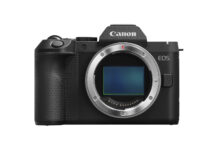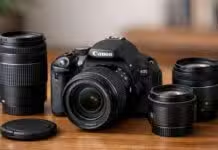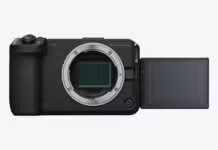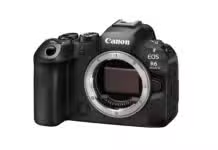

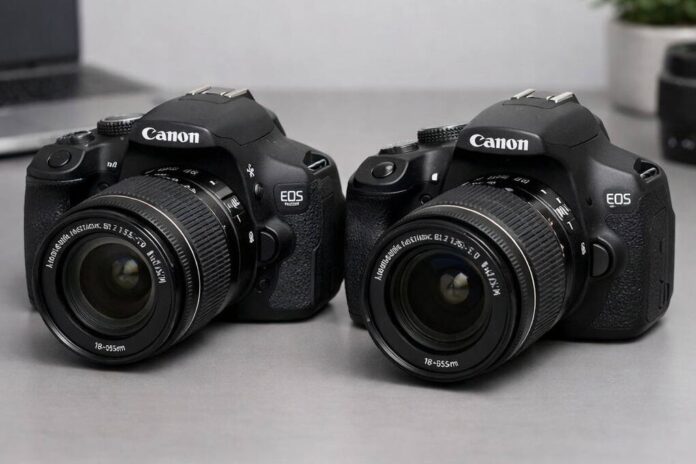
The Canon T3i vs T7 decision is not a simple newer-is-better contest. The T7 gives you 24.1MP files, a lighter body, and Wi-Fi/NFC. I would buy the older T3i for video, low-angle work, or off-camera flash because its articulated screen, microphone input, spot metering, and wireless flash control matter more. For a stills-first beginner who wants easy phone transfer, the T7 wins—but only at a sensible used price.
Canon T3i vs T7: the quick verdict
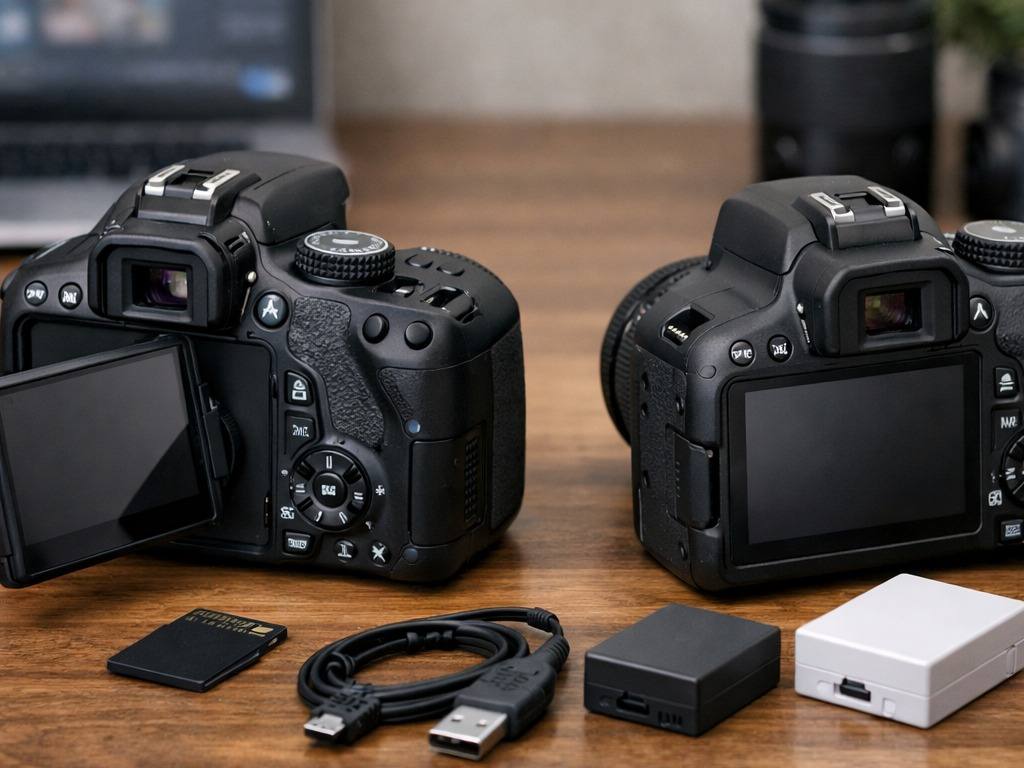
These are two different kinds of entry DSLR. The 2011 Rebel T3i, also called the EOS 600D, was the more feature-rich beginner model of its day. The 2018 Rebel T7, also called the EOS 2000D or 1500D, is newer but deliberately basic. Both use an APS-C sensor, Canon’s EF/EF-S mount, a 9-point viewfinder AF system, and Full HD video.
- Buy the T3i if you need a flip-out screen, an external microphone, spot metering, or built-in optical control of compatible Canon Speedlites.
- Buy the T7 if you mainly shoot stills and value 24.1MP resolution, lower weight, Wi-Fi transfer, and a slightly longer battery rating.
- Keep your T3i if you are considering the T7 as an upgrade. More pixels and Wi-Fi do not compensate for the features you lose.
- Skip both for dependable subject tracking, fast sports, 4K, walking video, weather sealing, in-body stabilization, or USB charging.
Condition can reverse the recommendation. A clean T7 is safer than an abused T3i, while a tested T3i at half the price is usually the better value. Our separate Canon Rebel T3i review and Canon Rebel T7 review cover each body in more depth.
Image quality and autofocus
The T7 gives you more pixels, not a different class of camera
The T3i records 18MP files at 5184 x 3456. The T7 records 24.1MP at 6000 x 4000. That extra resolution gives the T7 more room for moderate cropping and larger prints. You will see the benefit most at low ISO with accurate focus and a sharp lens.
Do not expect a dramatic low-light transformation. Both cameras offer ISO 100-6400 with an expanded ISO 12800 setting, and both reward careful exposure. The T7’s newer sensor is the better starting point for shadow recovery, but a fast lens or bounced flash changes indoor results more than the body swap. For portraits and family work, I would prioritize a clean lens and reliable focus over six extra megapixels.
Autofocus is basic on both bodies
Each camera has nine viewfinder AF points, with only the center point cross-type. That is workable for portraits, travel, landscapes, and family photos. It is restrictive for erratic pets, birds in flight, or field sports. Live View focusing is contrast-based and slow by current standards.
The T3i shoots slightly faster at about 3.7 fps, but its buffer is shallow: roughly 34 JPEGs or six RAW files. The T7 manages only 3 fps, yet Canon rates a longer burst of about 150 JPEGs or 11 RAW files under its test conditions. In practice, the T3i catches a short expression sequence faster; the T7 keeps going longer. Neither is a convincing action camera, and the focusing motor in your lens also affects the hit rate.
Handling, screen, and flash control
The T3i is older but less stripped down
The T3i’s 3-inch, 1.04-million-dot screen swings out and rotates. It helps with waist-level street work, low macro angles, overhead framing, tripod photography, and self-recording. The screen is not touch-sensitive, but its movement changes how the camera can be used. The T3i also provides spot metering, which is useful when a small subject sits against a much brighter or darker background.
Flash users get another meaningful advantage. The T3i’s pop-up flash can optically command compatible off-camera Canon Speedlites. The T7 cannot do that without extra equipment. The T3i also includes automatic sensor cleaning, while the T7 relies on dust-delete data and manual cleaning.
The T7 is lighter and simpler
The T7 weighs about 475g with battery and card, roughly 95g less than the T3i. Its fixed 3-inch, 920,000-dot screen is adequate for menus and playback, but awkward at low or high angles. Neither display is touch-sensitive. Both bodies use a single command dial, so manual exposure changes require more button work than on an enthusiast DSLR.
Inspect the T7 hot shoe before buying. Many examples omit the universal center sync contact, which can stop simple third-party flashes and radio triggers from firing. Some later bodies have the contact. If flash matters, take your actual trigger to the sale and test it rather than trusting the listing.
Video, audio, and wireless workflow
The T3i is the better video tool, within strict limits
Both cameras record 1080p at up to 30 fps and 720p at up to 60 fps. Neither has 4K, a headphone output, in-body stabilization, or modern continuous movie autofocus. Plan to focus before the take or pull focus manually. A tripod, controlled subject, and stable light suit these cameras far better than run-and-gun filming.
The T3i wins because its articulated screen makes framing easier and its 3.5mm microphone input accepts external audio. That combination still works for a locked-off interview, tabletop demonstration, or school project. The T7 has a fixed screen and no microphone input, so you would need separate audio and a way to sync it in editing.
The T7 is easier for phone sharing
The T7 has built-in Wi-Fi and NFC for remote control and transferring still photos through Canon Camera Connect. It does not have Bluetooth. The T3i has no built-in wireless connection. I often prefer a reliable card reader anyway: it is quick, leaves the camera free, and avoids app compatibility problems. Still, the T7 is more convenient when you want one image on a phone without opening a laptop.
Lenses, batteries, and ownership cost
Both use the same affordable DSLR lenses
The T3i and T7 accept Canon EF and EF-S lenses directly. They do not accept Canon EF-M, RF, or RF-S mirrorless lenses. That distinction matters because marketplace listings often say only “Canon mount.” If you later move to an EOS R body, EF and EF-S lenses can work through a Canon EF-EOS R adapter. EF-S glass uses a cropped image area on a full-frame EOS R camera.
A working EF-S 18-55mm IS II kit lens is enough to learn with. For a meaningful upgrade, the EF 50mm f/1.8 STM adds low-light ability and portrait blur. The EF-S 24mm f/2.8 STM makes a compact everyday kit, while the EF-S 55-250mm IS STM is a far better budget telephoto choice than a tired 75-300mm bundle lens. Our Canon Rebel T3i lens guide explains the tradeoffs by subject.
The T3i uses the LP-E8 battery and is rated for about 440 viewfinder shots. The T7 uses the LP-E10 and is rated for about 500. Neither charges over USB, so confirm that the correct wall charger is included. A missing charger, weak off-brand battery, or corroded compartment can erase a small price advantage.
Both cameras record to SD, SDHC, or SDXC cards. A reputable midrange card is enough; an expensive high-speed card cannot make these old interfaces fast. Add the price of a card, spare battery, strap, reader, and the lens you actually need before comparing kits.
How much should you pay used?
Use the price gap to make the decision
At the time of this update, MPB listed T3i bodies from about $47 to $189. Its T7 inventory ran from about $199 to $239. Dealer stock changes daily, and the cheapest examples may be rough. The useful point is the gap: a T7 commonly costs much more.
My practical ceiling is about $150 for a clean T3i body or $220 with a tested 18-55mm lens. For the T7, about $230 body-only or $300 with the kit lens feels reasonable. A dealer warranty can justify more. A T7 kit near $400 or above should be compared with a used Rebel SL2, T7i, 80D, or a discounted Canon mirrorless kit before you pay.
What to inspect before handing over money
- Photograph a plain bright surface at f/16 and inspect the file for heavy dust, scratches, and banding.
- Test every viewfinder AF point, then check Live View focus with the included lens.
- On the T3i, rotate the screen through its full range and watch for flicker or hinge play.
- On the T7, inspect the hot shoe for a center contact if you use third-party flash gear.
- Record a video clip, play it back, and test the T3i microphone input if you need it.
- Check the card slot, USB and HDMI ports, pop-up flash, lens aperture, autofocus, and stabilization.
- Confirm the exact battery and charger: LP-E8/LC-E8 for the T3i, LP-E10/LC-E10 for the T7.
Download Canon’s official T3i support material or T7 manual before meeting a seller. The menus give you a ready-made checklist, and the regional model names help you identify gray-market listings.
Better alternatives for most buyers
The Canon Rebel T5i is the first alternative I would check. It keeps the T3i’s articulated screen and microphone input, then adds a touchscreen, all-cross-type 9-point AF, and 5 fps shooting. If the premium over a T3i is modest, buy the T5i.
A used Canon 80D is the stronger step for action, handling, and video autofocus. A Rebel SL2 is smaller and adds Dual Pixel CMOS AF. If you are starting without EF/EF-S lenses, a Canon R50 is the cleaner long-term system because autofocus and video are in another league. Our beginner Canon DSLR guide explains where the late Rebels fit before you commit to an older mount.
Final verdict
For most bargain hunters, the T3i is the more interesting camera. It is cheaper and, oddly, better equipped for video framing, external audio, spot metering, and simple off-camera flash. Buy it when those features matter and the body is clean.
The T7 is the better stills-first choice when you need more resolution, less weight, wireless photo transfer, and a newer used body. Do not buy it as an upgrade from a working T3i. The gains are too narrow, and the fixed screen and missing microphone input are real regressions. Whichever body you choose, a good lens and honest condition matter more than the badge.
Frequently asked questions
Is the Canon T7 better than the T3i?
The T7 is better for resolution, weight, Wi-Fi/NFC, and battery rating. The T3i is better for an articulated screen, external audio, spot metering, burst speed, and built-in wireless flash control. There is no universal winner.
Should I upgrade from a Canon T3i to a T7?
No, not unless 24.1MP files or Wi-Fi solve a specific problem. You lose the articulated screen, microphone input, spot metering, and flash commander. Save for a T5i, SL2, T7i, 80D, or modern mirrorless body instead.
Are the Canon T7 and T7i the same camera?
No. The Rebel T7i is a much more capable model with a 45-point AF system, 6 fps shooting, Dual Pixel CMOS AF, and a vari-angle touchscreen. Sellers and search results often mix the names, so check the badge and exact model number.
Do the Canon T3i and T7 use the same battery?
No. The T3i uses the LP-E8; the T7 uses the LP-E10. Their chargers are also different, and neither camera supports in-body USB charging.
Which camera is better for video?
The T3i is better because it has a rotating screen and 3.5mm microphone input. Both are limited to 1080/30p and use dated movie autofocus. Choose a newer camera if the subject moves or video is your main reason for buying.