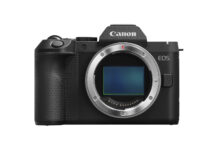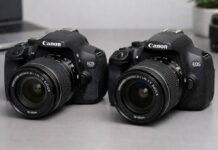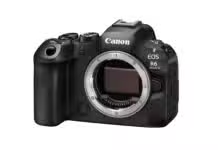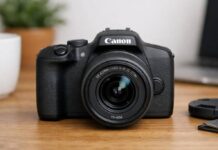

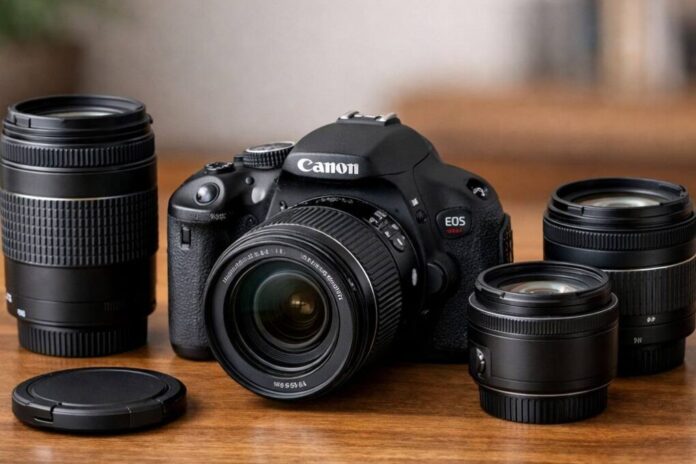
The best Canon Rebel T3i lenses are the ones that give this 2011 DSLR a capability its kit zoom cannot. Keep a working 18–55mm lens until you know what is missing. Then buy the EF-S 24mm f/2.8 STM for a small everyday kit, the EF 50mm f/1.8 STM for portraits and dim rooms, the EF-S 10–18mm for wide scenes, or the EF-S 55–250mm IS STM for distant subjects.
If I were building a T3i kit today, I would buy used and stop at two or three purposeful lenses. The camera’s 18MP APS-C sensor can reward good glass, but its basic autofocus and dated video focusing put a sensible ceiling on the investment.
Canon Rebel T3i lenses: the quick picks
| Lens | Best for | T3i angle of view | Main compromise |
|---|---|---|---|
| EF-S 24mm f/2.8 STM | Everyday, street, travel | About 38mm equivalent | No stabilization |
| EF 50mm f/1.8 STM | Portraits, low light | About 80mm equivalent | Tight indoors; no stabilization |
| EF-S 10–18mm f/4.5–5.6 IS STM | Landscapes, interiors | About 16–29mm equivalent | Slow maximum aperture |
| EF-S 55–250mm f/4–5.6 IS STM | Wildlife, field sports | About 88–400mm equivalent | Needs good light for action |
| EF-S 18–135mm f/3.5–5.6 IS STM | One-lens travel | About 29–216mm equivalent | Not bright; larger than the kit zoom |
| EF-S 17–55mm f/2.8 IS USM | Events, indoor work | About 27–88mm equivalent | Heavy and often costly |
There is no universal “best” lens here. The 24mm is my default first recommendation because it makes the T3i compact and gives a natural view. If your photographs are mostly people, choose the 50mm instead. If the kit lens already covers your subjects, spend nothing until reach, width, or aperture becomes a recurring limitation.
What lenses fit the Canon Rebel T3i?
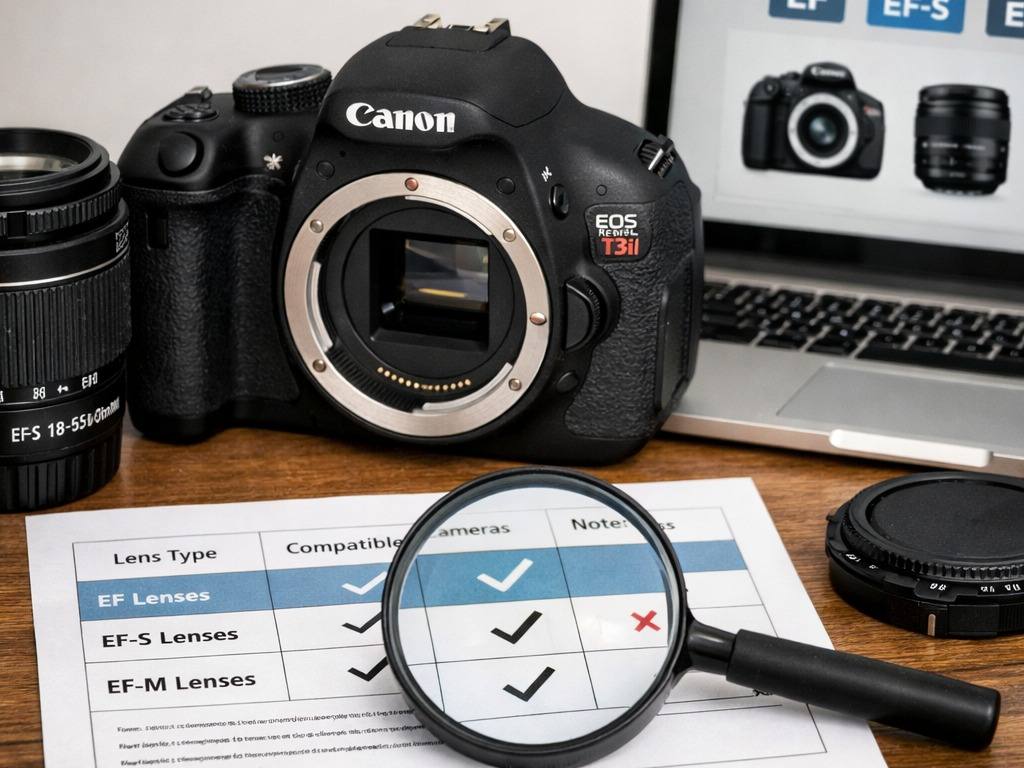
The Rebel T3i accepts Canon EF and EF-S lenses directly. Canon confirms both compatibility and the camera’s roughly 1.6× field-of-view factor in its official T3i support specifications. A 50mm lens therefore frames like an 80mm lens on a 35mm full-frame camera. The actual focal length and aperture do not change.
Canon RF, RF-S, and EF-M mirrorless lenses do not fit. Canon FD manual-focus lenses are also a poor adaptation choice because a simple mechanical adapter cannot preserve infinity focus. Marketplace listings that say only “for Canon” are not specific enough.
For Sigma, Tamron, or Tokina lenses, confirm the exact Canon EF-mount version. Older third-party lenses can fit physically yet produce aperture errors on later digital bodies. A return window or an in-person test is worth more than a seller’s vague compatibility claim.
The six best lenses for a Canon Rebel T3i
Canon EF-S 24mm f/2.8 STM: best everyday prime
The 24mm pancake is the lens I would put on a T3i for a walk, a vacation, or a day with family. Its 38mm-equivalent view is wide enough to include context without making people at the edge look stretched. At 125g, it also changes the camera’s carrying burden more than a specification table suggests.
The f/2.8 aperture is about one stop brighter than a typical kit zoom at 24mm. That helps indoors, though it is not a substitute for stabilization with static subjects. Its close 0.16m focus and 0.27× magnification are useful for food, details, and small objects. Skip it if you need zoom flexibility or frequently shoot below handheld shutter speeds.
Canon EF 50mm f/1.8 STM: best portrait and low-light value
On the T3i, this inexpensive 50mm behaves like a short telephoto. That makes it excellent for head-and-shoulders portraits, detail shots, stage work from nearby seats, and background separation. The f/1.8 aperture gives you far more control over shutter speed than the 18–55mm kit lens.
The familiar “nifty fifty” advice needs one objection: 80mm-equivalent framing is often too tight in a bedroom or small apartment. You may find yourself backed against a wall. Focus accuracy also matters at f/1.8; use the T3i’s center AF point when the outer points become uncertain. For everyday framing, the 24mm is the easier prime.
Canon EF-S 10–18mm f/4.5–5.6 IS STM: best ultra-wide zoom
This is the practical answer for interiors, architecture, dramatic foregrounds, and landscapes where the 18mm kit setting is not wide enough. The 16–29mm-equivalent range is a genuine expansion, not a small variation on what you already own. Canon rates the stabilizer at about four stops under its stated test conditions.
The small aperture makes it a daylight or tripod lens more than an available-light event lens. Stabilization can steady a building, but it cannot freeze people moving through a dim room. Keep the camera level for architecture, and leave space around people near the edges because ultra-wide perspective stretches nearby features.
Canon EF-S 55–250mm f/4–5.6 IS STM: best affordable telephoto
For zoo trips, compressed landscapes, outdoor sports, and approachable wildlife, the STM version of the 55–250mm is the value pick. It reaches an 88–400mm-equivalent angle of view while weighing 375g. Its stabilizer helps with camera shake, and the 0.85m minimum focus distance makes it more useful for close details than many buyers expect.
I would choose it over the common Canon EF 75–300mm f/4–5.6 III bundle lens. The 75–300 reaches a little farther, but it lacks stabilization and is rarely the smarter optical buy. Neither lens turns the T3i into a modern action camera. For sports, use the center AF point, AI Servo, and a shutter speed that freezes the subject.
Canon EF-S 18–135mm f/3.5–5.6 IS STM: best one-lens travel zoom
The 18–135mm STM covers wide views, portraits, and meaningful telephoto reach without a lens change. It is the right choice when dust, rain, crowds, or a family schedule makes swapping lenses impractical. The 29–216mm-equivalent range can replace the 18–55mm rather than overlap it.
The cost is a 480g lens and an f/5.6 maximum aperture at the long end. It will not match a fast prime indoors or the 55–250mm for distant wildlife. Canon’s later 18–135mm Nano USM version is also compatible and focuses faster through the viewfinder, but buy whichever clean copy offers better value. The T3i cannot exploit the later lens’s smooth continuous movie-AF promise.
The 17–55mm keeps a constant f/2.8 aperture across its useful 27–88mm-equivalent range. That is a real advantage for indoor events, available-light portraits, and consistent manual exposure while zooming. Canon also built in stabilization and fast USM focusing.
It weighs 645g—more than the T3i body alone—and clean copies can cost several times more than the camera. This is a defensible buy if you already like the EF-S DSLR system and need one fast working zoom. It is a poor “future-proof” purchase for someone planning an imminent system change. Compare the combined cost with a newer body before committing.
Two specialist choices worth knowing
For true macro work, the Canon EF-S 60mm f/2.8 Macro USM reaches 1:1 magnification and gives a 96mm-equivalent view. It is small enough to balance well on the T3i and doubles as a sharp portrait lens. It has no stabilization, so a tripod, flash, or deliberate shutter-speed technique helps at close range.
If you need an inexpensive flash rather than another lens, a compatible bounced Speedlite can improve indoor family photographs more than a slower zoom upgrade. The T3i’s pop-up flash can optically command compatible Canon Speedlites. That is one reason the older body remains useful for learning controlled light.
Video and autofocus: do not overpay for STM
STM lenses are quieter than many older designs, but the T3i predates Canon’s modern continuous Movie Servo AF. It can autofocus during recording when configured to do so, yet focus is button-triggered, slow, and visible in the clip. For interviews, tabletop work, or locked-off shots, focus before recording or pull focus manually.
That limitation changes the buying decision. Do not pay a large premium for an STM lens solely because a listing promises smooth video autofocus. STM still has value for quiet operation and good stills focusing, but the camera body determines the video experience. If dependable tracking is the goal, compare a modern mirrorless body such as the Canon EOS R50.
Used-lens buying traps and upgrade economics
Start with the complete model name. Canon made several 18–55mm, 55–250mm, and 18–135mm versions, and the suffix matters. A low-resolution listing can hide the difference between IS II, STM, and USM variants. Ask for a photograph of the barrel markings and the actual lens, not a stock image.
- Inspect for haze, fungus, separation, scratches, and impact damage.
- Test autofocus near and far through the optical viewfinder.
- Shoot at the widest and smallest useful apertures to catch diaphragm errors.
- Check stabilization, switches, zoom creep, filter threads, and electrical contacts.
- Prefer a return window if you cannot test the lens on your T3i.
EF lenses can move to a Canon full-frame DSLR and can adapt to EOS R bodies. EF-S lenses are for APS-C DSLRs; on a full-frame EOS R body, adapted EF-S glass uses a cropped sensor area. That does not make EF automatically wiser. Buying a large full-frame zoom for a T3i often leaves you without a useful wide angle and carrying more glass than the sensor needs.
Before putting premium money into the system, read our Canon Rebel T3i review and T3i vs T7 comparison. The T7 is not a meaningful upgrade for every owner, but the comparison clarifies which body limitations a lens cannot fix. Our broader Canon EF lens guide is more useful if full-frame or adapted RF use is part of the plan.
My recommended T3i lens kits
For everyday photography: keep the 18–55mm and add the EF-S 24mm f/2.8 STM. It is a light, inexpensive pairing that teaches you whether a prime fits your way of seeing.
For portraits and family events: use the 18–55mm for groups and the EF 50mm f/1.8 STM for individual portraits. Add bounced flash before buying another overlapping zoom.
For travel and wildlife: pair the 18–55mm with the EF-S 55–250mm IS STM. Choose the 18–135mm instead if avoiding lens changes matters more than maximum reach.
For landscapes and interiors: add the EF-S 10–18mm IS STM and a stable support. The kit zoom remains useful when you want a less exaggerated view.
The best Canon Rebel T3i lens is the one that solves a repeated problem. For most owners, one carefully chosen used lens is enough. Buy the 24mm for a smaller camera, the 50mm for people, the 10–18mm for width, or the 55–250mm for reach—and skip any bargain bundle that merely duplicates what you already have.
Frequently asked questions
Can the Canon Rebel T3i use EF-S lenses?
Yes. The T3i accepts both Canon EF and EF-S lenses directly. It does not accept RF, RF-S, or EF-M mirrorless lenses.
What is the best portrait lens for the Canon T3i?
The Canon EF 50mm f/1.8 STM is the strongest low-cost portrait choice. It frames like an 80mm lens on full frame, so it suits individual portraits better than tight indoor groups.
Should I replace the 18–55mm kit lens?
Not automatically. Keep it if it works and covers your subjects. Replace or supplement it only when you repeatedly need a wider aperture, more reach, a wider view, or a smaller prime.
Can I use Canon RF lenses with the T3i?
No. RF and RF-S lenses are designed for Canon’s mirrorless RF mount and cannot be adapted sensibly to an EF-mount DSLR such as the T3i.