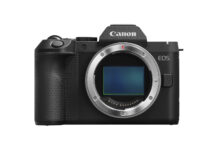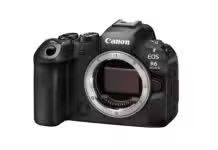

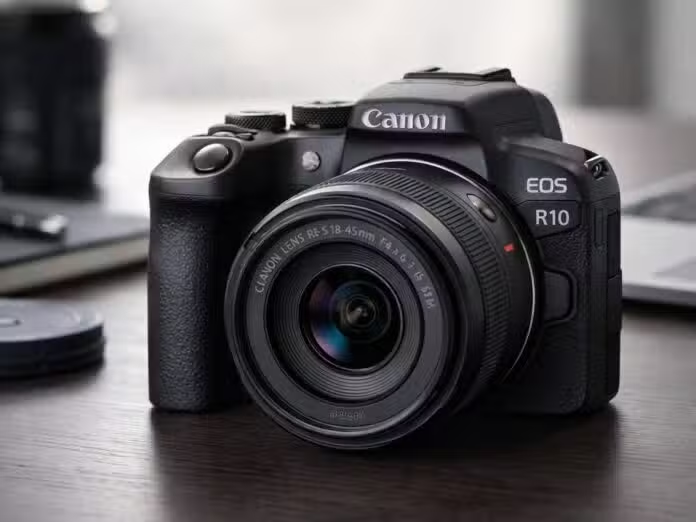
The Canon R10 remains one of Canon’s strongest compact APS-C cameras for action, wildlife, family photography, and learning beyond automatic mode. Its combination of 15fps mechanical bursts, subject-detection autofocus, a useful grip, and uncropped oversampled 4K30 is unusually capable for its size.
It is not automatically the best buy at any price. The EOS R10 has no in-body stabilization or official weather sealing, its 4K60 mode is heavily cropped, and availability can make newer or cheaper alternatives more sensible. This Canon R10 review explains when its speed is genuinely useful. It also explains when an R50, R7, Sony, Fujifilm, or Nikon body is the better decision.
Canon EOS R10 review: quick verdict
| Best for | Wildlife beginners, active families, travel and general photography |
|---|---|
| Main strengths | Autofocus, 15fps mechanical bursts, handling, EVF and uncropped 4K30 |
| Main weaknesses | No IBIS, no weather sealing, cropped 4K60 and one card slot |
| Buy it when | The price is competitive with the R50 and below an R7 or newer enthusiast alternative |
| Skip it when | You prioritize stabilized video, weather resistance or the broadest low-cost lens system |

Canon EOS R10 key specifications
| Sensor | 24.2MP APS-C CMOS |
|---|---|
| Processor | Canon DIGIC X |
| Lens mount | Canon RF; RF-S and RF lenses work natively |
| Autofocus | Dual Pixel CMOS AF II with people, animal/bird and vehicle detection |
| Burst speed | Up to 15fps mechanical or 23fps electronic |
| Video | Uncropped oversampled 4K30; cropped 4K60; Full HD 120p |
| Viewfinder | 2.36-million-dot electronic viewfinder |
| Screen | 3-inch fully articulating touchscreen |
| Stabilization | No IBIS; optical stabilization depends on the lens |
| Storage | One UHS-II-compatible SD card slot |
| Weight | Approximately 429g with battery and card |
| Connectivity | Wi-Fi, Bluetooth, USB-C, micro HDMI and microphone input |
Who should buy the Canon R10?
Beginners who want room to grow
The R10 is approachable without being stripped down. Canon’s guided interface and touchscreen help new users, while dual control dials, an AF joystick, customizable buttons, RAW capture, and UHS-II card support remain useful after the basics become familiar.
The cheaper Canon R100 is enough for slow-moving still subjects. The Canon R50 offers similarly friendly operation and strong autofocus in a smaller body. The R10 justifies the step up when grip, direct controls, buffer behavior, or mechanical burst speed matter.
Wildlife, pets and active families
The 1.6x APS-C crop makes a telephoto lens frame more tightly than it would on full frame, while Canon’s people, animal, bird, and vehicle detection reduces the work required to keep a moving subject in focus. The R10 is particularly attractive for someone entering wildlife photography who cannot justify an R7 or a larger professional body.
There are limits. The body is not weather-sealed, the small LP-E17 battery rewards carrying a spare, and the electronic shutter can distort fast motion under rolling shutter. For frequent wildlife work in poor weather, longer bursts, or stabilized handheld shooting, the Canon R7 is the more complete tool.
Design, controls and handling
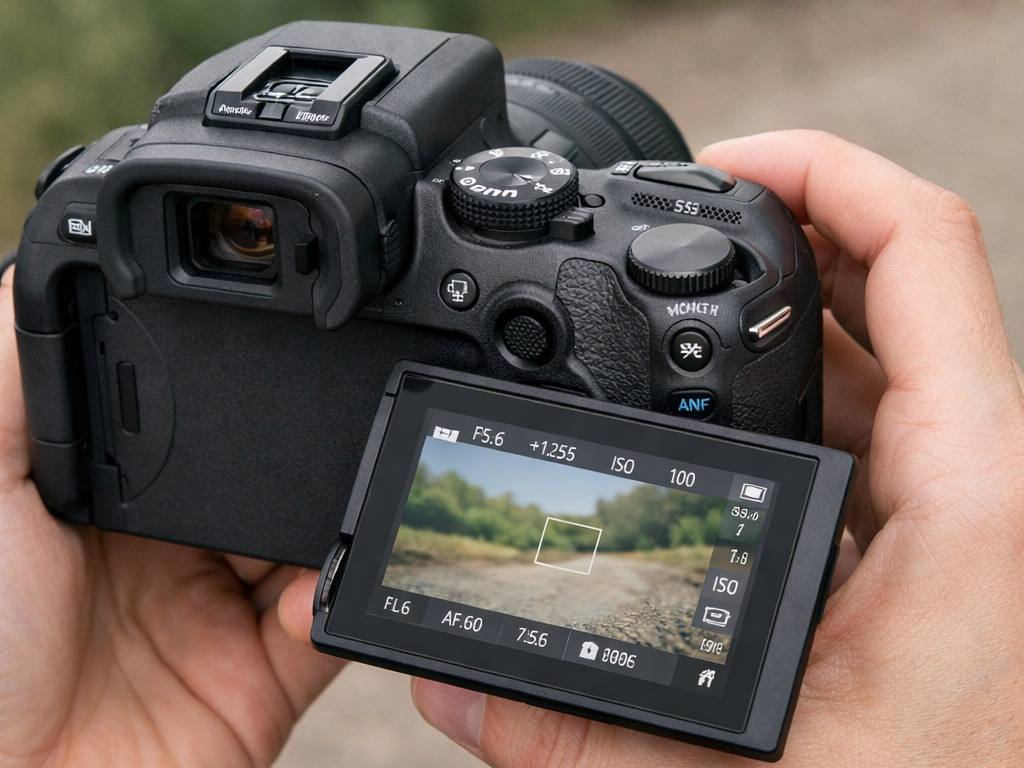
The R10 weighs approximately 429g with battery and card. Its 122.5 × 87.8 × 83.4mm body is compact, but the grip is deeper than the flatter bodies used by many entry-level rivals. The result is a camera that remains portable without becoming awkward with the RF-S 18-150mm or a light telephoto.
The 2.36-million-dot electronic viewfinder is modest rather than luxurious, but it solves the bright-light composition problem found on screen-only creator cameras. The fully articulating touchscreen supports low-angle stills, vertical framing, self-recording, and menu navigation.
The body uses one UHS-II SD card in the battery compartment. That is normal for this class, but it offers no in-camera backup for paid work. Canon does not claim weather sealing, so rain and dust require sensible protection.
A small built-in flash is useful for fill light and casual indoor photographs, a feature several compact rivals omit. USB-C supports charging while the camera is off and external power with compatible equipment. Neither replaces carrying a charged spare LP-E17 battery for a long day.
Autofocus, burst speed and buffer
Subject detection and tracking
Dual Pixel CMOS AF II detects people, animals such as birds, and vehicles. This is the R10’s defining advantage over older budget cameras: the system can identify a subject across much of the frame and continue tracking as composition changes.
Detection is not infallible. Branches, low contrast, small distant subjects, or a subject leaving the frame can still cause misses. Good shutter speed, an appropriate AF area, and enough light remain important; subject detection does not replace technique.
15fps mechanical versus 23fps electronic
The R10 reaches up to 15fps with its mechanical shutter and up to 23fps electronically with compatible lenses and settings. The 15fps mode is the safer default for fast movement because it avoids the rolling-shutter distortion that can affect electronic-shutter images of panning subjects, propellers, or rapidly moving limbs.
The buffer is useful for short action sequences, not unlimited bursts. RAW files fill it faster than JPEGs, and card speed affects recovery. A fast UHS-II card helps, but timing a short burst around the decisive moment produces better results than holding the shutter continuously.
RAW Burst mode can record a short sequence around the shutter press, including pre-shooting frames when configured. It can help with difficult moments such as a bird leaving a perch, but it adds an extraction step and is not a substitute for learning subject behavior and timing.
Image quality from the 24.2MP APS-C sensor
The R10’s 24.2MP sensor provides enough detail for substantial prints and moderate cropping without creating unnecessarily large files. Canon JPEG color is pleasing, especially for skin tones, while CR3 RAW files leave room to correct white balance, recover moderate highlight or shadow detail, and choose noise reduction later.
Low-light performance is competitive for APS-C but not magical. ISO 3200 is generally comfortable for normal output; ISO 6400 can remain useful when correct exposure and subject sharpness matter more than fine detail. A faster lens often improves indoor or dusk results more than changing bodies within this price class.
There is no sensor-shift stabilization. For static subjects, an optically stabilized RF/RF-S lens can permit slower shutter speeds. Stabilization cannot freeze a moving animal or child, so fast lenses and higher ISO still matter for action.
Focus bracketing is available for close-up and product work, allowing compatible software to combine frames focused at different distances. The camera also includes an in-camera panorama mode. These are useful extras, but autofocus, lenses, and handling remain better reasons to choose the R10.
Canon EOS R10 video quality and limitations
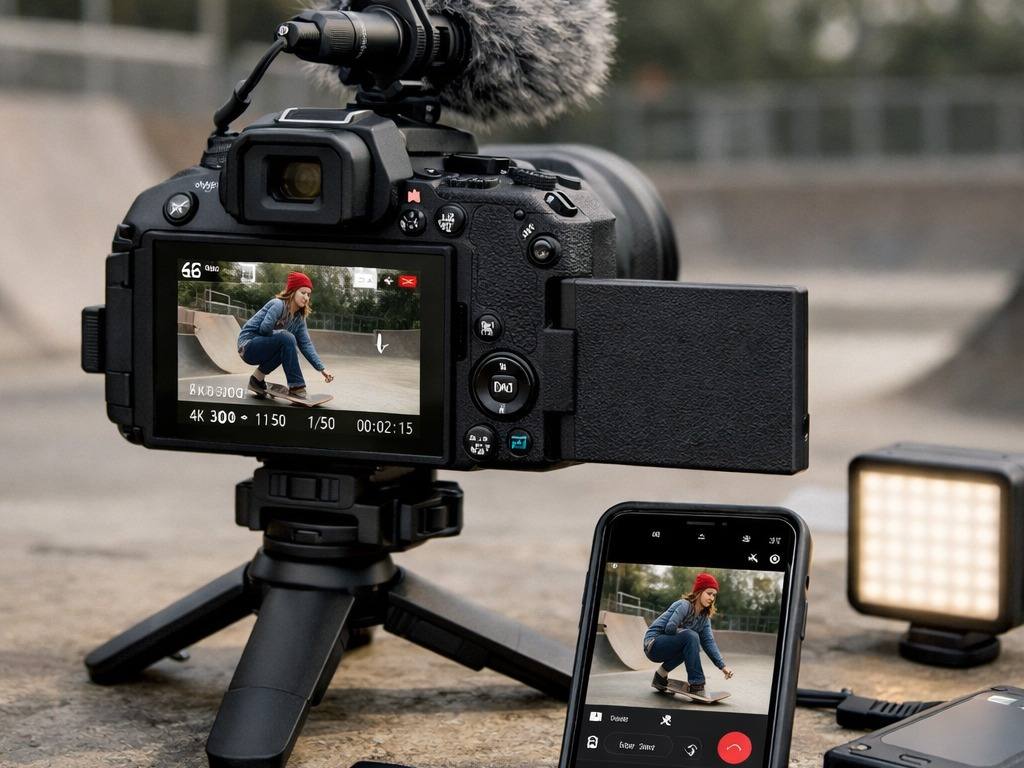
The strongest mode is uncropped 4K up to 30p, oversampled from the 6K sensor width. It produces detailed footage and retains the lens’s expected angle of view. Full HD up to 120p is available for slow motion.
4K60 uses only about 64% of the sensor’s horizontal area, creating a substantial crop of roughly 1.56x before considering the normal APS-C field of view. That can help distant wildlife but makes wide-angle vlogging difficult. Fast pans can also reveal rolling shutter.
The R10 includes a 3.5mm microphone input and clean HDMI output, but no headphone jack, Canon Log profile, or in-body stabilization. Digital movie stabilization crops the frame further. Video may stop because of battery level, card capacity, or temperature, so it should not be described as thermally unlimited.
Canon R10 lenses and system value
The RF-S 18-45mm kit zoom keeps cost and size down, but the RF-S 18-150mm is the more useful single-lens travel option. The RF-S 55-210mm F5-7.1 IS STM is the compact native telephoto. Its correct name is not “RF 55-210mm.” For more wildlife reach, the full-frame RF 100-400mm F5.6-8 IS USM is relatively light and becomes a 160-640mm-equivalent field of view on the R10.
The lens situation is better than it was at launch. Sigma now offers licensed Canon RF APS-C zooms and primes, including the 18-50mm F2.8, while Tamron has entered RF-S with APS-C options. Canon RF and RF-S lenses work natively, and EF/EF-S DSLR lenses work through the Mount Adapter EF-EOS R. EF-M lenses cannot be adapted.
Sony E and Fujifilm X still provide broader mature APS-C ecosystems. Before buying the R10, price the second lens you are most likely to need rather than judging the system only by the kit. The Canon RF-S lens guide compares the strongest native options by use case.
Canon EOS R10 versus R50, R7 and rivals
- R10 versus R50: choose the R10 for the deeper grip, AF joystick, faster 15fps mechanical shutter and more direct control. Choose the R50 for smaller size and beginner value.
- R10 versus R7: choose the R7 for IBIS, weather resistance, higher resolution, larger battery, dual cards and more serious wildlife use. Choose the R10 for lower weight and cost.
- R10 versus Sony A6400: the R10 has newer subject detection and friendlier handling; Sony has the deeper affordable lens ecosystem.
- R10 versus Nikon Z50 II: both are capable all-rounders. Compare current body/kit price, preferred handling and the lenses you will actually buy.
Pros and cons
Pros
- Strong people, animal, bird and vehicle autofocus
- 15fps mechanical burst without relying on electronic shutter
- Comfortable grip, AF joystick and useful direct controls
- Detailed uncropped oversampled 4K30
- Compact body with EVF and articulating touchscreen
- Improving licensed third-party RF-S lens support
Cons
- No in-body stabilization or official weather sealing
- Substantial crop in 4K60
- No headphone jack or Canon Log
- One card slot and a relatively small battery
- Availability can make pricing inconsistent
Is the Canon R10 worth buying in 2026?
Yes, when its price reflects its age and availability. The R10 remains a fast, comfortable APS-C camera that is especially useful for wildlife beginners, active families, travel, and anyone who wants more direct control than the R50 provides. Canon was still supporting it with firmware version 1.8.0 in May 2026, although that update should be treated as maintenance rather than a new performance feature.
Do not chase scarce stock at an inflated price. First compare the same configuration: body only, 18-45mm kit, or the more useful 18-150mm kit. The site’s best mirrorless cameras under $1,000 guide places the R10 beside current Canon, Sony, Nikon, Fujifilm, Panasonic, and OM System alternatives by use case. Canon-refurbished or dealer stock can make the R10 excellent value, but the warranty and included lens must be part of that comparison. If an R7, Nikon Z50 II, used Sony A6700, or newer Fujifilm body is close in total cost, compare the complete kit instead of the headline body price. If the R10 is clearly cheaper and its missing IBIS/weather sealing are acceptable, it remains one of the most capable compact action cameras in Canon’s lineup.
Frequently asked questions
Is the Canon R10 good for wildlife photography?
Yes. Animal and bird detection, 15fps mechanical bursts, a 1.6x crop factor and compatibility with RF telephotos make it a strong beginner wildlife body. The R7 is better for weather, stabilization, battery life and heavier use.
Does the Canon R10 have image stabilization?
It has no in-body image stabilization. Use an optically stabilized lens, a tripod, or digital movie stabilization where appropriate. Digital stabilization adds a crop.
Does the Canon R10 shoot uncropped 4K?
Yes, up to 4K30, oversampled from 6K. Its 4K60 mode uses a much smaller sensor area and applies a substantial crop.
Which lens should a Canon R10 beginner buy?
The RF-S 18-150mm is the most flexible single-lens travel option. The RF-S 18-45mm keeps the initial kit small and inexpensive. For wildlife, consider the RF-S 55-210mm or RF 100-400mm depending on budget and required reach.