
View full specs
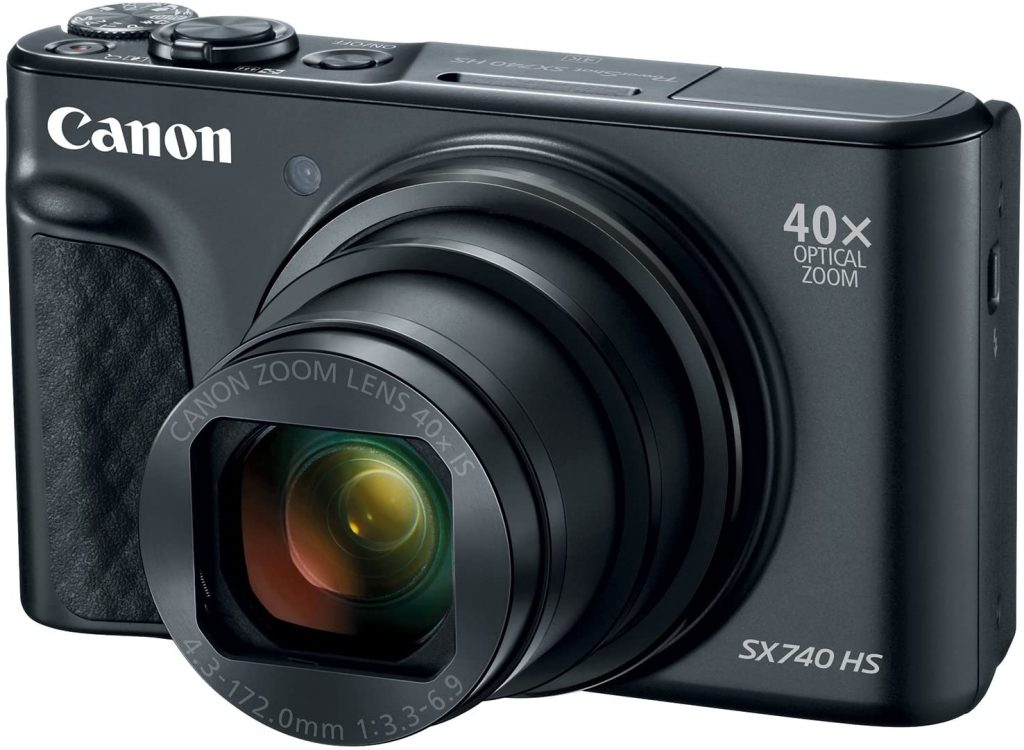
The Canon PowerShot SX740 HS still attracts buyers for one reason that phones and most premium compacts cannot match: a 24-960mm equivalent 40x optical zoom in a camera that weighs about 10.5 ounces with its battery and card. That combination is genuinely useful for sightseeing, zoo visits, cruises, school events, family trips, distant landmarks and daylight wildlife.
But this is not a universal phone upgrade. The small 1/2.3-inch sensor, slow f/6.9 aperture at full telephoto, JPEG-only recording and lack of a viewfinder make it much less convincing indoors, after sunset or for unpredictable action. In 2026, the Canon SX740 HS is best understood as a pocket travel-zoom specialist, not a premium compact and not a substitute for a modern mirrorless camera.
Canon SX740 HS review: the quick buying verdict
Yes, the Canon PowerShot SX740 HS is still worth buying if you specifically want long optical reach in the smallest practical Canon body and the price is sensible. It is a good camera for daylight travel and distant subjects. It is a poor choice if your priorities are low-light image quality, RAW editing, an electronic viewfinder, external audio or modern subject-recognition autofocus.
| Buy the SX740 HS if… | Skip it if… |
|---|---|
| You want a 40x zoom in a jacket-pocket camera. | You mostly photograph indoors, concerts or night scenes. |
| You shoot travel details, zoo animals, boats, aircraft or outdoor events. | You need dependable tracking for birds in flight or fast sports. |
| You prefer a dedicated camera with physical controls. | You expect RAW files, a touchscreen or an electronic viewfinder. |
| You accept that good light is part of the deal. | You mainly want a creator camera with a microphone input. |
Our recommendation: buy it for reach and portability, not because it has “20 megapixels” or because compact cameras are fashionable. If the asking price is heavily inflated, compare the current Panasonic ZS99, a clean used Canon SX730 HS, or a larger bridge camera before paying a scarcity premium.
How this review was produced: this is a buyer-focused, research-based review rather than a laboratory test or an original sample gallery. Specifications and operating details were checked against the Canon USA support documentation, Canon’s full technical specification and its July 2018 US announcement. Market and support status were checked on July 11, 2026.
Canon PowerShot SX740 HS pros and cons
What it does well
- Exceptional reach for the size: the 24-960mm equivalent range covers wide travel scenes and very distant details without changing lenses.
- Actually portable: at approximately 299g ready to shoot, it is far easier to carry than a bridge camera or mirrorless body with a long lens.
- Useful physical exposure controls: P, Tv, Av and M modes are available, along with manual focus and focus peaking.
- Fast headline burst rates: Canon specifies approximately 10 fps with One-Shot AF and 7.4 fps with Servo AF.
- Travel-friendly screen: the 3-inch LCD flips upward by 180 degrees for low-angle framing and self-recording.
- 4K and 60p Full HD: the video specification is still useful for casual travel clips.
What limits it
- Small-sensor image quality: good light matters, especially as the lens approaches f/6.9 at full zoom.
- JPEG only: the SX740 HS does not record RAW files, reducing recovery latitude for highlights, shadows and white balance.
- No viewfinder: composing at 960mm on the rear screen can be difficult in bright sun and less stable than bracing a camera against your eye.
- No touchscreen or microphone input: the flip screen helps, but this is not a modern creator-first camera.
- No weather sealing: the extending zoom mechanism needs protection from sand, rain and impacts.
- Scarcity can distort value: a useful old camera can still be a bad purchase at an inflated price.
Canon SX740 HS specifications that matter
| Sensor | 20.3MP 1/2.3-inch back-illuminated CMOS |
|---|---|
| Processor | Canon DIGIC 8 |
| Lens | 4.3-172mm; 24-960mm equivalent; 40x optical zoom |
| Maximum aperture | f/3.3 wide to f/6.9 telephoto |
| Stabilization | Lens-shift optical stabilization; Canon rates approximately 3.5 stops |
| Focus | Face and Tracking, Tracking, Zone, 1-point and Center; manual focus with peaking |
| Exposure modes | Auto, Hybrid Auto, P, Tv, Av, M, Sports and scene/creative modes |
| ISO range | ISO 100-3200 |
| Shutter range | 15 seconds to 1/3200 second |
| Continuous shooting | Approx. 10 fps One-Shot AF; 7.4 fps Servo AF |
| Still format | JPEG Fine/Normal; no RAW |
| Video | 4K 3840×2160 at 29.97p; Full HD up to 59.94p; stereo sound |
| Screen | 3-inch, approximately 922k dots, 180-degree upward tilt; not touch-sensitive |
| Viewfinder | None |
| Storage | SD, SDHC and SDXC; UHS-I compatible |
| Battery | NB-13L; approximately 265 shots or 370 in Eco mode |
| Weight | Approx. 299g / 10.5oz with battery and card |
The specification sheet tells the story clearly. This camera prioritizes lens range and portability. It does not give you a large sensor, bright telephoto aperture, RAW workflow or eye-level finder. Buyers who understand that trade can enjoy it; buyers expecting premium-compact image quality are likely to be disappointed.
How useful is the 40x optical zoom?
The lens begins at a practical 24mm equivalent, wide enough for streets, buildings, landscapes and groups. At the other end, 960mm equivalent can frame subjects that appear tiny on a normal phone camera: details on a tower, animals across an enclosure, performers from distant seats, boats offshore or a child on the far side of a playing field.
The important word is optical. The lens changes focal length before the image reaches the sensor. That is fundamentally different from taking a wide phone photo and cropping heavily. Canon also offers digital extensions, but the 40x optical range is the useful part; digital zoom throws away image information and should usually remain off.
Why full zoom is demanding
At 960mm equivalent, every small hand movement is magnified. Optical stabilization helps, but it cannot freeze a moving animal or compensate for an excessively slow shutter speed. The lens is also f/6.9 at the telephoto end, so the camera receives much less light than it does at the wide end. This is why full zoom works best outdoors.
Atmospheric haze matters too. When a subject is far away, heat shimmer, mist and dust between the camera and subject can reduce detail even when focus and stabilization are correct. More zoom does not automatically mean a sharper photograph.
Settings for sharper long-zoom photos
- Use Tv mode and favor a fast shutter speed for wildlife, sports and handheld telephoto work.
- Keep elbows close to your body and support the camera with both hands.
- Let stabilization settle briefly after framing.
- Shoot short bursts rather than relying on one frame.
- Reduce the zoom slightly when light falls or autofocus becomes uncertain.
- Avoid digital zoom and crop the best optical-zoom frame later if necessary.
- For static subjects, use a tripod or stable support and the self-timer to reduce shake.
Image quality: where the SX740 is good and where it struggles
Daylight photography
The 20.3MP sensor has enough resolution for ordinary prints, albums and online sharing when exposure, focus and light are favorable. The camera’s strongest case is a bright outdoor scene where its lens can reach a composition that a phone or short-zoom compact cannot capture.
Do not confuse pixel count with sensor size. Twenty megapixels on a 1/2.3-inch sensor do not behave like twenty megapixels on a 1-inch, APS-C or full-frame sensor. The SX740 packs many small photosites into a small area because that is what makes the 40x pocket lens possible. The result is reach and convenience, with less dynamic range and high-ISO flexibility than larger cameras.
Low light and indoor photography
Low light is the main weakness. As illumination falls, the camera must use a slower shutter speed, higher ISO or flash. At long focal lengths, the f/6.9 aperture makes that problem worse. Noise reduction can remove fine detail, while moving subjects blur if the shutter becomes too slow.
For indoor family snapshots, use the wide end of the lens, move closer, look for window light and use the built-in flash when appropriate. For concerts, dim indoor sports or evening wildlife, this is the wrong tool. A larger-sensor compact, mirrorless camera or a strong current phone will usually produce a cleaner result at ordinary focal lengths.
JPEG-only workflow
The SX740 records JPEG, not RAW. That is convenient for immediate sharing and keeps files manageable, but it places more importance on getting exposure and white balance right in-camera. You can still edit brightness, color and crop, but aggressive shadow recovery or highlight repair will reveal the file’s limits quickly.
Set the camera to its highest JPEG quality, disable unnecessary digital zoom, and protect highlights in difficult scenes. If RAW is essential, the larger Canon SX70 HS, Canon G7 X Mark III or Panasonic ZS99 is a better starting point.
Autofocus and burst shooting
Canon provides Face and Tracking, general Tracking, Zone, 1-point and Center focus-area choices. For stationary travel subjects, family photos and clear daylight scenes, the system is appropriate for the camera’s intended use. Servo AF and high-speed continuous shooting help with predictable movement, but this is still a contrast-detect compact rather than a recent mirrorless body with sophisticated subject recognition.
The headline burst rates are approximately 10 fps with focus fixed through One-Shot AF and 7.4 fps with Servo AF. Those numbers can help capture a short sequence, but they do not guarantee that every frame will be focused, and card writing or camera settings can reduce the practical rate. Use bursts selectively and anticipate the action.
Manual focus and focus peaking
The complete Canon specification confirms manual focus and MF peaking. This can help with static distant subjects or scenes where autofocus keeps selecting the wrong object. Peaking highlights areas of strongest contrast as a focusing aid. It does not turn the small rear screen into a precision viewfinder, but it is a useful advanced feature that simpler summaries of the camera sometimes overlook.
Video and vlogging
The SX740 records 4K at 29.97p and Full HD at up to 59.94p in the US format. Canon specifies MP4/H.264 video with stereo AAC audio and clips up to 29 minutes 59 seconds. The upward-flipping screen makes self-framing possible, and the long zoom can be useful for travel details or distant outdoor subjects.
The limitations matter more than the 4K label:
- There is no external microphone input, so wind and handling noise must be managed at the camera.
- The screen is not touch-sensitive, making self-operated focus changes less convenient.
- The small sensor and slow telephoto aperture limit indoor video quality.
- Long handheld zoom shots can still look unsteady despite optical stabilization.
- The camera is not weather sealed.
For occasional vacation clips, family video and short self-recorded updates, it is serviceable. For YouTube production, interviews, walk-and-talk video or audio-critical work, a Canon PowerShot V1, G7 X Mark III or creator-oriented mirrorless camera makes more sense.
Handling, screen and portability
The SX740’s best ergonomic feature is that it is likely to come with you. It measures approximately 4.33 x 2.51 x 1.57 inches and weighs around 299g ready to shoot. The lens retracts into the body, although the grip and lens housing make it larger than a basic shirt-pocket compact.
The 3-inch screen tilts upward through 180 degrees. That helps with waist-level photos, low viewpoints and self-recording. It does not tilt downward, and it is not a touchscreen. All focus-area, menu and playback operations use the buttons and rear control dial.
The missing viewfinder is the biggest handling compromise. At long zoom, an eye-level finder would provide a third contact point and reduce the effect of bright reflections. If you expect to spend most of the day photographing birds, aircraft or distant wildlife, the larger Canon SX70 HS is easier to brace and includes an EVF.
Who is the Canon SX740 HS really for?
The clearest way to judge this camera is to start with the photographs you cannot currently make. If a phone already handles your family, food and evening pictures but distant subjects remain tiny, the SX740 fills a real gap. A traveler can photograph a wide city square at 24mm equivalent, then isolate architectural details or a distant viewpoint without carrying another lens. Parents and grandparents may value the same reach at outdoor school events where they cannot move closer.
It also suits buyers who want a self-contained camera. There is no lens selection, sensor cleaning routine or bag of interchangeable equipment to manage. That simplicity is valuable, although the extending lens still needs careful treatment. The SX740 is less suitable as a first step into serious photography if the goal is to learn with RAW files, build a lens system or create shallow-depth-of-field portraits. A used mirrorless camera offers a better growth path for those priorities.
For wildlife, distinguish observation from action. The 960mm-equivalent view is useful for identifying and documenting a stationary animal in daylight. It does not give the SX740 the autofocus, viewfinder, bright lens or buffer behavior of a dedicated action setup. For travel, distinguish daylight sightseeing from nightlife. The Canon is at its best during the first and much less compelling during the second.
Best Canon SX740 HS settings
Simple travel setup
- JPEG quality: highest available.
- Mode: P for general daylight travel.
- ISO: Auto, while watching that shutter speed does not become too slow.
- Image stabilization: enabled for handheld use.
- Digital zoom: off.
- Focus: Face and Tracking for people; 1-point or Center for a specific distant subject.
Wildlife, zoo animals and outdoor sports
- Use Tv mode and select a fast shutter speed appropriate to movement.
- Use Servo AF for a predictably moving subject.
- Use short high-speed bursts.
- Keep the subject away from the very edge of the frame while tracking.
- Zoom back when the camera struggles to acquire focus.
Landscapes and travel details
- Use P or Av mode and keep ISO low when light allows.
- At wide angle, do not expect dramatic background blur from the small sensor.
- Use exposure compensation if bright skies are clipping.
- For static night scenes, support the camera and use the self-timer rather than raising ISO unnecessarily.
Macro and close-ups
Canon specifies focusing as close as approximately 1cm at the wide end in Macro. Stay near the wide position, provide plenty of light and keep the camera parallel to flat subjects when you need more of the scene in focus. At extremely close distance, the camera or lens can shade the subject, so side lighting often works better than direct frontal light.
What Av mode can and cannot do
The SX740 does provide aperture-priority exposure. However, the small sensor and compact zoom lens give you less aperture and depth-of-field control than an interchangeable-lens camera. Av remains useful for controlling exposure behavior, but do not buy this camera expecting the shallow-background portrait look of a large sensor and bright lens.
First-day setup checklist
A few setup choices prevent avoidable disappointments. Set the correct US date, time zone and daylight-saving option before shooting; accurate timestamps make a large travel library much easier to organize. Select the highest-quality JPEG setting, confirm that optical stabilization is active for handheld work and leave digital zoom disabled unless getting any record shot matters more than image quality.
Then customize the display so shutter speed, aperture and ISO are visible. These three values explain many apparent camera failures. A blurry moving subject usually means the shutter was too slow, while a noisy or smeared-looking file usually means ISO rose because there was too little light. At long zoom, check shutter speed before blaming autofocus.
Practice acquiring a distant subject before an important trip. Begin at a wider focal length, place the subject near the center, then zoom in while keeping it in the frame. Finding a small bird or aircraft directly at 960mm can be frustrating because the angle of view is extremely narrow. Assigning a small focus area for an unobstructed subject can also prevent the camera from choosing a nearby branch or fence.
Finally, take several representative photos and videos, transfer them to the device you will actually use, and inspect them before the retailer’s return period closes. Test the lens at wide, middle and full-telephoto positions; check flash, buttons, screen hinge, card slot, wireless connection, charger and battery. This is especially important with renewed, used or old-stock units.
Battery life, memory cards and firmware
Canon rates the NB-13L battery for approximately 265 still images or 370 in Eco mode. Video ratings are approximately 60 minutes under CIPA-style actual use and 100 minutes of total continuous-shooting battery endurance; the per-clip recording limit remains shorter. Cold weather, frequent playback, wireless transfer and heavy zoom use can reduce endurance.
A spare battery is sensible for travel. Canon’s US firmware version 1.4.3, released in November 2025, also adds support for the NB-15L battery. Confirm the installed firmware before relying on that compatibility.
The camera accepts SD, SDHC and SDXC cards and is UHS-I compatible. Use a reputable card, format it in the camera and carry a spare rather than trusting an unknown bundle card. For 4K video, prioritize a card with an appropriate sustained write-speed rating rather than buying solely by advertised peak speed.
Wi-Fi, Bluetooth and transferring photos
Built-in Wi-Fi and Bluetooth work with Canon Camera Connect for compatible phones and tablets. Bluetooth helps maintain the connection workflow, while Wi-Fi handles image transfer and remote functions. App compatibility changes over time, so use the current Canon app and current instructions rather than an old tutorial written for the 2018 app interface.
For a small number of photos, wireless transfer is convenient. For a full trip or many video clips, removing the card and using a card reader is usually faster and kinder to the battery. Keep original files backed up before editing or deleting them from the card.
Common SX740 problems and practical fixes
Photos are blurry at full zoom
First check the shutter speed and subject movement. Stabilization reduces camera shake but cannot stop a moving subject. Move into brighter light, raise the shutter speed in Tv mode, steady your stance and shoot a short burst. If the subject remains difficult to frame, zoom back until it is easy to track. A slightly wider sharp image is more useful than a maximum-zoom blur.
The camera focuses on a fence or branch
Switch from a broad automatic area to 1-point or Center focus, place that area over a clear part of the subject and try again. Manual focus with peaking is another option for a stationary subject. Heat shimmer can resemble missed focus at long distance, so compare several frames and, if possible, photograph earlier in the day when the air is cooler.
Indoor pictures look noisy or soft
Zoom toward the wide end, move physically closer and use brighter available light. The lens admits more light at wide angle than at full telephoto. For people at close range, the built-in flash may produce a more usable record than a high-ISO ambient exposure. If low-light photography is the main job, changing technique will not remove the sensor’s fundamental limitation; choose a larger-sensor camera instead.
The lens will not extend or reports an error
Turn the camera off, install a charged battery and check that nothing obstructs the lens. Do not pull or twist the extending barrel. Sand and impact damage require professional attention, not force. When carrying the camera, switch it off before placing it in a case and use a protective pouch that does not press against the lens cover.
The phone connection no longer works
Update Canon Camera Connect, remove the old pairing from both devices and follow Canon’s current pairing procedure. Mobile operating-system permissions can change after an update. If transfer remains unreliable or the files are large, a card reader is a straightforward alternative and avoids spending travel time troubleshooting wireless settings.
Useful accessories—and what not to overbuy
The most useful additions are modest: a genuine or reputable compatible spare battery, a reliable UHS-I SD card, a wrist strap, a compact padded case and a simple card reader. A small tabletop tripod can help with static scenes, group pictures and supported long-zoom video. A cleaning blower and clean microfiber cloth are more useful than elaborate generic bundles.
Avoid conversion lenses or filters that attach with improvised adapters unless their compatibility is well established; extra weight on a retracting compact lens can create handling and mechanical problems. Cheap high-capacity cards and no-name batteries can also undermine an otherwise reliable travel kit. Buy fewer accessories, test each one before departure and keep the original Canon battery available as a known-good diagnostic item.
Canon SX740 HS price and US buying advice
Canon launched the SX740 HS in the United States at $399.99 in 2018. That historical price is useful context, not a promise about today’s market. New stock can be inconsistent, and scarcity or social-media demand can push third-party listings much higher than the camera’s photographic value.
Do not interpret a high listing price as evidence that the SX740 produces better files than a newer camera. Before buying in the US:
- Compare the Amazon price with reputable US camera retailers and Canon-authorized sellers.
- Check whether the listing is new, renewed, used or an imported/international version.
- Confirm the return policy and US warranty status.
- Do not pay a large premium for low-quality bundle accessories.
- Compare the total against a current Panasonic ZS99 and used larger-sensor alternatives.
A clean used SX740 can be a better decision than inflated new-old stock. Test the full zoom range, autofocus, flash, screen hinge, battery door, card slot, Wi-Fi and every button during the return period.
Canon SX740 HS comparisons and alternatives
Canon SX730 HS vs SX740 HS
The SX730 HS has the same basic 20.3MP sensor size and 24-960mm equivalent 40x zoom concept. The SX740 moves to DIGIC 8, adds 4K and raises the headline burst performance. The older SX730 remains interesting only when it is meaningfully cheaper and Full HD is enough. Condition can matter more than the generation when comparing two used cameras.
Canon SX620 HS vs SX740 HS
The Canon SX620 HS is smaller and lighter, with a 25x 25-625mm equivalent lens and Full HD video. It is the cheaper, simpler travel option. The SX740 is the better choice when 960mm reach, 4K, the flip-up screen and stronger controls matter. Our SX620 vs SX740 comparison covers that decision directly.
Canon SX70 HS vs SX740 HS
The SX70 HS is a bridge camera with a 65x 21-1365mm equivalent lens, electronic viewfinder, vari-angle screen and RAW support. Choose the SX740 when pocketability is the priority. Choose the SX70 when you regularly work at long focal lengths and value a grip, finder and more stable shooting position.
Canon G7 X Mark III vs SX740 HS
The G7 X Mark III uses a much larger 1-inch sensor and a bright 24-100mm equivalent f/1.8-2.8 lens. It is the stronger camera for indoor photography, people, food, everyday image quality, RAW editing and creator work. The SX740 wins decisively on reach: 960mm versus 100mm equivalent. The right answer depends on whether your missing photograph is usually too dark or too far away.
Panasonic ZS99 vs Canon SX740 HS
The current Panasonic Lumix ZS99 is a particularly relevant US alternative. It offers a 30x 24-720mm equivalent lens rather than 40x, but adds a touchscreen, RAW recording, USB-C and current-product availability. The Canon reaches farther and is slightly lighter; the Panasonic is the more modern ownership proposition. Compare actual prices rather than assuming the older camera should automatically cost less.
Canon SX740 HS vs a smartphone
A current phone is usually better for instant sharing, computational low-light photography, HDR and ordinary wide-angle snapshots. The SX740 is better when you need genuine optical reach far beyond the phone’s telephoto camera. Carrying both is often the sensible travel answer: use the phone for quick wide and night images, and the Canon for distant daylight subjects.
For a broader category view, compare our best zoom cameras and Canon PowerShot comparison.
Frequently asked questions
Is the Canon PowerShot SX740 HS a good camera?
It is a good daylight travel-zoom camera for buyers who need 24-960mm equivalent reach in a small body. It is not a strong low-light camera and should not be treated as a general image-quality upgrade over every modern phone.
Is the Canon SX740 HS worth buying in 2026?
Yes, when long zoom and pocketability are the priorities and the US asking price is sensible. It becomes poor value when scarcity pushes it close to newer premium compacts, current travel zooms or capable mirrorless kits.
Does the Canon SX740 HS shoot RAW?
No. It records JPEG still images. If RAW is important, compare the Canon SX70 HS, Canon G7 X Mark III or Panasonic ZS99.
Does the Canon SX740 HS have Av mode?
Yes. Canon’s complete technical specification lists Program, Tv shutter priority, Av aperture priority and Manual exposure, plus Auto, Hybrid Auto, Sports and scene modes.
Does it have manual focus and focus peaking?
Yes. Canon lists manual focus with MF peaking. This is useful for static distant subjects or scenes where autofocus selects the wrong object.
Does the SX740 HS have a touchscreen or viewfinder?
No. It has a 3-inch screen that flips upward by 180 degrees, but the display is not touch-sensitive and there is no optical or electronic viewfinder.
How good is the Canon SX740 image quality?
It can produce useful, detailed JPEGs in good light, especially when its optical zoom gets a composition that another camera cannot. Its small sensor loses detail more quickly at high ISO and has less editing latitude than 1-inch, APS-C and full-frame cameras.
Is the Canon SX740 good for low light?
Not particularly. The small sensor and f/6.9 maximum aperture at full zoom make indoor and evening telephoto photography difficult. Use the wide end, available light, support or flash, or choose a larger-sensor camera.
Is it good for wildlife and birds?
It is useful for perched birds, zoo animals and casual daylight wildlife because of its reach. It is not an ideal bird-in-flight camera because framing without a viewfinder and tracking unpredictable movement are difficult.
Can the Canon SX740 record 4K video?
Yes, at 3840×2160 and 29.97p in the US format. It also records Full HD up to 59.94p. There is no external microphone input, and the screen is not touch-sensitive.
How long does the battery last?
Canon rates the NB-13L at approximately 265 shots, or 370 in Eco mode. Carry a spare for travel, 4K video, heavy playback or frequent wireless transfers.
What battery does the SX740 use?
The standard battery is the Canon NB-13L. Canon USA firmware version 1.4.3 adds support for the NB-15L as well.
When was the Canon SX740 HS released?
Canon announced it in the United States on July 31, 2018, with availability scheduled for late August 2018 at a launch price of $399.99.
Should I buy a black, silver or international-version SX740?
Color does not change image quality. For US buyers, seller reliability, warranty coverage, return policy and condition matter more. An imported version may have different warranty support, charger packaging or menu defaults, so read the listing carefully.
Final verdict
The Canon PowerShot SX740 HS succeeds when judged by the problem it was designed to solve. It puts a 24-960mm equivalent optical zoom into a camera small enough for ordinary travel. That remains valuable in 2026. It also provides more control than its simple appearance suggests, including P, Tv, Av and M exposure, manual focus and focus peaking.
Its weaknesses are equally clear: small-sensor low-light quality, JPEG-only capture, no viewfinder, no touchscreen, no microphone input and prices that sometimes reflect scarcity more than capability. Buy it for daylight reach and portability. Skip it when image quality, creator video or action autofocus matter more than carrying size.
Travelers, parents, cruise and zoo visitors, and casual photographers who want real optical reach in a pocketable camera.
You mostly shoot indoors, need a viewfinder, want RAW files, or expect modern phone-like low-light processing.
Low for daylight Auto-mode shooting, but telephoto technique and low-light limits still matter at the long end.
A larger-sensor compact or bridge camera if quality matters more than pocket size.
4K is useful, but the small sensor, fixed lens, and lack of microphone input keep it from serious video work.
Yes if you specifically need a pocket 40x zoom and accept current prices; no if you mainly want general image quality.