

View full specs
In this Fujifilm X-E5 review, the camera has to answer a harder question than the X-E4 did. It is no longer just the charming, relatively affordable rangefinder-style Fuji. The X-E5 is a premium compact X body with a 40MP sensor, in-body stabilization, modern autofocus, and a price that forces you to take it seriously.
- Best for: street, travel, daily carry, and photographers who want a compact rangefinder-style Fuji with serious image quality.
- Skip if: you need weather sealing, a deep grip, dual card slots, or the best specs-per-dollar Fujifilm body.
- Price discipline: buy it because the form factor matters, not because the spec sheet beats everything else.
- Lens pairing: compact primes make the X-E5 special; large zooms make it less convincing.
Fujifilm’s official X-E5 specifications confirm the major upgrades: a 40.2MP X-Trans CMOS 5 HR sensor, X-Processor 5, 5-axis IBIS rated up to 7 stops in the center, single UHS-II SD slot, 6.2K video, and a 445g shooting weight.
Who the Fujifilm X-E5 is really for
The X-E5 is for photographers who care about how a camera changes their behavior. That sounds soft until you spend time with a small rangefinder-style body. A camera like this encourages slower seeing, one-lens walks, and a more deliberate rhythm. It is not the best Fujifilm for every job. It may be one of the more attractive Fujifilm bodies for actually carrying every day.
In my experience, the X-E concept works best with compact primes. Put a small 23mm, 27mm, or 35mm lens on it and the camera feels coherent. Put a large constant-aperture zoom on it and you start asking why you did not buy an X-T5 or X-S20 instead.
The X-E5 also asks you to pay for taste. That is not an insult. Design, compactness, and handling have value. But if you are a purely rational buyer comparing features per dollar, the X-E5 has to fight very hard against the X-T50 and X-T5. Our best Fujifilm camera guide is useful if you want that broader body-by-body context.
Design, controls, and street handling
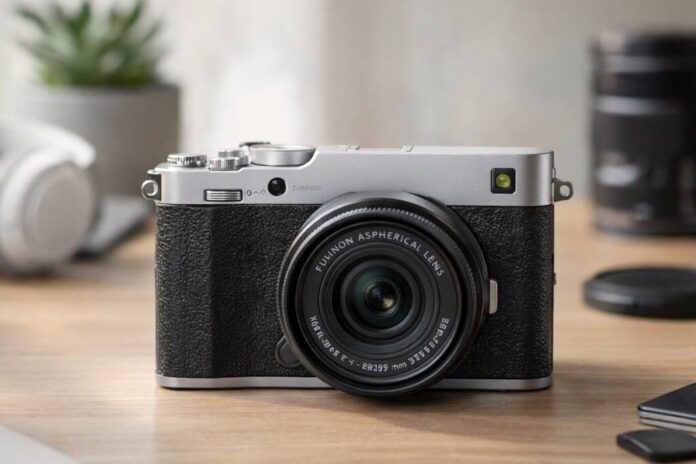
Hands-on, the X-E5 is the kind of camera that rewards people who like physical controls but do not want a large body. The rangefinder-style EVF position keeps your face slightly off the back of the camera, and the small footprint makes it less intrusive for street and travel work.
The big improvement over the X-E4 is not just the sensor. It is the return of a more secure body concept. The X-E4 was beautifully minimal, sometimes too minimal. The X-E5 feels more complete without becoming a mini X-T body. That balance matters for photographers who want a compact tool, not a fashion object.
There are still compromises. The EVF is modest, the grip is not built for heavy lenses, and there is no weather sealing. I would not choose it for bad-weather documentary work or long days with telephoto glass. I would choose it for walking cities, travel mornings, quiet portraits, and daily photography where discretion matters.
Image quality from the 40MP sensor
The 40.2MP X-Trans CMOS 5 HR sensor gives the X-E5 a serious image-quality ceiling. You can crop, print, and recover detail in a way that older 26MP X-E bodies cannot match. For street and travel, that extra resolution is more useful than people think, especially when you are working quickly and cannot always frame perfectly.
Fujifilm color remains one of the main reasons to buy the system. The X-E5 gives you current film simulations and enough RAW flexibility to treat JPEGs as creative drafts rather than final compromises. I would shoot JPEG+RAW and let the camera’s color guide the edit.
The catch is lens discipline. A 40MP APS-C sensor shows weak technique and mediocre glass more clearly. If you buy the X-E5, do not treat the lens as an afterthought. Start with compact, sharp Fujifilm primes; our best Fujifilm X lenses guide is useful for that exact decision.
Autofocus, IBIS, and video
Autofocus is much more modern than the old X-E reputation. Subject detection covers people, animals, birds, vehicles, trains, insects, and drones. For street, family, travel, and portraits, it is more than enough. For demanding sports and wildlife, I would still look at the X-H2S or another action-first body.
IBIS changes the X-E line. It makes slow shutter work with small primes more practical, and it gives the camera a wider margin in dusk light, museums, restaurants, and interiors. That is one of the strongest reasons to choose the X-E5 over older used X-E bodies.
Video specs are strong on paper: 6.2K, 4K60, FHD high speed, and current Fujifilm color profiles. But I still see the X-E5 as a stills-first camera. The body shape, single card slot, battery, heat considerations, and rangefinder handling are not what I would choose for heavy video work.
X-E5 vs X-T50, X100VI, and X-T5
The X-T50 is the obvious practical rival. It gives you the same general generation of image quality in a more SLR-style body, often with a more balanced grip for mixed lenses. If you want one Fujifilm body for everything, the X-T50 may be easier to recommend.
The X100VI comparison is more emotional. The X100VI is simpler because the lens decision is already made. The X-E5 is more flexible because it uses X-mount lenses. If you love the 35mm-equivalent view and want a fixed-lens discipline, the X100VI still has its own pull. If you want to choose between 23mm, 27mm, 35mm, and 50mm lenses, the X-E5 makes more sense.
The X-T5 remains the stronger serious stills body. Weather sealing, dual card slots, better handling with larger lenses, and a more complete control layout make it a better main camera. The X-E5 is the camera you choose because smaller and quieter matters more.
Best lenses for the X-E5 personality
The Fujifilm X-E5 review changes completely depending on the lens. With the XF 27mm f/2.8, it becomes a discreet daily camera. With the XF 23mm f/2 or the newer compact 23mm options, it becomes a street and travel body with a classic field of view. With the XF 35mm f/2, it becomes more intimate for details, portraits, and quiet documentary work.
I would be careful with large zooms. They work, but they pull the X-E5 away from its reason to exist. If you regularly want the XF 16-55mm f/2.8 or long telephotos, an X-T5 or X-H body is the more honest platform. The X-E5 is best when the camera and lens disappear together.
What to check before buying
Because the X-E5 is newer and relatively expensive, I would not chase a tiny used discount. Buy new, refurbished, or used only when the savings are real. Check the IBIS, screen hinge, EVF, top controls, USB-C port, and sensor. A compact body that gets carried daily can pick up knocks even when it looks clean in listing photos.
I would also pay attention to bundle pricing. If the kit with the compact 23mm lens is priced sensibly, it can make more photographic sense than body-only plus a random zoom. The right small prime is part of why this camera works.
Why this camera is not just an X100VI alternative
It is tempting to frame the X-E5 as the interchangeable-lens X100VI. That is useful but incomplete. The X100VI gives you a fixed lens, leaf shutter, built-in ND filter, and a more self-contained identity. The X-E5 gives you lens freedom, which is both an advantage and a trap.
If you know you want one focal length, the X100VI is cleaner. If your photography moves between 23mm, 27mm, 35mm, and short telephoto perspectives, the X-E5 is more flexible. The danger is building such a large lens kit around it that you erase the reason you bought the smaller body.
Final verdict
This Fujifilm X-E5 review lands on a qualified yes. The Fujifilm X-E5 review verdict makes the most sense when I stop asking it to be the sensible spreadsheet winner. It is expensive, imperfect, and absolutely not the best Fuji for everyone. But it has a clear photographic personality.
I would buy the X-E5 for street, travel, and daily carry with compact primes. I would not buy it for weather abuse, heavy lenses, paid events, or video-first work. If its shape makes you shoot more often and more intentionally, it earns its place. If you only want the best feature list for the money, look elsewhere in Fujifilm’s lineup.
Frequently asked questions
Does the Fujifilm X-E5 have IBIS?
Yes. The X-E5 has 5-axis in-body stabilization rated up to 7 stops in the center and 6 stops at the periphery under Fujifilm’s stated test conditions.
Is the Fujifilm X-E5 weather sealed?
No. The X-E5 is not a weather-sealed body. If weather resistance matters, compare it with the X-T5 or X-H series instead.
Is the Fujifilm X-E5 better than the X-T50?
Not universally. The X-E5 is more about compact rangefinder-style shooting. The X-T50 is often the more practical all-around body.
Street, travel, daily carry, and photographers who want 40MP Fuji files in a compact rangefinder-style body.
You need weather sealing, a deep grip, dual card slots, long battery life, or best-value specs per dollar.
Medium; beautiful to use, but expensive and more deliberate than beginner-oriented bodies.
X-T50 for similar sensor with SLR-style handling, X-T5 for weather sealing/dual slots, X100VI for fixed-lens simplicity.
Capable specs, but ergonomics, heat, battery, and single-slot design make it a stills-first camera.
Yes, if the body style changes how often you shoot; questionable if you are just buying the spec sheet.