
View full specs
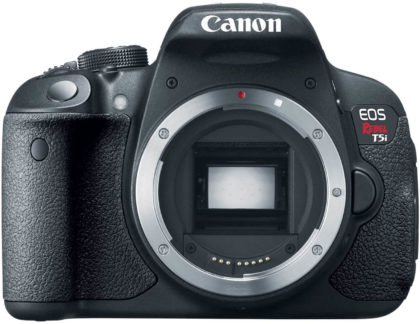
This Canon Rebel T5i review is for photographers who want a cheap DSLR that still feels pleasant to use. Outside North America this camera is the Canon EOS 700D, and in Japan it was sold as the Kiss X7i. The regional names change, but the camera is the same basic idea. You get an 18MP APS-C Canon DSLR with a flip-out touchscreen, simple controls, good color, and access to a huge used Canon EF/EF-S lens ecosystem.
I would not pretend the Canon Rebel T5i is modern. It has no 4K video, no Wi-Fi, no USB charging, no in-body stabilization, and Live View autofocus feels old. But if you want to learn photography with a real optical viewfinder, the Rebel T5i can still make sense. The body also does not cost much. Canon’s official EOS Rebel T5i product page shows exactly what kind of camera this is: simple, tactile, and built around still photography first.
Canon Rebel T5i at a glance
- 18MP APS-C CMOS sensor
- Canon EF/EF-S lens compatibility
- DIGIC 5 processor
- 9-point all cross-type viewfinder autofocus system
- 5 fps continuous shooting
- 3.0-inch vari-angle touchscreen, approx. 1.04M dots
- Full HD 1080p video up to 30p; no 4K
- External microphone input
- Single SD/SDHC/SDXC card slot, UHS-I compatible
- LP-E8 battery, rated around 440 shots
- Approx. 580g with battery and memory card
Who the Canon Rebel T5i is really for
The Canon Rebel T5i makes the most sense for beginners, photography students, families, and budget buyers. It is for people who want a proper DSLR without spending much. It is also a sensible backup body for someone who already owns Canon EF or EF-S lenses. If you have an old Canon kit lens, a 50mm f/1.8, or a telephoto zoom sitting in a drawer, the Rebel T5i helps. It gives that glass a useful second life.
I especially like it as a learning camera. The optical viewfinder teaches timing and framing in a way phones do not. The mode dial, exposure controls, and lens changes make photography feel physical. That matters. A beginner can see what aperture, shutter speed, ISO, and focal length actually do, instead of letting a phone blend everything into software.
The Canon Rebel T5i is less attractive if you mainly want video, fast autofocus in Live View, or instant phone transfer. For that, a newer Canon R50, Sony ZV-E10 II, or even a used Canon M50 will feel more current. But for stills-first learning, portraits, travel, family events, school projects, and everyday photography, the Rebel T5i is still a friendly used DSLR.
Design and handling
The Rebel T5i feels like a classic entry Canon DSLR. The grip is comfortable, the body is light enough to carry for a full afternoon, and the controls are simple without feeling toy-like. It is mostly polycarbonate over a metal chassis, so it does not feel like a pro body. It is still sturdy enough for normal use.
Canon got the ergonomics right here. The ISO button is easy to reach, the exposure controls are clear, and the mode dial is not intimidating. I also like the fully rotating mode dial because it is faster to move through modes than on some earlier Rebels. Small things like that matter when you are learning and still thinking through every setting.
The 3-inch vari-angle touchscreen is the feature that keeps the Canon Rebel T5i feeling less ancient. It flips out, rotates forward, and makes awkward angles much easier. For low shots, tripod work, product photos, family group shots, and beginner video, that screen is genuinely useful. The touch interface also makes menus and playback easier for people coming from smartphones.
Image quality
The 18MP APS-C sensor is old, but it still produces attractive files when the light is good. Canon color is one of the reasons cameras like this stayed popular for so long. Skin tones look natural, JPEGs are easy to like, and RAW files give enough flexibility for careful editing.
At ISO 100 to 800, the Canon Rebel T5i can still deliver clean, detailed photos. ISO 1600 is fine for family and travel work. ISO 3200 is usable if you expose well. Beyond that, noise and color softness become more obvious. This is not a camera for dark gyms, concerts, or night street work. A bright lens helps, but you still need to accept the limits.
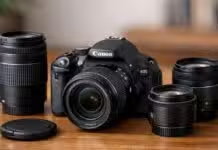
The bigger image-quality upgrade is not a different setting. It is a better lens. The EF-S 18-55mm IS STM kit lens is decent for learning. The EF 50mm f/1.8 STM changes the camera completely for portraits and indoor light. The EF-S 24mm f/2.8 STM is another small, cheap lens that makes the Rebel T5i feel much more fun for everyday photography.
Autofocus and speed
Through the optical viewfinder, the Canon Rebel T5i uses a 9-point autofocus system, and all 9 points are cross-type. For a beginner DSLR, that is useful. It is not a sports camera, but it can handle portraits, family events, travel, casual street photography, and kids moving at normal speeds.
The center point is the one I would trust most. If I were shooting portraits with this camera, I would often use the center point, focus carefully, then recompose when needed. The outer points are helpful. Still, this is not the kind of autofocus system where I would let the camera choose everything for me.
Continuous shooting is 5 fps. That is enough for casual action, but not enough to spray and pray. The buffer is also limited, especially in RAW. If you photograph pets, school sports, or kids running around, the Rebel T5i can do it. Timing matters more than with a modern mirrorless body.
Live View and video
If video is your main concern, I would treat this section as the short version. I also keep a separate Canon Rebel T5i / EOS 700D video quality guide for readers who want settings, lens, and audio advice in more detail.
Live View is the area where the Canon Rebel T5i feels most dated. Unlike the later Canon 70D and 80D, this camera does not have Dual Pixel CMOS AF. Live View autofocus is contrast-based and can hunt. For still subjects it is usable. For movement, it is slow.
Video is similar. The Rebel T5i records Full HD 1080p at 30, 25, or 24 fps, and it can record 720p at higher frame rates. The files are easy to edit and the color is pleasant, but there is no 4K and no modern subject tracking. If you want to shoot video with this camera, use an STM lens and an external microphone. The 3.5mm mic input is one of its better video features.
For casual YouTube, school projects, family clips, and simple talking-head videos on a tripod, the Rebel T5i is still workable. For handheld creator work, walking shots, or autofocus-heavy video, I would choose something newer. A Canon R50 or Sony ZV-E10 II is much easier for that style of shooting.
Battery, storage, and connectivity
The Canon Rebel T5i uses the LP-E8 battery. Canon rates it around 440 shots, and that is realistic if you mostly use the optical viewfinder. Live View and video drain it faster, so I would buy a spare battery with any used Rebel T5i kit.
Storage is simple: one SD/SDHC/SDXC card slot with UHS-I support. You do not need an expensive modern card for this camera. A reliable SDHC or SDXC card from a known brand is enough. I would rather buy two dependable mid-range cards than one oversized card of unknown origin.
Connectivity is basic. There is no built-in Wi-Fi or Bluetooth. You move files by card reader or cable. That may sound inconvenient, but for learning photography it can be a good habit. You slow down, import the files, review them properly, and start to understand what worked.
Lens choices for the Canon Rebel T5i
The best reason to buy a Canon Rebel T5i today is the lens ecosystem. Canon EF and EF-S lenses are everywhere on the used market. Many are inexpensive, and a few are still excellent values.
For a first kit, I would look for the EF-S 18-55mm IS STM rather than an older non-STM version. It focuses more quietly and works better for video. Add the EF 50mm f/1.8 STM for portraits, low light, and background blur. If you want a tiny walkaround lens, the EF-S 24mm f/2.8 STM is a lovely match for this body.
For wildlife, sports, and travel reach, a used EF-S 55-250mm IS STM is one of the smartest budget telephoto choices. It is not a pro lens, but it is light, sharp for the price, and much better than many cheap long zooms. A Canon Rebel T5i with the 18-55mm STM, 50mm f/1.8 STM, and 55-250mm STM is still a very capable beginner kit.
What to check before buying used
Condition matters more than tiny price differences. I would rather pay a little more for a clean Canon Rebel T5i with the right basics included. Look for a charger, battery, strap, body cap, and a good STM kit lens instead of chasing the cheapest listing online.
- Check that the touchscreen responds across the full display.
- Open and rotate the screen to make sure the hinge feels solid.
- Test autofocus through the viewfinder and in Live View.
- Inspect the lens mount for damage or excessive wear.
- Check the sensor for dust by shooting a plain bright surface stopped down.
- Confirm the LP-E8 battery and charger are included.
- Avoid bodies with sticky buttons, impact marks, or corrosion in the battery compartment.
I would also avoid overpaying for huge accessory bundles. Many used DSLR bundles include weak tripods, old bags, filters of unknown quality, and off-brand extras that add little value. Spend the money on a better lens instead.
Canon Rebel T5i versus newer alternatives
If the alternative is the previous generation, our Canon Rebel T3i review explains the real trade. Still-image quality is very similar, so the T5i earns its premium mainly through its touchscreen, quicker Live View behavior, and 5 fps burst.
The obvious upgrade path inside Canon DSLRs is the Canon 80D or Canon 90D. The Canon 80D gives you a better sensor, much better autofocus, Dual Pixel CMOS AF, better battery life, and a stronger body. The Canon 90D goes further with 32.5MP resolution, faster shooting, and 4K video.
If you want to stay very cheap, the Rebel T5i is still a good learner. If you want a DSLR you can grow with for longer, I would stretch to the 80D. If you want Canon’s more modern mirrorless path, the Canon R50 is easier for video, autofocus, and everyday sharing, but RF-S lenses are a different system.
That is the real decision. The Canon Rebel T5i is not a future-proof camera. It is a low-cost way to learn photography and use affordable EF/EF-S lenses. If that is what you need, it still has a clear role.
Final verdict
The Canon Rebel T5i is still worth considering if the price is right and you understand what you are buying. It is a friendly DSLR with good color, a useful touchscreen, a comfortable grip, and a deep lens ecosystem. It is not fast by modern standards, not connected, and not a serious video camera in 2026.
As a photographer, I like the Rebel T5i most as a teaching camera. It slows you down in a useful way. You look through the finder, choose a focus point, feel the shutter, and learn why the lens matters. For someone who wants that experience on a small budget, the Rebel T5i still works. With the right lens, it is a satisfying little kit.
Frequently asked questions
Is the Canon Rebel T5i still worth buying in 2026?
Yes, but mainly as a cheap used DSLR for learning photography, family photos, portraits, and casual travel. It is not the right choice if you need 4K video, fast Live View autofocus, wireless transfer, or modern subject tracking.
Is the Canon Rebel T5i the same as the EOS 700D?
Yes. The Canon EOS 700D was sold as the Rebel T5i in North America and as the Kiss X7i in Japan. The regional names differ, but the camera is essentially the same model.
What lenses work with the Canon Rebel T5i?
The Canon Rebel T5i works with Canon EF and EF-S lenses. Good budget matches include the EF-S 18-55mm IS STM, EF-S 24mm f/2.8 STM, and EF 50mm f/1.8 STM. The EF-S 55-250mm IS STM is the budget telephoto I would add next.
Is the Canon Rebel T5i good for video?
It is fine for basic 1080p video, school projects, family clips, and simple YouTube work on a tripod. It is not ideal for serious creator work because autofocus in Live View is slow and there is no 4K recording.
Should I buy the Canon Rebel T5i or Canon 80D?
Buy the Canon Rebel T5i if price is the main priority and you want a simple learning DSLR. Buy the Canon 80D if you can spend more. It gives you better autofocus, better battery life, a stronger body, and more room to grow.
Beginners, students, families, and Canon EF/EF-S lens owners who want a cheap Rebel DSLR for still photography.
You need 4K video, fast Live View autofocus, wireless transfer, USB charging, or modern subject tracking.
Low; the controls, touchscreen, and Canon menus are friendly for first-time DSLR users.
Canon 80D or 90D for a stronger DSLR; Canon R50 if you want a modern RF mirrorless body.
Pleasant 1080p color and mic input, but slow Live View AF and no 4K.
Yes, if it is clean, cheap, and bought as a learning DSLR rather than a modern hybrid camera.