
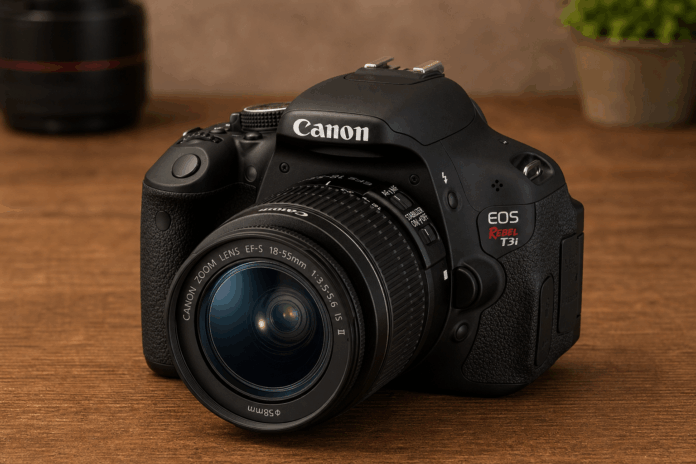
View full specs
The Canon EOS Rebel T3i is old enough that age alone is not a useful verdict. The important questions are what it still does well, what a clean used copy should cost, and whether a newer Rebel actually gives you more of the features you care about.
The short answer is that the T3i remains a good low-cost photography teacher. Its 18MP APS-C files are still capable, the optical viewfinder makes the camera feel direct, and Canon EF/EF-S lenses are plentiful on the used market. Its weak points are just as clear: slow Live View autofocus, primitive video focusing, no wireless transfer, and limited high-ISO latitude.
Quick verdict: is the Canon Rebel T3i still worth buying?
Yes, but only at the right price. I would consider a clean T3i body around $80 to $160, or a tested kit with the EF-S 18-55mm IS II around $150 to $230. Above that, newer used Rebels and entry mirrorless cameras become harder to ignore.
- Buy it for: learning exposure, family photos, portraits, school photography, tabletop work, and access to cheap EF/EF-S lenses.
- Skip it for: action, dependable video autofocus, 4K, wireless sharing, quiet shooting, or regular work above ISO 3200.
- The overlooked advantage: unlike the newer Rebel T7, the T3i has a fully articulated screen, an external microphone input, spot metering, and a built-in wireless Speedlite transmitter.
- Our price ceiling: about $160 body-only or $230 with a clean, working 18-55mm kit lens. Warranty and exceptional condition can justify a little more.
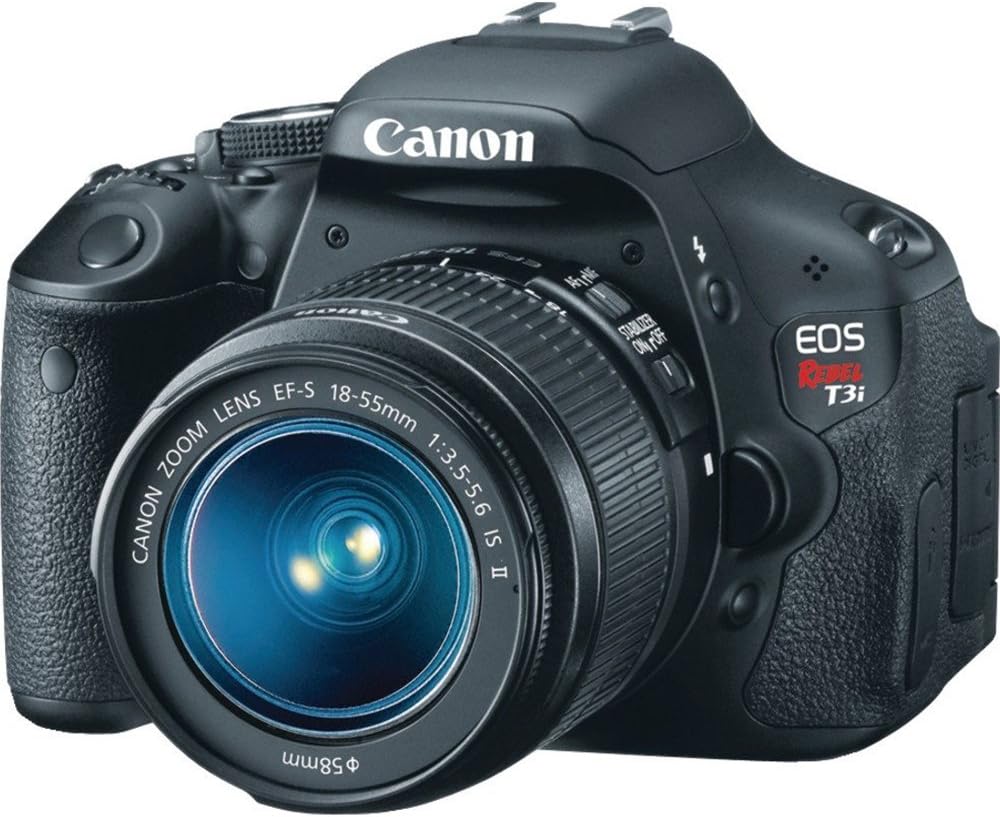
The Amazon listing above is useful for checking availability, but it is often priced like old new stock. Compare the total carefully with used-camera dealers. A T3i stops being a bargain when nostalgia adds $100 to the price.
Canon EOS Rebel T3i release date, names, and position in the lineup
Canon announced the EOS Rebel T3i in February 2011. The same camera is called the EOS 600D in most markets outside North America and the EOS Kiss X5 in Japan. Those names are interchangeable when you are shopping used, although chargers and regional accessories should still be checked.
The T3i followed the Rebel T2i / EOS 550D and sat above the cheaper Rebel T3 / EOS 1100D. It was replaced by the T4i / EOS 650D. The key addition over the T2i was not a new sensor. It was the more flexible body: a vari-angle screen, integrated wireless flash control, and a friendlier set of creative controls.
Canon Rebel T3i specifications that matter
| Feature | Canon EOS Rebel T3i / 600D | What it means now |
|---|---|---|
| Sensor | 18MP APS-C CMOS, 22.3 x 14.9mm | Enough detail for good prints and normal cropping, but less shadow recovery than current APS-C sensors. |
| Processor | DIGIC 4 | Responsive for single shots, dated for noise reduction and Live View. |
| Lens mount | Canon EF and EF-S | Large, inexpensive used-lens choice. Canon FD lenses are not a simple native fit. |
| Viewfinder | Pentamirror, about 95% coverage, 0.85x | The final image includes a little more around the edges than you see in the finder. |
| Autofocus | 9 points; center point cross-type | The center point is the reliable choice in difficult light. |
| Burst | 3.7 fps; about 34 JPEG or 6 RAW frames | Fine for expressions and casual movement, poor for sustained action. |
| Shutter | 30 sec to 1/4000 sec; 1/200 sec flash sync | Normal for an entry DSLR, with useful manual and bulb exposure control. |
| Screen | 3-inch vari-angle LCD, 1.04M dots | Still one of its best features for low angles, tripod work, and video framing. |
| Video | 1080p at 24, 25, or 30 fps; 720p up to 60 fps | Good enough for controlled manual-focus work, not modern run-and-gun video. |
| Audio | Built-in microphone and 3.5mm microphone input | A real advantage over the Rebel T7, although there is no headphone monitoring. |
| Battery | LP-E8, about 440 shots | Replacement batteries are easy to find. Buy a reputable one and confirm the charger is included. |
| Storage | SD, SDHC, SDXC | A normal UHS-I SD card is sufficient; an expensive modern card brings little benefit. |
| Wireless | No Wi-Fi or Bluetooth | Transfer by card reader or USB. Eye-Fi is obsolete and should not be part of a buying plan. |
| Weight | About 570g with battery and card | Comfortable with small EF-S lenses, but much larger than a compact mirrorless kit. |
Canon still hosts the T3i manual and support material. It is worth downloading the manual before buying because it lets you test functions such as wireless flash control, custom settings, and video exposure properly.
Image quality: where the 18MP sensor still holds up
Good light is the T3i’s natural territory
At ISO 100 to 400, the T3i can still produce detailed, pleasing photographs. Canon’s JPEG color is warm without being difficult to edit, and the RAW files give enough latitude for normal exposure corrections. Put a sharp lens on the camera and the result looks far less dated than the body specification suggests.
The 18MP sensor is not the reason to reject this camera. Technique, focus accuracy, light, and lens quality make a larger difference at this level. A T3i with the EF-S 24mm f/2.8 STM or EF 50mm f/1.8 STM can make a much stronger image than a newer body left permanently behind a mediocre lens.
Where the files show their age
The limit appears when you underexpose and then lift shadows. Newer APS-C sensors retain cleaner color and more detail. With the T3i, deep shadow recovery becomes rough quickly, and highlight protection matters more. I would expose carefully, shoot RAW for important work, and treat ISO 1600 as a normal upper working point rather than pretending ISO 6400 is clean.
ISO 3200 can be useful when getting the photograph matters more than fine detail. ISO 6400 and the expanded ISO 12800 setting are emergency options. For indoor family photography, a faster lens or bounced flash improves the result more than aggressive noise reduction.
Autofocus, handling, and real shooting speed
Through the optical viewfinder, the T3i feels simple and predictable. The 9-point AF array is concentrated near the middle of the frame, and only the center point is cross-type. For portraits, dim rooms, and moving subjects, select the center point, focus on an area with contrast, and recompose when subject movement allows.
The 3.7 fps burst rate is enough for a child running across a short distance or a sequence of expressions. It is not enough for serious sports or wildlife, and the RAW buffer is shallow. If action is the priority, an older enthusiast body such as the 7D Mark II or 80D is a better use of used-camera money.
The body itself is comfortable. The grip is deeper than many small mirrorless cameras, the top dial is easy to reach, and the articulated screen remains genuinely useful. The screen is not touch-sensitive, though, and Live View focus is slow. For still subjects on a tripod, magnified manual focus is often the better method.
Video: useful with manual focus, frustrating with autofocus
The T3i helped make DSLR video accessible, and it still records attractive 1080p footage when the shot is controlled. Manual exposure, a flip-out screen, and the external microphone input give it more serious video tools than the Rebel T7.
The catch is autofocus. The T3i does not provide modern continuous subject tracking in video. It can attempt contrast-detect focus during recording, but the movement is slow, visible, and often audible. For interviews, tabletop clips, stop-motion, or locked-off shots, manual focus works. For walking vlogs, children, events, or anything that moves unpredictably, a Canon R50 is in another class.
There is also no 4K, no headphone output, no in-body stabilization, and no simple phone workflow. The articulated screen does not cancel those limitations. Buy a T3i for video only if you specifically want a very cheap manual-learning camera.
Canon T3i vs T2i, T3, T5i, T7, and R50
| Camera | Key advantage over the T3i | What the T3i does better | Best choice when |
|---|---|---|---|
| Canon T2i / 550D | Usually cheaper and slightly lighter | Articulated screen and built-in wireless flash control | Buy the T2i only if the saving is meaningful. |
| Canon T3 / 1100D | Lower used price | 18MP sensor, better screen, 1080p video, external mic, faster burst | The T3i is normally worth the modest premium. |
| Canon T5i / 700D | Touchscreen, better Live View AF, 5 fps, newer interface | Often cheaper with nearly identical still-image quality | Choose the T5i when the price gap is under about $50. |
| Canon T7 / 2000D | 24MP sensor, Wi-Fi/NFC, lighter body | Articulated higher-resolution screen, mic input, spot metering, 3.7 fps, wireless flash commander | Choose by features, not model age. |
| Canon R50 | Modern subject AF, 4K, fast burst, touchscreen, wireless workflow | Much lower price, optical finder, cheap used EF/EF-S system | Choose the R50 if moving subjects or video matter. |
The surprising comparison: T3i vs T7
Our Canon T3i vs T7 comparison goes feature by feature, but the short version is that the T7 is newer and has more pixels without being a straight upgrade. Canon simplified it to hit a low price. The fixed screen, missing microphone input, lack of spot metering, and slower burst can matter more than the resolution difference.
For landscape work and easy phone transfer, the T7 has the advantage. For tripod framing, off-camera flash, or simple video with an external microphone, the T3i can be the more useful body. This is the comparison most used-camera buyers should make before assuming a higher model number wins.
Used Canon T3i prices and the buying checklist
At the time of this update, MPB listed T3i bodies from $47 to $189, while KEH listed warranted bodies from $128 to $198 depending on grade. A clean 18-55mm kit normally makes sense around $150 to $230. Private sales should cost less because you are accepting more risk and usually no warranty.
| Condition | Sensible 2026 target | Our view |
|---|---|---|
| Body only, private sale | $70 to $130 | Good value if fully tested and complete. |
| Body only, dealer warranty | $120 to $180 | Reasonable for clean condition and low risk. |
| 18-55mm kit, tested | $150 to $230 | The easiest starter package. |
| Above $250 | Usually skip | Compare a T5i, SL2, 80D, T7, or discounted mirrorless kit. |
What to test before paying
- Sensor and mirror box: photograph a plain bright wall at f/16 and inspect for heavy dust, scratches, or strange bands.
- Autofocus: test the center and outer points through the viewfinder with the included lens.
- Articulated screen: rotate it through its full range and watch for flicker or a loose hinge.
- Flash: confirm the pop-up flash opens and fires, then check the hot shoe for damage.
- Ports: inspect the rubber doors and test the microphone, USB, HDMI, and remote ports if they matter to you.
- Lens: check both AF and IS switches, zoom smoothness, fungus, haze, and front-element damage.
- Battery kit: confirm an LP-E8 battery and LC-E8 charger are included. USB charging is not supported.
- Shutter count: useful when available, but overall condition and reliable operation matter more than an unverifiable number.
Best first lenses for the Canon T3i
The inexpensive EF/EF-S catalog is the strongest reason to own this camera. Start with the kit lens if you do not yet know what focal lengths you like, then use our Canon Rebel T3i lens guide to choose one lens that changes what the camera can do.
- EF-S 24mm f/2.8 STM: compact everyday and street lens with a natural 38mm-equivalent view.
- EF 50mm f/1.8 STM: inexpensive portrait lens with much better low-light ability than the kit zoom.
- EF-S 55-250mm f/4-5.6 IS STM: the sensible low-cost telephoto for outdoor sports, wildlife, and travel details.
- EF-S 10-18mm f/4.5-5.6 IS STM: useful for interiors, architecture, and wide landscapes.
Do not buy a pile of lenses simply because they are cheap. One useful lens and a working flash will teach you more than a bag of overlapping kit zooms. The broader Canon DSLR lineup guide also explains where EF and EF-S equipment still makes sense in a mirrorless market.
Who should buy the T3i, and who should avoid it?
Buy it if
- You want the cheapest credible route into manual photography.
- You prefer an optical viewfinder and physical controls.
- You already own Canon EF or EF-S lenses.
- You need an articulated screen or basic off-camera Speedlite control on a tight budget.
- You are buying for a class where a simple DSLR is more useful than a phone-like interface.
Avoid it if
- You photograph fast action and expect the camera to track the subject for you.
- You want dependable video autofocus, 4K, or stabilized handheld video.
- You need direct phone transfer, Bluetooth control, or USB charging.
- You regularly shoot in dim light without flash or a fast lens.
- The price is close to a cleaner T5i, SL2, 80D, or modern mirrorless kit.
For a first camera, price still decides the argument. Our beginner Canon DSLR guide compares the late-generation Rebels that are worth paying more for.
Final verdict
The Canon Rebel T3i is not secretly modern. It is a straightforward 2011 DSLR whose core photography tools have aged better than its electronics. In good light, with a decent lens, it can still make photographs that do not need an apology. It is also pleasant to learn on because exposure, focus, and lens choice remain visible parts of the process.
The right reason to buy one is price plus purpose. Under roughly $160 for a body or $230 for a clean kit, the T3i is an honest beginner camera. At inflated old-stock prices, it loses the point. The T7 is not automatically better, the T5i is worth a modest premium, and the R50 is the clear step up when autofocus and video matter.
Canon EOS Rebel T3i / EOS 600D alternatives
The main alternatives to the Canon EOS Rebel T3i / EOS 600D are Canon T2i, T5i, T7, and R50. Compare autofocus, stabilization, video limits, lens choice and current price before deciding which camera fits you best.
Frequently asked questions
When was the Canon EOS Rebel T3i released?
Canon announced the Rebel T3i in February 2011. It is also sold as the Canon EOS 600D and EOS Kiss X5 in other markets.
Is the Canon Rebel T3i still worth buying in 2026?
Yes, as a low-cost used DSLR. It makes the most sense around $80 to $160 body-only or $150 to $230 with a tested 18-55mm kit lens. At higher prices, compare newer used Rebels and mirrorless cameras.
Does the Canon T3i have Wi-Fi or Bluetooth?
No. Use a card reader or USB cable for file transfer. The camera does support wired remote control, but obsolete Eye-Fi cards are not a sensible modern workaround.
Is the Canon T3i good for video?
It can produce good 1080p video with manual focus and controlled shots. Its articulated screen and microphone input help, but slow contrast-detect autofocus makes it a poor choice for moving subjects or walk-and-talk vlogging.
What battery does the Canon T3i use?
The T3i uses the Canon LP-E8 battery and LC-E8 charger. It does not charge over USB. Canon rated it for about 440 viewfinder shots under CIPA testing.
What lenses work with the Canon Rebel T3i?
Canon EF and EF-S lenses fit directly. Compatible third-party EF and EF-S lenses also work. Canon RF and RF-S mirrorless lenses do not fit, and Canon FD lenses are not a simple native adaptation.
Is the Canon T3i better than the T7?
It depends. The T7 has a 24MP sensor and built-in Wi-Fi, while the T3i has an articulated screen, microphone input, spot metering, a slightly faster burst, and built-in wireless flash control. Buy the feature set you need, not simply the newer model.
Beginners who want a low-cost DSLR, optical finder, articulated screen, and inexpensive EF/EF-S lenses.
You need tracking AF, 4K, wireless transfer, USB charging, or strong high-ISO files.
Low for basics, but Live View autofocus and video handling feel very dated.
Canon T5i or 80D used; Canon R50 for modern AF and video.
1080p is usable, but autofocus, audio, and codec limits make it poor for modern video work.
Yes below about $160 body-only or $230 with a clean 18-55mm kit.