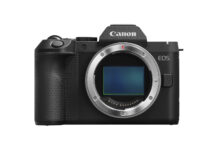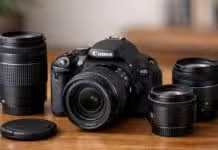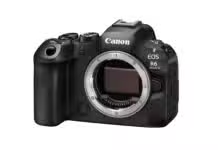

Choosing the best Canon EF lenses in 2026 is really about taking advantage of one of the deepest used lens ecosystems in photography. This guide focuses on the EF lenses that still make the most sense for portraits, travel, landscapes, events, wildlife, and adapted mirrorless use.
Why Canon EF lenses still matter in 2026
Canon may have moved its future development to RF, but the EF mount is still one of the easiest systems to buy into if you care about value, breadth, and real-world results. There are decades of Canon EF lenses on the used market, from small affordable primes to professional L-series zooms and telephotos. That matters for photographers buying used DSLRs, and it also matters for mirrorless shooters adapting EF glass to modern Canon RF bodies.
For many readers, the real question is not whether EF is the future. It is whether EF still makes sense right now at current used prices. In many cases, the answer is yes. If you shoot with a Canon DSLR such as the Canon 5D Mark IV, Canon 90D, or Canon 6D Mark II, native EF support is still a real advantage. If you are on RF, an adapter keeps many of these lenses relevant without forcing an immediate full-system rebuild.
EF vs EF-S in practical terms
Canon EF lenses work on both Canon full-frame and Canon APS-C DSLRs. Canon EF-S lenses are designed specifically for APS-C DSLR bodies, so they can be lighter, smaller, and often cheaper, but they do not belong on full-frame Canon DSLRs. That is why I usually treat EF as the safer long-term lens buy if you think you may move between APS-C and full-frame DSLR bodies. EF-S can still be smart when the lens fills a specific need, especially for budget ultra-wide work, but EF gives you more flexibility.
Buying EF in 2026 means buying selectively
The best Canon EF lenses are not simply the most famous or the most expensive. Some older EF lenses still produce beautiful images but feel slow or heavy compared to newer alternatives. Others are excellent bargains because the used market undervalues them. My approach is simple: prioritize lenses that still solve a real shooting problem well, have strong used availability, and do not rely on nostalgia alone.
Best Canon EF lenses for everyday photography
Best all-around zoom for most photographers
The Canon EF 24-105mm f/4L IS USM remains one of the most practical EF lenses ever made. It covers a genuinely useful range for travel, family photography, street shooting, landscapes, and casual portrait work. On a full-frame DSLR it feels like a complete everyday lens, and on APS-C it becomes a more portrait-friendly midrange zoom. It is not the fastest lens in low light, but the image stabilization helps, and used prices are usually much easier to justify than a 24-70mm f/2.8.
If you want one EF zoom that can stay on the camera most of the time, this is still my default recommendation.
Best budget prime for starting an EF kit
The Canon EF 50mm f/1.8 STM is still the easiest low-cost entry into the Canon EF system. It is small, sharp for the money, and fast enough to give beginners a real feel for shallow depth of field. On full frame it works as a general-purpose normal prime. On APS-C it behaves more like a short portrait lens. It is not luxurious and it is not weather sealed, but its value is hard to argue with.
Best Canon EF lenses for portraits and weddings
Best portrait prime for value
The Canon EF 85mm f/1.8 USM remains one of the best value portrait lenses in the entire Canon DSLR system. It is compact, bright, quick to focus, and capable of flattering subject separation without demanding L-series money. For portraits, family sessions, and event work on a budget, it still holds up extremely well. If you want a practical Canon EF portrait lens without overspending, this is where I would start.
Best professional portrait zoom
The Canon EF 70-200mm f/2.8L IS II USM is still a workhorse lens for wedding, portrait, and event shooters who do not mind the size. It gives you compression, flexibility, fast autofocus, and strong optical quality in one package. It is heavy, and that matters over a long day, but it remains one of the strongest used buys in the EF system if your work benefits from this range.
Best Canon EF lenses for landscapes and travel
Best wide zoom for full-frame DSLR users
The Canon EF 16-35mm f/4L IS USM is my preferred wide-angle Canon EF travel and landscape zoom for most people. It is sharp, stabilized, and easier to carry than the faster f/2.8 alternatives. For landscapes, architecture, interiors, and travel city work, it offers a very sensible balance of image quality, weight, and used price.
If you mostly shoot stopped down outdoors, this lens usually makes more sense than paying extra for speed you do not often need.
Best APS-C ultra-wide option
The Canon EF-S 10-18mm f/4.5-5.6 IS STM deserves mention because it solves a real problem cheaply. For APS-C Canon DSLR users who want an ultra-wide lens for travel, interiors, landscapes, or casual vlogging, it is still one of the smartest value buys. T3i owners can compare it with other practical options in our Canon Rebel T3i lens guide. This is exactly the kind of EF-S lens that makes sense even if I generally prefer EF for long-term flexibility.
Best Canon EF lenses for sports and wildlife
Best affordable wildlife zoom
The Canon EF 100-400mm f/4.5-5.6L IS II USM is still the Canon EF wildlife zoom I would recommend most often to serious hobbyists. It gives you reach, strong autofocus, excellent sharpness, and real field versatility without jumping into giant super-telephoto pricing. Bird, safari, motorsport, and outdoor action shooters still get a lot out of this lens.
It is not cheap, but relative to what it delivers, it remains one of the smartest premium EF investments.
Best telephoto value for tighter budgets
The Canon EF 70-300mm f/4-5.6 IS II USM is a more modest option that still makes sense for travel wildlife, kids’ sports, and general outdoor reach. It is smaller and less intimidating than the 100-400mm, and for many casual shooters that matters more than maximum prestige.
Best Canon EF lenses for video and adapted mirrorless use
Why EF still makes sense on RF bodies
One of the reasons Canon EF remains relevant is adapter compatibility. On Canon RF bodies, many EF lenses still autofocus well enough for stills, interviews, events, and slower-paced hybrid work. Not every adapted combination feels as seamless as native RF glass, but good EF lenses remain a sensible bridge if you already own them or can buy them cheaply.
If you are using EF glass on an RF body because you want the lowest total system cost, that can be rational. If you are building from zero for the long term, newer RF lenses may still be the cleaner path. The key is to avoid overpaying for EF when the price gap to RF has narrowed too much.
Best EF standard zoom for hybrid shooters
The Canon EF 24-70mm f/2.8L II USM is still one of the most dependable Canon EF lenses for professional general use. It lacks optical stabilization, but the image quality, autofocus, and versatility keep it relevant for both stills and video support work. For photographers who shoot events, editorial, or commercial assignments, it remains a very strong core lens.
Used Canon EF buying tips
Because so much EF buying is now used buying, condition matters almost as much as lens choice. Check for haze, fungus, decentering, zoom creep, damaged filter threads, and autofocus inconsistency. On stabilized lenses, listen for abnormal IS noise and test at slower shutter speeds. On older rubberized zooms, pay attention to wear and handling, not just cosmetics.
I would also compare used prices against current RF alternatives and against adapter-based kits. Some EF lenses are bargains because the market knows exactly what they are worth. Others still carry inflated reputation pricing. Buy the ones that solve your actual shooting needs better than the alternatives, not just the ones photographers used to dream about.
Final take on the best Canon EF lenses
The best Canon EF lenses in 2026 are the ones that still deliver clear value, not the ones that rely on nostalgia. For most photographers, that means starting with practical winners like the EF 24-105mm f/4L IS USM, EF 50mm f/1.8 STM, and EF 85mm f/1.8 USM, then adding specialty glass only when your shooting actually demands it.
If you shoot Canon DSLRs, EF is still one of the easiest systems to recommend. If you shoot RF and adapt carefully, EF can still be a very smart value path. What matters now is selectivity. The Canon EF ecosystem is mature, deep, and full of strong used options, but the smartest buys are the lenses that still earn their place in a modern kit.