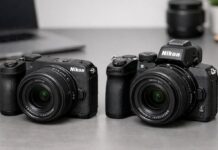

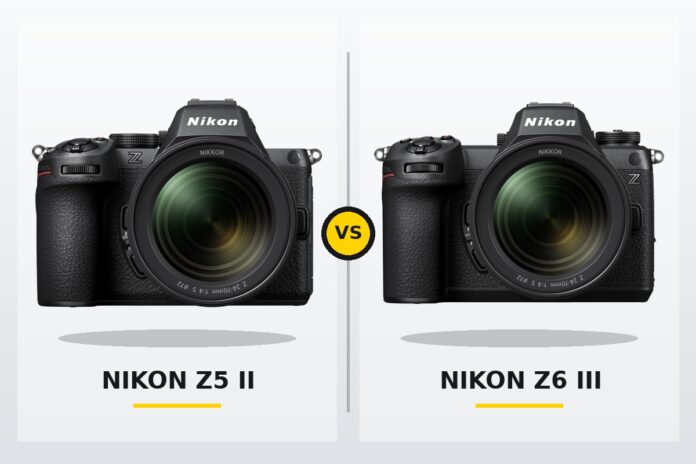
The Nikon Z5II vs Z6III decision comes down to one question: do you need faster sensor readout, or simply an excellent 24.5MP full-frame Nikon? For portraits, landscapes, travel, and general stills, I would buy the Z5II and put the savings into lenses. For action, silent-shutter work, and serious hybrid video, the Z6III is worth the premium.
These cameras are closer than Nikon’s pricing suggests. Both use EXPEED 7, recognize the same nine subject types, include in-body stabilization, and share a 3.2-inch vari-angle screen. The Z6III does not buy you more resolution. It buys speed, a better viewfinder, heavier video formats, and a card system able to sustain them.
The short answer: Z5II for value, Z6III for speed
Choose the Nikon Z5II if still photography comes first and your subjects are usually predictable. It gives up less than its lower position implies. Its autofocus system is modern, its stabilization is excellent, and its two UHS-II SD slots make backup simple and relatively affordable.
Choose the Nikon Z6III if you regularly photograph sport, wildlife, dance, or fast events. It is also the clear choice for video work that needs uncropped 4K/60p, 4K slow motion, internal 6K RAW, or ProRes. The partially stacked sensor is the important upgrade because it reads out much faster.
My buying threshold is practical. When the street-price gap is large, the Z5II is the better stills value. If a promotion brings the Z6III within roughly $400 to $500, its EVF, CFexpress slot, burst depth, and video headroom become much easier to justify.
Nikon Z5II vs Z6III key specifications
| Feature | Nikon Z5II | Nikon Z6III |
|---|---|---|
| Sensor | 24.5MP BSI CMOS | 24.5MP partially stacked CMOS |
| Processor / detection | EXPEED 7 / nine subject types | EXPEED 7 / nine subject types |
| Maximum RAW burst | Approx. 11 fps | 20 fps electronic; 14 fps mechanical |
| High-speed JPEG | 30 fps, full resolution | 60 fps full frame; 120 fps DX crop |
| Stabilization | 5-axis IBIS, up to 7.5 stops | 5-axis IBIS, up to 8 stops |
| Viewfinder | 3.69M dots; 3,000 nits; 60 fps | 5.76M dots; 4,000 nits; 120 fps |
| Card slots | Two UHS-II SD | CFexpress Type B/XQD + UHS-II SD |
| Video headline | Full-width 4K/30p; DX 4K/60p; 4K/30p N-RAW | 6K/60p RAW; full-width 4K/60p; DX 4K/120p |
| Weight, ready to shoot | Approx. 24.7 oz / 700 g | Approx. 26.8 oz / 760 g |
| US launch price, body only | $1,699.95 | $2,499.95 |
Nikon’s current Z5II specifications and Z6III specifications contain the full recording-mode qualifications. The burst headlines need particular care: the Z5II’s 30 fps mode records normal-quality JPEGs, while the Z6III’s 120 fps mode uses a DX crop.
Still-image quality: the Z5II gives up almost nothing
Both cameras produce 6,048 × 4,032-pixel files. At the same exposure with the same lens, there is no meaningful resolution advantage for the Z6III. Portrait, wedding, travel, and editorial photographers should expect broadly similar detail and high-ISO potential.
The sensor designs serve different priorities. The Z5II uses a conventional back-illuminated sensor. Independent measurements favor this slower design for low-ISO dynamic range and deep shadow recovery. The Z6III’s partially stacked sensor trades a little of that latitude for much faster readout. In most finished photographs, the difference is subtle. It matters most to photographers who routinely lift dark foregrounds in base-ISO landscape files.
Neither body replaces a high-resolution Z8 for aggressive cropping or very large prints. Both support pixel shift for static scenes, but the camera and subject must remain still, and Nikon’s NX Studio must merge the files. That is useful for copy work and controlled architecture, not moving leaves, water, people, or handheld travel shots.
Autofocus and action: similar detection, different ceiling
On a checklist, the autofocus systems look nearly identical. Both offer 273 points in single-point AF, 299 in auto-area AF, 3D tracking, and automatic recognition of people, dogs, cats, birds, cars, motorcycles, bicycles, trains, and airplanes. Both are rated to focus down to -10 EV under Nikon’s specified test conditions.
That does not make them equal action cameras. The Z6III feeds the autofocus system data from a faster-reading sensor. Its 120 fps EVF is also smoother when following erratic movement. Add 20 fps full-resolution RAW capture and a deep CFexpress-backed buffer, and it is easier to keep a bird, athlete, or dancer framed through a long sequence.
The Z5II reaches about 11 fps with RAW files. Its 14, 15, and 30 fps headlines depend on JPEG settings. That is plenty for children, pets, street work, and occasional wildlife. For a weekly sports assignment, however, the Z6III’s speed is not decorative. It directly improves timing and recovery between bursts.
Silent shooting and rolling shutter
The electronic shutter is where the sensor difference becomes visible. A conventional sensor takes longer to scan from top to bottom. Fast movement, quick pans, and some artificial lighting can therefore produce bent lines, stretched subjects, or banding. The Z5II has a silent mode, but I would reserve it for relatively calm subjects after checking the light.
The Z6III’s faster readout makes its electronic shutter more dependable for ceremonies, stage work, and action. It is still not a global shutter, so it can distort extreme movement. Even so, the risk is lower. This is one of the strongest stills-only reasons to pay more.
Mechanical-shutter photographers working with portraits, landscapes, flash, or ordinary events will see much less separation. In those situations, the Z5II’s lower cost has more value than the Z6III’s readout advantage.
Video and hybrid work: the Z6III wins clearly
The Z5II is not a token video camera. It records full-width 4K up to 30p, DX-cropped 4K up to 60p, Full HD up to 120p, 10-bit H.265, N-Log, and internal 12-bit N-RAW up to roughly 4K/30p. It also has microphone and headphone connections. That is enough for interviews, social video, travel films, and occasional hybrid event coverage.
The crop at 4K/60p is the buying trap. A 24mm lens frames like roughly 36mm, which can be awkward indoors. N-RAW also creates a demanding workflow even though it records to SD. Most Z5II owners will get faster results from 10-bit H.265 unless a project truly needs RAW.
The Z6III adds full-width 4K/60p, DX-cropped 4K/120p, Full HD/240p, and internal 6K/60p N-RAW or ProRes RAW HQ. It also offers ProRes 422 HQ and a full-size HDMI port. Those are not just bigger numbers. They provide more room for reframing, slow motion, color work, robust cabling, and mixed-format delivery.
For paid video, documentary work, or a single body that must switch between ceremony stills and motion, I would choose the Z6III. The faster scan also reduces skew during pans and subject movement.
The bodies are close in size, and both have a deep Nikon grip plus the same 2.1M-dot vari-angle rear screen. The Z6III weighs only about 2.1 ounces more when ready to shoot. Its top status display and more substantial controls are useful with gloves or under time pressure, but neither camera feels stripped down.
The viewfinder is a bigger distinction. The Z5II’s 3.69M-dot, 3,000-nit EVF is very good for its class. The Z6III’s 5.76M-dot, 4,000-nit finder refreshes at up to 120 fps. It is clearer in harsh sun and easier to follow during bursts. Action photographers will appreciate that every time they shoot.
Cards change the ownership cost. Two UHS-II SD slots make the Z5II easy to configure for backup with matching media. The Z6III combines one CFexpress Type B/XQD slot with one UHS-II SD slot. CFexpress is faster and required for the heaviest modes, but it costs more and may require a new reader. Backup speed can also fall to the slower SD card.
Both use the EN-EL15c battery and support USB power. Keep at least one spare for events or video. Spend the rest of the budget on the right Nikon Z lenses, because glass will affect your pictures more than either body’s small image-quality differences.
Which Nikon should you buy for your photography?
Portraits, landscapes, travel, and family photography
Buy the Z5II. Its files are just as detailed, its autofocus is much better than the original Z5’s, and dual SD cards suit straightforward backup. The money saved can move you from a kit zoom to a 24-120mm f/4 S, 50mm f/1.8 S, or 85mm f/1.8 S. That is the upgrade you will see in the photographs.
Weddings and events
For stills-led coverage, either works. I would take the Z5II for portraits, preparations, and calmer events. I would take the Z6III for dance floors, fast entrances, silent ceremonies, and frequent video clips. Working professionals should also consider whether mixed CFexpress/SD backup fits their existing card and ingest routine.
Wildlife and sports
Buy the Z6III unless choosing it would force you into an inadequate lens. Faster RAW bursts, smoother live view, better electronic-shutter behavior, and deeper buffering all matter here. A Z5II with a suitable telephoto still beats a Z6III with too little reach.
Video-first and serious hybrid work
Buy the Z6III. The Z5II is capable, but its cropped 4K/60p and slower readout are recurring limits. If cinema work is the main job, also read our Nikon ZR review before committing to a photographer-style body.
Alternatives and upgrade traps
The Nikon Zf is the interesting alternative for stills shooters. It combines a 24.5MP BSI sensor and EXPEED 7 autofocus with tactile controls. Its grip, single UHS-II slot, and styling make less sense with large lenses or high-pressure event work, but it is enjoyable for personal photography.
A discounted or used Z6II can be cheaper, yet its autofocus and viewfinder behavior belong to Nikon’s previous generation. Do not assume the higher model number makes it a better stills camera than the newer Z5II. Buy it only when the price is compelling and its older subject tracking suits your work.
The Z8 is the real step up for 45.7MP files, a fully stacked sensor, and professional action performance. It is also larger, more expensive, and harder on storage. If you do not need its resolution, the Z6III is the more balanced one-body hybrid.
A final trap is spending the whole budget on the body. Price two cards, a spare battery, a reader, and the lens you actually need. The Z5II package often wins once that complete kit reaches the cart.
Final verdict
For most stills photographers, the Nikon Z5II is the smarter buy. It matches the Z6III’s resolution, uses the same generation of autofocus processing, has excellent stabilization, and offers simpler dual-SD backup. It may even give base-ISO landscape shooters a little more shadow latitude.
The Nikon Z6III is worth paying for when speed changes the outcome. Its partially stacked sensor, 20 fps RAW capture, superior EVF, more usable electronic shutter, CFexpress support, and serious video formats create real working advantages. Those gains matter for wildlife, sport, stage work, weddings, and paid hybrid production.
My verdict is deliberately uneven: do not buy the Z6III because it is the higher model. Buy it because you can name the fast subject or video deliverable that needs its sensor. If you cannot, choose the Z5II and invest the difference in the lens.
Frequently asked questions
Is the Nikon Z6III better than the Z5II for image quality?
Not in normal resolution. Both produce 24.5MP files. The Z5II can retain more low-ISO shadow latitude, while the Z6III prioritizes faster readout. The Z6III is the better action camera, not automatically the better landscape camera.
Do both cameras have the same autofocus?
They share EXPEED 7, the same focus-point counts, 3D tracking, and recognition for nine subject types. The Z6III still has an action advantage because its sensor reads faster, its EVF refreshes faster, and it can sustain higher RAW burst rates.
Can the Nikon Z5II shoot professional video?
Yes, within limits. It has 10-bit H.265, N-Log, internal N-RAW, headphone monitoring, and 4K/60p. That 60p mode uses a DX crop, and its slower sensor shows more rolling shutter. The Z6III is safer for demanding paid video.
Are my Nikon Z lenses and EN-EL15c batteries compatible with both?
Yes. Both use the Nikon Z mount and the EN-EL15c battery. F-mount lenses can work through an FTZ or FTZ II adapter, with compatibility depending on the lens.