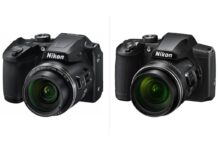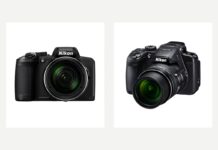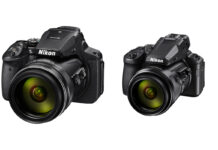

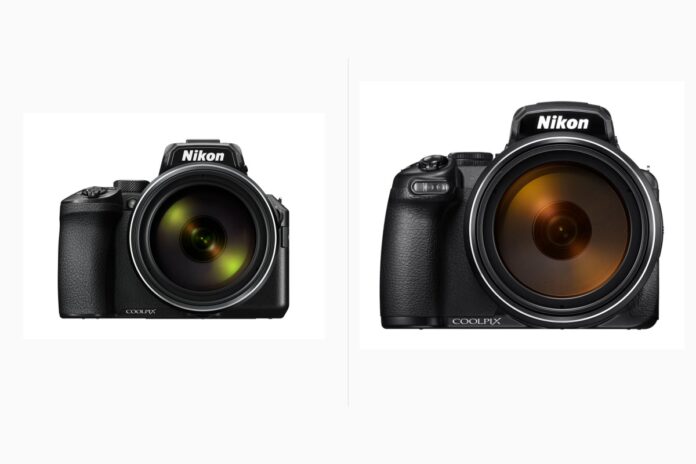
The Nikon P950 vs P1100 choice comes down to one honest question: do you need 3000mm-equivalent optical reach badly enough to carry a much larger camera? For most birders, travelers, and handheld shooters, I would buy the lighter P950 if it is available at a sensible price. Choose the P1100 for distant perched birds, aircraft, or moon photography when 2000mm routinely leaves the subject too small—and when a new-camera warranty, USB-C, and current support matter.
- Buy the P950 for long walks, handheld shooting, lower cost, and an already extreme 24–2000mm-equivalent zoom.
- Buy the P1100 for the unique 24–3000mm-equivalent optical range, USB-C, clean HDMI, and easier new-stock buying.
- Do not expect better basic image quality from the P1100. Both use a 16MP 1/2.3-inch CMOS sensor and contrast-detect autofocus.
One naming trap is worth clearing up immediately. The P1100 is the successor to the P1000, not a P950 Mark II. Nikon still separates these cameras into a relatively manageable 83x model and a far larger 125x specialist.
Nikon P950 vs P1100: key differences
| Feature | Nikon P950 | Nikon P1100 |
|---|---|---|
| Sensor | 16MP 1/2.3-inch CMOS | 16MP 1/2.3-inch CMOS |
| Optical zoom | 83x; 24–2000mm equivalent | 125x; 24–3000mm equivalent |
| Maximum aperture | f/2.8–6.5 | f/2.8–8 |
| Full-resolution burst | About 7 fps for up to 10 frames | About 7 fps for up to 7 frames |
| Viewfinder | 2.36M-dot OLED EVF | 2.36M-dot OLED EVF |
| Rear screen | 3.2-inch, 921k-dot vari-angle | 3.2-inch, 921k-dot vari-angle |
| Video | 4K UHD up to 30p | 4K UHD up to 30p; clean HDMI up to Full HD |
| Battery | EN-EL20a; about 290 shots | EN-EL20a; about 260 shots |
| USB | Micro-USB | USB-C |
| Dimensions | 5.6 × 4.4 × 5.9 inches | 5.8 × 4.7 × 7.2 inches |
| Weight | 35.5 oz / 1005g | 49.7 oz / 1410g |
The headline specifications come directly from Nikon’s current US pages for the Coolpix P950 and Coolpix P1100. The P1100 is 14.2 ounces heavier, yet the sensor resolution, EVF, rear display, battery type, and headline video modes stay closely matched.
Nikon rates the P950’s stabilization at 5.5 stops and the P1100’s at 4.0 stops. Do not treat that as a simple 1.5-stop loss. Nikon cites different CIPA test standards and focal lengths for the two figures, so they are not a clean apples-to-apples comparison.
Reach and image quality: what the extra 1000mm buys
At the same shooting position, 3000mm makes a subject about 1.5 times larger across the frame than 2000mm. That is meaningful for a distant owl, a small aircraft, or lunar detail. It can reduce the need for a heavy crop from a 16MP file.
The catch is that reach does not create detail on its own. At 3000mm, heat shimmer, haze, vibration, missed focus, and subject movement all become more visible. The P1100 also reaches f/8 at its long end. You need strong light or a slower shutter speed, and neither option helps a moving bird at dusk.
The P1100 has no published sensor-resolution or autofocus-system advantage over the P950. Both cameras therefore start with similar small-sensor limits. Expect their best files in good light at modest ISO settings. RAW capture helps with white balance and careful tonal adjustments, but it cannot recreate feather detail erased by noise reduction or atmosphere.
Ignore the digital-zoom numbers
Nikon advertises Dynamic Fine Zoom beyond each camera’s optical limit, and both offer still more conventional digital zoom. Those modes enlarge or crop sensor data; they do not add optical resolving power. I would compare these cameras at 2000mm and 3000mm optical, then crop the better RAW file myself. Retail listings that lead with 4000mm, 6000mm, 8000mm, or 12,000mm figures are selling magnification, not extra captured information.
Birding and wildlife: P950 for mobility, P1100 for reach
The P950 is the more balanced walking camera. A 1005g body is not light in absolute terms, but it is much easier to carry and raise repeatedly than the 1410g P1100. That 405g difference is roughly the weight of a small prime lens. It matters after an hour on a trail and when you are trying to reacquire a bird that has moved between branches.
The P1100 makes more sense from a hide, overlook, shoreline, or other mostly fixed position. Its extra reach can fill the frame while keeping a respectful distance from wildlife. I would budget for a solid monopod or tripod head, especially for long observation sessions. The camera is handholdable, but “possible” and “repeatably sharp” are different standards at 3000mm.
Neither camera has modern bird-eye detection or phase-detect autofocus. Both rely on contrast-detect AF, and both have dedicated Bird-Watching modes. That is useful for setup, but it does not turn either body into a fast mirrorless wildlife camera. Perched birds and predictable movement are the natural fit. Erratic birds in flight will expose the short bursts and limited tracking much faster.
If you want a deeper account of each body, read our Nikon P950 review and Nikon P1100 review.
Handling, battery, and field workflow
Both cameras provide a deep grip, a 2.36M-dot electronic viewfinder, a vari-angle screen, RAW capture, a hot shoe, and a 3.5mm microphone input. Each also has a snap-back zoom control. Press it when you lose a subject at long focal lengths, find the subject in the wider view, then release it to return to your previous framing.
The P950 has the better battery rating: about 290 shots versus 260 for the P1100 under CIPA testing. Heavy EVF use, zooming, wireless transfers, cold weather, and video can reduce real endurance. The cameras share the EN-EL20a, which is convenient if you already own one, but a spare is sensible for a full wildlife day.
The P1100’s USB-C port is a welcome workflow update. The P950 charges through Micro-USB and Nikon specifies its UC-E21 cable. Do not assume every random cable or power bank will behave as expected with either camera. Test the complete charging kit before traveling, and keep a charged spare battery when a missed morning cannot be repeated.
Neither body is advertised as weather-sealed. I would carry a simple rain cover and avoid zooming the lens in blowing grit. The extending barrel moves a lot of air, and this is not a camera pair I would treat casually on a dusty roadside or in salt spray.
Video and connectivity: fewer differences than expected
Both cameras record 4K UHD at 30p or 25p and Full HD at up to 60p. Both have stereo microphones, an external microphone input, Micro HDMI, Wi-Fi, Bluetooth, and SnapBridge. The shared sensor and recording formats mean the P1100 is not a general video-quality upgrade.
The P1100 does add clean HDMI output for an external recorder or monitor. Nikon’s manual is explicit that this clean feed cannot output 4K UHD; it is a Full HD workflow feature. That can still help with observation, streaming, or external recording, but it should not be mistaken for a new 4K production path.
For wildlife video, support and focus technique matter more than the model year. Tiny movements become violent at extreme focal lengths. A fluid head, sheltered microphone, and pre-focused static composition will usually improve the result more than extending from 2000mm to 3000mm.
Price, availability, and buying traps
The P950 launched in the US at $799.95, while the P1100 launched at $1,099.95. Those are historical list prices, not promises about today’s street price. P950 new stock has become inconsistent, so compare the actual seller, warranty, return window, and included accessories. A P950 is the value choice only when it is meaningfully cheaper.
Watch for gray-market P950 listings and padded bundles. A pile of low-grade filters, a questionable memory card, and a generic tripod does not turn an international body into a good US purchase. Confirm the exact model, warranty coverage, battery, lens cap, hood, strap, and charging accessories before ordering. On a used camera, test the entire zoom travel, EVF eye sensor, rear-screen hinge, ports, focus-mode selector, and tripod socket.
If the P950 costs close to a new P1100, I would buy the P1100 unless its size is a deal-breaker. If you already own a P950, upgrading makes sense only when you can name subjects that 2000mm cannot frame. The P1100 will not give you a larger sensor, faster core autofocus, or a dramatic image-quality jump.
Alternatives worth considering
A used P1000 is the closest route to 3000mm at a lower price. It shares the P1100’s core 125x lens concept but lacks USB-C and the newer model’s smaller usability updates. Our P1000 vs P1100 comparison explains when the used body is still rational.
If 2000mm already sounds excessive, the smaller bridge-camera class may be a better fit. Panasonic’s FZ80D covers a 20–1200mm-equivalent range in a much lighter body. A used Canon SX70 HS is another portable option with 21–1365mm-equivalent reach. Both give up substantial telephoto framing, but they are easier travel companions.
An APS-C mirrorless body with a serious telephoto zoom costs more and will not match 3000mm framing. It can, however, deliver much stronger autofocus, cleaner high-ISO files, and a better upgrade path. That is the right alternative for fast birds, dim woodland, or larger prints. See our Nikon Coolpix guide if you want to place all three Nikon superzoom bodies in context.
Verdict: which Nikon superzoom should you buy?
The Nikon P950 is my recommendation for most photographers choosing between these two. Its 24–2000mm-equivalent lens is already extraordinary, and the lighter body is easier to carry, aim, and use for a full day. Buy it when the price is clearly below the P1100 and the seller offers a trustworthy US-market product.
Buy the Nikon P1100 when maximum optical reach is the assignment. It is the better tool for small, distant, mostly static subjects when you can support the camera and work in good light. USB-C, clean HDMI, and current new-stock support strengthen the case, but the extra 1000mm remains the real reason to pay more.
Existing P950 owners should usually stay put. Upgrade only if repeated 2000mm files still need heavy crops and your atmosphere, light, and technique are good enough to use 3000mm. Otherwise, spend the difference on field time, support, and access to better locations.
Frequently asked questions
Does the Nikon P1100 have better image quality than the P950?
Not in any broad, documented sense. Both have a 16MP 1/2.3-inch CMOS sensor and similar core recording specifications. The P1100 can put more pixels on a distant subject through its longer optical lens, but it does not provide a larger sensor or higher resolution.
Is the P1100 worth the extra weight for bird photography?
Yes for distant perched birds or fixed-position observation where 3000mm changes the framing. For long walks, quick reactions, and birds in flight, the P950’s 14.2-ounce weight advantage is usually more valuable.
Is the P950 or P1100 better for moon photography?
The P1100 is better for the largest optical image of the moon because it reaches 3000mm equivalent. The P950 still gives excellent 2000mm framing and is easier to carry. Stable support, careful focus, and clear air matter with both.
Should I buy a used P1000 instead?
A good used P1000 can be sensible when you want 3000mm reach and it costs substantially less than the P1100. Check condition and returns carefully. If prices are close, the P1100’s USB-C connection, clean HDMI, and new warranty make it safer.