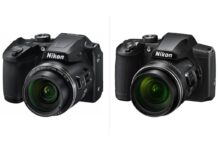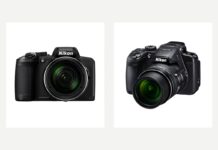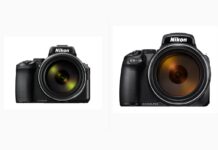

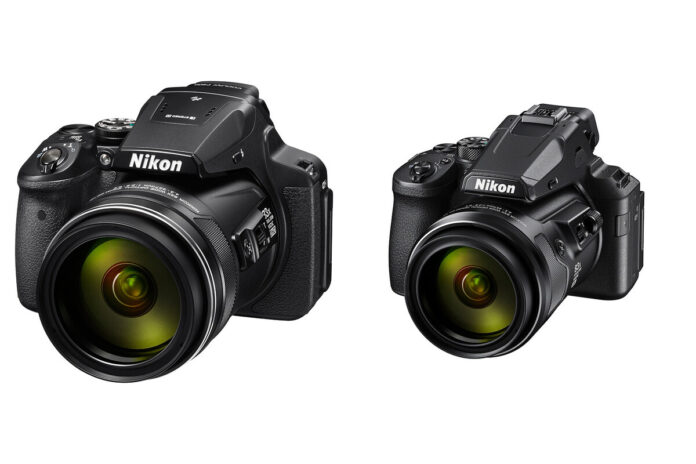
The Nikon P900 vs P950 decision is simpler than the model numbers suggest: buy the P950 if you want the better camera, and buy the P900 only if a clean used copy costs substantially less. They use the same 16MP sensor class and the same 24–2000mm-equivalent lens, so the P950 does not give you more optical reach. Its case rests on RAW files, a far better viewfinder, 4K video, improved controls, and a deeper burst. The P900 is lighter, lasts longer per charge, and has built-in GPS.
- Buy the P950 for birding, editing, video, manual focus, or any serious attempt to work at 2000mm.
- Buy the P900 when budget comes first, JPEG is enough, and its zoom mechanism and electronics pass a careful used-camera inspection.
- Skip both if you mainly photograph fast action, dim interiors, or subjects that rarely require extreme reach.
Nikon P900 vs P950: key differences
| Feature | Nikon Coolpix P900 | Nikon Coolpix P950 |
|---|---|---|
| Sensor | 16MP 1/2.3-inch BSI CMOS | 16MP 1/2.3-inch BSI CMOS |
| Lens | 83x; 24–2000mm equivalent, f/2.8–6.5 | 83x; 24–2000mm equivalent, f/2.8–6.5 |
| Still files | JPEG | JPEG and NRW RAW |
| Full-resolution burst | About 7 fps for 7 frames | About 7 fps for 10 frames |
| Viewfinder | 0.2-inch, 921k-dot EVF | 0.39-inch, 2.36M-dot OLED EVF |
| Rear screen | 3-inch, 921k-dot vari-angle | 3.2-inch, 921k-dot vari-angle |
| Video | Full HD up to 60p | 4K UHD up to 30p; Full HD up to 60p |
| Audio and accessories | Built-in stereo mic; no accessory shoe | External mic input and accessory shoe |
| Location and wireless | Built-in GPS; Wi-Fi and NFC | Phone-based location data; Wi-Fi and Bluetooth |
| Battery | EN-EL23; about 360 shots | EN-EL20a; about 290 shots |
| Weight | 31.8 oz / 899g | 35.5 oz / 1005g |
Nikon’s official P900 specifications and P950 specifications make the family relationship clear. The P950 is a functional update to the P900, not a longer-lens replacement.
Image quality: expect similar photographs, not a generational leap
Both cameras pair a 16MP 1/2.3-inch backside-illuminated CMOS sensor with a fixed 4.3–357mm lens. That physical focal range produces the angle of view of 24–2000mm on full frame. It does not provide the light-gathering ability or shallow depth of field of a full-frame 2000mm lens. At the long end, the maximum aperture is f/6.5, so either camera needs good light.
This is the most important corrective to a spec-sheet comparison: the P950 should not produce dramatically sharper JPEGs simply because it is newer. In daylight, both can make satisfying photos of perched birds, aircraft, ships, the moon, and distant landscape details. In shade or at dusk, the small sensor quickly shows noise and smudged fine detail. Neither is a persuasive choice for heavy cropping or large exhibition prints.
The P950’s NRW RAW option is still a meaningful advantage. It gives you more control over white balance, highlight recovery, and noise reduction than the P900’s JPEG-only workflow. RAW cannot rescue blur, heat shimmer, or missed focus, and Nikon disables it in Bird-watching, Moon, Creative, and other scene modes. Photographers who want RAW should work in P, S, A, M, or U and budget time for editing.
If you are considering the older model, our Nikon P900 review covers its JPEG performance and handling in more detail. The Nikon P950 review explains why reach, rather than absolute file quality, remains the P950’s reason to exist.
Viewfinder, controls, and autofocus in the field
The P950’s viewfinder is the upgrade I would notice on every outing. Its 2.36M-dot OLED panel is much larger and more detailed than the P900’s 921k-dot EVF. At 2000mm equivalent, a clearer view helps you find a small subject, assess focus, and hold the camera against your face. The P900’s viewfinder is usable, but it feels like an emergency framing aid beside the P950’s.
The P950 also adds a side dial, a dedicated AF/MF selector, an AE-L/AF-L button, and better manual-focus operation. Those controls matter when autofocus grabs branches behind a bird or the moon sits in a featureless sky. The accessory shoe accepts compatible flashes and Nikon’s DF-M1 dot sight, which can make reacquiring a bird or aircraft easier at extreme zoom.
Both cameras use contrast-detect autofocus, so neither should be mistaken for a modern mirrorless action body. Nikon improved the P950’s telephoto AF behavior and expanded its high-speed buffer from roughly seven to ten full-resolution frames. That helps with short, predictable action. It does not turn either model into a reliable birds-in-flight camera against cluttered backgrounds.
My practical rule is to zoom out, acquire the subject, then zoom in while tracking. At full telephoto, shoot short bursts and let the buffer clear. A monopod helps with waiting, but a loose head can be harder to aim than careful handheld technique. Atmospheric haze and heat shimmer often limit detail before the lens does.
Portability, battery life, and location data
The P950 is the more capable body, but the P900 is easier to carry. Nikon lists the P900 at 899g with battery and card, versus 1005g for the P950. A 106g difference is modest in a bag and noticeable after an hour at eye level. Neither is pocketable, and neither carries a formal weather-sealing claim, so add a rain cover rather than treating either as an all-weather wildlife camera.
The older P900 also wins the CIPA battery comparison: about 360 shots from an EN-EL23 versus 290 from the P950’s EN-EL20a. These batteries are not interchangeable. Used buyers should confirm the correct Nikon battery and charging accessories are included; a bundle of unknown third-party cells is not equivalent value.
Travel photographers may prefer the P900’s built-in GPS/GLONASS. The P950 drops the internal receiver and can obtain location information through a paired phone and SnapBridge. That saves an internal radio but adds phone battery use and another connection to manage. If automatic geotagging matters, decide which compromise you would rather carry.
Video and editing workflow: the P950 wins decisively
The P900 records Full HD at up to 60p with its built-in stereo microphones. That remains adequate for occasional clips, but it offers no external microphone input. Lens movement and handling noise can therefore become part of the recording, especially in a quiet scene.
The P950 records 4K UHD at up to 30p, retains Full HD up to 60p, and adds Movie manual mode, selectable zoom speeds, a microphone connector, and clean HDMI output. The accessory shoe gives a compact microphone somewhere sensible to sit. These are real workflow gains for wildlife behavior, aircraft, or distant stage work.
Extreme-telephoto video still demands support. Optical stabilization cannot make a wandering 2000mm composition look intentional, and autofocus can pulse when contrast is weak. Start wider, settle the frame, and zoom slowly. If video matters enough to grade, monitor sound separately and test how the P950’s MP4 files behave in your editor before an important trip.
Used buying traps and current value
The P900 is a used-camera purchase in the US. P950 availability is uneven as Nikon’s newer P1100 takes over the current superzoom conversation. That makes condition and total cost more useful than an arbitrary price cutoff. A P900 is attractive only when it is meaningfully cheaper than a sound P950. Collectible-compact enthusiasm is not a good reason to pay P950 money for the older camera.
Test the zoom through its full range several times. It should extend smoothly without grinding, hesitation, or a lens error. Check the EVF eye sensor, rear-screen hinge, flash, card slot, USB and HDMI ports, stabilization, and every button. Photograph a detailed target at wide, middle, and full telephoto settings, then inspect the files on a computer. A return window is worth more than a bag full of generic accessories.
Also check the tripod socket and lens barrel for impact damage. Dust on an external lens surface is easy to clean; internal haze, fungus, or a decentered lens is not. Confirm that the battery holds charge and price a genuine replacement before agreeing to the sale.
Who should buy the P900, the P950, or neither?
Buy the Nikon P900 if
- You found a well-kept copy at a genuinely low used price.
- You mainly want share-ready JPEGs in good light.
- Lower weight, longer rated battery life, and built-in GPS matter more than RAW or 4K.
Buy the Nikon P950 if
- You edit stills and want NRW RAW files.
- You will use the improved EVF and direct focus controls for birds, aircraft, or the moon.
- You need 4K, a microphone input, an accessory shoe, or a slightly longer high-speed burst.
Skip both if
- Your priority is fast, erratic action rather than static or predictable distant subjects.
- You regularly shoot in low light or need substantial shadow recovery.
- You rarely go beyond 600mm equivalent and would benefit more from a larger sensor.
Alternatives worth considering
If you need more optical reach, the P1000 and current P1100 extend to 3000mm equivalent, but they are much larger at roughly 1.4kg. Our Nikon P950 vs P1100 comparison explains why 2000mm is the more manageable limit for most handheld photographers.
If image quality matters more than maximum reach, consider a used one-inch bridge camera such as the Sony RX10 IV or Panasonic FZ1000 II. Their lenses stop much shorter, but the larger sensor is more forgiving in weak light. A mirrorless body with a telephoto zoom improves autofocus and gives you an upgrade path, though matching even half the Coolpix reach becomes expensive and heavy.
The Nikon Coolpix buying guide places the P900, P950, P1000, and P1100 in context. Do not pay for 2000mm just because it looks spectacular in a listing. Pay for it when your subjects actually require it.
Final verdict
For a first-time buyer, the P950 is the clear winner. It preserves the P900’s defining lens while fixing several of the older camera’s most consequential limitations. RAW capture, the substantially better EVF, direct focus controls, 4K, external audio, and the larger buffer all change real shooting or post-production.
The P900 remains defensible as a bargain. Its lighter body, longer rated battery life, and built-in GPS are genuine advantages, not nostalgia. But the price gap must be large enough to compensate for JPEG-only stills, the small EVF, weaker controls, and the risks of an older zoom mechanism.
My buying line is straightforward: if the two cameras are close in price and condition, buy the P950 without hesitation. Choose the P900 only when the savings are substantial and you have tested the exact copy. If you already own a healthy P900 and shoot JPEG stills, keep it; the P950 is a workflow upgrade, not an image-quality revolution.
Frequently asked questions
Does the Nikon P950 have more zoom than the P900?
No. Both use an 83x lens with a 24–2000mm-equivalent optical range and an f/2.8–6.5 maximum aperture.
Does the Nikon P900 shoot RAW?
No. The P900 records JPEG stills. The P950 adds Nikon NRW RAW, although RAW is unavailable in its scene modes.
Is the P950 worth upgrading to from a P900?
Yes for RAW editing, 4K video, external audio, or the improved viewfinder and controls. No if you mainly make daylight JPEGs and your P900 works reliably.
Which camera is better for bird photography?
The P950 is easier to recommend because its larger EVF, focus controls, RAW files, and deeper burst improve the keeper-making process. Neither is ideal for fast birds in flight.