
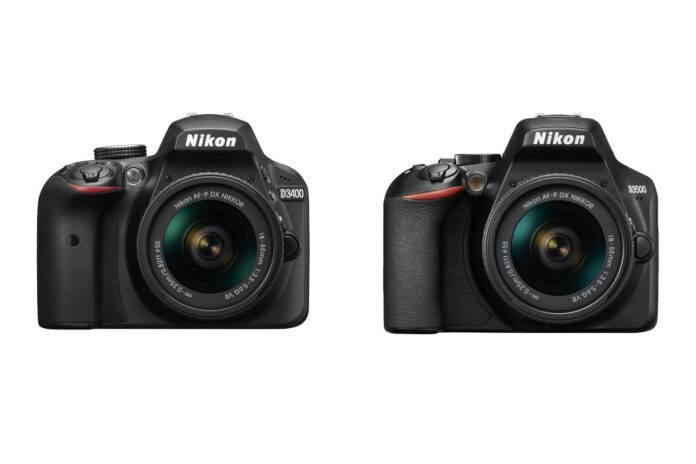
The Nikon D3400 vs D3500 decision is mostly about price and handling, not image quality. Buy the D3500 when equally clean kits cost about the same: its deeper grip, tidier controls, lighter body, and longer battery life make it nicer to use. Buy the D3400 when it is meaningfully cheaper. Both deliver essentially the same 24.2MP files, autofocus, burst speed, and Full HD video.
Neither camera is a sensible new purchase in 2026. Both are discontinued, so condition, lens version, battery health, and return rights matter more than the model-year gap. I would not upgrade from a working D3400 to a D3500. The differences are refinements, not a new level of capability.
Nikon D3400 vs D3500: the short answer
The D3500 is the better first DSLR if the price gap is small. Nikon reshaped the grip and moved the rear controls to the right of the screen. That makes one-handed menu and playback operation easier. Its CIPA battery rating also rises from 1,200 to 1,550 shots.
The D3400 is the value choice. It uses the same battery, lens mount, viewfinder AF system, image processor, effective resolution, and maximum video format. A clean D3400 with the stabilized 18-55mm kit lens is a better buy than a tired D3500 with a non-VR lens or questionable battery.
| Feature | Nikon D3400 | Nikon D3500 |
|---|---|---|
| Announced | August 2016 | August 2018 |
| Sensor | 24.2MP Nikon DX CMOS | 24.2MP Nikon DX CMOS |
| Image size | 6000 × 4000 pixels | 6000 × 4000 pixels |
| ISO range | 100–25,600 | 100–25,600 |
| Viewfinder AF | 11-point phase detect | 11-point phase detect |
| Maximum burst | 5 fps | 5 fps |
| Video | Full HD 1080/60p | Full HD 1080/60p |
| Screen | Fixed 3-inch, 921k-dot | Fixed 3-inch, 921k-dot |
| Battery rating | Approx. 1,200 shots | Approx. 1,550 shots |
| Body-only weight | 395 g | 365 g |
| Wireless | Bluetooth transfer | Bluetooth transfer and remote shutter |
Nikon’s official D3400 reference manual and D3500 specifications confirm how much of the shooting hardware is shared. The D3500 is a redesign around the same entry-level formula.
Image quality and autofocus are effectively a tie
Nikon described the D3500 sensor as updated, and its total pixel count differs slightly. That does not create extra usable resolution: both cameras record 24.2MP files at 6000 × 4000 pixels. With the same lens, exposure, and processing, I would not choose between them for detail or low-light quality.
The sensor remains the strongest reason to consider either body. It gives a beginner enough resolution for substantial prints and useful cropping. RAW files also leave room to correct white balance and recover moderate shadow detail. A sharper lens or better light will change the result more than moving from the D3400 to the D3500.
Autofocus is also unchanged. Both use an 11-point phase-detect system through the optical viewfinder and slower contrast-detect AF in live view. They are comfortable with landscapes, portraits, travel, products, and family photographs. Erratic pets, field sports, birds, and children running toward the camera expose their narrow AF coverage and limited tracking.
The same applies to the 5 fps burst. It can catch a short expression or predictable movement, but neither camera is an action specialist. If missed focus is your recurring problem, the D3500 does not solve it.
Handling and battery life are the D3500’s real wins
The D3500’s deeper grip is the most meaningful upgrade. Its body is also 30 g lighter without a battery or card, although the lens will determine most of the kit’s carrying weight. Buttons that sat to the left of the D3400 screen move to the right on the D3500, and the live-view button becomes a lever.
I prefer the D3500 layout for walking around with the camera in one hand. The D3400 is not uncomfortable, but its split rear controls encourage more two-handed operation. Hand size can reverse that preference, so hold both if you can.
Battery life is a clearer advantage. Both cameras use the EN-EL14a battery and MH-24 charger, but Nikon rates the D3500 for about 1,550 shots against 1,200 for the D3400. Used batteries may fall well short of either figure. The shared battery is useful because a genuine spare works in both bodies.
The optical viewfinder, fixed non-touch screen, single command dial, 1/4,000-second top shutter, and single SD-card slot are otherwise much the same. Neither body has weather sealing or in-body stabilization.
Video and SnapBridge show their age
Both cameras record Full HD up to 60p. Neither offers 4K, a microphone input, a headphone jack, a tilting screen, or dependable modern video autofocus. They are fine for occasional clips with controlled focus. For vlogging, interviews, or regular hybrid work, skip both.
SnapBridge uses Bluetooth rather than Wi-Fi on these bodies. Automatic 2MP JPEG transfer can be convenient for casual sharing, but an SD-card reader is usually faster for a full shoot. The D3500 adds remote still-photo triggering through the app; the D3400 does not.
That remote feature is modest. Nikon’s current SnapBridge compatibility chart lists Bluetooth remote still shooting for the D3500, without a live-view feed or remote video. Set the exposure and focus behavior on the camera before triggering it.
Lens compatibility and used-kit traps
Both bodies use Nikon F mount but lack an internal autofocus motor. Nikon AF-P lenses and compatible AF-S lenses with built-in motors are the safe choices for autofocus. Older screw-drive AF and AF-D lenses may mount, but they will not autofocus. Some non-CPU lenses also lose metering, so check the exact lens rather than trusting “Nikon fit” in a listing.
The AF-P DX 18-55mm f/3.5-5.6G VR is the kit lens I would seek. It is light, reasonably sharp, and stabilized. The nearly identical non-VR version saves little weight and removes useful protection against camera shake. Since neither body has sensor stabilization, those two letters matter.
Two-lens kits require another check. Nikon sold US bundles with a stabilized 18-55mm and an AF-P DX 70-300mm f/4.5-6.3G ED that did not include VR. Sellers often describe the bundle without spelling that out. For handheld telephoto work, I would pay more for the AF-P 70-300mm VR version.
Do not assign much value to generic filters, tiny tripods, or unknown batteries in oversized marketplace bundles. A clean body, Nikon charger, healthy EN-EL14a, reliable SD card, and one useful VR lens are the better package. Our individual D3400 review and D3500 review cover each used body in more depth.
Which camera fits your photography?
Choose the Nikon D3400 if
- It is clearly cheaper in comparable condition.
- The kit includes the 18-55mm VR lens, Nikon battery, and charger.
- You mainly shoot deliberate stills through the optical viewfinder.
- You do not need phone-based remote shutter release.
Choose the Nikon D3500 if
- The two kits cost about the same.
- You prefer its deeper grip and right-side control layout.
- You value the longer battery rating for travel or classes.
- Bluetooth remote still shooting is useful for group photos or tripod work.
Skip both if
- You expect eye detection or broad subject-tracking autofocus.
- You compose mainly on the rear screen rather than through a viewfinder.
- You need 4K, a microphone input, or a screen that faces forward.
- You are paying enough to reach a stronger DSLR or used mirrorless kit.
Alternatives worth checking before you buy
A used Nikon D5600 is the natural step up. It keeps the F-mount system while adding a 39-point autofocus module, an articulating touchscreen, and a microphone input. If its price is close, I would choose it over either entry-level body. See our Nikon D5600 review for the tradeoffs.
A used Nikon D7500 makes more sense for sports, wildlife, and photographers who want direct controls. It is heavier and more expensive, but its autofocus, burst depth, and handling offer room to grow.
Buyers without F-mount lenses should also compare current or used mirrorless options. They usually provide easier live-view shooting, subject detection, and stronger video, though battery life is shorter and the total lens cost can be higher. Our beginner camera guide covers the broader choice.
Final verdict
The Nikon D3500 wins this comparison, but only narrowly. Its grip, control placement, lower weight, and longer battery rating improve the experience every time you carry or operate it. When two equally healthy kits cost the same, choose the D3500.
The Nikon D3400 is not meaningfully behind in the photographs it can make. Choose it when the savings buy a better lens, a class, or simply more time shooting. I would take a clean D3400 with the 18-55mm VR over a compromised D3500 bundle without hesitation.
For an existing D3400 owner, the verdict is simpler: do not upgrade to the D3500. Move to a D5600, D7500, or mirrorless body only when you can name the limitation you need to fix.
Frequently asked questions
Does the Nikon D3500 take better photos than the D3400?
Not by a meaningful amount. Both produce 24.2MP files at 6000 × 4000 pixels and share the same ISO range and EXPEED 4 processor. Lens choice, focus, light, and exposure matter more.
Do the D3400 and D3500 use the same battery and lenses?
Yes. Both use the EN-EL14a battery and Nikon F-mount lenses. For autofocus, favor compatible AF-P or AF-S lenses with built-in focus motors. Neither body autofocuses older screw-drive AF-D lenses.
Is the D3500 worth upgrading to from the D3400?
No. The D3500 improves ergonomics, weight, battery endurance, and remote triggering, but it does not improve effective resolution, autofocus, burst speed, or maximum video quality.
Which is better for a beginner?
The D3500 is slightly friendlier to hold and operate. The D3400 teaches the same photographic fundamentals and produces comparable files, so it is the smarter choice when a clean kit costs less.