
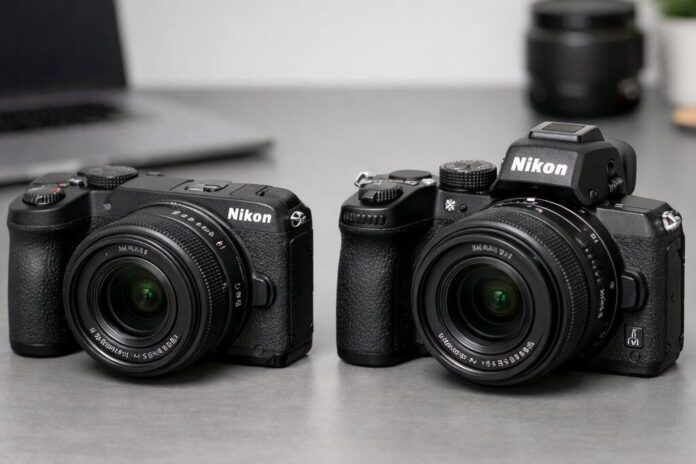
The Nikon Z30 vs Z50 II choice is simple once you separate image quality from shooting experience: buy the Z50 II for photography or serious hybrid work, and buy the Z30 when compact size, lower kit cost, and uncomplicated self-recording matter more than a viewfinder and Nikon’s newer autofocus. Both make 20.9MP DX files. The extra money buys a much more capable body, not more resolution.
Nikon Z30 vs Z50 II: the short answer
For most readers, I recommend the Z50 II. Its electronic viewfinder alone makes bright-day photography easier. The EXPEED 7 processor also brings better subject recognition, 3D Tracking, pre-release capture, and a far stronger video toolset. It is the camera you are less likely to outgrow.
The Z30 still has a clear job. It is 145g (5.1 ounces) lighter with battery and card, has a fully articulated screen, and gives you clean 4K/30p recording without paying for features you may not use. It makes sense on a small grip, on a desk, or in a bag where every ounce counts.
- Choose the Z30: video-first beginners, streaming, travel vlogs, and the smallest Nikon DX kit.
- Choose the Z50 II: stills, wildlife, sports, family photography, and hybrid creators who want room to grow.
- Image-quality tie: both use 20.9MP, 23.5 × 15.7mm DX CMOS sensors and the Nikon Z mount.
Our separate Nikon Z30 review and Nikon Z50 II review go deeper on each body.
Image quality, autofocus, and action
Do not upgrade from the Z30 to the Z50 II expecting noticeably larger files or more cropping room. Both top out at 5,568 × 3,712 pixels. With the same lens and careful exposure, their RAW files should be much closer than the price gap suggests. The Z50 II’s newer processing can change JPEG rendering and noise reduction, but resolution is not its advantage.
The autofocus gap is the real upgrade
The Z30’s 209-point hybrid system recognizes people and animals. It is adequate for a presenter, a portrait, or predictable movement. The Z50 II adds EXPEED 7, 3D Tracking, and automatic detection for nine subject types. Nikon includes dedicated bird and airplane modes as well.
That difference matters when a subject changes direction or crosses a busy background. The Z50 II lets you spend less attention managing AF-area modes. It is the safer choice for children, pets, wildlife, and casual sports. The Z30 can shoot at 11 fps, but a fast burst is only useful when focus stays on the intended subject.
The Z50 II also shoots full-resolution RAW at 11 fps. Its 15 and 30 fps modes are JPEG-only electronic-shutter modes, with possible rolling-shutter distortion. Pre-release capture can save frames from just before you fully press the shutter. That is genuinely useful for birds taking off and other reactions you cannot time perfectly.
Viewfinder, screen, and handling
The physical difference is not subtle. The Z30 has no viewfinder and weighs about 405g ready to shoot. Its 3.0-inch, 1.04-million-dot screen swings to the side and faces forward. The Z50 II weighs about 550g with battery and card. It adds a 2.36-million-dot OLED viewfinder, a built-in flash, and a larger 3.2-inch vari-angle screen.
For landscapes, street work, or a child’s game in hard sunlight, I would take the Z50 II. An EVF blocks glare, adds a third point of contact, and makes a long lens easier to hold steadily. The deeper, taller body also suits photography controls better. The Z30 feels more natural when the camera points back at you.
Both screens articulate for low angles, vertical video, and self-recording. A side-hinged screen can conflict with an HDMI or microphone cable, though, so rig builders should test the exact cable direction.
When I assess a small camera, I mount the lens before judging the body. The 16-50mm kit zoom keeps either setup compact. A 50-250mm or full-frame Z telephoto makes the Z50 II’s viewfinder and larger grip more valuable. Body-only comparisons hide that balance.
Video and vlogging workflow
The Z30 records 4K at 24, 25, or 30p and Full HD up to 120p. It uses 8-bit H.264, includes a tally lamp, accepts a 3.5mm microphone, and can run from USB-C power. For talking-head clips, classes, and straightforward YouTube work, that is enough. Nikon allows individual recordings up to 125 minutes, although heat, power, and card capacity can end a take sooner.
The Z50 II is the more serious video camera. It adds 4K/60p, internal H.265 10-bit recording, N-Log, HLG, waveform display, Product Review mode, a video self-timer, and a headphone/remote port. Those features improve monitoring and give colorists much more latitude.
There are two catches. First, 4K/60p applies an additional 1.5× crop. A 16mm lens then frames like roughly 36mm on full frame, which is tight for arm’s-length vlogging. Second, electronic VR is unavailable at 4K/60p. Neither body has in-body image stabilization, so a VR lens, tripod, gimbal, or careful technique still matters.
For a solo creator who publishes in 4K/30p and does little color grading, the Z30 remains the efficient purchase. For interviews, monitored audio, slow motion, product work, or a 10-bit post-production workflow, pay for the Z50 II. Nikon’s full Z50 II specifications detail the recording modes and their conditions.
The Z30 ships with an EN-EL25 battery. Nikon rates it for about 330 shots, or about 360 with the newer EN-EL25a after firmware 1.10. The Z50 II ships with the EN-EL25a and accepts the older EN-EL25, but Nikon warns that endurance drops. Its CIPA rating is only 220–250 shots depending on display and energy-saving settings. A spare battery is not optional for a long Z50 II day.
Both cameras have one SD slot, so neither provides an in-camera backup. The Z30 supports UHS-I cards. The Z50 II supports UHS-II, which is the better fit for 10-bit, high-bit-rate video and quicker buffer clearing. A UHS-II card will work in the Z30, but the camera cannot use its faster bus.
Lens compatibility is otherwise equal. Both accept Z-mount DX and FX lenses. Nikon F lenses can be adapted with an FTZ adapter, subject to lens-specific restrictions. Neither body adds stabilization to an unstabilized lens.
Compare matched kits, not a Z30 kit against a Z50 II body. The compact 16-50mm VR is the sensible starting lens for either camera. Avoid retailer bundles padded with generic batteries, filters, and tiny tripods. A Nikon kit, a reputable SD card, and one good spare battery are usually the better use of the budget.
Who should buy each camera?
Buy the Nikon Z30 if…
- You mainly record yourself at 4K/30p.
- You want Nikon’s smallest and lightest interchangeable-lens body.
- You work from a tripod, desk mount, or compact grip.
- You would rather fund a lens, microphone, and lighting than a stronger body.
I would not choose it as a first serious stills camera unless the discount is substantial. Screen-only composition is workable, but it becomes frustrating in bright sun and with telephoto lenses. Our best vlogging cameras guide includes stronger alternatives if video is your only priority.
Buy the Nikon Z50 II if…
- You shoot more photos than video, or want a true hybrid.
- You photograph moving people, pets, birds, vehicles, or sports.
- You need an EVF, built-in flash, headphone monitoring, or 10-bit Log.
- You want a body with more learning and upgrade headroom.
The Z50 II also makes more sense for DSLR owners moving into mirrorless. Its viewfinder, twin command dials, and subject-tracking tools feel like a continuation rather than a stripped-down creator camera.
Skip both if…
Choose the Canon EOS R50 if low cost and beginner-friendly stills are the priority. Consider the Sony ZV-E10 II for a video-first system with a broader APS-C lens catalog. The Fujifilm X-S20 costs more but adds in-body stabilization. If you routinely shoot dim events or want shallow depth of field, save for a full-frame body instead. Our beginner camera guide puts those paths in context.
Verdict
The Nikon Z50 II is the better camera and the better long-term buy for most people. Its viewfinder and autofocus change how often you get the shot. UHS-II storage, monitored audio, and 10-bit video also remove workflow ceilings that the Z30 reaches quickly.
The Nikon Z30 wins only when its specific advantages are the ones you need: less weight, a smaller rig, longer rated battery life, and a lower entry cost. That is not faint praise. A compact camera that gets used is more valuable than a stronger body left at home.
My buying rule is straightforward: if photography is at least half of what you do, get the Z50 II. If you mostly film yourself at 4K/30p and the savings pay for better sound or glass, get the Z30.
Frequently asked questions
Does the Nikon Z50 II have better image quality than the Z30?
Not by resolution. Both use 20.9MP DX sensors and record the same 5,568 × 3,712 maximum image dimensions. The Z50 II has newer processing and much better autofocus, which can improve JPEG output and the number of correctly focused frames. It does not give you more pixels for cropping.
Is the Nikon Z30 good for photography?
Yes, especially for travel, family photos, and street work with a small lens. It has the same resolution and 11 fps headline burst rate. Its limitations are operational: no EVF, no built-in flash, older subject detection, and a UHS-I card slot.
Can the Z30 and Z50 II use the same lenses and batteries?
They use the same Nikon Z mount. Both also accept EN-EL25 and EN-EL25a batteries, with firmware and endurance caveats. The Z50 II ships with the higher-capacity EN-EL25a. Nikon says the older EN-EL25 produces fewer shots in that body.
Do either the Z30 or Z50 II have IBIS?
No. Both rely on optical VR in compatible lenses or electronic stabilization for supported video modes. Electronic VR crops the frame, and it is unavailable on the Z50 II at 4K/60p.