
View full specs
This Sony ZV-E10 review asks the question that matters in 2026: does the original still make sense now that the ZV-E10 II exists? Yes, but only at the right price. The first-generation camera remains a capable APS-C video body with excellent autofocus, strong audio connections and access to the best-established crop-sensor mirrorless lens system. Its age shows in the slow sensor readout, limited touchscreen, small battery and 8-bit video.
Quick verdict: buy the original ZV-E10 when you mainly shoot talking-head video, tutorials, product work or controlled travel clips and can find it meaningfully below the Mark II. It is also a decent compact stills camera if you can live without a viewfinder. Do not buy it expecting stabilized walking footage, fast-action 4K or a modern touch-first interface.
Sony ZV-E10 specifications
| Feature | Sony ZV-E10 |
|---|---|
| Sensor | 24.2MP APS-C Exmor CMOS |
| Lens mount | Sony E mount |
| Autofocus | 425 phase-detection and 425 contrast-detection points |
| Continuous shooting | Up to 11fps |
| Video | 4K up to 30p; Full HD up to 120p |
| Color depth | Internal 4:2:0 8-bit XAVC S |
| Stabilization | No IBIS; lens OSS and electronic Active mode for video |
| Screen | 3.0-inch vari-angle LCD, 921,600 dots |
| Viewfinder | None |
| Audio | 3.5mm microphone and headphone ports; digital Multi Interface Shoe |
| Memory card | Single SD UHS-I / Memory Stick combination slot |
| Battery | NP-FW50; approximately 440 stills or 80 minutes of actual video |
| Weight | 343g with battery and card |
Sony announced the ZV-E10 in July 2021 at $699.99 body-only or $799.99 with the 16-50mm power zoom. The company still maintains the camera’s official specifications and support information, including firmware updates.
Who the original ZV-E10 is for now
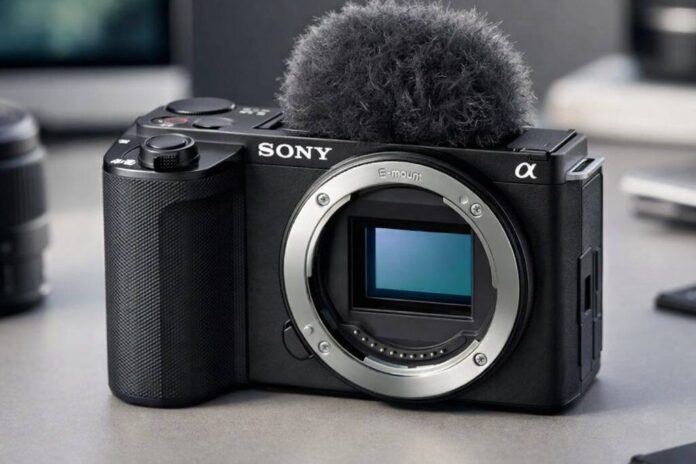
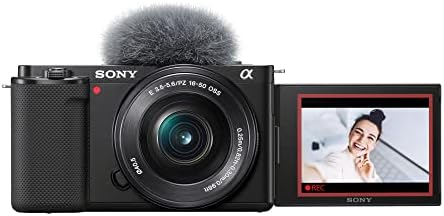
The ZV-E10 is a video-first version of Sony’s older 24MP APS-C formula. It removes the electronic viewfinder and built-in flash, adds a side-hinged screen, a prominent record button, a directional microphone and creator shortcuts such as Product Showcase and Background Defocus. That sounds superficial until you film alone. A screen that faces forward, a clear recording lamp and autofocus that does not need an operator are more useful than another page of cinema terminology.
I find the camera easiest to recommend to someone making repeatable content: a desk-based YouTube channel, cooking videos, interviews, online courses, product demonstrations or a travel diary built from composed shots. Put it on a tripod, connect a microphone, set a sensible white balance and it produces video that still looks professional.
It is less convincing as an action or walk-and-talk camera. The body is light, but the footage is not automatically smooth. The sensor reads slowly enough to bend vertical lines during quick pans, and Active stabilization adds a crop without replacing a gimbal or a well-practiced step. This is where the marketing picture of effortless handheld creation meets physics.
Handling: simple on the surface, old Sony underneath
At 343g, the ZV-E10 almost disappears behind a medium lens. With the retracting 16-50mm kit zoom it fits into a small shoulder bag and never feels like a production camera. That is liberating in public. People react differently to this body than they do to a caged cinema rig, and less attention often produces better street interviews and more natural family footage.
The grip is adequate rather than generous. With compact APS-C lenses, the balance is good; with a heavy full-frame zoom, the lens controls the camera. There is only one main command dial, and the rear wheel is small. I can work manually with it, but I do not enjoy changing exposure as much as I do on an a6400 or a body with front and rear dials.
The screen articulates fully and can face forward. Its touch function is limited to focus, tracking and shutter operations. You cannot navigate the older Sony menu system as if it were a phone. This distinction matters because many product descriptions simply say “touchscreen.” Build a My Menu page and assign the function button early; otherwise, the camera feels more complicated than its creator branding suggests.
There is no EVF. For video, that is usually harmless. For photography in bright sunlight, it changes the relationship with the camera. You compose at arm’s length, shade the LCD when necessary and lose the stability of bracing a viewfinder against your face. Photographers who expect the ZV-E10 to be a tiny a6400 should think carefully about that omission.
Photo quality and autofocus
The 24.2MP APS-C sensor remains very good for photographs. RAW files hold enough detail for generous prints, portraits and travel work, while the 1.5x crop gives telephoto lenses useful reach. Dynamic range at low ISO is strong for the class. Noise becomes visible as ISO rises, but a well-exposed ISO 3200 image is entirely usable for the web and normal prints.
What dates the camera is not basic image quality but the surrounding experience. There is no in-body stabilization, no viewfinder and no anti-dust mechanism. The mechanical and electronic shutter top out at 1/4000 second, while flash sync is 1/160. The body can shoot at 11fps, but it is not shaped like a sports camera and its buffer and controls do not invite long action sequences.
Autofocus is the reason it remains easy to use. The 425-point hybrid system covers most of the frame and tracks faces and eyes confidently. Product Showcase mode deliberately shifts attention from the presenter’s face to an object held toward the lens. It can save a solo reviewer from repeatedly tapping the screen, though I switch it off as soon as I return to normal people photography.
Sony added animal eye autofocus for video through firmware, but the ZV-E10 does not have the broader AI subject-recognition system found in newer bodies. For people, pets and predictable motion it still feels quick. For birds, vehicles or erratic sport, a modern Sony is more intelligent and easier to configure.
Video quality: excellent detail, obvious movement limits
The best-looking mode is 4K24. The camera reads the width of its 24MP sensor and oversamples roughly 6K of information into a detailed 4K file. Faces, hair, fabric and product textures look crisp without needing aggressive sharpening. For interviews and controlled scenes, the result remains competitive with many newer budget cameras.
Switch to 4K30 and the camera applies an additional crop of about 1.23x. A 16mm lens that already frames like 24mm on APS-C becomes roughly a 30mm-equivalent view before Active stabilization adds its own crop. That is acceptable for a tripod shot but uncomfortable at arm’s length. Buyers often blame the kit lens when the real issue is the combination of APS-C, 4K30 and stabilization crops.
Rolling shutter is the central video weakness. In full-width 4K24, quick horizontal movement can make door frames and buildings lean. A fast subject crossing the frame may also distort. The cropped 4K30 mode reads a smaller area and behaves somewhat better, but it does not turn the camera into an action specialist. I pan more slowly, use wider lenses and let subjects move within a mostly stable frame.
Internal recording is 8-bit 4:2:0, with S-Log2, S-Log3 and HLG profiles available. The presence of Log does not mean the footage tolerates the same correction as a 10-bit file. Expose carefully and avoid extreme white-balance repairs. For quick delivery, a restrained standard profile is often a better choice than underexposed S-Log3. The ZV-E10 II is the better tool when 10-bit grading is part of the workflow.
Full HD reaches 120p for slow motion. It is useful for short B-roll inserts, though it is visibly softer than the oversampled 4K. There is no 4K60. If slow-motion 4K is essential, the original camera is the wrong economy.
Stabilization and handheld vlogging
The ZV-E10 has no sensor-shift stabilization. In stills, it relies on lenses with Optical SteadyShot. In video, Standard mode uses lens stabilization when available, while Active mode adds electronic correction and crops the image.
For a static handheld shot, a stabilized lens and careful posture can look good. For walking footage, Active mode reduces small shakes but can introduce a floating or warping feel at the edges. A compact gimbal provides better movement, but it also changes the appeal of the tiny body. My practical preference is simpler: use a genuinely wide lens, keep clips short and stop treating every sentence as a walking shot.
The 16-50mm OSS kit lens helps, but 16mm is only just wide enough for handheld self-filming at 4K24. At 4K30 or with Active stabilization, it becomes tight. This is why lens choice is not an accessory question on the ZV-E10; it determines whether the camera works for the intended shot.
Audio and solo-creator features
The audio setup is unusually complete for an entry-level body. There is a 3.5mm microphone input, a separate headphone output and a Multi Interface Shoe that accepts compatible digital microphones without an external cable. The supplied windscreen clips over the built-in directional microphone.
The internal mic is useful for a spontaneous clip in quiet surroundings. It is not a substitute for placing a microphone near the speaker. A modest lavalier or compact shotgun microphone usually improves a video more than replacing the camera body. The headphone jack is equally important: monitoring a loose cable or clothing rustle before recording saves footage rather than decorating a specification sheet.
Background Defocus opens the aperture with one button, while Product Showcase changes focus behavior for objects held toward the camera. Both are helpful teaching tools. Once you understand aperture and AF transition settings, you may prefer direct control, but the shortcuts get a beginner to the intended result quickly.
Battery, heat and recording workflow
The small NP-FW50 battery is the same older pack used by several Sony APS-C bodies. Sony rates it for about 440 stills, 80 minutes of actual movie recording or 125 minutes of continuous recording. Real use falls when you review clips, transfer files or keep the screen bright. Carrying a second genuine battery is sensible.
The USB-C port supports charging and external power, which makes a power bank useful for long tripod sessions. The card slot is UHS-I, so there is little reason to overpay for the fastest UHS-II card. A reputable V30 SDXC card is the practical match for the camera’s 100Mbps 4K modes.
Long 4K recordings can trigger heat limits, especially in direct sun or a warm room. Setting Auto Power Off Temp to High extends recording, but airflow and ambient temperature still matter. For a one-hour event, I would test the exact setup beforehand rather than assume a small sealed body will behave like an actively cooled cinema camera.
Best lenses for the Sony ZV-E10
The E-mount lens catalog is the ZV-E10’s long-term advantage. Sony, Sigma, Tamron, Samyang and Viltrox all make useful APS-C options, so the camera is not trapped behind one slow kit zoom.
- Sony E 11mm f/1.8: the most natural handheld-vlogging choice. It stays wide after digital stabilization and is bright enough for indoor work.
- Sigma 16mm f/1.4 DC DN: excellent for tripod-based talking heads, environmental portraits and low light. It is often too tight for arm’s-length walking footage.
- Sigma 18-50mm f/2.8 DC DN: a compact general-purpose upgrade with better low-light ability than the kit zoom, but no optical stabilization.
- Sony E 35mm f/1.8 OSS: a stabilized normal-to-short-portrait lens for photography, interviews and detail shots.
- Sony E PZ 16-50mm OSS: optically modest but tiny, stabilized and convenient. Keep it when portability matters more than edge sharpness.
Our guide to the best Sony E APS-C lenses covers the wider system. Buy for the shot you make most often, not for a hypothetical lens collection. A creator filming indoors needs width and aperture; a travel photographer may value a compact stabilized zoom more.
Sony ZV-E10 versus ZV-E10 II
The ZV-E10 II is a substantial video upgrade, not a cosmetic revision. It moves to a 26MP backside-illuminated sensor and newer processor, records 10-bit 4:2:2 internally, adds 4K60, uses the much larger NP-FZ100 battery and has Sony’s newer menu interface. Its autofocus recognizes more subjects and its color workflow is more current.
The original still has two arguments: price and its mechanical shutter. The Mark II is more clearly video-first and uses an electronic shutter for stills. Photographers dealing with LED lighting or flash should not assume the newer model is automatically better for every still image.
The price gap decides the recommendation. Current US used-dealer listings for the original can sit uncomfortably close to its roughly $698 new body price. A used original around $500-$550 is appealing. At $600-$650, compare a discounted new body with warranty and the newer alternatives before buying. The Mark II earns its premium when 10-bit color, 4K60 and longer battery life will be used rather than merely admired.
How it compares with the a6400, Canon R50 and Nikon Z30
The Sony a6400 is the better photography-first choice. It adds an EVF, a more conventional body and stronger outdoor handling while sharing broadly similar 24MP image quality and rolling-shutter behavior. The ZV-E10 counters with its side-hinged screen, headphone output, creator shortcuts and more convenient self-filming design.
The Canon EOS R50 offers a friendlier touch interface, an EVF and a newer-feeling stills experience. The Sony answers with a deeper APS-C lens catalog, a headphone jack and established third-party options at almost every price. The Nikon Z30 is another viewfinder-free creator body with pleasant handling and good 4K, but Sony’s autofocus behavior and lens choice remain compelling.
None is universally best. The ZV-E10 is strongest when the lens ecosystem and solo-video conveniences matter more than stabilization, touch menus or an EVF.
Who should buy it, and who should not
Buy the Sony ZV-E10 if:
- You make controlled YouTube, tutorial, interview or product content.
- You want reliable face and eye autofocus without operating the camera from behind.
- You value microphone and headphone connections.
- You want affordable access to Sony and third-party APS-C lenses.
- You find the original at a clear discount from both a new body and the Mark II.
Skip it if:
- You need smooth walking footage without a gimbal.
- You regularly pan quickly or film fast action in 4K.
- You need 4K60, 10-bit color or heavy Log grading.
- You are primarily a photographer who wants an EVF and direct controls.
- You expect a phone-like touchscreen and modern menu system.
Final verdict
The original Sony ZV-E10 remains a good camera, but it is no longer the automatic budget recommendation it once was. Its 4K24 detail, autofocus, audio connections and lens access are genuinely strong. Its rolling shutter, stabilization, 4K30 crop and old interface are equally real.
I like it most as a small camera on a stable support with a lens chosen for a specific job. In that role, it stops trying to imitate a phone and becomes a proper interchangeable-lens production tool. Buy it cheaply, learn its movement limits and spend the saved money on the right lens and microphone. That combination can still outperform a newer body wearing the wrong glass.
Sony ZV-E10 alternatives
The main alternatives to the Sony ZV-E10 are Sony ZV-E10 II, Sony a6400, Canon EOS R50, Nikon Z30. Compare autofocus, stabilization, video limits, lens choice and current price before deciding which camera fits you best.
Frequently asked questions
Is the Sony ZV-E10 good for beginners?
Yes, particularly for video. Autofocus, the vari-angle screen and creator shortcuts make initial results easy. The older menu system and limited touchscreen require some setup, so it is approachable rather than completely effortless.
Is the Sony ZV-E10 good for photography?
Its 24.2MP APS-C sensor and autofocus produce strong photographs, and it retains a mechanical shutter. However, the lack of a viewfinder, small controls and absence of in-body stabilization make the a6400 or another photography-first body more comfortable.
Does the Sony ZV-E10 have image stabilization?
It does not have in-body stabilization. It supports optical stabilization in compatible lenses and an electronic Active mode for video. Active mode crops the frame and does not fully stabilize walking footage.
Does the Sony ZV-E10 crop 4K video?
4K24 uses the sensor’s full width. 4K30 applies an additional crop of approximately 1.23x. Electronic Active stabilization crops the image further.
Does the Sony ZV-E10 overheat?
It can reach its heat limit during long 4K recordings, especially in warm conditions or direct sun. The High Auto Power Off Temperature setting helps, but long-form users should test their exact environment and power setup.
Is the Sony ZV-E10 still worth buying in 2026?
Yes when it is substantially cheaper than the ZV-E10 II and its limitations fit your work. Around $500-$550 used is more persuasive than dealer listings that approach the roughly $698 price of a new body.
Talking-head video, tutorials, product work and solo creators who want Sony autofocus and interchangeable lenses.
You need an EVF, IBIS, 4K60, 10-bit color, fast-action 4K or a modern touch interface.
Low-medium; creator shortcuts help, but the older menus and lens choices need setup.
ZV-E10 II for 10-bit and 4K60, a6400 for photography, or FX30 for production video.
Detailed 4K24, but 4K30 crops, rolling shutter is strong, and Active stabilization crops further.
Yes below about $550 used or at a strong new discount; less compelling near ZV-E10 II pricing.