
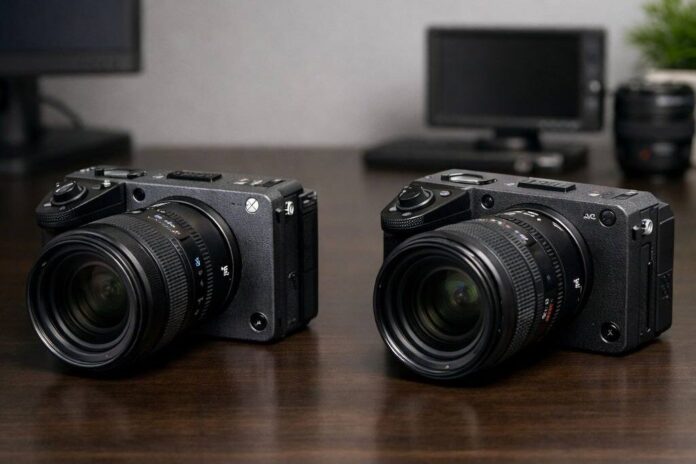
In this Sony FX2 vs FX3 comparison, the real choice is not simply newer camera versus older camera. Sony’s FX2 is the more hybrid, more affordable Cinema Line body, with a 33MP full-frame sensor, an EVF, and stronger still-photo usefulness. By contrast, the FX3 is the more proven video-first tool. It gives you 4K 120p, excellent low-light behavior, and a production layout that has already earned trust on real jobs. If you searched for Sony FX3 vs FX2, the useful distinction is the same: the FX3 is the dedicated cinema body, while the FX2 trades high-frame-rate 4K and some low-light specialization for detailed stills, an EVF, and a lower price. That is the difference between FX2 and FX3 that matters more than launch order.
Sony FX2 vs FX3: the short version
The easiest way to understand the Sony FX2 vs FX3 decision is to look at what each camera is trying to protect. The FX2 protects flexibility: serious stills, a viewfinder, a lower price, and a Cinema Line body for solo creators. Our Sony FX2 review examines those hybrid strengths and the cropped 4K60 tradeoff. Video confidence is the FX3’s territory: 4K 120p, a 12MP sensor tuned for motion, active cooling, and the XLR handle workflow that made it so common on small productions. The full Sony FX3 review goes deeper into its real-world strengths.
That makes the FX2 attractive for hybrid creators, travel filmmakers, YouTubers, wedding shooters, and small teams that need one body to cover more jobs. For people who mainly shoot video, the FX3 is still the cleaner choice. It has high-frame-rate 4K, low-light headroom, and a body that behaves like a dedicated production camera.
Sony’s official specifications make the split clear: the FX2 uses a 33MP full-frame Exmor R sensor and records 4K up to 60p, while the FX3 uses a 12.1MP full-frame sensor and reaches 4K 120p. Those are not small differences. They shape the way each camera feels in the field.
Quick recommendation
- Choose the Sony FX2 if you want a smaller-budget Cinema Line camera that also makes sense for stills.
- Pick the Sony FX3 if video is the job and you need the stronger high-frame-rate, low-light, and production-focused body.
- Pick the FX2 if an EVF matters to you for handheld outdoor work.
- Pick the FX3 if 4K 120p matters more than still-photo resolution.
- Do not buy the FX2 expecting it to be a cheaper FX3 with the same sensor. It is a different camera with a different compromise.
Sensor and image quality
The FX2 and FX3 do not share the same sensor. This is the first thing I would correct in almost every casual Sony FX2 vs FX3 discussion. Inside the FX2 is a 33MP full-frame sensor, closer in spirit to Sony’s hybrid stills bodies. Inside the FX3 is a much lower-resolution 12.1MP full-frame sensor designed around video sensitivity, fast readout, and 4K capture.
For photography, the FX2 is clearly more useful. Thirty-three megapixels gives you more cropping room, better stills detail, and more confidence if you are delivering images alongside video. If a client expects both a short film and usable photo selects, the FX2 feels less like a compromise.
For video, the FX3 has the cleaner professional identity. Its lower pixel count is not a weakness for its intended use. That design helps the camera deliver strong low-light performance, 4K 120p, and dependable full-frame video. This is why the FX3 became popular with documentary, wedding, commercial, and YouTube shooters.
The FX2 can still look excellent. It offers S-Cinetone, S-Log3, LUT support, and Sony’s Cinema Line color workflow. But it is not the same low-light, high-frame-rate specialist as the FX3. If I were shooting mostly interviews, controlled pieces, travel films, and hybrid creator work, the FX2 image would be more than enough. If I were shooting paid video in difficult light every week, I would rather have the FX3.
Video specs and frame rates
This is where the Sony FX3 separates itself. The FX3 records 4K up to 120p. That matters for slow motion, sports details, wedding films, music videos, action cutaways, and commercial B-roll. It also gives you a more established video pipeline, with the body and cooling system built around long video sessions.
The FX2 records 4K up to 60p. The important catch is that 4K 60p is not the same full-frame high-speed flexibility people often associate with the FX3. Think of the FX2 as a 4K 24p/30p full-frame camera with useful 4K 60p options. It is not a direct FX3 replacement if slow-motion 4K is central to your work.
Both cameras give you serious codecs and color tools: 10-bit 4:2:2 internal recording, S-Cinetone, S-Log3, Cine EI-style workflows, and 16-bit RAW output over HDMI. For grading and client work, neither body feels lightweight. The difference is less about whether the files are professional and more about which compromises you accept to get them.
Autofocus, stabilization, and solo shooting
Both cameras are strong for solo shooting. Sony’s autofocus is a major reason small-crew filmmakers keep buying these bodies. The FX3 is already proven for face and eye tracking in documentary-style work. The FX2 adds newer AI-based subject recognition that makes sense for creators who jump between people, products, and travel scenes.
The FX2 has one practical advantage that I like for outdoor handheld work: the angle-adjustable EVF. A viewfinder is not just a stills feature. In bright sun, it gives you a more stable shooting posture and a clearer way to judge framing. If you shoot travel pieces, handheld street work, or quick hybrid assignments, that can matter more than the spec sheet suggests.
The FX3 still feels more natural once rigged. Its body design, mounting points, tally lights, fan, and common production accessories make it easy to build into a small cinema setup. If I am using an external monitor, top handle, wireless audio, and a cage, the FX3 feels like the more obvious tool.
Audio, rigging, and production workflow
The FX3’s XLR handle is one of its defining strengths. It gives you a familiar top-handle shape, dual XLR/TRS inputs, and physical audio controls in a package that still stays compact. For interviews, documentary work, and small commercial jobs, that matters. Good audio is not an accessory detail; it is often the difference between usable and unusable footage.
The FX2 can also be bought with an XLR handle configuration, but its identity is more flexible. It is a body you can keep smaller when you want to travel light, then build up when the job demands it. That flexibility is useful, but if you already know every project will be video-first, the FX3 feels more direct.
Both use Sony E mount, NP-FZ100 batteries, dual CFexpress Type A / SD card slots, full-size HDMI, USB-C, microphone input, and headphone output. In practical terms, you can share lenses, media strategy, batteries, and much of your accessory ecosystem. That makes the choice less painful if you are already inside Sony.
Photography and hybrid use
This is the FX2’s strongest argument. The FX3 can shoot stills, but nobody buys an FX3 because it is a great photography camera. The FX2 is different. Its 33MP sensor, mechanical shutter, EVF, and stills-oriented usefulness make it a better one-body solution for creators who deliver mixed media.
If you shoot weddings, branded travel work, behind-the-scenes content, thumbnails, editorial stills, and video with the same kit, the FX2 is easier to justify. You can carry one body and feel less exposed when someone asks for photos.
If your camera bag already includes a strong stills body, the FX2’s hybrid advantage matters less. In that case, the FX3 becomes more attractive because it can focus on video without trying to be everything.
Price and value
The FX2 is the value play. It costs less than the FX3 and gives newer buyers a more accessible entry into Sony’s full-frame Cinema Line. For creators moving up from an Alpha hybrid, that matters. You get Cinema Line tools, full-frame depth, good autofocus, and a body that still works for stills.
The FX3 costs more because it is the safer dedicated video body. It has years of field use behind it, strong accessory support, 4K 120p, excellent low-light ability, and a workflow many shooters already know. Used prices can still be high because the FX3 remains desirable.
My rule is simple: if the FX2 saves enough money to fund a lens, audio kit, light, or gimbal, it may produce better real-world results for a solo creator. If the camera itself must be the most dependable video body in the kit, the FX3 is worth the extra spend.
Which one should you buy?
Buy the Sony FX2 if you are a hybrid creator first. It is the better choice if you shoot both photos and video, want an EVF, work solo, and rarely need 4K 120p. It is especially interesting for YouTube, travel, documentary-style creator work, and small business content where flexibility beats maximum cinema specialization.
Buy the Sony FX3 if video is the main job. It is the better camera for filmmakers who shoot long takes, need 4K 120p, work in low light, rely on XLR audio, and want a production-proven body. If a client hires you for video and stills are secondary, the FX3 remains the stronger professional tool.
Personally, I see the FX2 as the camera I would take when I need to travel light and return with both polished video and credible stills. I see the FX3 as the camera I would take when I want fewer compromises on a paid video set. Neither choice is wrong, but confusing the FX2 for a cheaper FX3 is the mistake to avoid.
Frequently asked questions
Is the Sony FX2 better than the FX3?
The Sony FX2 is better for hybrid creators who need stronger stills, an EVF, and a lower price. For dedicated video shooters, the FX3 is better. It gives you 4K 120p, stronger low-light specialization, and a more proven production workflow.
Does the Sony FX2 have the same sensor as the FX3?
No. Sony gives the FX2 a 33MP full-frame sensor, while the FX3 uses a 12.1MP full-frame sensor. That difference affects still-photo detail, low-light behavior, readout, and high-frame-rate video.
Can the Sony FX2 shoot 4K 120p?
No. Sony rates the FX2 for 4K up to 60p. If 4K 120p is important to your work, the Sony FX3 is the better choice.
Which is better for low light, Sony FX2 or FX3?
The Sony FX3 is the better low-light video camera. The FX2 is capable, but the FX3 is the stronger choice for dark receptions, documentary work, and available-light filmmaking. Its lower-resolution sensor and video-first design are the reason.
Should I buy the Sony FX2 or FX3 for YouTube?
For most YouTube creators, the FX2 is easier to justify because it is cheaper, more hybrid, and still very capable. Choose the FX3 if your channel depends on high-end video production, 4K 120p, long recording sessions, or professional audio workflows.