

View full specs
This Sony FX2 review starts with the distinction that matters: the FX2 is not a cheaper FX3, and it is not an Alpha body wearing a cinema badge. It is a 33MP full-frame hybrid built around serious video ergonomics. That makes it unusually good for filmmakers who must also deliver photographs, but less convincing for anyone who expects the FX3’s 4K120 and exceptional high-ISO character.
Sony FX2 review: the short verdict
The FX2 makes the most sense for solo documentary, wedding, corporate and small-crew work. Its detailed full-width 4K, reliable autofocus, cooling fan, tilting electronic viewfinder and proper still-photo mode solve real production problems. The body is compact enough for a gimbal yet has mounting points that let it grow into a practical rig.
There are three catches. Full-frame recording stops at 4K30, while 4K60 switches to an APS-C/Super 35 crop. There is no 4K120, and there is no internal ND filter. Those are not footnotes on a cinema camera. They should determine whether you buy the FX2, the video-first FX3 or a larger body such as the FX6.
- Buy it for: 33MP stills, crisp oversampled 4K, the tilting EVF, excellent subject recognition and compact Cinema Line handling.
- Think twice if: you rely on full-frame 4K60, 4K120, very fast sensor readout or internal ND.
- Best fit: a photographer-filmmaker who needs one compact body to cover both sides of an assignment.
Where the FX2 fits in Sony’s lineup
Sony announced the FX2 in May 2025 at a body-only price of $2,699. It sits between the Super 35 FX30 and the low-resolution, video-specialist FX3. That sounds simple on a price chart. In use, however, its closest relative is arguably a 33MP Alpha hybrid rebuilt for filmmaking.
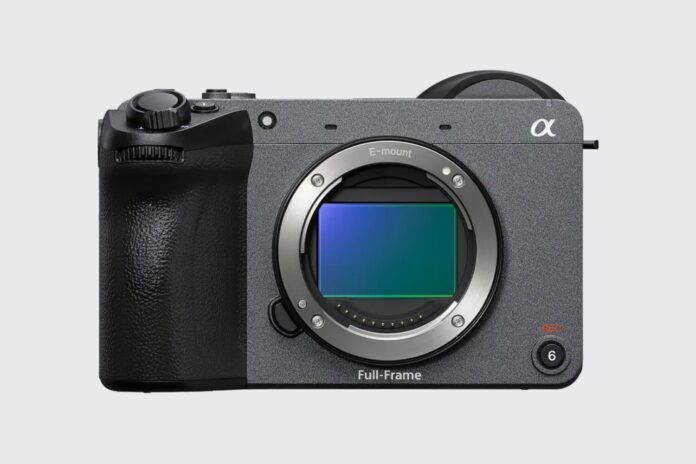
The FX2 uses a 33MP back-illuminated Exmor R sensor and BIONZ XR processor, plus a separate AI processing unit for subject recognition. Video uses about 27.6MP. Full-width 4K up to 30p is oversampled from a 7K readout, which gives the camera its clean, finely resolved look.
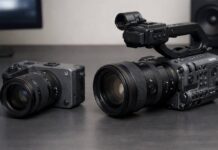
The FX3 takes the opposite approach. Its 12.1MP sensor gives away photographic resolution but offers 4K120 and a better high-ISO temperament. I would not choose between them by asking which is the more professional camera. I would ask whether a 33MP still file and an EVF matter more than high-frame-rate video and faster sensor readout.
Our Sony FX2 vs FX3 comparison goes through that choice in detail. You can also read the full Sony FX3 review before deciding.
Body, controls and the tilting viewfinder
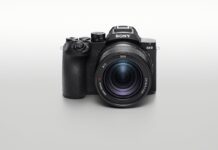
The FX2 keeps the squat, cage-friendly shape of Sony’s compact Cinema Line bodies. There are threaded mounting points around the chassis, a large record button, tally lamps and an internal fan. At 679g with battery and card, it remains manageable on a compact gimbal. It also feels substantial enough to carry a normal full-frame zoom without becoming comically front-heavy.
The grip is more reassuring than a pure box camera, but this is still a body designed to be configured. A top microphone, monitor or wireless receiver can mount without immediately forcing you into a full cage. Add a matte box, rails and a focus motor, though, and the compact-camera advantage disappears quickly.
The EVF changes how the camera works
The 3.68-million-dot OLED finder tilts from 0 to 90 degrees. It is not merely there to make the specification sheet look more photographic. Outdoors, it gives you a stable point of contact and a dependable way to judge framing when the rear screen is fighting glare. At waist level, the upward tilt is genuinely useful.
I would still want a larger monitor for a crewed production or careful manual focus. For handheld documentary work, the finder makes the FX2 feel more immediate than the FX3. Be aware that some accessories in the Multi Interface Shoe can obstruct its movement.
The rear display is a 3-inch vari-angle touchscreen with roughly 1.04 million dots. It is functional rather than luxurious. Sony’s current menus are much easier to navigate than the older Alpha system, but a well-built My Menu remains essential. On a paid shoot, settings such as frame rate, shutter mode, stabilization and audio should never be three screens away.
Video quality: detailed 4K with a meaningful crop
The FX2’s best image is its full-width 4K24 or 4K30. The 7K oversampling produces fine detail without the brittle edge enhancement that can make digital footage look over-processed. For interviews, controlled documentary work, architecture and commercial detail, that extra resolution is easy to appreciate.
Sony claims more than 15 stops of dynamic range in S-Log3. Treat that as a controlled-test figure, not a promise that every stop will look equally clean after a hard grade. The practical point is more useful: highlights roll off well when exposure is disciplined, while the shadows give you enough room to work without inviting reckless underexposure.
Dual base ISO settings of 800 and 4000 in S-Log3 help when lighting changes. ISO 4000 is valuable for interiors and evening events, but the FX2 is not an FX3 in the dark. The higher-resolution sensor does not have the same large-pixel advantage. I would choose the FX2 for detail and flexibility, not because I wanted to shoot every reception by available light at five-digit ISO values.
4K60 changes the lens calculation
To record 4K60, the FX2 switches to APS-C/Super 35 mode. Your 24mm lens then frames more like a 36mm lens. That can be useful for reach, but it can also dismantle a carefully chosen wide-angle setup. Wedding shooters, real-estate filmmakers and anyone working in tight interiors should plan for it before the job.
There is no 4K120. Full HD can reach 120p, but that is not a substitute when the final delivery needs detailed 4K slow motion. This is the strongest technical reason to choose the FX3 instead.
Rolling shutter is also more visible than on the FX3’s lower-resolution sensor. Normal pans, interviews and deliberate handheld movement are fine. Fast lateral motion, whip pans and vibration can reveal skew. The FX2 rewards a measured operator; it is not the body I would select for aggressive action coverage from a moving vehicle.
S-Cinetone, S-Log3 and practical color
S-Cinetone remains the sensible choice when the deadline matters more than an elaborate grade. Skin is pleasing, contrast is controlled and footage can move quickly from camera to edit. I use Log when the scene or post-production plan earns the extra work, not because Log is a badge of seriousness.
S-Log3 supports Flexible ISO, Cine EI and Cine EI Quick workflows. The FX2 also accepts user LUTs and can apply a look for monitoring. That helps clients and small crews see a useful image instead of judging a flat Log preview. Anamorphic desqueeze and breathing compensation add production value, although lens compatibility and crop behavior need checking before a shoot.
Sony’s official FX2 specifications confirm the recording limits and current supported modes. I would verify card requirements there when building a high-bitrate setup.
Autofocus and stabilization
The autofocus system is one of the FX2’s safest professional advantages. It offers up to 627 phase-detection points for movies and recognizes people, animals, birds, insects, cars, trains and aircraft. Human pose estimation helps maintain tracking when a face turns away or is briefly obscured.
That does not remove the need to operate the camera. Transition speed, subject-shift sensitivity and the selected recognition target still shape the result. For a single-person interview, I prefer restrained transitions that do not advertise every small correction. At an event, a more responsive setup makes sense.
The camera has 5-axis sensor-shift stabilization. Sony rates it at up to 5.5 stops at the center of the frame, with Standard, Active and Dynamic Active movie modes. Active modes crop the image, and Dynamic Active crops more. They calm small movements; they do not turn walking footage into a floating gimbal shot.
The useful combination is IBIS, sensible body mechanics and a lens suited to the shot. For a static handheld interview clip, it can look composed. For a long walking take, use support rather than asking software to disguise poor technique.
Stills are a real feature, not an emergency mode
This is where the FX2 separates itself most clearly from the FX3. It records 33MP RAW and JPEG/HEIF files, has a mechanical shutter, shoots at up to 10fps and gives you that usable EVF. A wedding filmmaker can make proper portraits. A documentary shooter can return with publication-quality stills rather than frame grabs.
The body remains video-led. The control layout and screen experience are not as natural for all-day photography as a conventional Alpha camera. Sports photographers will also find 10fps and the sensor readout modest by current high-end standards. Still, calling the FX2’s photo mode an afterthought misses the reason this camera exists.
Its hybrid value is strongest when video remains the main deliverable but photography is expected. If stills and video are truly equal, compare the FX2 with the a7 IV-class bodies as carefully as you compare it with the FX3.
Codecs, media and post-production
Internal options include XAVC S, XAVC S-I and XAVC HS, with 10-bit 4:2:2 recording available. All-Intra files can be easier to edit but consume storage quickly, reaching 600Mbps in demanding modes. Long-GOP and H.265 options save space, though an older computer may need proxies.
The two card slots are not identical. Slot 1 accepts CFexpress Type A or SD UHS-II cards. Slot 2 accepts SD UHS-II only. That matters when planning redundant recording: this is not the FX3’s pair of CFexpress Type A/SD combination slots.
For ordinary 4K, good V90 SD cards can be the rational choice. CFexpress Type A earns its cost when a selected high-bitrate mode requires it or when offload speed affects the working day. Check Sony’s media chart for the exact codec and frame rate instead of buying cards by reputation.
A full-size HDMI Type A port can output 16-bit RAW data at up to 4.6K to a compatible recorder. USB-C supports 10Gbps transfer, charging and USB Power Delivery. There are also 3.5mm microphone and headphone ports. Ethernet requires a USB-LAN adapter; wired LAN is not built into the body.
Audio, cooling and long-form reliability
The body-only ILME-FX2B does not include Sony’s XLR-H1 handle. The optional handle adds two XLR/TRS inputs, a 3.5mm input and physical audio controls through the Multi Interface Shoe. For interviews and corporate work, it can simplify a rig considerably. It also raises the total price, so compare like-for-like kits.
The internal fan is the less glamorous feature that may matter more. It makes the FX2 far better suited to long interviews, ceremonies and continuous takes than a passive hybrid body. Sony specifies a maximum single recording session of about 13 hours, though temperature, power and media still affect real operation.
I would power a locked-off camera over USB-C PD and keep a charged NP-FZ100 inside as a buffer. Sony rates actual movie recording at roughly 100 minutes using the rear screen. That is adequate for mobile work, but not a reason to arrive at a full-day job with one battery.
The missing internal ND matters
The FX2 has no built-in neutral-density filter. In bright light, holding a cinematic shutter speed at a wide aperture requires lens filters or a matte box. Variable ND is quick, but poor filters can introduce color shifts and uneven polarization. Fixed ND is more predictable when there is time to work.
This is where the FX2 remains a compact cinema-style hybrid rather than a miniature FX6. If your day constantly moves between interiors and hard sunlight, internal electronic ND can save more time than another megapixel or autofocus mode.
Sony FX2 vs FX3, FX30 and a7 IV
Choose the FX2 over the FX3 when
- You need 33MP photographs and an electronic viewfinder.
- You favor detailed full-width 4K24/30 over 4K120.
- AI subject recognition and reframing tools suit solo production.
Choose the FX3 over the FX2 when
- 4K60 without the FX2’s Super 35 crop is important.
- You need 4K120 or better high-ISO video.
- Faster sensor readout matters more than still-photo resolution.
The FX30 is the value option for filmmakers comfortable with Super 35. It leaves more budget for lenses, audio, lighting and support. The a7 IV is often the more natural stills-first hybrid, but lacks the FX2’s fan-cooled Cinema Line body and video-centered rigging.
Price and value in 2026
The FX2 launched at $2,699 body-only, and Sony has already offered meaningful US discounts. Because pricing moves, the useful comparison is not a fixed number. Compare the body-only FX2 with the complete cost of an FX3 or FX30 rig, including the XLR handle if you need balanced audio.
At a strong discount, the FX2 is persuasive for hybrid assignments. Near the FX3’s price, the decision becomes more specialized: stills resolution and the EVF versus high-frame-rate video and low-light performance. The used market is still young, so I would expect discounts and warranty coverage to matter more than a small used saving.
Final verdict
The Sony FX2 is a thoughtful camera with a badly misunderstood position. It is not the junior FX3. It trades some of the FX3’s most valuable video abilities for higher-resolution stills, an EVF, oversampled full-width 4K and newer recognition tools.
For a solo filmmaker who also photographs, that exchange can be exactly right. The camera is compact, configurable and dependable. Its files can look excellent without turning every job into a grading exercise. Just buy it with open eyes: 4K60 is cropped, 4K120 is absent, rolling shutter needs respect and daylight exposure still requires external ND.
If those compromises fit your work, the FX2 is one of Sony’s more useful hybrid production bodies. If they do not, no amount of Cinema Line styling will make it the right tool.
Sony FX2 (ILME-FX2) alternatives
The main alternatives to the Sony FX2 (ILME-FX2) are Sony FX3, Sony FX30, Sony a7 IV, Panasonic S5 IIX, Canon R5 C. Compare autofocus, stabilization, video limits, lens choice and current price before deciding which camera fits you best.
Frequently asked questions
Does the Sony FX2 have internal ND filters?
No. The FX2 requires screw-in filters, a magnetic system or a matte box when you need neutral density. The larger Sony FX6 has internal electronic variable ND.
Can the Sony FX2 record full-frame 4K60?
No. Its 4K60 recording uses an APS-C/Super 35 crop. Full-width oversampled recording is available up to 4K30.
Does the Sony FX2 record 4K120?
No. The FX2 reaches 4K60 and Full HD 120p. Choose the FX3 if 4K120 is essential.
Is the Sony FX2 good for photography?
Yes, especially for a video-led hybrid assignment. It has a 33MP sensor, mechanical shutter, up to 10fps shooting and a 3.68-million-dot EVF. A conventional Alpha body still handles more naturally for photography-first work.
Is the XLR handle included with the Sony FX2?
Not with the body-only ILME-FX2B. Sony also sells configurations with the XLR-H1 handle, and retailers may bundle it separately. Check the exact SKU rather than relying on the product photo.
Solo documentary, wedding, corporate and hybrid creators who need serious video tools plus 33MP stills.
You need full-frame 4K60, 4K120, internal ND, SDI or the FX3 level of high-ISO performance.
Medium-high; approachable controls but professional codec, exposure and audio choices.
FX30 below it for value, FX3 for high-frame-rate video, FX6 for internal ND and production I/O.
Excellent detailed 4K up to 30p; 4K60 is cropped and 4K120 is unavailable.
Yes for video-first hybrid work, especially at a meaningful discount.