
View full specs
The Kodak PIXPRO AZ255 is worth considering for one reason: its 25x optical zoom reaches subjects that an inexpensive phone cannot. It is not a general image-quality upgrade over a good smartphone. In bright light, though, it can frame birds, the moon, school events and distant travel details from 24mm to 600mm equivalent without interchangeable lenses.
Kodak PIXPRO AZ255 review: the short verdict
| Question | Answer |
|---|---|
| Is the AZ255 good? | Only for daylight shooting when long optical zoom matters more than fine detail. |
| Best use | Static wildlife, travel landmarks, the moon and family events from a distance. |
| Main weakness | Soft detail, color fringing, slow operation and poor low-light quality. |
| Best buyer | A beginner who wants a simple 600mm-equivalent view on a tight budget. |
| Who should skip it | Anyone expecting better everyday photos than a recent phone, fast action autofocus or 4K video. |
The honest buying rule is simple. Buy the AZ255 when the price is low and 25x zoom solves a real problem for you. If the AZ405 or AZ425 is only slightly more expensive, compare them before ordering. If your subjects are usually nearby, a phone or pocket camera is more convenient and often produces cleaner results.
Kodak PIXPRO AZ255 sample photos
Tap a photo to open the full-resolution file. These images are identified as AZ255 files in their Unsplash camera metadata. They are more useful than promotional examples because they show both the appeal and the limits of the lens.




What the real samples reveal
The town-hall frame shows acceptable color and useful detail at ISO 100, but the sky and fine brickwork reveal the camera’s limited tonal range and processing. The bird image demonstrates why 600mm-equivalent reach is appealing. It also shows purple fringing around bright leaves and branches, plus softer feather detail than the 16MP number may suggest.
The moon is the camera’s most convincing use case. A phone without a strong telephoto module cannot frame it this tightly through optical zoom alone. The ISO 1600 woodland sample is the warning: fine texture becomes coarse and smeared as the camera tries to manage noise. This is a daylight superzoom, not an indoor or night camera.
25x zoom: where the AZ255 earns its place
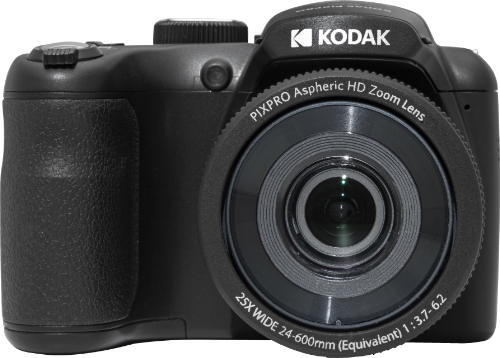
The fixed lens covers 4.3-107.5mm, equivalent to 24-600mm on full frame, with a maximum aperture of f/3.7 at the wide end and f/6.2 at full telephoto. At 24mm it handles landscapes, buildings and group photos. At 600mm it can fill the frame with a perched bird, a stage performer or architectural detail from far away.
Optical image stabilization helps with camera shake, but it cannot freeze a moving subject. At full zoom, use good daylight, brace your elbows, pause after the lens settles and take several frames. For the moon, support the camera and use the self-timer to avoid moving it when you press the shutter.
A 4x digital zoom option extends the displayed reach, but it does not add optical detail. Leave it off unless getting a record shot matters more than image quality. Cropping later gives you more control over the result.
Image quality: useful reach, modest files
The 16.35MP 1/2.3-inch BSI CMOS sensor is similar in size to sensors used in older point-and-shoot cameras. Its best files come at ISO 100 in even daylight. Color can be pleasant, and the 4608 x 3456 output is large enough for social sharing and modest prints when focus and exposure are right.
High-contrast scenes expose the lens more clearly. Expect colored edges around branches against bright sky, softer corners and less fine detail at long zoom. Indoors, slower shutter speeds create blur when people move. Raising ISO reduces that blur but replaces detail with noise reduction and smearing.
Independent hands-on reviews reached the same conclusion. Digital Camera World found pleasing results only in favorable light, with visible chromatic aberration and weak indoor detail. That matches the real samples above and is why this review does not present the AZ255 as a universal phone upgrade.
Handling, screen and controls
The AZ255 resembles a small DSLR, but it weighs about 336g before four AA batteries are installed. The deep grip is easier to hold at telephoto than a flat compact camera. The zoom rocker surrounds the shutter button, and the important buttons sit on the right side for simple one-handed operation.
The mode dial includes Auto, scene modes, panorama, video and P, S, A and M exposure modes. Those manual choices give a beginner room to experiment, but the control system is basic. Aperture selection is limited, settings are changed through buttons rather than command dials, and menus take time to learn.
There is no electronic viewfinder. Every photo is composed on the fixed 3-inch, 460K-dot LCD. The screen neither tilts nor responds to touch, and it can be difficult to see in strong sunlight. That is a meaningful weakness on a camera whose best image quality requires outdoor light.
Operation is also slow by current standards. A hands-on test measured roughly 2.5 to 3 seconds before the camera was ready to shoot, with pauses when changing modes. This is fine for a landscape or a bird sitting still. It is frustrating for sports, birds in flight or unpredictable children.
AA batteries, memory cards and video
The camera takes four AA batteries. Kodak rates alkaline cells for about 300 stills under CIPA testing and also supports NiMH rechargeable AAs. Rechargeable cells and a charger are the sensible long-term choice. Disposable batteries remain useful as an emergency option while traveling.
Use a Class 10 SD, SDHC or SDXC card no larger than 512GB. The camera has about 67MB of internal memory, which is enough for testing but not a day of shooting. It does not support in-camera charging because the batteries are removable AAs.
Video tops out at 1080p/30, with 720p/60 and a low-resolution 120 fps mode also available. Audio is mono, autofocus and stabilization are basic, and there is no microphone input. It is adequate for short family clips, but a recent phone is the better video tool.
Kodak PIXPRO AZ255 alternatives
| Camera | Choose it for | Main tradeoff |
|---|---|---|
| AZ255 | Lowest-cost 25x zoom and AA convenience | 16MP, weak low light and no viewfinder |
| AZ405 | 40x zoom, 20MP and the same AA approach | Larger body with similar basic screen and video |
| AZ425 | 42x zoom and a rechargeable lithium battery | Still a budget small-sensor bridge camera |
| AZ528 | 52x zoom, Wi-Fi and a rechargeable battery | More bulk and expense |
| FZ55 | Pocket size and everyday snapshots | Only 5x optical zoom |
The AZ405 is the closest alternative. It extends reach to 960mm equivalent and raises resolution to 20MP while keeping AA batteries. The AZ425 makes more sense if you prefer a rechargeable pack, and the AZ528 is the stronger Kodak option when wireless transfer and still more reach matter. None of them fixes the fundamental low-light limits of a small sensor.
For the entire range, see our Kodak PIXPRO camera guide. If you are open to other brands and used models, the budget digital camera guide offers a broader comparison.
Who should buy the Kodak PIXPRO AZ255?
Buy it for a specific daylight task: backyard wildlife, the moon, distant travel details or family events where a phone cannot get close enough. Its grip, Auto mode and AA power make it approachable, while P, S, A and M modes provide a basic route into exposure control.
Skip it if your priority is indoor family photography, night scenes, fast action, selfies, vlogging or instant wireless sharing. A modern phone handles most nearby subjects better. A used larger-sensor camera produces better image quality, though matching 600mm reach makes that system larger and more expensive.
Frequently asked questions
Is the Kodak PIXPRO AZ255 a good camera?
It is a useful budget camera for static subjects in daylight when 25x optical zoom matters. It is not a strong general-purpose choice for low light, fast action or buyers expecting better everyday image quality than a recent smartphone.
When was the Kodak PIXPRO AZ255 released?
The Kodak PIXPRO AZ255 was released in December 2022. It remains part of Kodak PIXPRO’s current Astro Zoom range.
Is the AZ255 better than the AZ252?
They are different generations with similar budget-superzoom goals. The AZ255 uses a 16.35MP BSI CMOS sensor and a 25x 24-600mm equivalent lens. Check the exact model number on a listing because AZ252 search results and marketplace titles are often mixed together.
Can the Kodak AZ255 photograph the moon?
Yes. Its 600mm-equivalent telephoto end can frame the moon much more tightly than an ordinary phone camera. Use ISO 100, stabilize the camera, avoid digital zoom and use the self-timer for the cleanest result.
Does the Kodak AZ255 have Wi-Fi or a viewfinder?
No. It has neither Wi-Fi nor an electronic viewfinder. Photos are composed on the fixed rear LCD and transferred through the memory card or USB connection.
What batteries and memory card does the AZ255 use?
It uses four AA alkaline or NiMH batteries and accepts Class 10 SD, SDHC and SDXC cards up to 512GB. Rechargeable NiMH cells are the practical choice for regular use.
Budget buyers who want a real grip, AA batteries, and more reach than a pocket compact.
You need an EVF, Wi-Fi, 4K video, fast autofocus, or the longest possible bridge-camera zoom.
Low in Auto mode, with useful P/S/A/M room to learn later.
Kodak AZ405 for more reach, or AZ528/AZ653 if superzoom range matters most.
1080p only, mono audio, and basic handling keep it casual.
Yes at a discount; no if the AZ405 or AZ528 costs only slightly more.