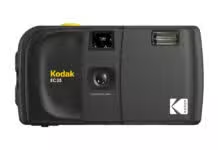

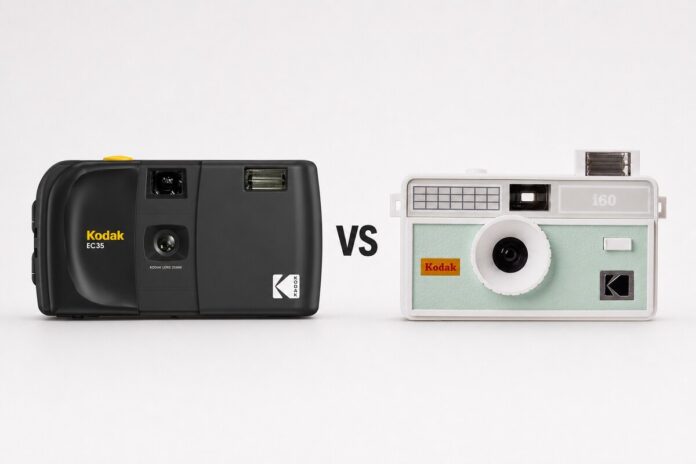
The Kodak EC35 vs i60 choice looks close because both are reusable 35mm cameras with fixed focus, one shutter speed, manual film transport, and built-in flash. In practice, the newer EC35 is the better value for most people. It costs $34.99, weighs less, protects its lens with a sliding cover, and uses a wider two-element 25mm lens.
The i60 still has reasons to exist. Its 31mm view is less wide, its fixed-focus range begins at one meter rather than the EC35’s stated 1.5m guidance, and its pop-up flash gives the camera much more personality. The question is whether those differences are worth paying for when US stock is inconsistent and often expensive.
Quick verdict
| Choose the Kodak EC35 if… | Choose the Kodak i60 if… |
|---|---|
| You want the least expensive new reusable Kodak film camera. | You strongly prefer the Instamatic-inspired body and pop-up flash. |
| You photograph groups, travel, parties, and tight spaces where 25mm is useful. | You prefer a more natural 31mm view with less wide-angle emphasis. |
| You want a lighter body and a cover that protects the lens in a bag. | You expect to photograph people between roughly 1m and 1.5m away. |
| You are buying in the US and want straightforward current availability. | You find a sensibly priced i60 rather than an inflated marketplace listing. |
My choice: I would buy the EC35 at current prices. The i60’s design is more memorable, but the EC35 is easier to justify as a low-stakes film camera. If the i60 costs twice as much, the extra money has not bought twice the camera; it has mainly bought styling and a different focal length.
Kodak EC35 vs i60 specifications
| Feature | Kodak EC35 | Kodak i60 |
|---|---|---|
| Release | July 2026 | 2022 |
| Licensed product program | Reto Production | 2022 documentation credits Sino Promise Holdings; current support is through GT Company |
| Film format | 135 film, standard 24 x 36mm frame | 135 film, standard 24 x 36mm frame |
| Lens | 25mm f/10, two-element optical-grade acrylic | 31mm f/10, single element |
| Focus | Fixed; official guide advises at least 1.5m | Fixed; 1m to infinity |
| Shutter | Fixed 1/100 second | Fixed 1/125 second |
| Flash | Built in, manually activated | Manually raised pop-up flash |
| Film transport | Manual wind and rewind | Manual wind and rewind |
| Battery | One AA alkaline battery for flash | One AA alkaline battery for flash |
| Dimensions | 119 x 65 x 41.5mm | 112 x 64.6 x 46mm |
| Weight | 102g | 144.3g without film and battery |
| Body material | ABS plastic | ABS plastic |
| US price/availability | $34.99 camera only at launch | Variable; camera-only stock is limited and some listings are substantially higher |
The specifications come from the official EC35 product listing and the i60 manual. Neither camera has autofocus, metering, automatic exposure, a zoom, a screen, or digital storage.
This is not a conventional predecessor-and-successor comparison. The EC35 and i60 share Kodak branding and a similar fixed-exposure idea, but they come from different licensed product programs. The EC35 is not an i60 Mark II, and owning the newer model does not imply that every component or design decision is an upgrade.
The biggest difference is the lens, not the flash
The EC35’s 25mm lens records a noticeably wider view than the i60’s 31mm lens. That makes the EC35 easier for groups around a table, interiors, travel scenes, and photographs where the surroundings matter. It also asks more from your composition. Move too close to a face near the edge and the wider perspective can look stretched.
The i60’s 31mm lens is still wide, but it feels more conventional. I find this range easier for one or two people and casual street photographs because it includes context without making every frame feel expansive. If you tend to step close and fill the frame, the i60’s perspective is the calmer of the two.
Optical construction favors the EC35 on paper: two acrylic elements rather than the i60’s single element. I would not turn that into a promise of crisp photographs. These are inexpensive fixed-exposure cameras, and the EC35 is too new for a meaningful long-term body of independent samples. Expect both to produce soft corners, modest contrast, flare, and the occasional frame that works more because of atmosphere than detail.
For deeper assessments, read our full Kodak EC35 review and Kodak i60 review.
Focus distance changes how casually you can shoot
The EC35’s official quick-start guidance places the main subject at least 1.5m from the camera. The i60 is specified from one meter to infinity. That half-meter difference matters for a friend across a small table, a half-length portrait, or a child standing close to you.
Neither camera is suitable for close-up photographs. There is no autofocus confirmation and no focus ring. If a subject matters, give it more distance than the minimum. With fixed-focus cameras I would rather crop a slightly loose frame later than spend money developing a confidently framed blur.
Exposure and flash: almost the same limitations
The EC35 exposes every frame at f/10 and 1/100 second. The i60 uses f/10 and 1/125 second. That small shutter difference will not transform the result. Both need useful daylight or flash, and neither can react automatically when a scene becomes darker.
The i60’s pop-up flash is visually satisfying and makes its status obvious. Press the front release to raise it and push it down when finished. Its published recycle time is approximately 15 seconds, so it is not designed for rapid party sequences.
The EC35’s flash is less theatrical but the camera itself is faster to understand. Open the sliding cover, decide whether the light needs flash, and shoot. Closing the cover protects the acrylic lens and locks the shutter. For something likely to share a bag with keys and a phone, that protection is a practical advantage rather than a styling detail.
ISO 400 color-negative film is my first choice in either camera. It gives more flexibility in shade than ISO 200 and is still comfortable in bright outdoor conditions. Indoors, use flash at realistic room distances. Faster film helps, but it does not make an f/10 camera into a low-light camera.
Handling and build
The EC35 is 42g lighter, although neither body is heavy. More important, its curved cover creates a clear packed state: lens protected, shutter locked. The i60 exposes its lens at all times and uses a protruding rear film-door latch. One independently tested i60 sample also had a very stiff battery cover and a rear latch that was easy to nudge, so I would inspect both before loading an important roll.
The i60 wins on visual character. Its faux light-cell panel, textured front, central lens surround, and raised flash look like a playful reinterpretation of an Instamatic. The EC35 is cleaner and more pocket-oriented. Seven colors give it personality, but the basic shape is more conventional once the sliding cover is open.
Style can reasonably decide this comparison. These cameras are purchased for pleasure, not measurable productivity. I would only resist paying a large premium for the i60 because its internals remain as basic as its cheaper rivals.
Film cost makes the body-price debate smaller
Both cameras use the full 35mm frame, so a 36-exposure roll yields roughly 36 photographs. Neither doubles the frame count like a half-frame camera. Film, development, and scans can cost as much as the EC35 body after only one or two rolls.
That makes the reusable design meaningful over repeated disposables, but it also changes the upgrade calculation. Saving money on the EC35 body leaves more for film and processing. If economy per photograph is the main concern, look at the Kodak Ektar H35 instead; its half-frame format roughly doubles the number of photographs per roll.
Should an i60 owner buy the EC35?
No, not as a general upgrade. The EC35 is newer, lighter, wider, and better protected, but it does not add exposure control, autofocus, automatic film transport, or a glass lens. A working i60 already provides the same core experience.
Buy the EC35 alongside an i60 only if the 25mm view has a clear purpose or you want a cheap camera you are less worried about carrying. Otherwise, spend the money on film or save toward a used autofocus compact, a basic 35mm SLR, or the more sophisticated Kodak Snapic A1.
Which one should you buy?
Buy the Kodak EC35 if…
- You are new to film and want the lowest current cost of entry.
- You regularly photograph groups, travel scenes, parties, or small rooms.
- You want the lens protected while the camera is loose in a bag.
- You are comfortable keeping the main subject at least 1.5m away.
- You want straightforward US availability and an official $34.99 price.
Buy the Kodak i60 if…
- You prefer a 31mm view for people and everyday snapshots.
- The one-meter fixed-focus range better matches how you photograph.
- You specifically enjoy the Instamatic styling and pop-up flash.
- You find a complete, sensibly priced example from a reliable seller.
- You accept that the extra cost is primarily for design, not automation or optical quality.
Final verdict
The Kodak EC35 wins this comparison for most buyers. It offers the same honest, limited full-frame film experience at a lower price, while adding a wider two-element lens, substantially lower weight, and a sliding cover that genuinely improves daily carry.
The Kodak i60 remains the more expressive object and the better fit for photographers who want a 31mm view or need the shorter specified focus distance. Seen as an i60 vs EC35 upgrade question, however, neither is a meaningful step above the other.
I understand choosing the i60 with the heart, but I would set a strict price ceiling. Once it approaches the cost of a better used compact or the Snapic A1, its basic lens and fixed exposure become difficult to defend.
Frequently asked questions
Are the Kodak EC35 and i60 made by the same company?
No. Both use Kodak branding under license, but the EC35 is a Reto Production model. The i60’s 2022 documentation credits Sino Promise Holdings, with current retail support provided through GT Company.
Are the Kodak EC35 and i60 disposable cameras?
No. Both are reusable cameras that accept standard 35mm film. After rewinding a finished roll, you remove it and load another.
Is either camera half frame?
No. Both use standard 24 x 36mm exposures. A 36-exposure roll therefore provides roughly 36 photographs, not the approximately 72 possible with a half-frame camera.
Which camera has the better lens?
The EC35 has the stronger paper specification: a two-element 25mm acrylic lens versus the i60’s single-element 31mm lens. That does not guarantee dramatically better images; both remain inexpensive fixed-exposure cameras.
Which camera is better for portraits?
The i60’s 31mm perspective and one-meter minimum focus are more natural for casual photographs of one person. Neither camera is suitable for close portraits or blurred backgrounds.
Do the EC35 and i60 need batteries?
Each uses one AA alkaline battery for flash. Their manual shutters, film advance, and rewind do not depend on battery power.