
View full specs
The Kodak PixPro AZ405 is a budget bridge camera built around one simple promise: a lot of optical zoom for not much money. If you want to photograph distant birds, school events, travel details, or family moments without buying lenses, that promise is easy to understand.
This Kodak PixPro AZ405 review is for buyers who want the honest version. The AZ405 is not a hidden professional bargain. It is a simple 40x zoom camera with beginner-friendly controls, AA batteries, a small sensor, and basic video. It can be fun and useful in daylight. It can also disappoint you indoors, at full zoom, or with fast-moving subjects.
Key takeaways
- The 40x optical zoom is the main reason to buy the Kodak PixPro AZ405.
- Image quality is best outdoors, in bright light, and at moderate zoom settings.
- The AZ405 uses a 20MP 1/2.3-inch BSI CMOS sensor, not a large sensor.
- Video goes up to 1080p Full HD, but this is still a basic video camera.
- It runs on four AA batteries, which is convenient but not as sleek as USB-C charging.
- It is a good beginner superzoom only if the price stays low.
Kodak PixPro AZ405 at a glance
| Best for | Beginners, daylight travel, casual wildlife, family events, and anyone who wants long optical zoom on a tight budget. |
|---|---|
| Skip it if | You need fast autofocus, strong low-light image quality, RAW files, 4K video, or a compact pocket camera. |
| Sensor | 20MP-class 1/2.3-inch BSI CMOS sensor. |
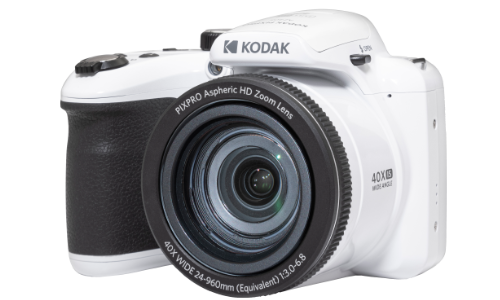
| Lens | 40x optical zoom, about 24-960mm equivalent, f/3.0-6.8. |
| Video | 1080p Full HD at 30 fps, plus 720p options. |
| Screen | Fixed 3-inch LCD, not a touchscreen. |
| Battery | Four AA batteries; about 300 stills with alkaline batteries. |
Who the Kodak PixPro AZ405 is really for
The AZ405 is for someone who wants reach more than refinement. A phone can crop into a distant subject, but it cannot give you a true 40x optical zoom. That is the reason this camera exists.
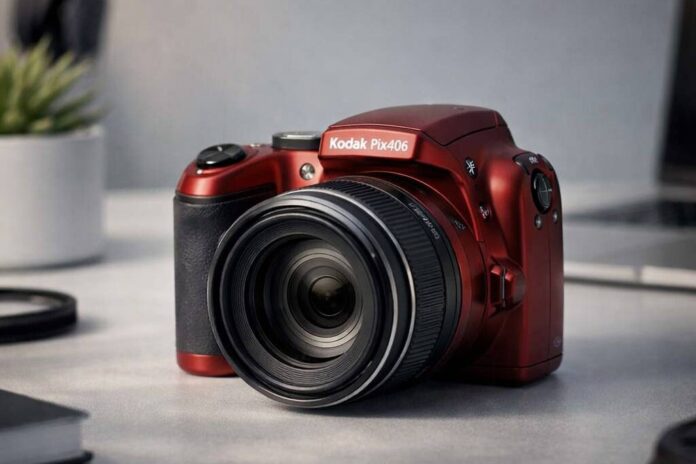
It makes sense for parents at outdoor school events, travelers who want to photograph distant buildings, casual birdwatchers, and beginners who like the shape of a traditional camera. The grip, zoom lever, mode dial, and clear buttons make it feel more like a camera than a phone.
It is less suitable for someone trying to grow into serious photography. There is no RAW capture, no interchangeable lens path, no electronic viewfinder, and no modern subject-recognition autofocus. If you want a camera to learn exposure deeply, a used mirrorless body may be a better long-term choice.
For buyers comparing Kodak’s own lineup, our Kodak PixPro camera guide gives broader context. The nearby Kodak PixPro AZ255 review is also useful if you want a cheaper, shorter-zoom alternative.
Design, handling, and controls
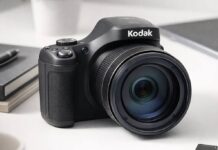
The AZ405 has the classic bridge-camera shape: a deep grip, a large fixed zoom lens, and a body that looks more serious than its price suggests. It is not pocketable, but it is easy to carry in a small bag.
The body is about 436 g before batteries and card. With four AA batteries installed, it feels noticeably heavier than a slim compact, but still much lighter than a DSLR and telephoto lens. The extra grip size is useful when you are zoomed far in.
The controls are straightforward. You get physical buttons, a zoom rocker, a mode dial, and a simple menu system. That matters for beginners because the camera does not bury every basic function behind a touchscreen interface.
Screen and viewfinder limitations
The rear LCD is fixed and not touch-sensitive. It is usable for basic framing, but it is not bright or flexible like the screen on a newer mirrorless or premium compact camera.
There is also no electronic viewfinder. In bright sun, that can be frustrating. Holding a long-zoom camera away from your face also makes it harder to keep steady at the long end of the lens.
Zoom range and lens performance
The 40x zoom is the AZ405’s headline feature. In full-frame terms, it covers roughly 24mm at the wide end to 960mm at full telephoto. That is a huge range for the price.
At 24mm equivalent, the camera works for landscapes, buildings, group photos, and general travel scenes. At the long end, it can frame distant wildlife, signs, architecture, or stage details that a phone would have to crop heavily.
The important word is daylight. The lens is f/3.0 at the wide end and f/6.8 at the telephoto end, so it gets slow when you zoom in. In dim light, the camera must raise ISO or use slower shutter speeds. Both can soften the image.
What full zoom is actually like
Full zoom is fun, but it is not magic. At 960mm equivalent, small hand movements become large framing jumps. Optical image stabilization helps, but a steady stance matters.
Sharpness also drops at the far end of the zoom. For small web images, the results can still be enjoyable. For heavy cropping or large prints, the limits become obvious.
Image quality in real use
The AZ405 uses a small 1/2.3-inch BSI CMOS sensor. That sensor size is common in budget superzoom cameras. It gives you reach and affordability, not premium low-light performance.
In bright outdoor light, the camera can produce pleasant 20MP images. Colors are lively, exposure is usually sensible, and there is enough detail for social sharing, small prints, and family albums.
Indoors, at dusk, or under mixed lighting, the image quality drops quickly. Noise increases, fine detail gets softer, and moving subjects become harder to freeze. This is the trade-off for getting a long zoom at a low price.
Best settings for cleaner results
Use the AZ405 in good light whenever possible. Keep ISO low, avoid extreme digital zoom, and brace the camera when using the long end of the lens.
If the subject matters, take more than one frame. Budget superzooms are less consistent than modern phones or mirrorless cameras, so a second shot often saves the moment.
Autofocus, speed, and subject tracking
The autofocus system is basic but not useless. The autofocus setup includes single AF, multi-AF, object tracking, and face detection. That is enough for slow subjects and everyday scenes.
In good light, the camera can focus on landscapes, posed people, travel details, and animals that are not moving too quickly. It is a reasonable casual camera for patient subjects.
Fast action is different. The camera can hesitate at long zoom settings, and it does not track like a modern mirrorless camera. If you want birds in flight, indoor sports, or kids running straight at the camera, expect missed shots.
How it feels for family and travel
For travel, the AZ405 feels responsive enough if you shoot deliberately. It is better for composing a distant subject than reacting instantly to a sudden moment.
For family use, it works best outdoors. School plays, gyms, and evening events are harder because the camera has to fight both low light and subject movement.
Video quality and limitations
The AZ405 records 1080p Full HD at 30 fps. It also offers lower-resolution modes, including 720p and a high-speed 640×480 option. That is usable for short casual clips, but still basic by 2026 standards.
For short family clips or simple travel videos, the footage is usable. Colors are fine, and the zoom gives you framing options that a phone may not match optically.
For serious video, the camera feels dated. There is no 4K, no microphone input, no advanced stabilization mode, and autofocus can be slow during recording. A recent phone will usually be easier for video.
Battery, storage, and ownership costs
The AZ405 runs on four AA batteries. That is unusual in a market full of USB-C rechargeable cameras, but it has real advantages. You can buy AA batteries almost anywhere, which is useful for travel and emergencies.
Alkaline battery performance is rated at about 300 shots, with about 120 minutes of 1080p video recording. In real use, battery life depends heavily on zooming, flash use, playback, and the type of AA batteries you use.
I would use good rechargeable NiMH AA batteries if you plan to shoot regularly. They cost more upfront but make the camera cheaper to own over time.
Memory cards and internal memory
The camera supports SD, SDHC, and SDXC cards up to 512GB. Kodak recommends Class 10 or faster cards. You do not need an expensive high-end card for this camera.
There is a small amount of internal memory, about 67MB, but treat that as emergency space only. Buy a normal SD card before you use the camera seriously.
Pros and cons
What I like
- 40x optical zoom gives far more reach than a phone.
- Simple controls are friendly for beginners.
- AA batteries are easy to replace while traveling.
- Optical image stabilization helps at longer focal lengths.
- Low price makes it accessible for casual shooters.
What I do not like
- Small sensor limits low-light image quality.
- Autofocus is basic for moving subjects.
- No RAW capture for deeper editing.
- Fixed non-touch screen and no viewfinder.
- Video is only basic 1080p, with no creator-focused audio tools.
Best alternatives to consider
If you want more zoom within Kodak’s lineup, read our Kodak PixPro AZ528 review. The AZ528 gives you a longer zoom and a more ambitious feature set, though it still has budget-camera limitations.
If you want better image quality instead of more zoom, consider a used premium compact from Sony, Canon, or Panasonic. You will usually lose telephoto reach, but gain better files, faster operation, and a more pocketable body.
If you mainly shoot video, a recent phone is often the better tool. It will usually give you easier sharing, stronger stabilization, and cleaner video in mixed light.
Final verdict
The Kodak PixPro AZ405 is worth considering if your main priority is affordable optical zoom. It gives beginners a simple way to photograph distant subjects without buying a mirrorless camera and a long lens.
It is not a camera for demanding image quality, low light, action, or serious video. The small sensor, basic autofocus, fixed screen, and 1080p-only video all matter.
At the right price, the AZ405 still makes sense for daylight travel, casual wildlife, and family use. Just buy it for the zoom, not because you expect it to outperform a good phone or a used higher-end camera in every situation.
Frequently asked questions
Is the Kodak PixPro AZ405 good for beginners?
Yes. The AZ405 is easy to understand, has a comfortable grip, and gives beginners a huge optical zoom range. It is best for daylight shooting and casual subjects.
How good is the zoom on the Kodak PixPro AZ405?
The 40x optical zoom is the main reason to buy it. It is very useful for distant subjects, but sharpness and stability are weaker at the longest zoom settings.
Does the Kodak PixPro AZ405 shoot 1080p video?
Yes. The AZ405 records 1080p Full HD video at 30 fps. It does not shoot 4K, and its video features are basic compared with a recent smartphone.
Does the Kodak PixPro AZ405 use AA batteries?
Yes. The AZ405 uses four AA batteries. Rechargeable NiMH AA batteries are the best option if you plan to use the camera often.
Is the Kodak PixPro AZ405 better than a smartphone?
For distant subjects, yes, because it has true 40x optical zoom. For low light, video, fast sharing, and everyday convenience, a good smartphone may be better.
Beginners who want a cheap long-zoom camera for daylight travel, family, and casual wildlife
You need fast autofocus, RAW files, strong low-light quality, or serious video features
Low
Kodak AZ528 for more reach, or a used Panasonic/Sony bridge camera for stronger performance
1080p only, basic autofocus, no creator-focused tools
Yes, if the price is low and optical zoom matters more than image quality in poor light