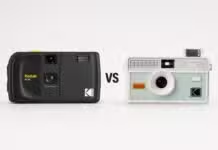

View full specs
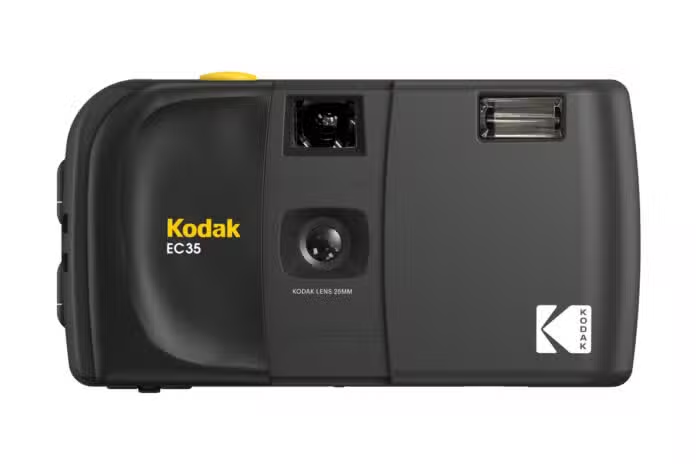
In this Kodak EC35 review, I am looking at one of the most interesting cheap film cameras of 2026: a $34.99 reusable 35mm point-and-shoot with a 25mm lens, built-in flash, manual film advance, and almost nothing to configure. It is not a disposable camera, and it is not a half-frame model like the Ektar H35. The EC35 uses the full 35mm frame and is designed to be reloaded roll after roll.
Before you order: the camera-only package includes a strap but no film or AA battery. Add a roll of 35mm film and one AA alkaline cell if you want to shoot immediately; the $44.99 bundle includes a 24-exposure roll of Kodak Ultramax 400 but still excludes the battery.
The Kodak EC35 was launched in July 2026 by Reto Production, which makes Kodak-branded cameras under license. It is too new for any honest reviewer to claim months of use. My assessment is therefore based on the verified design, official instructions, early sample images, and the practical consequences of shooting every frame at 1/100 second and f/10.
Kodak EC35 review: my quick verdict
The Kodak EC35 makes sense if you want the disposable-camera experience without throwing away the camera after one roll. Its $34.99 launch price is low, the sliding cover protects the lens, and its 102g body is easy to carry. The wide 25mm view should be particularly useful for groups, travel snapshots, parties, and casual street photography.
What you are buying is simplicity and character, not technical image quality. The two-element acrylic lens, fixed f/10 aperture, fixed 1/100-second shutter, and fixed focus leave no room to correct a difficult scene. The camera never compensates for changing light; film latitude and your decision to use flash carry the exposure.
| Buy the Kodak EC35 if… | Skip it if… |
|---|---|
| You want a new reusable film camera for about $35. | You expect autofocus, exposure control, or a sharp glass lens. |
| You like wide, casual full-frame 35mm snapshots. | You regularly photograph subjects closer than 1.5m. |
| You accept manual winding and the cost of developing film. | You want half-frame economy or dependable low-light results. |
| You want something less wasteful than buying repeated disposables. | You mainly want a retro look without paying for film and scans. |
My recommendation: buy it as a fun, low-stakes camera that can live in a day bag. Do not buy it as the cheapest route to consistently sharp photography. The camera is inexpensive; shooting film is not.
What the Kodak EC35 actually is
The EC35 is a reusable fixed-focus camera for standard 35mm film. It exposes the normal full 35mm frame rather than splitting each frame in two. A 36-exposure roll therefore gives about 36 photographs, not the roughly 72 frames produced by a half-frame camera such as the Kodak Ektar H35.
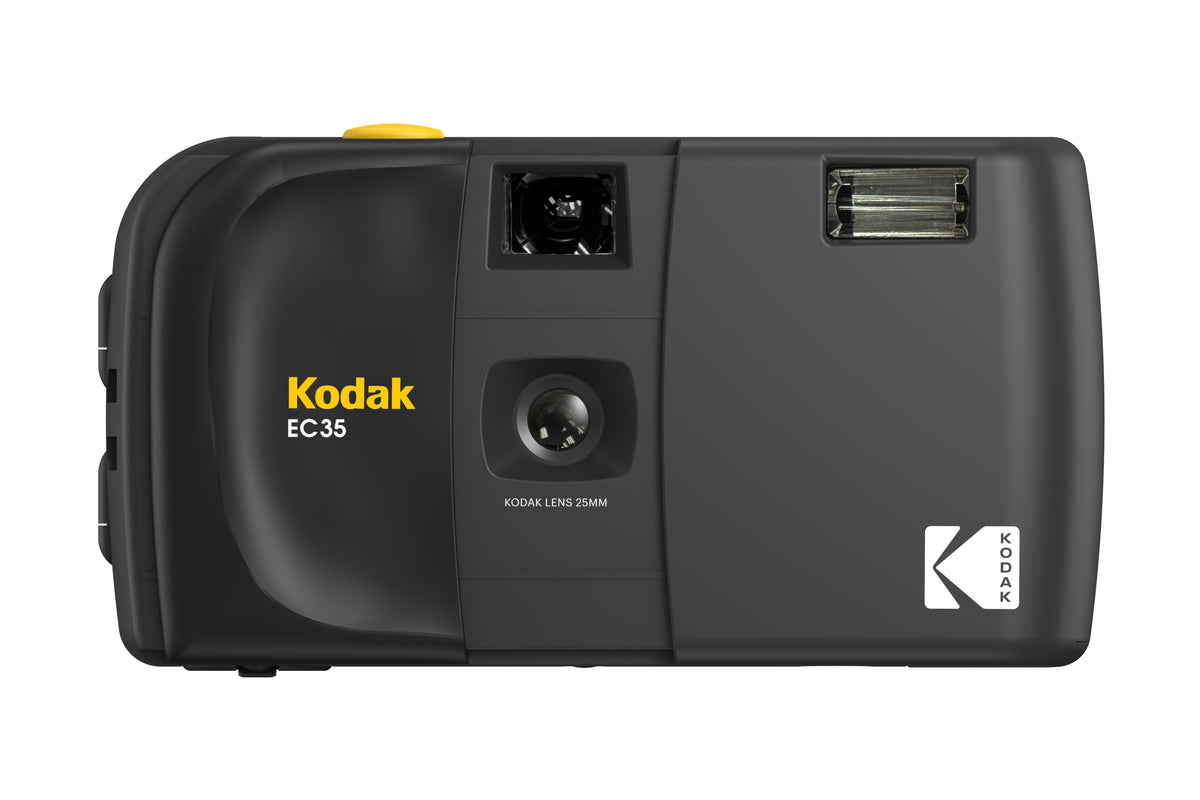
Its most distinctive feature is the curved sliding front cover. Open it to reveal the lens and prepare the camera for shooting. Close it to protect the acrylic optic and lock the shutter. That is more than retro decoration. Cheap reusable cameras are often carried without a case, so a cover that prevents scratches and accidental exposures is genuinely useful.
The branding deserves a precise explanation. The EC35 carries Kodak trademarks, but Reto Production is the company behind the camera. This is the same licensed Kodak ecosystem that includes the Ektar H35 and Snapic A1. That does not make the EC35 illegitimate; it simply tells you who designed, sells, and supports it.
See all seven Kodak EC35 colors
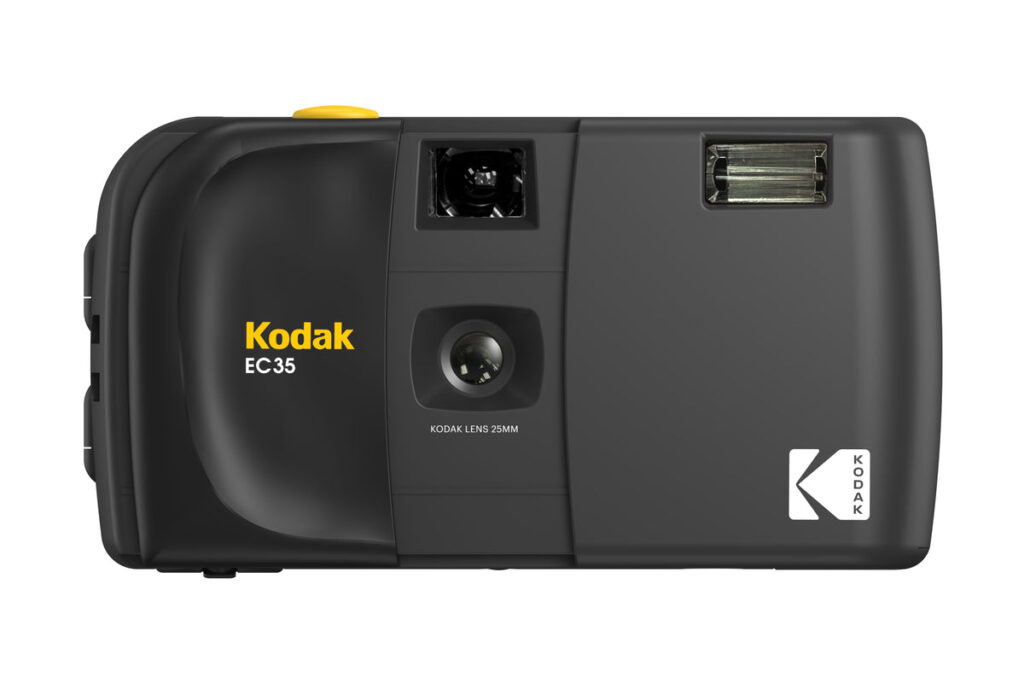
The EC35 is sold in seven finishes. The controls and specifications are identical, so this is purely a style decision.
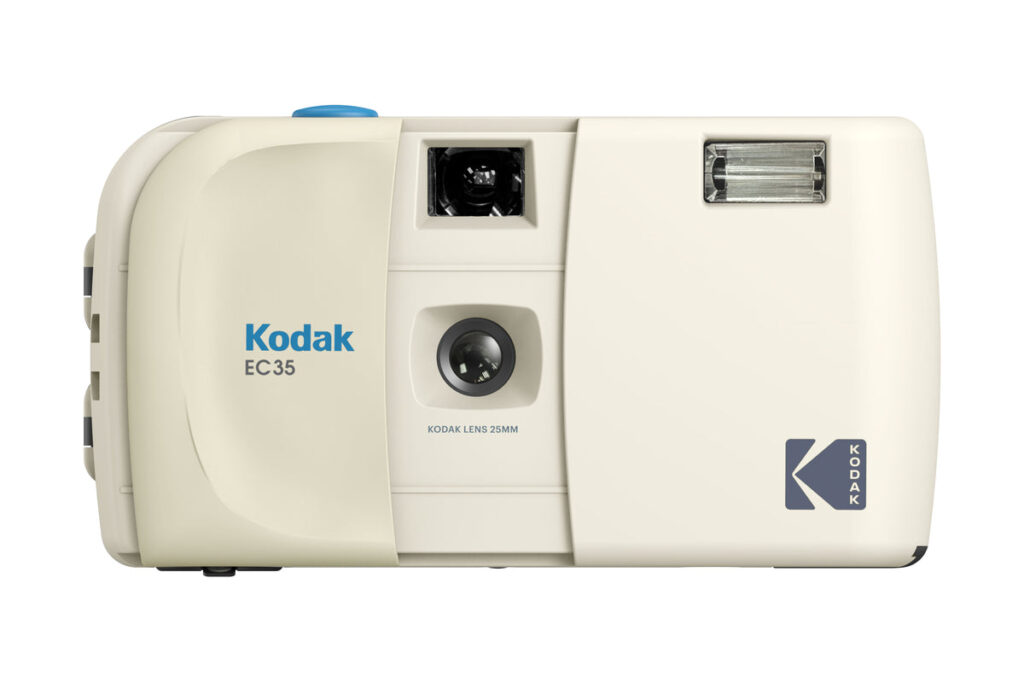
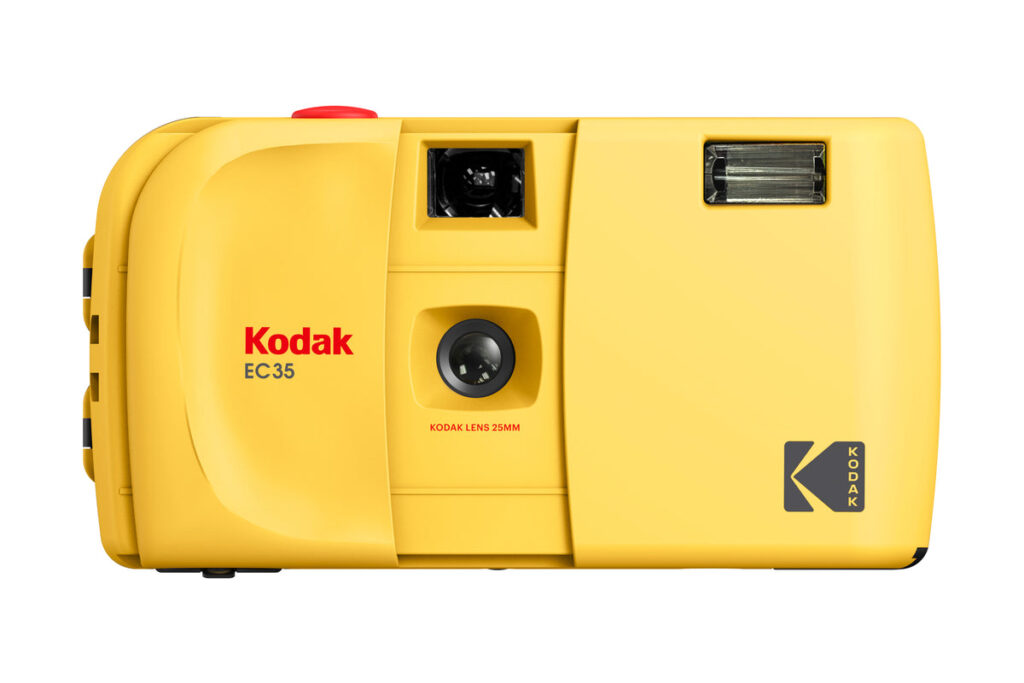
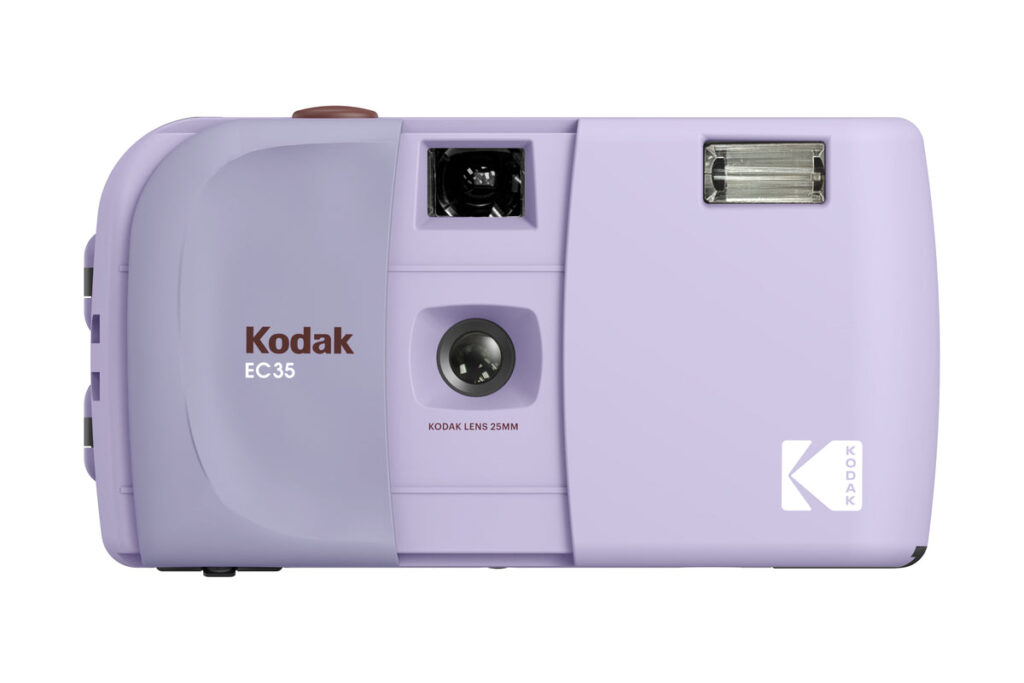
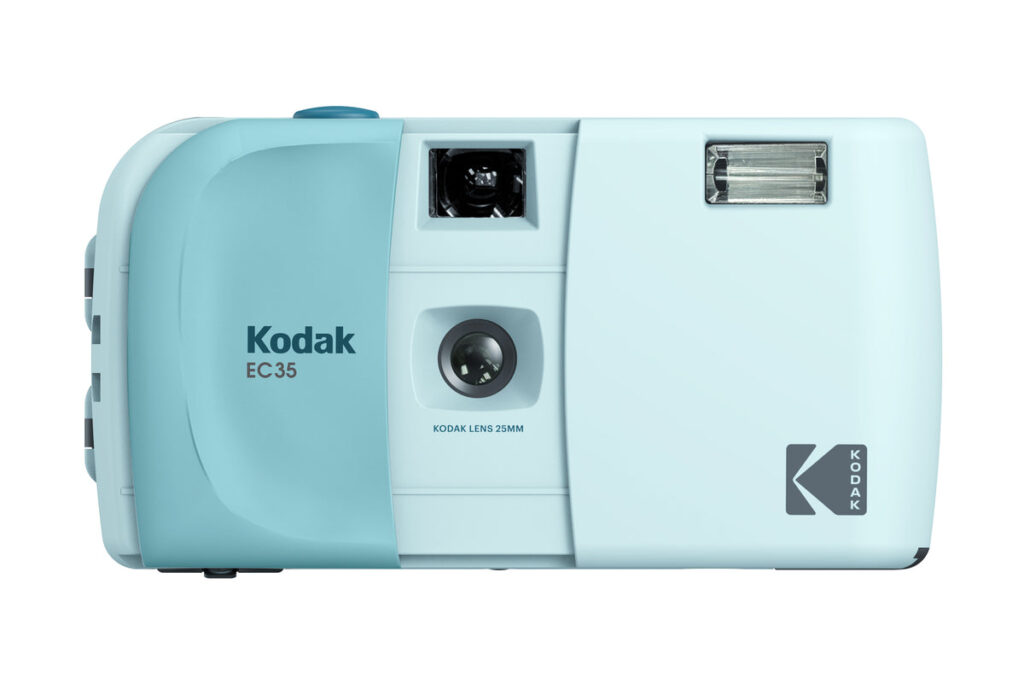
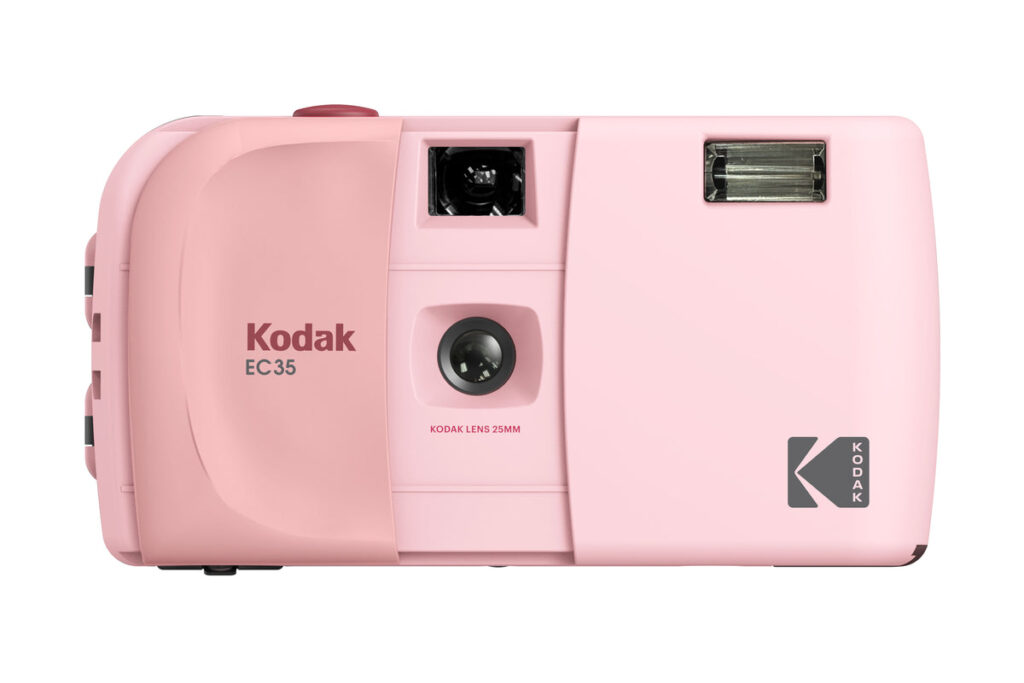
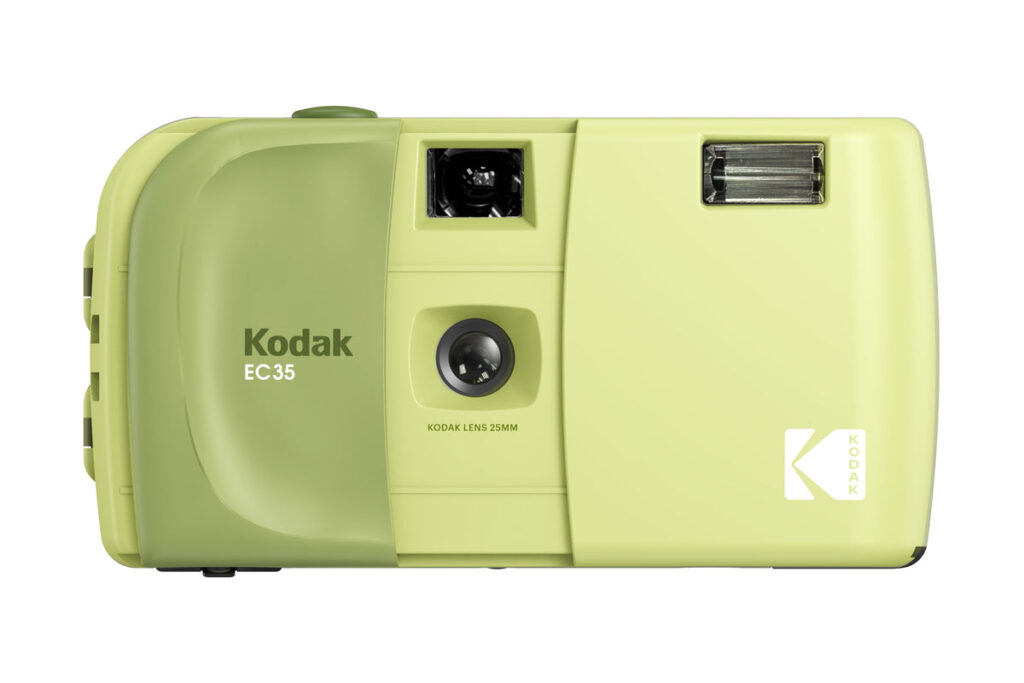
Kodak EC35 specifications
The basic specification is now confirmed on Reto’s official Kodak EC35 product page and in the camera’s quick-start guide.
| Specification | Kodak EC35 |
|---|---|
| Film format | Standard 35mm film, full-frame exposures |
| Lens | 25mm f/10, two-element optical-grade acrylic |
| Focus | Fixed focus; key subject should be at least 1.5m away |
| Shutter | Fixed 1/100 second |
| Exposure control | None; aperture and shutter speed do not change |
| Flash | Built in, manually switched |
| Battery | One AA alkaline battery for the flash |
| Film transport | Manual wind and rewind |
| Dimensions | 119 x 65 x 41.5mm |
| Weight | 102g |
| Body material | ABS plastic |
| Launch price | $34.99 camera only; film and battery excluded |
| Colors | Midnight Black, Vanilla White, Butter Yellow, Lavender, Powder Blue, Blush Pink, and Avocado Green |
A strap is included. At launch, Reto also lists a $44.99 bundle with a 24-exposure roll of Kodak Ultramax 400. The single-camera Amazon US listing is ASIN B0H3V8S5T1.
What f/10 and 1/100 second mean for your photographs
The EC35 does not meter the scene or choose an exposure. Every photograph is made at the same f/10 aperture and 1/100-second shutter speed. Film latitude helps, but choosing suitable light or using flash remains your responsibility.
That arrangement works best outdoors, where color-negative film has enough latitude to tolerate imperfect exposure. Indoors or after sunset, f/10 is very dark. The flash is not an optional flourish in those conditions; it is the camera’s only practical response to low light.
The 1/100-second shutter is fast enough to reduce ordinary hand shake with a 25mm lens, but it will not freeze quick movement. A person walking across the frame may show blur, and children running at a party will test it. Ask people to pause for a beat when the light is poor.
The wide 25mm lens is a better fit for groups and tight rooms than for flattering close portraits. More importantly, the official guide says the main subject should be at least 1.5m from the camera. There is no autofocus system to rescue a face held close to the lens. Keep some distance, especially for selfies or tabletop details.
Expected image quality
I would expect the EC35 to produce the kind of result people now deliberately seek from a disposable camera: obvious film grain, modest contrast, soft corners, and occasional exposure surprises. The lens uses two acrylic elements, not a multi-element glass design. That keeps the cost and weight down, but it also sets a sensible ceiling on detail and flare control.
The early released samples support the low-fi premise, but they are not enough for a final judgment on consistency. Lab scans, film stock, processing, and exposure all affect what you see online. I would not judge this camera from one heavily compressed sample, positive or negative.
The more useful question is whether you enjoy that uncertainty. If you want clean files and immediate feedback, the Kodak PIXPRO C1 is the more logical cheap Kodak option. If you want a physical negative and do not mind a few imperfect frames, the EC35 has a clearer personality.
Which film should you use in the Kodak EC35?
The safest first roll is ISO 400 color-negative film. Kodak’s own launch bundle pairs the EC35 with Ultramax 400, and that is a sensible match for mixed daylight, shade, and flash photography. ISO 400 does not make the camera automatic, but its latitude gives a beginner more room for exposure error.
For a bright summer trip, ISO 100 or 200 film is reasonable. For indoor social photography, stay with ISO 400 and use the flash at practical room distances. Faster ISO 800 film can help in weak light, but it does not replace the flash when the aperture is fixed at f/10.
- Kodak Ultramax 400: the easy general-purpose choice and the film in the official launch bundle.
- Kodak Gold 200: a good daylight option if most photographs will be outdoors.
- Black-and-white 35mm film: fully compatible, provided your chosen lab processes it.
- Other brands: also compatible. The camera accepts standard 35mm film and does not require Kodak film.
The EC35 has no DX-coded automatic ISO system. Changing film speed does not change the shutter or aperture; it only changes how sensitive the loaded film is to the fixed exposure.
Kodak EC35 vs disposable camera
The EC35 is best understood as a reusable alternative to a disposable camera. Both provide a fixed-focus, fixed-exposure experience with a simple lens and built-in flash. The difference is what happens after the roll.
With a disposable, the entire camera goes to the processor. With the EC35, you rewind and remove the film, then load another roll. Processing and scanning cost essentially the same either way, but the reusable body avoids buying a new shell every time.
The economics are not quite as simple as the $35 price suggests. The base EC35 does not include film or a battery, while a disposable arrives loaded. The reusable camera starts to make more financial sense over several rolls, assuming its film transport and flash remain reliable. If you only want one roll for a wedding table or vacation, a disposable may still be simpler.
Kodak EC35 vs Ektar H35 and Snapic A1
| Model | EC35 | Ektar H35 | Snapic A1 |
|---|---|---|---|
| Launch/list price | $34.99 | $49.99 | $99 |
| Frame format | Full 35mm frame | Half frame | Full 35mm frame |
| Lens | 25mm f/10, 2-element acrylic | 22mm f/9.5, 2-element acrylic | 25mm f/9.5, 3-element glass |
| Focus | Fixed, 1.5m or farther | Fixed | Two zones: 0.5-1.5m and 1.5m-infinity |
| Film transport | Manual | Manual | Automatic |
| Main advantage | Lowest price and sliding lens cover | Twice as many photographs per roll | Better lens, closer focus, and more automation |
The EC35 is the price-first choice. The H35 is the film-economy choice because a roll lasts roughly twice as long. The Snapic A1 is the quality-and-convenience choice, with a glass lens, closer focusing option, and automatic film handling.
The older Kodak i60 sits closer to the EC35 in spirit: a simple reusable full-frame film camera with manual transport. I would favor the EC35 when its lower price and lens cover matter. I would not replace a working reusable film camera merely to gain the EC35’s styling. Our Kodak EC35 vs i60 comparison examines the focal-length, focus-distance, handling, and price differences directly.
How to avoid wasting your first roll
The camera is simple, but loading errors can ruin an entire roll. Insert the film leader into the take-up spool, then confirm that the sprocket teeth engage the film perforations. Close the back and alternate shutter releases with winding until the counter reaches 1. Watch for normal tension rather than forcing the advance wheel.
Before each exposure, open the lens cover fully and keep your fingers away from the lens, viewfinder, and flash. Keep the key subject at least 1.5m away. Indoors or in dim and cloudy conditions, switch on the flash and wait for the red ready light.
Reto’s support advice describes a flash subject at about arm’s length, while the quick-start guide specifies a minimum subject distance of 1.5m. Those instructions are not perfectly aligned. I would follow the more conservative 1.5m focus limit, keep the subject within a small room rather than across a hall, and judge the first developed roll before trusting important photographs.
After the final frame, press the rewind-release button on the bottom before turning the rewind crank clockwise. Never open the back until the film has returned to its lightproof cassette. If the advance or rewind control resists, stop rather than forcing it. The official EC35 support page includes the quick-start guide and loading tutorial.
Who should buy the Kodak EC35?
The EC35 is a convincing first film camera for someone who values fun over control. I can see it working well for a teenager documenting summer, a digital photographer who wants a deliberately imperfect side camera, or a group of friends who would otherwise keep buying disposables.
It is also a sensible gift because there is little technical setup. Include a roll of ISO 400 film and an AA battery, though. Giving only the camera creates a $35 object that cannot make a photograph out of the box.
More serious beginners should think carefully. A tested autofocus compact or inexpensive 35mm SLR can teach more and produce sharper results, but used cameras introduce condition risk and often cost much more. The EC35 offers a new body, a straightforward support path, and no vintage-camera repair gamble.
Final verdict: is the Kodak EC35 worth it?
Yes, provided you want what it actually offers. The Kodak EC35 is a cheap reusable film camera with attractive retro styling, a genuinely useful lens cover, and a wide 25mm perspective. At $34.99, it lowers the cost of trying full-frame 35mm photography without pretending to be a precision camera.
Its limits are equally clear. The lens is acrylic, exposure is fixed, focus starts at 1.5m, film transport is manual, and every roll adds processing costs. For photographers who regard softness and unpredictability as defects, the EC35 will be frustrating. For photographers who regard them as part of the experience, it may be one of the most appealing impulse-buy film cameras of the year.
Kodak EC35 alternatives
The main alternatives to the Kodak EC35 are Kodak Ektar H35, Kodak i60, Kodak M35, Ilford Sprite 35-II, Kodak FunSaver, Kodak Snapic A1. Compare autofocus, stabilization, video limits, lens choice and current price before deciding which camera fits you best.
Frequently asked questions
Is the Kodak EC35 a disposable camera?
No. It is a reusable 35mm camera. You rewind and remove each finished roll, then load another standard 35mm film cartridge.
Is the Kodak EC35 a half-frame camera?
No. It uses the normal full 35mm frame. The Kodak Ektar H35 is the half-frame alternative and produces roughly twice as many photographs from the same roll.
Does the Kodak EC35 include film?
The $34.99 camera-only package excludes film and the AA battery, although it includes a strap. A launch bundle with a 24-exposure roll of Kodak Ultramax 400 is listed separately.
Does the Kodak EC35 need a battery?
One AA alkaline battery powers the built-in flash. Film winding and rewinding are manual.
Does the Kodak EC35 autofocus?
No. It is fixed focus. The official quick-start guide says to place the main subject at least 1.5m from the camera.
What film works in the Kodak EC35?
It accepts standard 35mm film from Kodak or other brands. ISO 400 color-negative film is the easiest general-purpose starting point.
How many photographs does the Kodak EC35 take?
The number depends on the roll. A 24-exposure film provides about 24 photographs, while a 36-exposure roll provides about 36.
Film-curious beginners and casual photographers who want a cheap reusable alternative to disposables.
You need autofocus, exposure control, close focus, technical sharpness, or low ongoing costs.
Low controls burden; film loading, flash judgment, and development add friction.
Kodak Ektar H35 for half-frame economy, Snapic A1 for a glass lens and automation, or a tested autofocus compact.
No video; this is a stills-only 35mm film camera.
Yes near $35 if you want low-fi full-frame film snapshots and accept fixed exposure.