
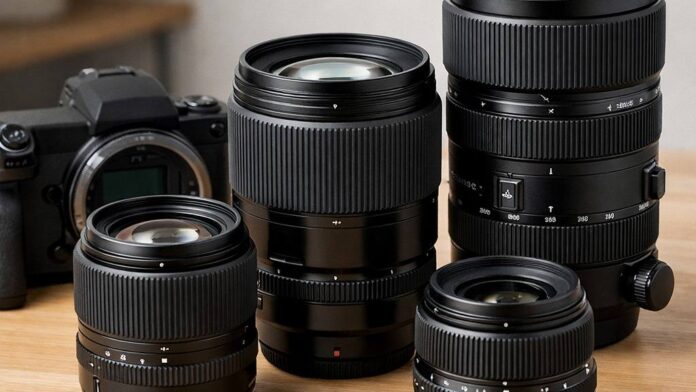
Choosing the best Fujifilm GFX lenses is less about chasing specs and more about matching glass to the way you actually shoot. From portraits and landscapes to travel and commercial work, this guide breaks down the options I’d consider first and explains where each lens really shines in the field.
How to choose the right GFX lens for your work
Match focal length to the way you shoot
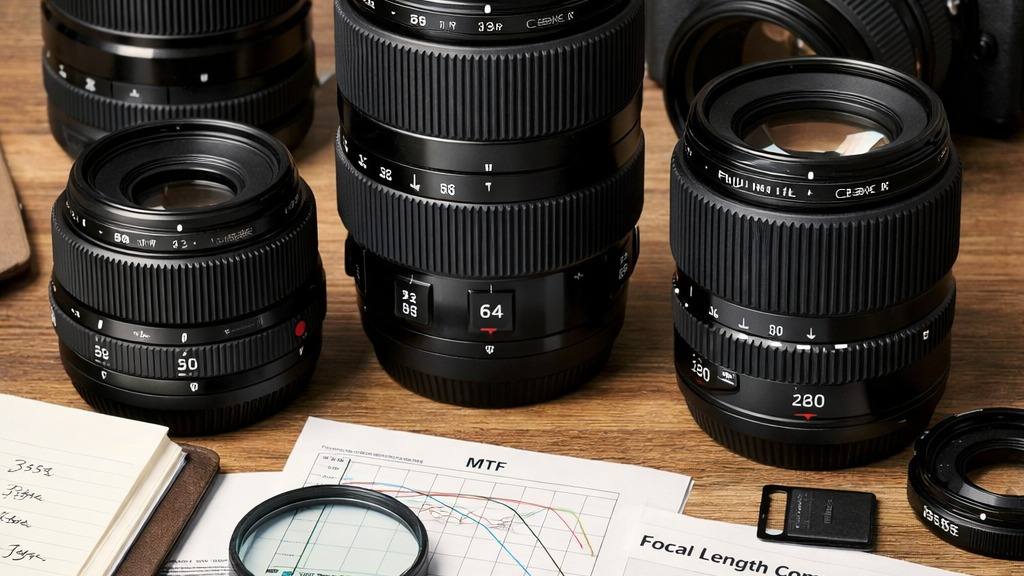
The first thing to consider when picking from the best Fujifilm GFX lenses is how your subject and shooting style interact with focal length. With GFX, focal lengths are a bit different than what you might be used to on full frame or APS-C. The sensor is physically larger, so a 63mm lens on GFX gives a similar field of view as a classic 50mm on full frame. This is key when choosing your lens for portraits, landscapes, or general use.
Once you know which focal lengths fit your subjects, it helps to see the whole lineup in one place before narrowing things down. A Complete List of Fujifilm GF Lenses and Their … makes it easier to compare your options and spot which lenses best match your shooting priorities.
Beyond focal length, it also helps to think about when and where you shoot most often, since available light can change which GFX lens feels most practical day to day. If evening streets, interiors, or dim event spaces are part of your workflow, these Low light photography tips can help you choose more confidently.
Think about your main subjects. Do you mostly shoot people, dramatic wide landscapes, or tight architectural scenes? Each genre has a natural set of focal lengths that just feel right. For example, 80mm to 110mm lenses excel for portraits, giving flattering perspective and beautiful background separation. If you’re drawn to landscapes, a 23mm or 30mm lens (roughly 18mm and 24mm full frame equivalent) will help capture vast scenes without distortion. For travel or everyday use, a “normal” focal length like 45mm or 63mm offers a familiar and versatile perspective.
Decide how much size, speed, and budget matter
Once you know your preferred focal lengths, weigh the importance of lens speed (maximum aperture), physical size, and price. The fastest GFX primes, such as the GF 80mm f/1.7, are larger and pricier but create creamy backgrounds and handle low light beautifully. Slower lenses like the GF 50mm f/3.5 are much more compact and less expensive, making them a favorite for travel or when you want to keep your kit light.
Budget plays a big role with GFX, as the system is an investment. However, even the “entry-level” GF lenses deliver outstanding quality. Ask yourself: do you need weather sealing, or will you work mostly indoors? Do you shoot handheld often, or are you usually on a tripod? These questions will guide you towards the right balance between speed, portability, and cost. If you need a flexible all-purpose zoom, the GF 32-64mm f/4 is a safe bet. But for pure creative impact, the primes still have the edge.
Best Fujifilm GFX lenses for portraits
Why medium format portrait lenses feel different
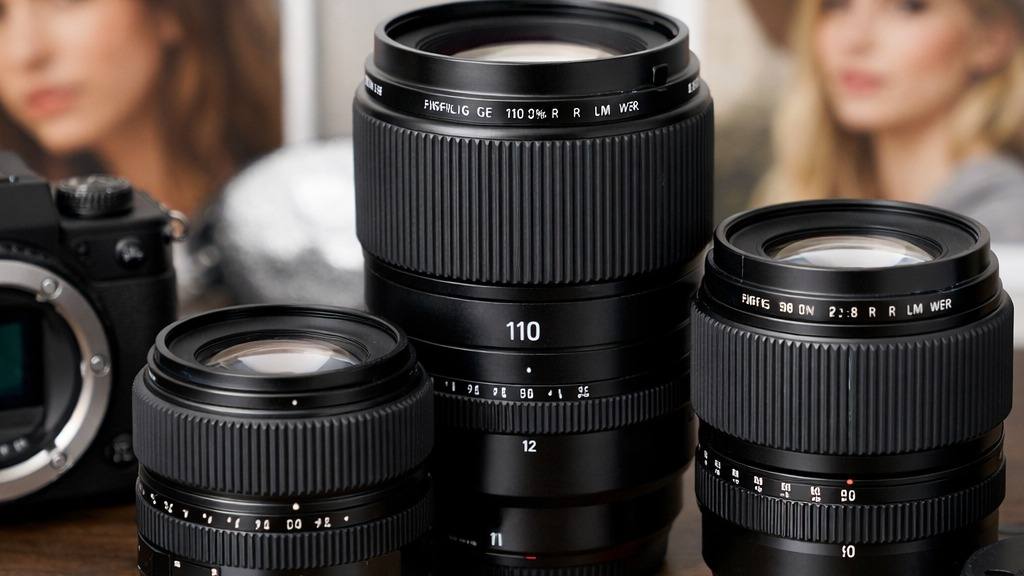
Portraits are where the Fujifilm GFX system really stands out. The larger sensor gives a unique look: sharp eyes, gentle falloff, and a smooth yet dimensional rendering. The best Fujifilm GFX portrait lens for most people is the GF 110mm f/2 R LM WR. This lens is a staple in my kit for studio and location work. Its focal length (roughly equivalent to 87mm on full frame) delivers flattering compression, and at f/2, the background melts away while keeping plenty of detail in your subject.
If you want even more background blur or work in lower light, the GF 80mm f/1.7 R WR is the fastest native portrait lens for GFX. It’s a bit shorter, framing more of your subject, and brings an almost cinematic depth to headshots and environmental portraits. Both of these lenses are razor sharp wide open, but the 80mm has a touch more character in the bokeh and transitions – something many portrait photographers seek.
For those who prefer a little more working distance, the GF 120mm f/4 Macro R LM OIS WR doubles as an outstanding portrait lens. It’s a macro, so it’s slower and heavier, but the rendering is gorgeous and the optical stabilization is a real bonus for handheld work. Lastly, don’t overlook the GF 63mm f/2.8 R WR for travel and candid portraits. It’s closer to a classic 50mm, so you get a more natural, “in the scene” perspective.
- GF 110mm f/2: Best for classic head and shoulders, creamy backgrounds, studio or location work.
- GF 80mm f/1.7: Fastest for low light, artistic shallow depth of field, environmental portraits.
- GF 120mm f/4 Macro: Versatile for tight portraits and macro detail, stabilized for handheld use.
- GF 63mm f/2.8: Compact and discreet, great for travel portraits and street photography.
Choosing between these comes down to how much compression, subject isolation, and portability you want. In my own work, the 110mm is the most “medium format” feeling lens for portraits, while the 80mm offers a dreamier, more experimental character for personal projects.
Best Fujifilm GFX lenses for landscapes and architecture
What to look for in a wide GFX lens
Landscape and architectural photographers demand edge-to-edge sharpness, minimal distortion, and precise color rendering. The best Fujifilm GFX landscape lens should also handle flare and chromatic aberration gracefully, since you’ll often shoot in challenging light. Wide angle options in the GF lineup are excellent, and each has its own personality.
The GF 23mm f/4 R LM WR is the go-to ultra-wide for GFX, roughly equivalent to an 18mm on full frame. It’s sharp all over, with minimal distortion, making it perfect for interiors and grand landscapes. The lens is weather-sealed, which is a must for outdoor work, and the rendering is crisp without feeling clinical.
For a more “classic” wide field, the GF 30mm f/3.5 R WR (about 24mm equivalent) strikes a beautiful balance. It’s smaller and lighter than the 23mm, making it easier to carry for long hikes or travel. The 30mm is incredibly sharp and handles sunstars and backlighting with ease, which matters when shooting sunrises or modern glass architecture.
The GF 45mm f/2.8 R WR (36mm equivalent) is a favorite for landscape photographers who want a little more versatility. It’s not ultra-wide, but it can double as a walkaround lens and still deliver outstanding sharpness and color.
- GF 23mm f/4: Best for sweeping vistas, interiors, and architecture with demanding edge-to-edge quality.
- GF 30mm f/3.5: Ideal for travel landscapes, lighter kit, and fieldwork – superb sharpness and handling.
- GF 45mm f/2.8: Versatile for both wide scenes and environmental portraits, compact and fast focusing.
If you use filters, all three of these lenses accept screw-in filters, unlike some ultra-wide zooms. And for the ultimate in technical control, keep an eye on the GF tilt-shift lenses, which are designed specifically for architecture but come at a premium price.
Best Fujifilm GFX lenses for travel and everyday shooting
Travel and everyday photographers need lenses that combine versatility, portability, and robust weather sealing. The best Fujifilm GFX travel lens is often the one you’ll actually bring with you, so size and weight really matter. My top pick is the GF 50mm f/3.5 R LM WR. This lens is the smallest and lightest native GF lens, giving a 40mm equivalent field of view – just wide enough for street scenes, but natural for portraits and details. Autofocus is quick, and it balances perfectly on the smaller GFX bodies.
If you want a little more flexibility, the GF 32-64mm f/4 R LM WR zoom covers everything from wide to short portrait perspectives in a single (but not tiny) lens. It’s weather-sealed, optically excellent, and the f/4 aperture is fine for most travel scenarios. For many photographers, this is the only lens they need for an entire trip.
For those who prefer a slightly wider normal lens, the GF 45mm f/2.8 is another strong option. It offers a 36mm equivalent angle of view, balances well on the camera, and lets you work in lower light thanks to the faster aperture.
- GF 50mm f/3.5: The best compact GFX lens, ideal for walkaround and travel, excellent sharpness and color.
- GF 32-64mm f/4: Flexible zoom for all-in-one travel, sharp across the range, weather-sealed.
- GF 45mm f/2.8: Slightly wider, fast and compact, great for street and urban exploration.
With compact digital cameras making a comeback in 2026, it’s nice to see Fujifilm GFX bodies and lenses trending lighter and more portable. For daily use, sticking with the 50mm or 45mm primes gives you the full medium format look without weighing you down. These lenses prove that you do not have to compromise image quality for convenience on the GFX system.
Best Fujifilm GFX lenses for studio, product, and commercial work
Studio, product, and commercial photography demand a different approach from portrait or travel work. Consistency, edge-to-edge sharpness, and precise rendering matter far more than dreamy bokeh or compact size. The best Fujifilm GFX lenses for these jobs are purpose-built for detail, color accuracy, and minimal distortion. While the GFX system is already prized for its resolution, choosing the right lens can make or break your results when clients expect perfection.
For most controlled-lighting environments, autofocus speed is less important than performance at f/8-f/16. Stopping down is routine to maximize depth of field and sharpness across the frame, especially for products, artwork, and catalog work. Color rendering and microcontrast also become critical, since subtle differences can affect branding and post-production workflows.
When macro performance matters more than speed
The best Fujifilm GFX studio lens for close-up and product work is the GF 120mm f/4 Macro R LM OIS WR. This lens delivers true 1:2 macro magnification, which is enough for most product and fine art reproduction. It is razor sharp from wide open, but most of my studio work is shot between f/8 and f/16, where it excels. Its optical image stabilization helps with handheld shots, but on a tripod its real strength is in rendering fine texture and color accuracy.
If you need even greater magnification, extension tubes are available for the GFX system, and the 120mm Macro pairs well with them. The autofocus is slower than shorter primes, but in studio conditions, I almost always use manual focus anyway for pinpoint accuracy. For jewelry, watches, and electronics, this lens is hard to beat. It also doubles as an excellent short telephoto for portraits with a flatter perspective and clinical sharpness.
For larger items or flat artwork, the GF 50mm f/3.5 R LM WR is another top pick among Fujifilm GF lenses for product photography. It is extremely sharp, distortion-free, and compact. Its minimum focusing distance is not true macro, but it is close enough for most tabletop setups and gives more working space when photographing paintings or prints.
Other top choices for commercial and studio work:
- GF 110mm f/2 R LM WR: Not a macro, but delivers beautiful rendering for commercial portraiture or fashion with outstanding sharpness and falloff.
- GF 32-64mm f/4 R LM WR: When you need flexibility for group shots, interiors, or catalog sets, this zoom is remarkably sharp and color-accurate throughout its range.
- GF 23mm f/4 R LM WR: For wide product scenes, interiors, or environmental commercial images, this lens is rectilinear and extremely well-corrected.
Ultimately, the best GFX macro lens depends on your subject size and working distance, but the 120mm Macro remains my default for most critical studio work.
Prime or zoom lenses on the GFX system
The debate between GFX prime vs zoom lenses is ongoing, but the GFX system offers strong options in both camps. Traditionally, medium format shooters leaned heavily on primes because early zooms were slow or lacked sharpness. Fujifilm’s GF zooms, however, are designed to compete head-to-head with prime lenses on resolution.
Fujifilm GF prime lenses like the 63mm f/2.8, 80mm f/1.7, and 110mm f/2 are world-class for sharpness, low distortion, and pleasing rendering. They excel when you need maximum image quality, subject isolation, or low-light performance. Primes also tend to be lighter, though not always smaller, than their zoom counterparts on GFX.
For event, travel, or commercial shooters who value flexibility, the Fujifilm GF zoom lenses are surprisingly capable. The 32-64mm f/4 is my go-to for any situation where I need to move quickly or frame precisely without swapping lenses. Its sharpness at every focal length rivals many primes. The 45-100mm f/4 and 100-200mm f/5.6 both deliver consistent results for portraits, events, or landscape work.
In practical terms, primes offer the best possible image quality and wider apertures for creative depth of field. Zooms give you speed and versatility, especially when you cannot control your position in the studio or on location. For most GFX shooters, I recommend at least one fast prime and one top-tier zoom to cover your specific needs. The modern GF zooms are not a compromise – they are a real asset.
Are third party and adapted lenses worth using on GFX
The GFX sensor’s large size makes it tempting to adapt lenses from other medium format or full frame systems. There is a growing market for third party lenses for Fujifilm GFX, as well as manual focus classics and technical lenses. Using adapted lenses on GFX can open creative possibilities, but there are trade-offs to consider.
First, almost all adapted lenses will be manual focus only, with no electronic aperture control or EXIF data. This slows down workflow and can reduce consistency if you shoot in fast-paced environments. However, for studio or controlled work, this is often acceptable. Some older medium format glass (from Mamiya, Pentax 645, or Hasselblad V) covers the GFX sensor beautifully, especially if you want a specific rendering or vintage look.
Laowa, Mitakon, and other third parties now offer native GF mount lenses, often filling gaps like ultra-wides or extreme macros. The Laowa 17mm f/4 GFX Zero-D, for example, is one of the widest options available and a favorite for architecture and interiors. While manual focus, its optical design is tailored for digital sensors and delivers excellent sharpness.
Using manual lenses for GFX is rewarding for personal projects, fine art, or when chasing a particular character absent from modern glass. Still, for mission-critical commercial work, I find myself returning to native GF lenses for their reliability, autofocus, and color consistency. Adapted lenses are best as creative tools, not as your daily drivers for client deadlines.
My final recommendations by shooting style and budget
Choosing which Fujifilm GFX lens to buy depends on your shooting style and what you value most: speed, flexibility, or ultimate image quality. Here are my personal recommendations, tested in real-world scenarios and tailored to different needs and budgets.
- Starter kit / budget-conscious: The GF 50mm f/3.5 R LM WR is compact, sharp, and affordable for a medium format prime. Pair it with the GF 32-64mm f/4 R LM WR if you need a versatile zoom that covers most shooting situations.
- Portrait and people photography: The GF 80mm f/1.7 R WR is the definitive choice for shallow depth of field and creamy bokeh. If you need a longer reach, the GF 110mm f/2 R LM WR is legendary for its rendering.
- Landscape and travel: The GF 23mm f/4 R LM WR and GF 45mm f/2.8 R WR are lightweight, weather-sealed, and optimally sharp for wide vistas. The 32-64mm zoom is also an excellent all-in-one solution.
- Studio, product, and commercial: The GF 120mm f/4 Macro R LM OIS WR is my pick for product work. Add the 50mm or 63mm primes for versatility, or the 32-64mm zoom for larger scenes or catalog shoots.
- Creative / adapted lens enthusiasts: Try the Laowa 17mm f/4 GFX Zero-D or a vintage Pentax 67 lens with an adapter for unique looks. Just be aware of workflow limitations with manual focus and aperture.
For most photographers, starting with one versatile zoom and a fast prime gives the best balance. As your needs evolve, you can add specialty lenses for macro, wide angle, or portrait work. If budget is no object, building a kit with the 23mm, 50mm, 80mm, and 120mm macro covers nearly every professional scenario. If you need a full list of specifications for every GF lens, refer to A Complete List of Fujifilm GF Lenses and Their Specifications.
Frequently asked questions
What is the best all around Fujifilm GFX lens?
If I had to choose only one lens for everyday use, the GF 32-64mm f/4 R LM WR is the most versatile. It covers wide to short telephoto, is weather-sealed, and delivers sharpness on par with many primes. The 50mm f/3.5 is another excellent choice if you want a compact, walkaround prime.
Are Fujifilm GFX zoom lenses good enough for professional work?
Yes, the latest GF zooms are among the sharpest and most color-accurate medium format zooms ever made. For most applications, they match or exceed the performance of classic primes and are absolutely professional-grade.
Which GFX lens is best for portraits?
The GF 80mm f/1.7 R WR is my top pick for portraits, with outstanding subject separation and softness. The 110mm f/2 is also a favorite for its flattering compression and exceptional sharpness.
Can you use adapted full frame lenses on Fujifilm GFX cameras?
Yes, you can adapt many full frame and medium format lenses to GFX bodies. However, not all will cover the full sensor without vignetting, and all will be manual focus only. Results can be excellent for creative work, but native GF lenses still offer the best reliability and performance for most photographers.