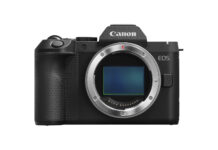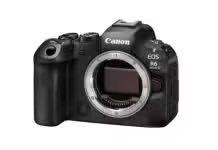

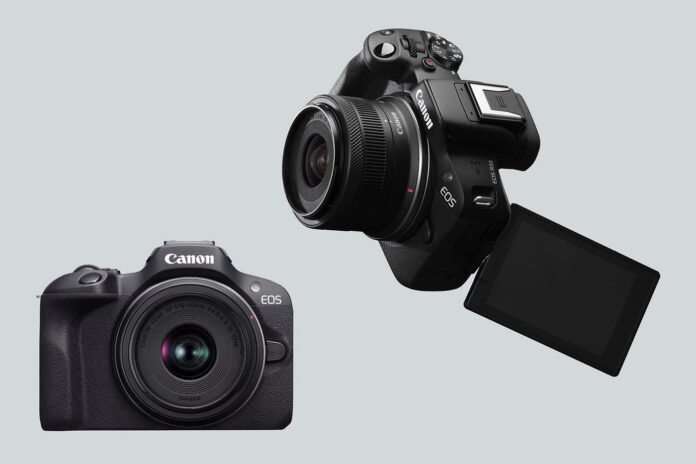
Choose the Canon R50 if you can afford its complete kit and want easier focusing on moving people or pets, a touchscreen, or regular video recording. Choose the R100 when the saving is substantial for your budget and you mainly photograph still subjects and accept simpler controls. The R50 buys you more help getting the shot, not a meaningful jump in megapixel count.
The important word is kit. An inexpensive R50 body-only listing is not directly comparable with an R100 that includes a lens. This guide compares both cameras with the RF-S18–45mm F4.5–6.3 IS STM, then looks at when spending the difference on something else makes more sense.
This is a research-based buying guide, not a hands-on comparison. Specifications were checked against Canon documentation on October 27, 2026. Our recommendations are editorial judgments about those capabilities and the buying decision, not measured autofocus or image-quality test results. As an Amazon Associate, we earn from qualifying purchases.
Jump to the full side-by-side specifications.
The quick decision
| Your main use | Start with | Why |
|---|---|---|
| Children, pets and unpredictable family moments | R50 | More advanced subject detection and tracking, plus easier touch control. You still need enough light and an appropriate shutter speed. |
| Travel scenery, buildings and posed daylight photographs on a tight budget | R100 | Its main compromises matter less here. A lower complete-kit cost can leave money for the trip and useful equipment. |
| Self-filming, frequent video or awkward camera angles | R50 | A fully articulating touchscreen and a more useful 4K focusing/framing combination. |
| Posed portraits with a strict total budget | Compare the whole setup | An R100 with a suitable portrait lens may solve a different problem from an R50 with only the standard kit zoom. |
| Long sports sequences or distant wildlife as the main purpose | Look beyond the basic kits | The 18–45mm lens lacks substantial telephoto reach, and headline burst rates do not make either kit a dedicated sports setup. |
Compare these two kits, not two headline prices
Start with the same lens and the same condition. A used camera, a refurbished manufacturer offer, a new body and a seller bundle with several accessories can all appear in the same shopping search. They are different purchases.
These destinations identify the lens kits, not body-only cameras. Check the selected variation, condition, seller, return terms and delivery for your US address. Offers can change. We are not quoting a current price or promising stock.
Use this simple comparison before choosing:
- Write down the checkout price of each new 18–45mm kit, including shipping and tax where applicable.
- Add equipment you actually need to start, such as a compatible memory card. Do not add every accessory a seller happens to bundle.
- Subtract the R100 total from the R50 total. Ask what that extra spend buys for your pictures: better handling, tracking and video—or equipment you need more urgently?
A “new and used from” price is not necessarily the price of a new kit. If the selected new offer hides its price until later in the shopping process, do not compare it with the other camera’s lowest mixed-condition price.
Our buying rule is straightforward: lean toward the R50 when the extra cost stays within your complete-camera budget and its handling or video advantages match your use. Lean toward the R100 when its saving is what makes owning a suitable camera setup possible. Neither decision needs to be justified by pretending one camera is better at everything.
Canon R50 vs R100: specifications side by side
Both columns compare the cameras with the same 18–45mm kit lens. This is a specification comparison, not a measured performance score.
Sensor, lenses and photographs
| Feature | Canon EOS R50 | Canon EOS R100 |
|---|---|---|
| Camera type | APS-C mirrorless | APS-C mirrorless |
| Sensor dimensions | 22.3 × 14.9mm | 22.3 × 14.9mm |
| Effective resolution | Approx. 24.2MP | Approx. 24.1MP |
| Processor | DIGIC X | DIGIC 8 |
| Lens mount | Canon RF; accepts RF and RF-S lenses | Canon RF; accepts RF and RF-S lenses |
| Adapted lenses | EF/EF-S with EF-EOS R adapter; not EF-M | EF/EF-S with EF-EOS R adapter; not EF-M |
| Kit compared here | RF-S18–45mm F4.5–6.3 IS STM | RF-S18–45mm F4.5–6.3 IS STM |
| Kit angle of view | Approx. 29–72mm full-frame equivalent | Approx. 29–72mm full-frame equivalent |
| Still-photo formats | JPEG, HEIF, RAW and C-RAW | JPEG, RAW and C-RAW; no HEIF |
| Standard still-photo ISO | 100–32,000; expanded 51,200 | 100–12,800; expanded 25,600 |
| In-body stabilization | No; the selected kit lens has optical IS | No; the selected kit lens has optical IS |
Focus, speed and controls
| Feature | Canon EOS R50 | Canon EOS R100 |
|---|---|---|
| Still-photo autofocus | Dual Pixel CMOS AF II | Dual Pixel CMOS AF |
| Subject detection | People, animals and vehicles | Human face and eye detection |
| Maximum continuous shooting | 12 fps electronic first-curtain; 15 fps electronic | 6.5 fps One-Shot AF; 3.5 fps Servo AF |
| RAW burst depth | Approx. 7 frames at maximum rates in Canon reference tests | Approx. 6 frames at 6.5 fps in Canon reference tests |
| Electronic viewfinder | 0.39-inch OLED; approx. 2.36 million dots | 0.39-inch OLED; approx. 2.36 million dots |
| Rear screen | 3-inch vari-angle touchscreen; approx. 1.62 million dots | 3-inch fixed non-touch screen; approx. 1.04 million dots |
| Built-in flash | Yes; manually raised | Yes; manually raised |
| Accessory shoe | Multifunction shoe; AD-E1 needed for accessories not designed for it | Conventional shoe; not compatible with multifunction-shoe accessories |
Video and connections
| Feature | Canon EOS R50 | Canon EOS R100 |
|---|---|---|
| 4K recording | Up to 29.97p; oversampled from 6K, no extra crop in normal 4K mode | 23.98p or 25p; additional crop |
| 4K autofocus | Dual Pixel CMOS AF II | Contrast detection |
| Full HD recording | Up to 59.94p normally; 119.88p high-frame-rate mode | Up to 59.94p; high-frame-rate 119.88p is HD, not Full HD |
| Microphone input | 3.5mm stereo input | 3.5mm stereo input |
| HDMI connector | Micro HDMI (Type D) | Micro HDMI (Type D) |
| USB connection | USB-C; USB 2.0 data | USB-C; USB 2.0 data |
| USB charging / power | Supported with a compatible supply; Canon specifies PD-E1 | Not supported |
| Wireless | 2.4GHz Wi-Fi and Bluetooth 4.2 | 2.4GHz Wi-Fi and Bluetooth 4.2 |
Battery, storage and carrying weight
| Feature | Canon EOS R50 | Canon EOS R100 |
|---|---|---|
| Battery | LP-E17 | LP-E17 |
| Rated shots with viewfinder | Approx. 310 | Approx. 320 |
| Rated shots with rear screen | Approx. 440 | Approx. 400 |
| Memory cards | One SD/SDHC/SDXC slot; UHS-I | One SD/SDHC/SDXC slot; UHS-I |
| Body dimensions (W × H × D) | Approx. 116.3 × 85.5 × 68.8mm | Approx. 116.3 × 85.5 × 68.8mm |
| Body with battery and card | Approx. 375g (black) | Approx. 356g |
| With the 18–45mm lens | Approx. 505g, excluding strap and caps | Approx. 486g, excluding strap and caps |
Sources: Canon R50 specifications, Canon R100 specifications and Canon’s model comparison. Battery figures use Canon’s power-saving, 23°C, 50%-flash CIPA conditions; actual endurance varies. Burst rates and depth depend on settings and shooting conditions. High-frame-rate modes have restrictions. Kit weights add Canon’s 130g lens specification; equivalent focal ranges use the 1.6× crop factor. Checked October 28, 2026.
For photographs, the difference is getting the shot—not 24.1 versus 24.2MP
The R100 has an approximately 24.1-megapixel APS-C sensor; the R50 has approximately 24.2 megapixels. Both support RAW capture. That tiny resolution difference should not determine your purchase. It also does not establish that their image quality is identical: this guide has not measured noise, dynamic range or processing side by side. See the R100 specifications and R50 specifications.
For a building, a landscape or a person holding still, you can take time over focus and framing. For a child who turns away or a dog moving toward you, the camera’s ability to keep following the subject matters more. This is why the R50 can be worth the extra money without offering a large resolution increase.
The R100 has face and eye detection. The R50 adds more advanced subject detection, including animals and vehicles. Those capabilities are the reason we prefer it for unpredictable family subjects. Canon explains the autofocus differences in its R100 versus R50 overview.
Neither camera can make a moving subject sharp if your shutter speed is too slow. If your main problem is blurred people in a dark room, consider light, shutter speed and lens aperture as well as autofocus. More sophisticated tracking is useful, but it does not replace enough light.
The screen can matter more than the spec-sheet headline
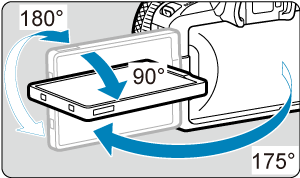
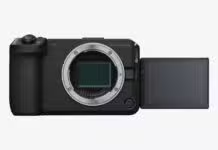
The R100 has a fixed, non-touch rear screen. The R50 has a fully articulating touchscreen. These are practical differences, not just conveniences for video: they affect how you select focus, navigate controls and frame from above a crowd or near the ground.
If you prefer looking through a viewfinder and using buttons, the R100’s screen may not bother you. If you expect phone-like touch operation, choose the R50. For photographing yourself, its movable display is also the much more useful arrangement.
Both cameras have an electronic viewfinder. This is worth remembering if you are comparing them with creator cameras that rely entirely on a rear screen. More detail is available in our Canon R50 review and Canon R100 review.
For video, do not treat “4K” as the same feature
The R100 records 4K with an additional crop and contrast-detection autofocus. Its Dual Pixel autofocus is available for Full HD, but not for 4K. The R50 offers uncropped 4K at up to nominal 30p, oversampled from 6K, with Dual Pixel CMOS AF II. “Uncropped” here refers to its normal 4K recording mode; additional electronic stabilization can change framing. These distinctions are documented in Canon’s R100 technical information and R50 technical information.
Think about where you will record. An additional crop makes it harder to fit yourself and the room into a shot with the same lens and camera position. A camera that focuses well for a posed photograph can still be frustrating if its chosen video mode uses a different autofocus system.
For occasional straightforward Full HD clips, the R100 remains a possible choice. For regular self-filming or a mix of photos and 4K video, the R50’s screen and focusing combination is the stronger reason to pay more. Do not buy the R100 expecting the same video experience merely because both boxes say 4K.
Neither camera has in-body image stabilization. The 18–45mm kit lens has optical stabilization, which helps with camera shake, but neither lens stabilization nor electronic stabilization freezes a moving person. Walking footage, a stationary handheld shot and a fast-moving subject are three different problems.
What the kit lens can—and cannot—do
The RF-S18–45mm covers a roughly 29–72mm full-frame-equivalent angle of view on these Canon APS-C cameras. That is a useful starting range for everyday scenes and people, not a long wildlife zoom. This is an angle-of-view comparison calculated from Canon’s 1.6× crop factor, not a change to the lens’s actual focal length.
Its maximum aperture is f/4.5 at the wide end and f/6.3 at the long end. The lens is compact and stabilized, but it is not a bright-aperture indoor specialist. If most of your photographs happen indoors after sunset, recognize that limitation in either kit before assigning the whole budget to the body.
A lens upgrade can change what you can photograph, but buying a cheap prime without considering its field of view is not a shortcut. For example, a 50mm lens gives an approximately 80mm-equivalent view on either camera: useful for some portraits, potentially too tight for a family around a table in a small room.
Start by identifying what the kit cannot do for you. Need to fit more into the room? Look at a wider lens. Need distant subjects larger in the frame? Look at telephoto reach. Need more light for a similar view? Compare wider-aperture options. A larger number in the lens name does not mean a better all-purpose upgrade.
Both cameras use Canon RF and RF-S lenses. Compatible EF and EF-S lenses can be used through the appropriate EF-EOS R adapter; EF-M lenses are not compatible. Existing DSLR lenses can therefore change your personal budget calculation, but include the adapter and the combined size before deciding.
A worked example: spend on the body or preserve the budget?
The following numbers are hypothetical, not current camera prices or deal claims. Suppose your total budget is $800, and the comparable kit totals after tax and shipping are $500 for the R100 and $750 for the R50. Suppose you also need $50 of essentials for either setup.
| Budget item | R100 example | R50 example |
|---|---|---|
| Camera plus the same 18–45mm lens | $500 | $750 |
| Identical essentials | $50 | $50 |
| Total | $550 | $800 |
| Money remaining from $800 | $250 | $0 |
If the kit lens meets your needs and you want to follow children or record yourself, spending that illustrative $250 difference on the R50’s capabilities may be sensible. If you mainly make stationary indoor photographs and need a different lens or lighting, preserving money can be more useful. Price that specific addition before choosing; this example does not promise that $250 buys every lens you might want.
Keeping the saving is also a valid decision. You do not need to buy an accessory simply because the cheaper camera leaves room in the budget. And if you cannot yet identify a photograph your phone prevents you from taking, it may be worth delaying either camera purchase.
For distant wildlife, price the needed telephoto setup first rather than comparing only these standard kits. Our wildlife camera guide explains the broader choices.
Details worth checking before checkout
Burst speed is not sustained sports performance
Canon rates the R50 at up to 12 fps with electronic first-curtain shutter or 15 fps electronically, subject to shooting conditions. The R100’s up-to-6.5 fps figure uses One-Shot AF; its stated maximum with Servo AF is 3.5 fps. Do not compare the largest numbers without checking the focusing mode.
The R50 also has a small RAW buffer: Canon’s reference specifications list seven RAW frames at its maximum shooting rates under the stated test conditions. File type and shooting conditions matter. Treat the headline rate as a short-burst capability, not a promise that you can keep photographing action indefinitely. Electronic-shutter shooting has further restrictions, including flash use.
Compare kit weight, not body weight
Canon lists approximately 375g for the black R50 with battery and card, before the lens. Add the approximately 130g RF-S18–45mm lens and the working combination is about 505g, excluding items such as a strap or lens cap. The lens weight is documented in Canon’s RF-S18–45mm reference.
External flash accessories need a compatibility check
If an external flash is part of your plan, check the exact accessory before buying a bundle. On the R50, accessories not designed for its multifunction shoe require Canon’s optional AD-E1 adapter. Its built-in flash is a separate matter. Do not assume every familiar-looking shoe accessory connects directly; see Canon’s multifunction-shoe guidance.
The R100 has a conventional accessory shoe and does not support accessories designed for the multifunction shoe. Its different shoe is not a promise of universal compatibility either; match the exact flash or other accessory to the camera.
Do not confuse the R50 with the R50 V
This comparison concerns the EOS R50, not the separately named R50 V. Check the model lettering and included lens on the final offer. A creator-focused alternative can be worth considering, but it is not an interchangeable variation of the same camera.
Verdict: buy the capability you will use
The R50 is our default choice for a beginner who can afford the complete kit and wants one camera for family photographs and video. Its advantages are easiest to justify when subjects move, you want touch control, or you film yourself.
The R100 makes sense as a genuinely cheaper route into interchangeable-lens photography. Buy it deliberately for simpler use and a lower total setup cost—not because two headline megapixel figures make the cameras look identical.
Before paying, check the lens, condition and actual seller price on both offers. If the R50’s extra cost consumes money needed for the lens or equipment your photography requires, compare the whole setup again. The right camera is the one that solves your shooting problem within your total budget.