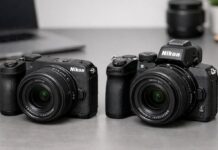

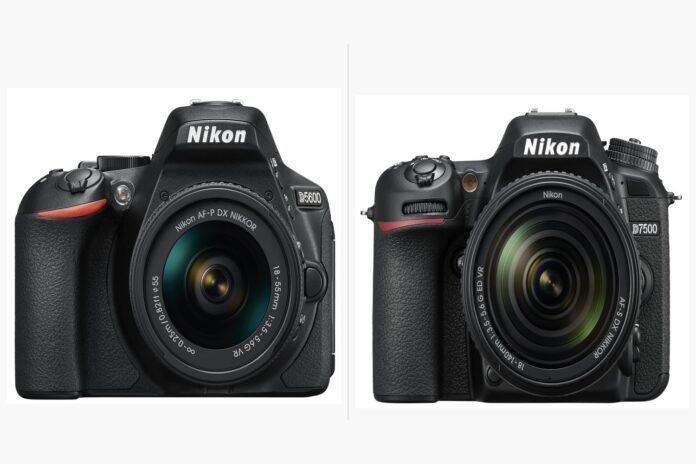
Nikon D5600 vs D7500 is really a choice between portability and performance. Buy the D5600 if low cost, a light bag, and a fully articulating screen matter most. Buy the D7500 for sports, wildlife, events, faster control, and broader autofocus compatibility with older Nikon lenses. For most committed photographers, the D7500 is worth the extra money. The D5600 remains the smarter value when its savings leave room for a genuinely better lens.
Nikon D5600 vs D7500: the quick decision
Both are Nikon DX-format DSLRs, but they sit in different tiers. The D5600 is an approachable 24.2MP body built around low weight and its excellent vari-angle touchscreen. The 20.9MP D7500 gives up a little resolution for a faster processor, stronger autofocus, a deeper buffer, better controls, and a tougher body.
- Choose the D5600 for travel, family photography, landscapes, and learning on a tight budget.
- Choose the D7500 for wildlife, sports, events, frequent low-light work, and heavier lenses.
- Skip both if continuous video autofocus, subject detection, or a future-facing lens system is central to the purchase.
The standalone Nikon D5600 review and Nikon D7500 review go deeper on each body. Here are the differences that should drive the comparison.
| Feature | Nikon D5600 | Nikon D7500 |
|---|---|---|
| Sensor | 24.2MP DX CMOS; no optical low-pass filter | 20.9MP DX CMOS; no optical low-pass filter |
| Processor and ISO | EXPEED 4; ISO 100–25,600 | EXPEED 5; ISO 100–51,200 |
| Viewfinder | Pentamirror; approx. 95% coverage; 0.82× | Pentaprism; approx. 100% coverage; 0.94× |
| Viewfinder autofocus | 39 points; 9 cross-type; rated to –1 EV | 51 points; 15 cross-type; rated to –3 EV |
| Continuous shooting | 5 fps JPEG/12-bit RAW; 4 fps 14-bit RAW | 8 fps; up to 50 14-bit lossless RAW or 100 JPEG |
| Fastest shutter / flash sync | 1/4,000 sec. / 1/200 sec. | 1/8,000 sec. / 1/250 sec. |
| Rear screen | 3.2-inch, 1.037M-dot vari-angle touchscreen | 3.2-inch, 922k-dot tilting touchscreen |
| Video | 1080/60p; microphone input | 4K/30p or 1080/60p; mic and headphone ports |
| Older screw-drive lens AF | No | Yes |
| Card slots | One UHS-I SD slot | One UHS-I SD slot |
| Battery rating | EN-EL14a; approx. 970 shots | EN-EL15a; approx. 950 shots |
| Weight with battery and card | Approx. 16.4 oz. / 465 g | Approx. 25.4 oz. / 720 g |
Image quality: resolution is not the whole story
The D5600 records 6000 × 4000-pixel files, while the D7500 produces 5568 × 3712-pixel files. That gives the D5600 about 16% more pixels. It is a modest advantage for detailed landscapes, careful studio work, and crops made from well-focused images.
Do not translate that difference into a blanket image-quality win. Both sensors omit an optical low-pass filter and can resolve plenty of detail with a sharp lens. Focus accuracy, shutter speed, and lens quality will usually matter more than the 3.3MP gap. At base ISO, I would not pay extra for either body on sensor output alone.
The D7500 is the better working camera as light falls. Its native range reaches ISO 51,200, compared with 25,600 on the D5600. More important, its viewfinder autofocus is rated two stops lower. That can be the difference between locking focus and hunting at an indoor event. The extreme expanded ISO settings are emergency options, not a reason to buy the camera.
For tripod landscapes or portraits at controlled ISO, choose based on handling and price. For dim gyms, wildlife near dusk, or fast event work, the D7500 gives you a more useful margin.
Autofocus, burst speed, and the action gap
This is where the D7500 earns its place. Its 51-point module includes 15 cross-type points, group-area AF, and 3D tracking. The D5600 has 39 points and nine cross-type sensors. Either camera can focus a static portrait, but the D7500 is more dependable when a subject changes direction or moves through poor light.
The shooting-rate difference also understates the gap. The D5600 reaches 5 fps with JPEG or 12-bit RAW, then drops to 4 fps with 14-bit RAW. The D7500 shoots at 8 fps and can sustain up to 50 14-bit lossless-compressed RAW files or 100 JPEGs under Nikon’s stated conditions. Nikon details those limits in its official D7500 specifications.
For a child running across a yard, the D5600 is adequate. For a bird in flight or a full sports sequence, the D7500 gives you more chances before the camera slows. Its 1/8,000-second top shutter also helps with fast lenses in bright light. The 1/250-second flash sync is useful for fill flash, though it is only a small gain over the D5600’s 1/200 second.
Neither body has modern eye-detection or animal-detection autofocus through the optical viewfinder. If you expect the camera to identify the subject for you, a current mirrorless body is the better tool.
Handling, viewfinders, and screens
The D5600 is about nine ounces lighter with its battery and card. That is noticeable on a long walk, especially with a compact AF-P kit zoom. Its screen swings to the side, rotates for vertical compositions, and faces forward. It is the better design for low vertical shots, self-recording, and working around awkward angles.
The D7500 feels much faster once exposure becomes deliberate. It has front and rear command dials, a top status display, more direct buttons, and a deeper grip. With gloves or a telephoto lens, I would take those controls over the D5600’s lighter body. The tradeoff is a screen that only tilts up and down.
The viewfinder difference matters more than a spec sheet suggests. The D7500’s pentaprism is larger and brighter, and its approximate 100% coverage makes edge placement more predictable. The D5600 shows about 95% of the final frame, so small objects can appear around the edges of the captured image.
Nikon described the D7500 as having comprehensive weather sealing. Treat that as resistance, not waterproofing; Nikon gives no IP rating. Use a protected lens and sensible rain cover. The D5600 is the body I would shelter sooner in dust or wet weather.
Lens compatibility and ownership costs
Both cameras accept Nikon F-mount DX and compatible FX lenses, but “it mounts” does not mean every function works. The D5600 has no body-mounted focus motor. It autofocuses with compatible AF-S, AF-P, and AF-I lenses, while older screw-drive AF and AF-D lenses become manual-focus lenses. Nikon’s official D5600 manuals and firmware are the safest place to check a specific combination.
The D7500 has an autofocus coupling and motor, so many inexpensive older AF and AF-D lenses retain autofocus. That can offset part of the body’s higher price. It is not a free pass for every vintage NIKKOR, however. Non-CPU AI lenses have limited operation, and neither camera should be paired with a questionable pre-AI lens without checking the exact model.
Neither body has in-body image stabilization. For hand-held work at slower shutter speeds, look for a lens marked VR. Our guide to the best Nikon D5600 lenses is also useful for the D7500 because many of the same AF-S and AF-P DX options fit both bodies.
Budget for different batteries if you are upgrading. The D5600 uses the smaller EN-EL14a; the D7500 uses the EN-EL15 family. They do not share chargers, and neither camera charges its battery over USB. Also remember that both bodies have only one SD slot. Buyers moving from a D7200 sometimes assume the D7500 kept two slots, but it did not.
Video: the D7500 wins, but neither is a modern hybrid
The D5600 tops out at 1080p and 60 fps. Its fully articulating screen and microphone input are useful, but live-view autofocus relies on contrast detection. Focus transitions can hunt, especially with a moving subject or a lens that is not video-friendly.
The D7500 adds 4K UHD at 24, 25, or 30 fps, plus 1080p up to 60 fps. It also provides microphone and headphone connections, clean HDMI output, and electronic VR for Full HD recording. The 4K mode reads a smaller area than the full DX frame, so wide-angle coverage becomes harder. Electronic VR is not available for 4K.
Both cameras still use contrast-detect autofocus in live view. That is the real limitation for one-person filming, not the resolution label. Manual focus or controlled, pre-focused clips are a better fit. For interviews, the D7500’s audio monitoring and 4K output make it the clear choice. For walking video, vlogging, or reliable face tracking, put the money toward a newer mirrorless camera instead.
Buying used: traps and better alternatives
Nikon now labels the D5600 as an archived product in the US, so used examples are the normal route. The D7500 may still appear new, but compare its price with clean used bodies and newer mirrorless kits. A warranty has value; an inflated old-stock price does not.
For either camera, inspect the sensor, lens mount, card slot, screen hinge, command dials, ports, and battery compartment. Test autofocus through the viewfinder and live view with the lens you intend to use. Record a clip with an external microphone. Check the shutter count, but weigh it alongside impact damage, moisture history, and the seller’s return policy.
- Consider a used D7200 if you want 24MP, two card slots, and broader support for older manual-focus Nikon lenses. It is slower and lacks 4K.
- Consider a used D500 if wildlife or sports is the entire reason for buying. Its 153-point AF system and 10 fps shooting are a real step up.
- Consider a Nikon Z50 II if you own few F-mount lenses. It offers newer subject detection and video tools, though adapted F-mount lenses add cost and bulk.
Our broader Nikon DSLR models guide places those alternatives in context. Avoid bundles padded with weak tripods, generic filters, and unknown batteries. Price the body and useful lenses separately.
Verdict: which Nikon DSLR should you buy?
The Nikon D7500 is the better camera for most serious photographers. Its autofocus, buffer, controls, viewfinder, shutter, and screw-drive lens support all change what you can capture. Those gains are much more meaningful than the D5600’s modest resolution advantage.
The Nikon D5600 is the better buy for a narrower, sensible brief. Choose it when weight, a forward-facing vari-angle screen, and the lowest total kit cost are priorities. It is excellent for landscapes, travel, family photographs, and learning. Pairing it with a good 35mm prime or a useful telephoto can be smarter than spending the whole budget on a D7500 body.
For an existing D5600 owner, the D7500 upgrade makes sense only if autofocus, burst depth, direct controls, or older lens support is a repeated limitation. If the problem is image quality at ordinary ISO settings, change the lens or technique first. If video and subject recognition are the frustration, move to mirrorless rather than making a sideways move between older DSLRs.
Frequently asked questions
Does the D5600 take better photos because it has more megapixels?
No. It records slightly larger files and gives you a little more cropping room. The D7500’s stronger autofocus and handling can produce more keepers with moving subjects or in poor light.
Can the Nikon D7500 autofocus with AF-D lenses?
Yes, many screw-drive AF and AF-D NIKKOR lenses autofocus because the D7500 has an in-body motor. The D5600 does not. Check Nikon’s compatibility information for the exact lens before buying.
Do the D5600 and D7500 use the same battery?
No. The D5600 uses an EN-EL14a, while the D7500 was supplied with an EN-EL15a and uses the EN-EL15 battery family. The chargers are different.
Is the D7500 too advanced for a beginner?
No. Its automatic modes are accessible, and the extra dials become useful as you learn exposure. It is heavier and costs more, so a D5600 remains reasonable when those savings buy a better lens.