

View full specs
This Canon M50 review starts with the practical answer: the original EOS M50 can still be a very enjoyable small camera if you buy it for the right reasons. It is a charming used-market Canon mirrorless body for travel, family photos, casual video, and learning photography. It is not the smartest choice if you want a system that keeps growing around you.
Who the Canon M50 still makes sense for
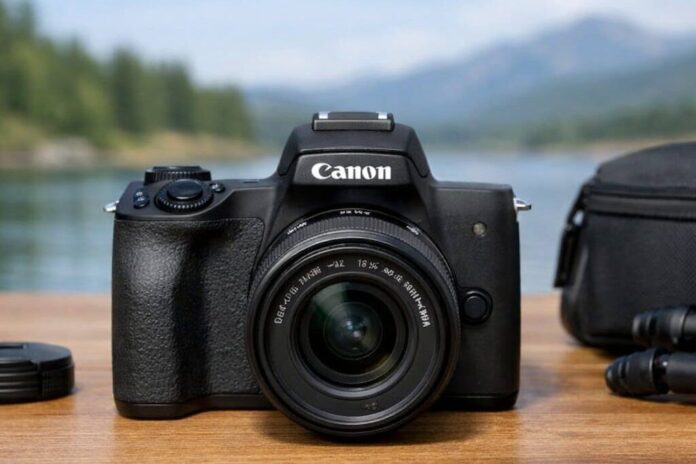
The Canon EOS M50 sits in a strange but interesting place today. Canon has moved on from EF-M and is pushing RF and RF-S cameras instead. Even so, the M50 still has the qualities that made it popular: a small body, a proper viewfinder, a flip-out touchscreen, pleasant Canon color, and easy autofocus in normal shooting.
If you are moving up from a phone, the M50 feels like a real camera without becoming intimidating. You get a grip, a viewfinder, interchangeable lenses, RAW files, and enough manual control to learn properly. At the same time, Canon’s menus and touchscreen make the camera less technical than many older enthusiast bodies.
I would mainly recommend it to three buyers. It fits beginners who find one at a genuinely good used price, travelers who want a small Canon kit, and casual creators who are happy shooting mostly in 1080p. If you are buying new, building a long-term lens kit, or expecting modern 4K video, the Canon R50 is the more sensible Canon path.
Canon M50 specs that matter
For a Canon M50 review, the spec sheet is only useful if it explains the camera’s limits. The M50 uses a 24.1MP APS-C CMOS sensor with Canon’s DIGIC 8 processor. Canon’s own EOS M50 product information lists the 24.1MP APS-C sensor, Dual Pixel CMOS AF, 4K UHD 24p, HD 120p, and built-in OLED EVF as headline features. Its support pages confirm the detailed video frame rates and screen specifications.
The important practical specs are straightforward. You get the EF-M lens mount, a 2.36-million-dot electronic viewfinder, a 3-inch vari-angle touchscreen, single SD card storage, and LP-E12 battery power. The body weighs about 390g with battery and card. There is no in-body image stabilization, no weather sealing, and no headphone jack.
Those numbers explain the whole personality of the camera. It is light, friendly, and very portable. It is also clearly an older entry-level body, especially when you compare battery life, 4K video, and lens-system depth with current mirrorless cameras.
Handling and everyday use
The M50 is one of those cameras that makes more sense in the hand than on a spec sheet. It is small, but not slippery. Its grip gives your fingers enough shape to hold onto. The body balances nicely with the EF-M 15-45mm kit zoom or the EF-M 22mm f/2 pancake.
The touchscreen is one of the camera’s best features. You can tap to focus, move through menus quickly, and flip the screen forward for video or self-portraits. For low-angle travel shots, tabletop videos, family photos, and quick framing in awkward spaces, that vari-angle screen is genuinely useful.
The electronic viewfinder is another reason I still prefer the M50 over many point-and-shoot alternatives. A viewfinder changes how you shoot in bright light and helps you compose with more intention. It is not a luxury EVF by today’s standards, but it is good enough to make the camera feel more serious than its size suggests.
Controls are simple. There is not a deep array of custom buttons, and advanced photographers may miss a second dial. For the buyer this camera is aimed at, that restraint is not a problem. The M50 lets you learn aperture, shutter speed, ISO, and exposure compensation without burying you under pro-body complexity.
Image quality for photos
For still photography, this Canon M50 review is mostly positive: the camera remains easy to like. The 24MP APS-C sensor gives you a clear step up from a phone. You gain more natural background blur, cleaner detail, and the ability to edit RAW files. In good light, JPEGs have the warm, flattering Canon look that works well for people, food, travel scenes, and family photos.
Dynamic range is respectable but not class-leading by modern standards. If you underexpose heavily and try to lift shadows, newer sensors give you more room. Still, for normal travel and everyday shooting, the files are flexible enough. The camera rewards good exposure and decent light.
Low light is where expectations matter. The body has no sensor-shift stabilization, and the common 15-45mm kit lens is not very bright. Indoor evening photos can become noisy or blurry if you rely only on the kit zoom. Pairing the M50 with the EF-M 22mm f/2 changes the character of the camera completely. That little lens makes the kit faster, smaller, and better for cafes, city evenings, and casual portraits.
If I were building a minimal M50 stills kit, I would start with the 15-45mm zoom for daylight flexibility. I would add the 22mm f/2 as soon as possible. That two-lens setup is the reason the M50 still has a following. It gives you a tiny camera bag with real image quality.
Autofocus and speed
Autofocus is one of the M50’s pleasant surprises, as long as you stay in its comfort zone. In stills and 1080p video, Canon’s Dual Pixel CMOS AF is smooth, confident, and beginner-friendly. Face detection works well for portraits and casual family scenes, and tapping the screen to choose focus feels natural.
The camera can shoot up to 10 fps with focus locked, or slower when tracking focus continuously. That is enough for children, street moments, pets, and general travel action. It is not enough to turn the M50 into a sports or wildlife camera. The buffer is modest, and tracking is not in the same class as newer Canon R-series bodies.
For the real user, the important point is this: the M50 usually makes focusing feel easy. That matters more than the headline speed. A beginner is more likely to get sharp people photos with the M50 than with many older DSLRs. The touchscreen and face detection remove a lot of friction.
Video and vlogging
The M50 became famous partly because it looked like an affordable Canon vlogging camera. For 1080p, that reputation is fair. The flip screen, microphone input, small body, and Dual Pixel autofocus make it comfortable for talking-head videos. It also works well for travel clips and simple YouTube work. Our broader camera picks for YouTube show how much creator needs have changed, but the M50 still works if your standards are realistic.
Its 4K mode is the catch. The camera records 4K UHD at 23.98p, but the crop is heavy and Dual Pixel AF is not available in 4K. That makes wide vlogging harder and autofocus less dependable. If you put the camera on a tripod, pre-focus, and shoot a static scene, the 4K can be useful. If you want walk-and-talk 4K, it is the wrong tool.
Audio is decent for the class because the M50 has a microphone input. The missing headphone jack means you cannot monitor sound properly while recording. For casual video, that is acceptable. For paid work or serious documentary shooting, it is limiting.
My practical video advice is to treat the Canon M50 as a very good 1080p Canon camera. Think of 4K as a bonus for controlled situations. If you buy it expecting modern uncropped 4K with confident tracking AF, you will be disappointed.
The EF-M lens problem
The lens mount is the biggest long-term issue. The Canon M50 uses EF-M lenses, and Canon no longer treats EF-M as its future system. That does not make the mount bad. In fact, several EF-M lenses are excellent because they are so small. Growth is the problem.
For a compact setup, EF-M can be lovely. The EF-M 22mm f/2 is the lens that makes the M50 feel pocketable and creative. For travel and interiors, the EF-M 11-22mm is the standout small zoom. Portrait shooters should look at the EF-M 32mm f/1.4. The kit zoom is ordinary, but convenient.
Where EF-M struggles is choice. If you want a wide future of native lenses, RF-S, Sony E, Fujifilm X, and Micro Four Thirds are stronger systems. You can adapt EF and EF-S DSLR lenses with Canon’s EF-EOS M adapter. The setup becomes bulkier, though, and loses some of the compact charm that makes the M50 attractive.
That is why I would not tell a new photographer to build a large EF-M kit in 2026. I would tell them to buy the M50 only if the price is right. The small EF-M lens set also needs to cover what they want to shoot.
Canon M50 vs M50 Mark II vs R50
The original M50 and the M50 Mark II are very close cameras. The Mark II brings small creator-focused refinements. Eye detection behavior and live-streaming-oriented features improve, but it is not a dramatic hardware leap. If the Mark II costs much more, I would not automatically pay the premium.
The R50 is a different story. It uses Canon’s newer RF mount, has much stronger subject detection, better 4K behavior, and a more future-facing lens path. If you are buying into Canon today and do not already own EF-M lenses, the R50 is usually the smarter buy.
The M50 wins only when price and size are the priority. A cheap M50 with the 15-45mm kit lens and maybe the 22mm f/2 can be a delightful little camera. A pricey M50 close to R50 money is hard to justify.
What I would pay attention to when buying used
Because the M50 is now mostly a used-market camera, condition matters more than box contents. Check that the screen hinge feels firm, the EVF activates correctly, the battery door closes cleanly, and the lens mount is not loose. Test the touchscreen, microphone port, hot shoe, and Wi-Fi if those features matter to you.
Also check the lens. Many kits include the EF-M 15-45mm, which has a retracting design. Make sure it extends smoothly and focuses without strange noises. If the seller includes the 22mm f/2, that makes the kit much more appealing.
I would avoid paying collector-style prices for this camera. The M50 is attractive because it is small and affordable. Once the price climbs too close to newer bodies, the compromises become harder to defend.
Canon M50 pros and cons
What I like
- Small, light body that is easy to carry all day
- Pleasant Canon color for JPEGs and people photos
- Good Dual Pixel autofocus for stills and 1080p video
- Useful built-in EVF and fully articulating touchscreen
- Microphone input for simple creator work
- Excellent compact pairing with the EF-M 22mm f/2
What I do not like
- EF-M is not a future-facing lens system
- 4K has a heavy crop and weaker autofocus
- No in-body image stabilization
- Battery life is modest, so spares are wise
- No weather sealing or headphone jack
- Not worth buying if priced too close to newer Canon RF bodies
Final verdict
The Canon M50 is still worth considering, and that is the balanced conclusion of this Canon M50 review. It is not a camera I would recommend blindly. Its best version is a small used kit bought at the right price. Ideally, that kit includes the EF-M 15-45mm and EF-M 22mm f/2. In that form, it is light, fun, approachable, and capable of very nice photos.
It is less compelling as a long-term system investment. The EF-M mount limits future growth, and the video features feel dated once you look beyond 1080p. If you want the safest current Canon path, buy an R50 instead. If you want an affordable, compact Canon camera that makes photography feel easy and enjoyable, the M50 still has a real place.
Canon EOS M50 alternatives
The main alternatives to the Canon EOS M50 are Canon R50, Sony a6100, Sony a6400, Fujifilm X-T200, Panasonic G100. Compare autofocus, stabilization, video limits, lens choice and current price before deciding which camera fits you best.
Frequently asked questions
Is the Canon M50 still worth buying?
Yes, the Canon M50 is still worth buying at a good used price if you want a small, beginner-friendly mirrorless camera. It is strongest for photos and 1080p video. It is weaker for long-term lens growth and serious 4K work.
Is the Canon M50 good for beginners?
The Canon M50 is very good for beginners. It has a clear touchscreen interface, a built-in viewfinder, helpful automatic modes, and enough manual control to learn photography properly.
Is the Canon M50 good for YouTube?
The Canon M50 is good for YouTube if you mainly shoot 1080p. It has a flip screen, microphone input, and reliable Dual Pixel autofocus in Full HD. For 4K YouTube, newer cameras are better because the M50’s 4K mode is heavily cropped and loses Dual Pixel AF.
What lenses should I get for the Canon M50?
For a simple Canon M50 kit, the EF-M 15-45mm is fine for daylight travel and everyday use. The EF-M 22mm f/2 is the lens I would add first. The 22mm makes the camera smaller, brighter, and more enjoyable in low light.
Should I buy the Canon M50 or Canon R50?
Most new buyers should choose the Canon R50 because it uses Canon’s newer RF system and has better autofocus and video features. The Canon M50 makes sense only if it is much cheaper and you want the smallest possible Canon mirrorless setup.
Beginners, travelers, family shooters, and 1080p creators who want a small Canon mirrorless kit.
You want a future-proof lens system, uncropped 4K, in-body stabilization, weather sealing, or advanced subject tracking.
Low; the touchscreen, guided Canon menus, viewfinder, and face detection make it easy to learn.
Canon R50 for the modern Canon path; Canon R10 for more controls; Sony a6400 or Fujifilm X-S20 for a deeper APS-C system.
Excellent simple 1080p usability, but 4K has a heavy crop and loses Dual Pixel AF.
Yes at a good used price, especially with the EF-M 22mm f/2; no if it costs close to a Canon R50.