
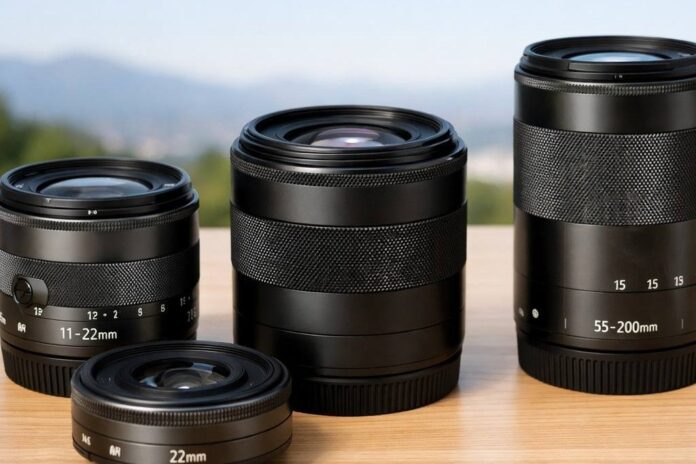
Choosing the best Canon EF-M lenses is really about protecting what makes the EOS M system appealing: small bodies, discreet handling, and image quality that is much better than the size suggests. If you shoot an EOS M50, M50 Mark II, M6 Mark II, M200, or another EOS M body, the right EF-M lenses can turn that compact camera into a very capable travel, family, street, portrait, and video setup.
The trick with the best Canon EF-M lenses is to stay disciplined. The EOS M system works best when it stays compact. Once every solution becomes an adapted DSLR lens, the camera loses some of its charm. I would rather build around a few lenses that make the camera easier to carry, sharper in real use, or genuinely more flexible.
How to choose EF-M lenses in 2026
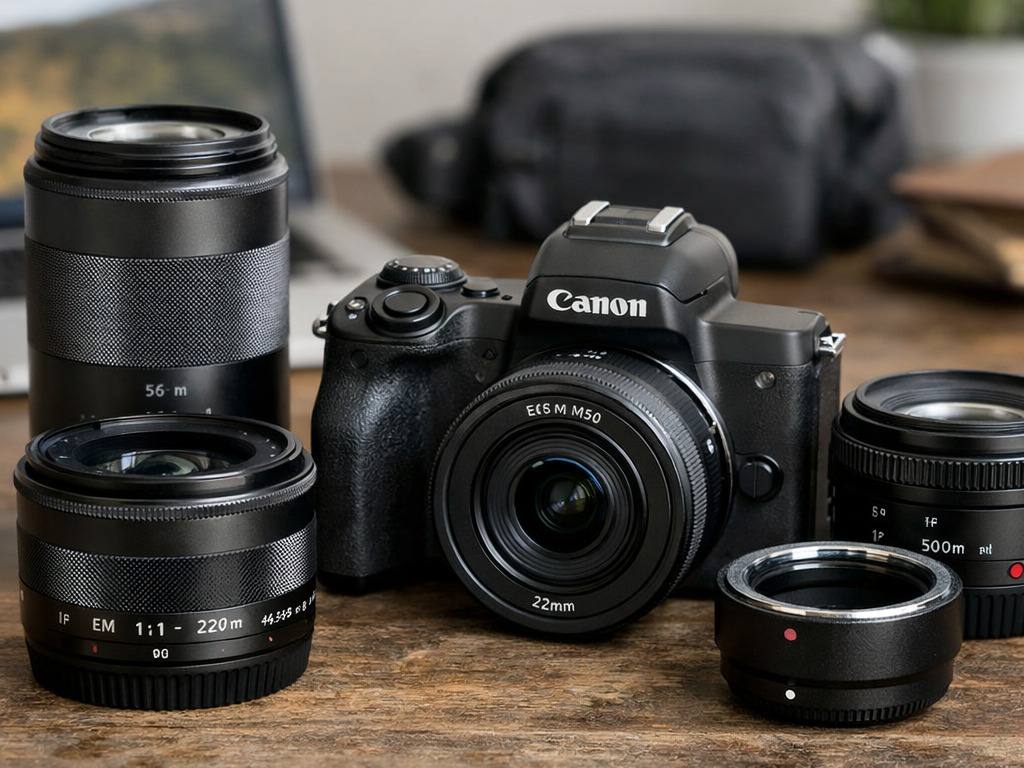
Canon U.S.A. defines an EF-M lens around EF-M-compatible interchangeable-lens cameras, which is the key distinction from RF and RF-S. In practical terms, EF-M is now a mature compact system. That makes lens choice less about chasing a roadmap and more about choosing the glass that best suits the EOS M body you already enjoy using.
That context changes the way I would spend money. A sharper prime or a small stabilized zoom can improve the pictures you actually take without changing the character of the camera. A bag full of adapted heavy lenses usually does the opposite.
If you also use Canon’s newer APS-C mirrorless bodies, our Canon RF-S lens guide gives useful context. RF-S is where Canon is putting its current APS-C mirrorless energy; EF-M remains the smaller, lighter option when compactness is the main reason you carry the camera.
Quick picks: the EF-M lenses I would buy first
| Lens | Best for | Why it matters |
|---|---|---|
| Canon EF-M 22mm f/2 STM | Everyday carry, street, food, travel | Tiny, bright, sharp, and gives a natural 35mm-equivalent view. |
| Canon EF-M 32mm f/1.4 STM | Portraits, detail shots, low light | The strongest native EF-M lens optically, with real subject separation. |
| Canon EF-M 11-22mm f/4-5.6 IS STM | Travel, interiors, landscape, handheld video | Small, stabilized, genuinely wide, and more useful than it looks on paper. |
| Canon EF-M 18-150mm f/3.5-6.3 IS STM | One-lens travel | The best single-lens option when convenience matters more than aperture. |
| Canon EF-M 15-45mm f/3.5-6.3 IS STM | Budget starter kits | Not exciting, but small, stabilized, cheap, and useful enough. |
| Sigma 16mm, 30mm, and 56mm f/1.4 DC DN | Low light, portraits, video, stronger image quality | The best third-party EF-M options if you can find them at a fair price. |
Best Canon EF-M lens for everyday carry: EF-M 22mm f/2 STM
If I had to choose one EF-M lens to make an EOS M camera feel special, it would be the Canon EF-M 22mm f/2 STM. It is the lens that makes the system make sense. Mounted on an EOS M50 or M200, it keeps the camera small enough to take out when a larger kit would stay home.
The 22mm focal length behaves like roughly a 35mm lens on full frame. That is a comfortable angle for street photography, travel scenes, food, family moments, and casual environmental portraits. It is wide enough to show context but not so wide that people look distorted when you get close.
The f/2 aperture is also important. Most EF-M zooms get slow very quickly, especially indoors. The 22mm lets you keep ISO lower, shoot in restaurants or evening light, and create a little separation between subject and background. It is not a dreamy portrait lens, but it gives small EOS M bodies a much more serious feel.
The drawback is the lack of image stabilization. For stills, that is not a dealbreaker if you keep your shutter speed sensible. For walking video, it is less forgiving. Use it for static clips, talking-head shots, travel details, and low-light scenes; use a stabilized zoom when you need handheld movement.
Best EF-M portrait lens: EF-M 32mm f/1.4 STM
The Canon EF-M 32mm f/1.4 STM is the native EF-M lens that feels least like a compromise. Canon introduced it as a compact large-aperture EF-M prime, and the 32mm focal length gives about a 51mm full-frame equivalent field of view. In practice, that makes it a natural short-normal lens rather than a tight headshot lens.
This is the lens I would choose for portraits, indoor family photography, small product shots, and detail work where the kit zoom starts to look flat. The f/1.4 aperture gives the EOS M system the background separation it often lacks. It also helps in poor light, especially on older EOS M bodies that are not as clean at high ISO as newer Canon mirrorless cameras.
It is sharper and more refined than the EF-M 22mm, but it is also larger and more expensive. That is the tradeoff. The 22mm makes the camera pocketable. The 32mm makes the files look more polished. If portraits matter to you, the 32mm is one of the best Canon EF-M lenses Canon ever made.
Just remember that it is not stabilized. For stills, the fast aperture helps. For video, you will want a tripod, gimbal, or careful handheld technique.
Best wide EF-M lens for travel and video: EF-M 11-22mm f/4-5.6 IS STM
The Canon EF-M 11-22mm f/4-5.6 IS STM is the lens I would look for after the 22mm prime. It solves a real problem: small cameras are often used for travel, interiors, handheld video, and city scenes, and the normal kit zoom is not always wide enough.
At the wide end, the 11-22mm gives you a field of view that feels genuinely expansive. It is excellent for cramped rooms, narrow streets, architecture, landscapes, and vlogging when you need more of the background in the frame. The built-in stabilization makes it more useful than its modest aperture suggests.
For video, this is one of the safest EF-M choices. The STM focus is quiet, the range is practical, and the lens stays small enough that the camera remains comfortable in the hand. If you shoot travel clips or family video, I would rather have this lens than a faster but unstabilized prime.
The main weakness is obvious: it is not bright. This is not a night-event lens, and it will not blur the background dramatically. Use it because you need the angle, stability, and portability.
Best one-lens travel zoom: EF-M 18-150mm f/3.5-6.3 IS STM
If you want to pack one lens and stop thinking about focal lengths, the Canon EF-M 18-150mm f/3.5-6.3 IS STM is the most useful native EF-M zoom. It covers wide-ish travel scenes, portraits, details, and distant subjects without a lens change.
This is the lens I would choose for vacations, family trips, hiking, and daytime sightseeing where the shot can change quickly. The long end is especially helpful when you cannot physically move closer. That matters more in real travel than charts suggest.
The compromise is aperture. Like most superzooms, the 18-150mm is not the best choice for dim interiors or shallow-background portraits. It also makes the camera noticeably larger than the 22mm or 15-45mm. But if the point is to bring one small camera instead of a full kit, it earns its place.
For many EOS M owners, the smartest two-lens travel setup is the EF-M 18-150mm for daytime flexibility plus the EF-M 22mm f/2 for evening, food, and low-light scenes.
Best budget EF-M zoom: EF-M 15-45mm f/3.5-6.3 IS STM
The Canon EF-M 15-45mm f/3.5-6.3 IS STM is not a glamorous lens, but it is easy to underestimate. It is small, stabilized, inexpensive on the used market, and good enough for a lot of everyday photography.
I would not buy an EOS M system because of this lens. I would, however, keep it if I already had it. The 15mm wide end is useful for travel and casual video, and the stabilization helps with handheld shooting. On a small body like the Canon M200, it keeps the setup light and simple.
The weak points are low-light performance and long-end sharpness. Indoors, the aperture gets limiting quickly. For portraits, the files can look ordinary compared with the 32mm f/1.4 or Sigma 56mm f/1.4. As a starter lens, though, it is practical. As your only lens forever, it is limiting.
Best compact telephoto: EF-M 55-200mm f/4.5-6.3 IS STM
The Canon EF-M 55-200mm f/4.5-6.3 IS STM is the telephoto lens for people who still want the EOS M system to stay small. It is not a sports specialist, and it is not a wildlife powerhouse. It is a compact daylight telephoto for travel, compressed landscapes, casual portraits, school events, and details you cannot reach with the standard zoom.
Used with realistic expectations, it is a useful lens. The stabilization helps, and the size is much easier to live with than adapted EF telephotos. The biggest limitation is light. At f/6.3 on the long end, you will want good daylight or higher ISO. For indoor sports or serious action, this is not the right tool.
I would buy it only if you know you need reach. If most of your photography is everyday travel, food, street, and family, the 22mm, 11-22mm, or 18-150mm will probably serve you better.
Best EF-M macro option: EF-M 28mm f/3.5 Macro IS STM
The Canon EF-M 28mm f/3.5 Macro IS STM is one of the stranger native EF-M lenses, but it can be fun. It focuses very close, includes built-in macro lighting, and works well for small objects, flowers, textures, collectibles, and casual product shots.
I would not call it essential. The short focal length means you often work close to the subject, which can block light or disturb insects. But for tabletop work and creative close-ups, it is more useful than many photographers expect.
If you only want one fast prime, buy the 22mm or 32mm first. If you already have your everyday lens covered and want something different, the 28mm macro gives EOS M cameras a genuinely playful close-focus option.
What about the older EF-M 18-55mm f/3.5-5.6 IS STM?
The Canon EF-M 18-55mm f/3.5-5.6 IS STM is an older kit zoom. It can still produce good images, and some photographers prefer its handling over the collapsing 15-45mm. But I would not treat it as the default best walkaround lens today.
If you already own it and like the way it handles, keep using it. If you are buying from scratch, I would usually choose based on purpose: 15-45mm for the smallest budget kit, 18-150mm for travel flexibility, or 22mm f/2 for the image-quality jump that makes the camera feel new.
Best third-party EF-M lenses: Sigma’s f/1.4 trio
Sigma gave EF-M users the fast primes Canon never fully built out. Sigma’s official Canon EF-M mount lineup includes the 16mm, 30mm, and 56mm f/1.4 DC DN Contemporary lenses, and they are worth considering if you want stronger low-light performance or more subject separation.
Sigma 16mm f/1.4 DC DN Contemporary
The Sigma 16mm f/1.4 is a strong choice for video, environmental portraits, indoor scenes, and low-light travel. It is much bigger than Canon’s native pancakes, but the bright aperture gives the EOS M system a look the kit zooms cannot match. I would choose it for creators who film in available light or want a wider prime with real background blur.
Sigma 30mm f/1.4 DC DN Contemporary
The Sigma 30mm f/1.4 sits close to the Canon EF-M 32mm f/1.4 in field of view. It is often the value alternative if you find it at a better price. The Canon 32mm is the cleaner native choice, but the Sigma 30mm can make a lot of sense for portraits, street details, and everyday low-light work.
Sigma 56mm f/1.4 DC DN Contemporary
The Sigma 56mm f/1.4 is the most portrait-focused option here. On Canon APS-C, it gives a tight short-telephoto view, closer to a classic portrait lens than Canon’s 32mm. It is not the lens I would use in a tiny room, but outdoors or in larger spaces it gives the strongest background separation of the group.
Should you adapt EF or EF-S lenses to EOS M?
You can use EF and EF-S DSLR lenses on EOS M bodies with the Canon EF-EOS M adapter. That opens the door to a huge catalog of lenses, and it can be a smart move if you already own Canon DSLR glass. Canon’s own EOS M50 compatibility support notes that EF and EF-S lenses require the optional Mount Adapter EF-EOS M.
Still, I would not build an EF-M kit around adapted lenses unless you have a specific reason. Adapted lenses make the camera larger, shift the balance forward, and often remove the casual carry-anywhere feel. A compact EOS M body with a big EF-S zoom attached can become less pleasant than a larger camera with a better grip.
Adapt when it solves a real problem: a specialty macro, a fast telephoto, a lens you already own, or a look you cannot get natively. For everyday work, native EF-M lenses usually make more sense.
The EF-M kits I would actually recommend
Smallest useful kit
Buy the EF-M 22mm f/2 STM. That is it. This turns an EOS M body into a compact everyday camera with better low-light ability and better image quality than the basic zoom experience.
Best travel kit
Pair the EF-M 18-150mm IS STM with the EF-M 22mm f/2 STM. Use the zoom during the day and the prime at night. This keeps the bag small but covers a lot of real travel situations.
Best video and vlogging kit
Start with the EF-M 11-22mm IS STM. Add the EF-M 22mm f/2 STM or Sigma 16mm f/1.4 if you shoot controlled talking-head clips or low-light b-roll. If you use the Canon M50, this is the setup that best matches the camera’s small-body appeal.
Best portrait kit
Choose the Canon EF-M 32mm f/1.4 STM if you want the clean native option. Choose the Sigma 56mm f/1.4 if you want tighter framing and stronger background blur. I would not buy both unless portraits are a major part of your shooting.
Frequently asked questions
Are Canon EF-M lenses still worth buying?
Yes. The best Canon EF-M lenses are compact, often good value used, and still produce excellent results on EOS M bodies. The smart approach is to buy for the camera you actually carry: a small prime, a stabilized wide zoom, or a practical travel zoom usually adds more value than trying to turn EOS M into a large system.
What is the best Canon EF-M lens overall?
For most people, the Canon EF-M 22mm f/2 STM is the best overall EF-M lens because it is small, bright, sharp, and genuinely changes how often you carry the camera. If portraits are your priority, the EF-M 32mm f/1.4 STM is the stronger optical lens.
Which EF-M lens is best for travel?
The EF-M 18-150mm f/3.5-6.3 IS STM is the best one-lens travel choice. If you prefer a two-lens kit, combine it with the EF-M 22mm f/2 STM for low light and casual evening photography.
Which EF-M lens is best for video?
The EF-M 11-22mm f/4-5.6 IS STM is the safest video choice because it is wide, stabilized, compact, and quiet. The 22mm f/2 and Sigma 16mm f/1.4 are better for controlled shots where you want more light and background blur.
Can EF-M lenses be used on Canon RF cameras?
No. EF-M lenses are for Canon EOS M cameras. They do not adapt cleanly to Canon RF or RF-S bodies. If you are moving to a Canon R50, R10, R7, or R8, you should plan around RF, RF-S, or adapted EF lenses instead.
Can Canon EF or EF-S lenses be used on EOS M cameras?
Yes, with the EF-EOS M adapter. It can be useful if you already own DSLR lenses, but it makes the camera larger. For the everyday EOS M experience, native EF-M lenses usually keep the system more enjoyable.
Bottom line
The best Canon EF-M lenses are not about building the biggest kit. They are about keeping a small Canon mirrorless camera useful, sharp, and easy to carry. My first choice would be the EF-M 22mm f/2 STM. After that, I would add the EF-M 11-22mm for travel and video, the EF-M 32mm f/1.4 for portraits, or the EF-M 18-150mm if I wanted one-lens convenience.
EF-M still works beautifully when the kit stays focused. The best Canon EF-M lenses preserve that compact character; the moment the setup becomes bulky and complicated, it stops playing to its strength.