

View full specs
This OM System OM-1 Mark II review comes down to a clear buying decision: it is one of the best wildlife bodies for photographers who value reach, speed, weather resistance, and a kit they can carry all day. Its 20.4MP Micro Four Thirds files do not match a modern full-frame camera for heavy cropping or fast action in very low light. For birds, macro, field sports, and travel wildlife, however, the complete system is unusually convincing.
OM-1 Mark II review: the short verdict
The OM-1 Mark II is a specialist camera with enough range to work as an all-purpose outdoor body. Buy it for up to 50 fps continuous autofocus with supported lenses, a deep buffer, Pro Capture, excellent stabilization, and compact telephoto options. Skip it if your work depends on large prints from aggressive crops, clean files at very high ISO, or advanced video production.
- Best for: birds, wildlife, macro, outdoor sports, hiking, and expedition travel.
- Main compromise: native resolution is 20.4MP, and moving subjects remove the benefit of the high-resolution composite modes.
- Upgrade advice: original OM-1 owners should upgrade only for the larger buffer, refined autofocus behavior, Live GND, or revised controls.
- Value point: it is much easier to recommend around common US sale prices near $2,000 than at its $2,399.99 launch price.
What its speed changes for wildlife
Autofocus is capable, but setup still matters
The camera uses 1,053 all-cross phase-detection points and adds subject recognition for birds, common animals, people, cars, trains, motorcycles, and aircraft. Bird detection can prioritize an eye, which is genuinely useful when a subject is small in the frame. It does not automatically choose every subject category, though. You still need to select the appropriate detector.
Against reeds, branches, waves, or crowded colonies, the system can favor a stronger foreground shape. I get better results by limiting the autofocus area and keeping the detector inside a controlled zone. A recognized eye can still be blurred by a slow shutter speed, so subject detection never replaces exposure discipline or steady panning.
With a compatible SH2 lens, the headline rate is 50 fps with autofocus and exposure tracking; 120 fps locks both on the first frame. OM System limits 50 fps C-AF to selected M.Zuiko PRO lenses, so verify your exact telephoto before treating that rate as part of the system. At 120 fps, OM System rates the buffer for about 213 RAW files or 219 JPEGs. Pro Capture can retain as many as 99 frames from before the full shutter press. That makes bird takeoffs and sudden strikes much less dependent on reaction time.
In practice, 50 fps is the more useful ceiling for moving wildlife. It preserves tracking and creates fewer near-duplicates to sort. The camera has two UHS-II SD slots, but no CFexpress slot. Fast UHS-II cards are part of the real purchase price, and a long burst still takes time to clear. Set a lower frame rate for routine action, then reserve the maximum rate for short, predictable peaks.
Image quality, reach, and low-light limits
The 20.4MP stacked BSI sensor produces detailed files at low and moderate ISO settings. The fast readout also keeps electronic-shutter distortion relatively well controlled. A Micro Four Thirds 300mm lens gives the angle of view of a 600mm lens on full frame. That does not add magnification or light, but it can put more pixels on a distant subject with a smaller lens.
The format trade-off becomes obvious at dawn, dusk, or under a dense canopy. At the same shutter speed, depth of field, and final framing, larger sensors offer more room for noise and tonal recovery. I prefer a slightly noisy sharp frame over a clean blurred one, but there is a point where noise reduction starts erasing feather or fur detail.
Native resolution also limits cropping freedom. The 50MP handheld and 80MP tripod High Res Shot modes combine several exposures, so they suit static landscapes and still-life detail rather than active wildlife. If distant subjects regularly occupy a small part of your frame, a higher-resolution APS-C or full-frame body may be the better tool.
Handling, stabilization, and weather sealing
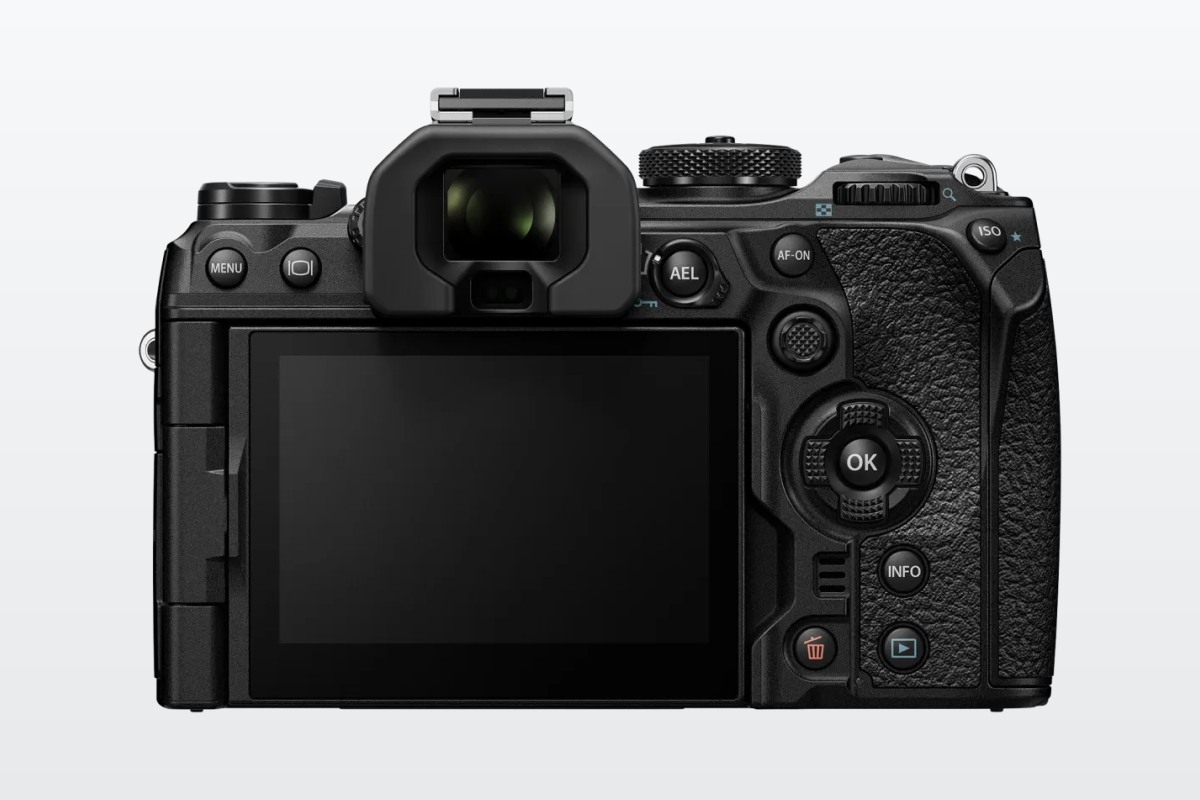
At 599g with battery and memory card, the body is not tiny. It is light for a sealed flagship, and the deep grip balances serious telephotos well. Rubberized command dials improve purchase with gloves. The 5.76-million-dot OLED viewfinder is large and responsive, while the fully articulating screen helps at ground level or when working around cover.
The body carries an IP53 rating when paired with a compatible sealed lens. OM System also rates it for operation down to 14°F (-10°C). That is more specific protection than most competitors publish, but it does not mean waterproof. Open card doors, ports, charging connections, and a mismatched lens remain weak points.
Stabilization is rated up to 8.5 stops under specified CIPA conditions, including with compatible Sync IS lenses. The biggest wildlife benefit is often a steadier viewfinder, not an extremely slow exposure. Stabilization cannot freeze a moving bird, but it makes precise long-lens framing less tiring.
The BLX-1 battery is rated for about 520 images under CIPA testing, or up to 1,100 with Quick Sleep enabled. Burst use can produce far more frames, while cold weather, wireless transfer, and long review sessions reduce endurance. I would carry at least one genuine spare for a full day away from power.
USB-C charging and USB Power Delivery are useful during travel. They do not replace a charged spare when the camera must stay ready. The two matched card slots can record backups, split RAW and JPEG files, or switch automatically. For action, check that both cards are fast enough for the chosen recording scheme.
The menu is broad because the camera has so many drive, autofocus, and computational options. I recommend building a custom menu before a trip. Put subject type, autofocus area, Pro Capture, card settings, stabilization, and formatting in one place. Save separate custom modes for perched subjects and flight rather than rebuilding the camera when behavior changes.
Computational features and video
Pro Capture is the computational feature that matters most for wildlife. Focus stacking is also valuable for insects, flowers, and close details, though movement between frames can create artifacts. Live ND helps with water or wind movement, while Live GND can balance a bright sky over a darker wetland. Neither is a substitute for careful inspection around moving subjects or irregular horizons.
The video specification is respectable: uncropped 4K and Cinema 4K reach 60p, and Full HD high-speed recording reaches 240 fps. OM-Log400 and HLG support 10-bit H.265 recording. Stabilization and a fully articulating screen make handheld clips easy to capture.
Video remains secondary to stills. The body uses micro-HDMI and offers less production support than video-led hybrids. Ten-bit recording is also tied to specific profiles. Photographers who make occasional wildlife clips should be satisfied. Dedicated filmmakers should compare codecs, monitoring, heat behavior, and audio workflow before buying.
OM-1 Mark II vs the closest alternatives
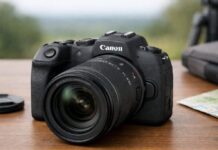
The Canon EOS R7 gives you 32.5MP APS-C files, excellent subject recognition, and more cropping room. The OM-1 Mark II counters with a stacked sensor, faster bursts, stronger published weather protection, dual UHS-II slots, and a broader set of in-camera tools. Compare complete lens kits, not body prices.
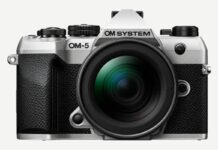
If travel and hiking matter more than action, the OM System OM-5 Mark II keeps the same mount in a much smaller, less expensive body. You give up the OM-1 Mark II’s subject detection, dual cards, large battery, deep grip, and flagship speed.
n
The Panasonic Lumix G9 II shares the Micro Four Thirds mount and is the stronger value for many hybrid shooters. It offers more ambitious video features and high-resolution stills, but the OM-1 Mark II is the more coherent wildlife body. Its stacked readout, grip, sealing, viewfinder, and Pro Capture implementation are better aligned with field action.
A Nikon Z6 III or used Nikon Z8 makes more sense when low-light files, video, or full-frame rendering matters most. Those bodies also lead to larger and costlier long-lens kits. For a broader shortlist by budget and format, see our guide to the best cameras for wildlife photography.
Lens choices and buying traps
A body-only bargain is not a bargain if the lens plan is wrong. The 40-150mm F2.8 PRO is excellent for larger animals and field sports. The 100-400mm zooms are more affordable birding options. The 300mm F4 IS PRO is a lighter premium prime, while the 150-400mm F4.5 TC1.25x IS PRO is the no-compromise native choice at a very high price.
Compatibility is broad because Micro Four Thirds is a shared mount, but stabilization and weather protection vary by pairing. OM System Sync IS requires a supported lens. Panasonic Dual I.S. does not transfer wholesale to an OM body. Our guide to the best Micro Four Thirds lenses explains the practical combinations.
Also compare the body-only price with the 12-40mm F2.8 PRO II kit. A discounted kit can be the better deal even if wildlife is your priority, because the lens covers landscapes, travel, and general use. Buy from an authorized US seller when warranty coverage matters, and inspect used bodies for card-slot errors, worn dials, damaged port doors, sensor condition, and genuine BLX-1 batteries.
Should original OM-1 owners upgrade?
For most original OM-1 owners, no. The Mark II keeps the same basic 20.4MP sensor concept, body shape, battery, viewfinder resolution, and headline burst speeds. The gains are a larger buffer, revised autofocus behavior, human recognition in the subject menu, Live GND, higher rated stabilization, rubberized dials, and several workflow refinements.
Upgrade if the original buffer interrupts real action sequences, if Live GND replaces filters you actually carry, or if the autofocus changes solve a recurring problem. Otherwise, a better telephoto, faster cards, spare batteries, or travel will probably improve your photography more. New buyers should still choose the Mark II when the price gap is modest because it is the more complete and current body.
Final verdict
The OM System OM-1 Mark II earns a strong recommendation for wildlife photographers who work handheld, walk far, and need serious reach without a full-frame burden. Its speed is not just a spec-sheet trick: Pro Capture, the deeper buffer, and controlled 50 fps shooting can change how you approach brief behavior.
The camera is not a universal bargain. Its 20.4MP files leave limited room for careless framing, and larger sensors remain better when high shutter speeds meet very low light. The smartest buyer accepts those limits in exchange for a weather-ready body, compact telephoto system, excellent stabilization, and field tools that rivals often leave to accessories or postproduction.
Frequently asked questions
Is the OM-1 Mark II good for bird photography?
Yes. Bird-eye detection, 50 fps tracking, Pro Capture, a deep buffer, and compact long lenses make it particularly effective for birds. You still need the right autofocus area, shutter speed, and subject mode.
What battery and memory cards does it use?
It uses the OM System BLX-1 battery. Both SD slots support UHS-I and UHS-II SDHC/SDXC cards. U3 media is recommended for demanding video modes, while fast UHS-II cards reduce the wait after large stills bursts.
Is it better than the original OM-1?
It is better, but not dramatically different. The deeper buffer, revised autofocus options, Live GND, higher stabilization rating, and control changes matter most. Image quality and the overall shooting experience remain close.
Bird, wildlife, macro, outdoor sports, hiking, and travel photographers who prioritize reach, speed, sealing, and low system weight.
You routinely crop heavily, shoot fast action in very low light, need large native files, or require a video-first production body.
Medium-high; autofocus areas, subject modes, Pro Capture, card behavior, and computational tools reward careful setup.
Nikon Z6 III or Z8 for larger-sensor files and video; higher-resolution APS-C or full frame when cropping latitude matters more than kit size.
Useful uncropped 4K/C4K 60p and stabilized 10-bit capture, but micro-HDMI, profile restrictions, and stills-first production features limit demanding video work.
Yes, especially near $2,000, for wildlife photographers who will use its speed, Pro Capture, sealing, and compact telephoto system.