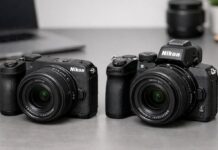

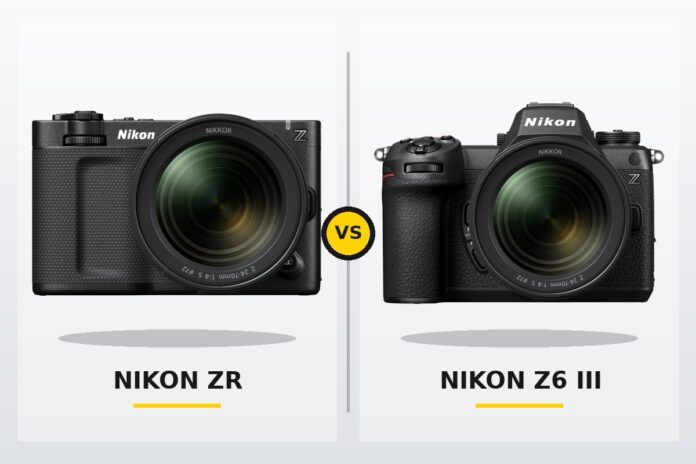
The Nikon ZR vs Z6 III choice comes down to whether you need a cinema-first body or a dependable hybrid camera. Choose the ZR when R3D NE, 32-bit float audio, a 4-inch monitor, and low rig weight will improve your video work. Choose the Z6 III for photography, mixed assignments, flash, or any one-body kit that must adapt quickly. For most photographers who also shoot video, the Z6 III is the better buy.
Nikon ZR vs Z6 III: the quick answer
These Nikons share 24.5MP full-frame resolution, EXPEED 7 processing, Z mount, strong subject detection, and internal 6K RAW recording. That common foundation can make them look interchangeable. They are not.
- Buy the Nikon ZR for filmmaking, documentary work, interviews, gimbals, or a compact RED-compatible B-camera.
- Buy the Nikon Z6 III for weddings, events, portraits, travel, action, flash work, or a genuine 50/50 photo-video workload.
- Skip both if you require built-in ND filters, SDI, XLR inputs, or extensive mounting points. A dedicated cinema body may save more rigging than either Nikon.
My dividing line is simple. If photography is more than an occasional requirement, I would buy the Z6 III. I would choose the ZR only when its production features solve needs that I can name before ordering it.
The specifications that change the decision
| Feature | Nikon ZR | Nikon Z6 III |
|---|---|---|
| Primary role | Compact cinema camera | Full-frame hybrid camera |
| Sensor | 24.5MP full-frame CMOS | 24.5MP partially stacked full-frame CMOS |
| Internal RAW video | 6K/60p R3D NE, N-RAW, or ProRes RAW HQ | 6K/60p N-RAW or ProRes RAW HQ |
| Audio | 32-bit float or 24-bit; five built-in mic patterns | 24-bit Linear PCM; built-in stereo mic |
| Viewfinder | None | 5.76M-dot OLED EVF |
| Rear display | 4-inch, 3.07M-dot vari-angle | 3.2-inch, 2.1M-dot vari-angle |
| Shutter | Electronic only; 1/60-sec flash sync | Mechanical, EFCS, electronic; 1/200-sec sync |
| Media | CFexpress Type B/XQD + microSD UHS-I | CFexpress Type B/XQD + SD UHS-II |
| HDMI | Micro HDMI | Full-size HDMI |
| Operating weight | Approx. 630 g | Approx. 760 g |
Nikon’s official ZR specifications and Z6 III specifications confirm the shared imaging core. The consequential differences sit around it: viewing, audio, ports, shutter, media, and body shape.
For still photography, the Z6 III is the easy winner
The ZR can make the same-size 24.5MP still files and can shoot full-resolution RAW at up to 20 fps. Its autofocus system is not a token video implementation. The problem is the experience around those files.
There is no viewfinder. You compose every photograph on the rear display, which is awkward in bright sun and less stable with a long lens. The shallow grip also gives your right hand less leverage. A compact prime can make the ZR pleasant for casual stills, but a 24-70mm f/2.8 or telephoto exposes the ergonomic compromise quickly.
The electronic-only shutter is the bigger warning. Flash synchronizes at 1/60 second or slower. Fast movement can skew, and some artificial lighting can produce banding. That combination makes the ZR a poor first choice for weddings, studio flash, indoor sports, and fast event work.
The Z6 III adds a deep grip, direct photo controls, a bright EVF, and a mechanical shutter with 1/200-second sync. It also supports auto FP high-speed sync with compatible Nikon flash equipment. Our full Nikon Z6 III review covers its autofocus, image quality, and handling in more detail.
For video, decide whether R3D changes your workflow
What the Nikon ZR adds
The ZR’s headline feature is internal 12-bit R3D NE up to 6K/59.94p. It brings REDWideGamutRGB and Log3G10 into a small Nikon body. That matters when you already use a RED pipeline, need a compact matching camera, or want the exposure and color controls offered by an R3D workflow.
It does not make every shot look cinematic by itself. R3D files are large, require deliberate grading, and can slow delivery on ordinary projects. If your work already looks good in 10-bit H.265 or Nikon N-RAW, the Z6 III may give clients the same useful result with a simpler camera.
The ZR also records 32-bit float audio in supported NEV, R3D, and MOV modes. Its three built-in microphones offer five pickup patterns. Those features can reduce the need for a separate recorder on a small solo setup. The 4-inch DCI-P3 display can also replace an external monitor for many lightweight shoots.
Where the Z6 III remains stronger
The Z6 III already records internal 6K/60p N-RAW and ProRes RAW HQ, plus ProRes 422 HQ and 10-bit H.265. It includes waveform, zebras, focus peaking, timecode, and proxy recording. This is serious video capability, not an incidental movie mode.
Its full-size HDMI port is safer for frequent monitor or transmitter use than the ZR’s micro connector. The EVF is useful in harsh light, and the deeper body is easier to operate bare-handed. The Z6 III is the more practical choice for a wedding filmmaker who also shoots stills. The ZR is more compelling for a solo filmmaker who wants to strip the rig down.
Handling and rigging pull in opposite directions
Ready to shoot, the ZR is about 130 g lighter. It is also much shorter and shallower. That difference is welcome on a gimbal, car mount, slider, or travel rig. Its box-like front and large screen make sense when a cage, handle, or support system will define the final grip.
Small does not always mean complete. The ZR has one 1/4-inch tripod socket, micro HDMI, and no built-in ND, SDI, or XLR. Add a cage, cable clamp, matte box, power solution, and audio adapter, and the weight advantage can disappear. Price the finished rig, not the body.
The Z6 III is 74 mm deep, compared with 49 mm for the ZR. Much of that depth is useful grip. I prefer this shape when handholding a normal zoom or switching rapidly between stills and video. Full-size HDMI also makes more sense when a cable stays attached during a long production day.
Both cameras use the EN-EL15c battery and support USB power delivery. That shared battery is convenient for an existing Nikon kit. Neither body turns a small battery into all-day cinema power, so long takes still deserve tested external power and strain-relieved cables.
Media and post-production can erase the price difference
Both cameras use CFexpress Type B or XQD in the primary slot. The Z6 III pairs it with a full-size UHS-II SD slot. The ZR uses UHS-I microSD instead. That smaller secondary slot is fine for still backups and lighter duties, but demanding RAW video belongs on fast CFexpress media.
The ZR launched at a lower body-only MSRP than the Z6 III. Street promotions can reverse or erase that gap, so compare current US prices on the day you buy. More important, add the parts required for your actual workflow.
- Budget for high-capacity CFexpress cards and a fast reader.
- Multiply footage by at least two for working storage and backup.
- Check whether your editor handles R3D NE efficiently before choosing it.
- Include cages, cable clamps, external power, and audio hardware.
Nikon’s current ZR firmware is version 1.11. The earlier 1.10 update added wired timecode and extended selected recording modes to as much as six hours with external power. A used or new-old-stock ZR should be updated before production use.
Who should buy the Nikon ZR or Z6 III?
Buy the Nikon ZR if…
- Video accounts for most of your paid or personal work.
- You will use R3D NE or need to match footage with RED cameras.
- 32-bit float audio and the large monitor remove gear from your solo kit.
- Low body weight matters on gimbals, mounts, or travel productions.
- You accept micro HDMI, UHS-I microSD, and screen-only stills shooting.
Buy the Nikon Z6 III if…
- Photography is half the job or more.
- You shoot events, weddings, action, or flash-lit work.
- You want one body that can move between stills and serious video.
- Full-size HDMI and UHS-II SD improve your working reliability.
- N-RAW, ProRes RAW, and 10-bit H.265 already meet your video needs.
If you are considering a higher-resolution hybrid as well, our Nikon ZR vs Z8 comparison explains when the Z8’s 45.7MP stacked sensor is worth the extra size and cost.
Alternatives and buying traps
The Nikon Zf is a strong alternative for photographers who value a smaller body and traditional controls. Its video ceiling is lower, but an EVF and mechanical shutter make it a far more natural photo camera than the ZR.
A purpose-built cinema model is the better alternative when you require built-in ND filters, full-size XLR, SDI, active cooling, or multiple mounting points. The Sony FX line, Canon Cinema EOS bodies, and Blackmagic cameras solve different combinations of those needs. Lens ownership, autofocus expectations, and post-production software should narrow that list.
Do not buy the ZR merely because it says RED. Buy it because the codec, monitor, audio system, or body shape reduces friction. Do not buy the Z6 III assuming its video is second rate. For many small businesses, weddings, interviews, and documentary projects, its internal formats are already more demanding than delivery requires.
There is one current used-market check for both cameras. Nikon issued a US service advisory for certain ZR and Z6 III serial numbers because affected units may become inoperable. Nikon offers free repair, including parts and shipping. Verify the serial number before buying used or new-old stock.
Final verdict
The Nikon ZR is the more distinctive video camera. Internal R3D NE, 32-bit float audio, a large display, and a light body make it unusually capable for a solo filmmaker or small crew. Those advantages are real, but they are specialized.
The Z6 III is the better camera for most people comparing these two. It preserves nearly all the video capability a hybrid shooter is likely to use. It also adds the EVF, mechanical shutter, grip, flash behavior, full-size HDMI, and faster secondary card slot that make daily work easier.
My recommendation is decisive: buy the Z6 III unless you are video-first and can explain exactly how the ZR’s cinema features will improve your production. For deeper detail on the specialist option, read our Nikon ZR review.
Frequently asked questions
Does the Nikon ZR have better image quality than the Z6 III?
Not by default. They share the same full-frame format and 24.5MP resolution. The ZR’s R3D NE option changes color and post-production flexibility, not the basic sensor resolution. Lighting, exposure, lenses, and the chosen recording format still matter more.
Can the Nikon ZR replace the Z6 III for photography?
It can make excellent 24.5MP files, but I would not choose it for regular photo work. The lack of an EVF and mechanical shutter is limiting. Its 1/60-second flash sync is also a poor fit for events and studio lighting.
Which camera is better for wedding work?
The Z6 III is the safer one-body choice. It handles stills, flash, and video without changing operating style. The ZR can be a strong dedicated video body when another camera covers photography.
Do both cameras use the same lenses and battery?
Yes. Both use Nikon Z-mount lenses and the EN-EL15c battery. F-mount NIKKOR lenses work through the FTZ II adapter, with restrictions for some combinations. Our best Nikon Z lenses guide is a useful next step when building either kit.