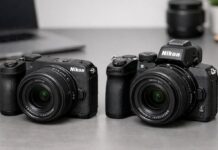

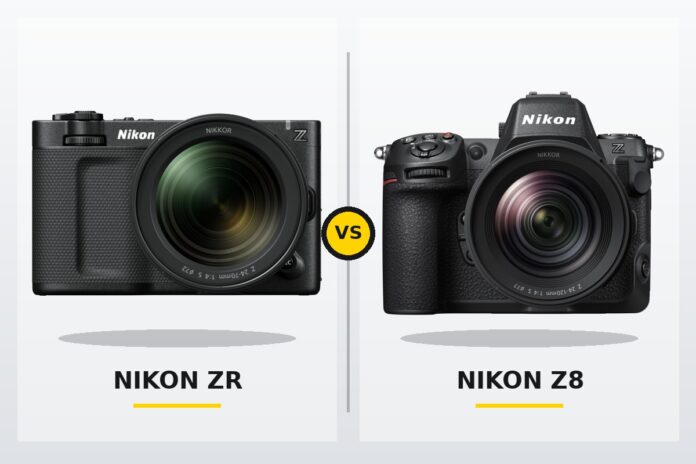
The Nikon ZR vs Z8 decision is unusually simple once you decide what the camera must do most often. Buy the ZR for video-first work, especially if internal R3D NE, 32-bit float audio, and a compact rig will save you time. Buy the Z8 for serious stills or mixed photo-video assignments. Its 45.7MP stacked sensor, EVF, deeper grip, stronger flash support, and more practical ports make it the far better one-body hybrid.
Nikon ZR vs Z8: the quick decision
These cameras share Nikon Z mount, subject-detection autofocus, in-body stabilization, and the EN-EL15c battery. They are not close substitutes, though. The ZR is a 24.5MP cinema camera that can take good photographs. The Z8 is a 45.7MP professional stills camera with remarkably deep video features.
- Choose the Nikon ZR for documentary work, interviews, small crews, gimbals, travel productions, or a compact RED-compatible B-camera.
- Choose the Nikon Z8 for wildlife, sports, weddings, events, studio work, landscapes, or any assignment where stills and video carry equal weight.
- Choose neither if you mainly want an affordable all-round Nikon. The Nikon Z6 III is the more balanced middle ground.
My short verdict: the ZR is the more interesting video product, but the Z8 is the safer camera for a photographer who cannot predict the next assignment.
Key specifications that change the answer
| Feature | Nikon ZR | Nikon Z8 |
|---|---|---|
| Primary role | Compact cinema camera | Professional hybrid camera |
| Sensor | 24.5MP full-frame partially stacked CMOS | 45.7MP full-frame stacked CMOS |
| Maximum RAW video | 6K 60p R3D NE or N-RAW | 8.3K 60p N-RAW |
| Viewfinder | None | 3.69M-dot OLED EVF |
| Rear screen | 4-inch, 3.07M-dot vari-angle | 3.2-inch, 2.1M-dot four-axis tilt |
| Stabilization | 5-axis IBIS; rated up to 7.5 stops | 5-axis IBIS; up to 6 stops with compatible lenses |
| Continuous stills | Up to 20 fps RAW | 20 fps RAW; 30 fps full-resolution JPEG |
| Media | CFexpress Type B/XQD + microSD UHS-I | CFexpress Type B/XQD + SD UHS-II |
| HDMI | Micro HDMI | Full-size HDMI |
| Audio | 32-bit float; 3.5mm input and headphone output | 24-bit; 3.5mm input and headphone output |
| Body-only weight | Approx. 540 g | Approx. 820 g |
| Launch price | $2,199.95 | $3,999.95 |
The price difference is real, but it is not the whole cost. A ZR may need a cage, cable clamp, external power, and substantial CFexpress capacity. A Z8 buyer may spend less on rigging, yet more on storage for 45.7MP stills and 8K footage.
For still photography, the Z8 wins easily
The Z8 gives photographers much more than another 21 megapixels. Its stacked sensor reads quickly, the body has a proper EVF and substantial grip, and the control layout is built around eye-level shooting. At 20 fps it records full-resolution RAW files. It can also shoot 30 fps at full resolution in JPEG, or 120 fps at 11MP.
That combination matters for wildlife and sport, but resolution also benefits quieter work. A 45.7MP file leaves room to crop a distant subject or deliver a large print. The Z8’s base ISO 64 is also useful for landscapes and studio lighting. For a fuller account of its handling and autofocus, see our Nikon Z8 review.
The ZR is not a bad stills camera. It records 14-bit NEF files at 24.5MP and reaches 20 fps in RAW. Nikon also gives it modern subject detection and five-axis stabilization. The trouble is everything around the file. You compose on the rear screen, hold a shallow body with larger lenses, and rely on an electronic shutter that syncs flash at only 1/60 second.
That 1/60-second limit is a serious buying trap for studio, event, and wedding photographers. Fast movement under some LED lighting can also reveal banding or skew. The ZR works for production stills, portraits between takes, travel, and personal work. It should not replace a Z8 when photography pays the bill.
For video, choose between R3D workflow and hybrid range
Why the ZR is the stronger cinema tool
The ZR’s defining advantage is internal 12-bit R3D NE up to 6K/59.94p. It uses REDWideGamutRGB and Log3G10, so it fits naturally beside RED footage and allows ISO, white balance, and color decisions in post. It also records N-RAW, ProRes RAW HQ, ProRes 422 HQ, and H.265. This is not merely a different badge on a Z6-series body; the file and color workflow is the point.
The 4-inch vari-angle DCI-P3 monitor is another practical win. It is larger than the Z8’s screen, faces forward, and reduces the need for an external monitor on a small setup. Built-in 32-bit float audio can protect a solo operator from badly set levels, although it is unavailable in H.264. The compact body is also much easier to balance on a gimbal.
Why the Z8 remains a formidable video camera
The Z8 reaches 8.3K/60p in 12-bit N-RAW and offers internal ProRes RAW HQ, ProRes 422 HQ, and 10-bit H.265. Its oversampled 4K, full-size HDMI, waveform display, timecode support, and two USB-C ports make it a serious production body. The four-axis tilting screen is excellent behind the camera, though it cannot face a solo presenter.
If resolution, reframing, and one-camera hybrid coverage matter most, the Z8 has the broader ceiling. If RED color management, 32-bit float audio, and a light cinema setup matter more, the ZR has the cleaner purpose. Our detailed Nikon ZR review explains the codec and audio tradeoffs in more depth.
Handling and rigging are opposite propositions
The ZR weighs about 540 g without battery or cards, versus roughly 820 g for the Z8. That 280 g difference is obvious on a gimbal, suction mount, slider, or travel rig. The ZR’s flat body also packs neatly around accessories. Its screen-led interface and prominent record control make sense when video is the starting point.
Compactness brings costs. The shallow grip is less secure with a 70-200mm lens. The body has one 1/4-inch tripod socket, no built-in ND filters, and no SDI or XLR inputs. Micro HDMI deserves a cage and cable clamp if an external monitor stays connected. Once you add those parts, the tiny body becomes a system.
The Z8 is heavier, but its grip balances long lenses better. It has an EVF, illuminated buttons, a top display, full-size HDMI, and separate USB-C ports for data and power. Its rear screen tilts horizontally and vertically without swinging beside the camera. I prefer that arrangement for stills, while the ZR’s vari-angle screen is more useful for self-recording and awkward rig positions.
Both bodies are described by Nikon as weather resistant, but neither carries a published IP rating. The Z8 is rated for operation down to 14°F, while the ZR’s stated operating range begins at 32°F. Cold-weather shooters should not assume the smaller cinema body has the same environmental rating.
Media, storage, audio, and post-production costs
Both cameras accept CFexpress Type B or XQD in the primary slot. The second slot is where their priorities diverge. The Z8 uses full-size UHS-II SD, which is practical for backup stills, overflow, and lighter video. The ZR uses UHS-I microSD. It can back up stills, but high-bitrate RAW video belongs on fast CFexpress media.
R3D NE is especially demanding. Nikon lists about 3,730 Mbps for 6K/59.94p, which works out to roughly 28 GB per minute before backups. That can be justified for a demanding grade or RED multi-camera job. It is wasteful for a quick interview that will be delivered in 4K with minimal correction. The ZR’s 10-bit H.265 modes are often the more rational choice.
The Z8 creates a different storage problem. Its 45.7MP stills are excellent, but a high-volume event or wildlife burst can fill cards and catalogs quickly. Its 8.3K N-RAW modes also demand fast media and a capable editing machine. Neither camera makes heavy codecs free.
The shared EN-EL15c battery is convenient for an existing Nikon kit. USB-C power is sensible for long video takes, and the Z8 also accepts the MB-N12 battery grip. Whichever body you choose, budget for genuine spare batteries, a tested power-delivery setup, and enough duplicate storage to back up a full shooting day.
Who should buy each camera?
Buy the Nikon ZR if…
- Video is at least 80% of the work.
- You will genuinely use R3D NE or need to match RED cameras.
- You work alone and value autofocus, IBIS, a large monitor, and 32-bit float audio.
- Low rig weight matters more than an EVF, deep grip, or full-size HDMI.
- You can support a CFexpress-heavy storage and backup workflow.
Buy the Nikon Z8 if…
- Photography is the main job, or stills and video are equally important.
- You need 45.7MP files, strong cropping latitude, and fast action shooting.
- You use flash, long telephoto lenses, or an eye-level viewfinder regularly.
- You want 8.3K N-RAW, full-size HDMI, UHS-II SD, and more robust body controls.
- You need one Nikon body that can move between wildlife, events, studio, and video production.
If the Z8 feels right but you need more battery life and an integrated vertical grip, our Nikon Z9 vs Z8 comparison covers that step up.
Alternatives and buying traps
The Z6 III is the obvious alternative. It keeps a 24.5MP partially stacked sensor, EVF, mechanical shutter, deep grip, full-size HDMI, UHS-II SD, and 6K internal RAW. It loses the ZR’s R3D NE, 32-bit float audio, and 4-inch screen. For a photographer who shoots serious video but does not need 45.7MP files, it may be the best answer of all.
Video teams that require built-in ND, SDI, XLR, active cooling, or extensive mounting points should compare purpose-built cinema bodies before choosing either Nikon. The ZR is inexpensive partly because those production features live outside the body. The Z8 is powerful, but rigging a large photo body can be inefficient.
Used buyers should inspect ports, card slots, the screen hinge, sensor, IBIS behavior, and battery health. For the ZR, there is one extra check: Nikon issued a US service advisory for certain serial numbers manufactured with parts that may cause the camera to become inoperable. Nikon offers free repair for affected units. Check the serial before buying used or old stock.
Do not buy either camera because a headline format sounds future-proof. Confirm that your editor supports the chosen RAW format, calculate a full day’s storage, and test your exact card. Nikon’s official ZR bitrate tables are more useful for budgeting than a maximum-resolution badge.
Verdict: ZR for cinema, Z8 for the complete job
The Nikon ZR wins when the assignment begins with motion. It offers a rare combination of internal R3D NE, 32-bit float audio, excellent autofocus, stabilization, and a genuinely small full-frame body. For documentary shooters, interview crews, and RED users who need a light B-camera, it is the sharper purchase.
The Nikon Z8 wins for almost everyone who identifies as a photographer first. It is vastly better to operate for stills, resolves more detail, handles flash and long lenses properly, and still records professional internal RAW video. It costs more and weighs more because it solves more kinds of assignment.
I would buy the ZR as a deliberate video tool. I would buy the Z8 when one body has to earn its place across stills and motion. That is the real Nikon ZR vs Z8 divide.
Frequently asked questions
Is the Nikon ZR better than the Z8 for video?
The ZR is better for a compact RED-oriented workflow because it records R3D NE, supports 32-bit float audio, and has a larger forward-facing screen. The Z8 is better when you need 8.3K N-RAW, full-size HDMI, an EVF, or one body for high-end stills and video.
Can the Nikon ZR replace a Z8 for photography?
Not for most serious photographers. The ZR can make strong 24.5MP RAW files, but it has no EVF, a shallow grip, an electronic-only shutter, and 1/60-second flash sync. The Z8 is the much more complete stills camera.
Do the Nikon ZR and Z8 use the same lenses and batteries?
Yes. Both use Nikon Z-mount lenses and the EN-EL15c battery. F-mount NIKKOR lenses can be adapted with the FTZ II, although compatibility restrictions may apply. Sharing batteries and lenses makes the ZR a logical video companion to a Z8 kit.
Which is better for a solo creator?
Choose the ZR if the work is video-led and you value a light rig, vari-angle screen, and forgiving audio. Choose the Z8 if you also shoot substantial stills, need an EVF, or regularly work with flash and long lenses.