
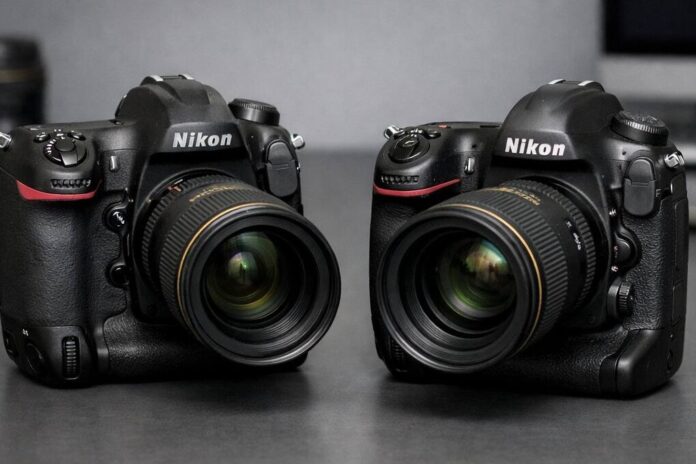
Nikon D5 vs D6 is now a used-market decision between value and refinement. Buy the D5 if you want flagship DSLR toughness for the least money. Pay more for the D6 only if its denser autofocus coverage, 14 fps shooting, and built-in transfer tools will improve real assignments. Image quality is too similar to justify the upgrade by itself.
Nikon D5 vs D6: the short answer
The D6 is the better sports camera, but not automatically the better buy. It improves the parts of the D5 that working action photographers notice: AF-point density, cross-type coverage, low-light acquisition, burst speed, customization, and deadline workflow. The gains are useful rather than transformative.
The D5 remains the value choice for wildlife, events, and sports when you find a clean body at a much lower price. It has the same 20.8MP resolution, the same native ISO range, familiar pro controls, and excellent battery endurance. If you already own one, the D6 is a narrow upgrade rather than a new imaging platform.
My call is straightforward. Choose the D6 for paid action work where a small improvement in focus recovery or file delivery can earn its keep. Choose the D5 for personal wildlife, local sports, or any job where the D6 premium would be better spent on a lens, travel, or service reserve.
Key differences that matter in the field
| Feature | Nikon D5 | Nikon D6 | Practical winner |
|---|---|---|---|
| Sensor | 20.8MP FX CMOS | 20.8MP FX CMOS | Tie |
| Native ISO | 100–102,400 | 100–102,400 | Tie |
| Viewfinder AF | 153 points; 99 cross-type; 55 selectable | 105 points; all cross-type and selectable | D6 |
| Low-light AF rating | -4 EV | -4.5 EV at center | D6, slightly |
| Mechanical burst | 12 fps with AF/AE | 14 fps with AF/AE | D6 |
| Card slots | Dual XQD or dual CompactFlash, depending on version | Dual CFexpress Type B/XQD | D6 |
| Wireless and location | Optional transmitters and GPS unit | Built-in Wi-Fi, Bluetooth, and GPS | D6 |
| Video | 4K UHD up to 30p | 4K UHD up to 30p | Tie |
Nikon’s point counts need context. The D5 lists more total points, but many are assist points that you cannot select directly. The D6 makes all 105 points selectable and cross-type. Nikon also says its revised layout is about 1.6 times denser than the D5 system.
Autofocus: why the D6 is better despite fewer points
The D6’s Multi-CAM 37K module is the central reason to buy it. Its focus array has fewer gaps, and every point reads contrast on both axes. You also get 17 custom Group-area patterns. Those patterns help when a net, another player, reeds, or branches enter the frame.
The improvement is about consistency more than magic subject recognition. Neither DSLR gives you the near-full-frame animal and bird detection found in current mirrorless bodies. You still need to select an appropriate AF-area mode, keep the active area on the subject, and tune blocked-shot response.
For field sports, the D6 is better at holding a subject through crossings and keeping the AF area useful near its edges. For wildlife, the benefit is more situational. A skilled D5 user may see little difference against a clean sky, yet the D6 has more to offer around clutter and erratic movement.
Low-light acquisition also moves from a rated -4 EV on the D5 to -4.5 EV at the D6’s center point. That half-stop will not transform a dark stadium. It can, however, reduce hesitation on a low-contrast face or animal at dusk. I value faster recovery after an obstruction more than one perfectly sharp frame from an easy sequence.
Burst speed, buffer, and viewfinder rhythm
The D5 shoots at 12 fps with continuous autofocus and exposure. Its headline 14 fps mode locks the mirror up, so it is not equivalent to normal viewfinder action shooting. The D6 delivers 14 fps with full AF and AE under Nikon’s stated conditions.
Two extra frames per second can matter at a finish line, a bat strike, or a bird’s wing position. They also create more files to ingest and edit. If your timing is good and delivery is not immediate, 12 fps remains plenty.
Both bodies offer the direct, lag-free view of an optical finder. That is still appealing with fast pans and long lenses. The tradeoff is central AF coverage, mechanical noise, and no live exposure preview. A modern Z body places focus far closer to the frame edge and can shoot silently.
Buffer claims vary with file type, bit depth, card, and camera settings. Test a used body with the exact card and RAW setup you plan to use. A cheap or tired card can make either flagship feel slower than its specification sheet suggests.
Image quality: do not upgrade for the sensor
Both cameras produce 20.8MP FX files at the same 5,568 × 3,712 maximum resolution. Their native ISO ranges are also identical. In a matched RAW workflow, expect broadly similar detail, high-ISO character, and cropping latitude.
The modest resolution is deliberate. Files move quickly, bursts stay manageable, and high-ISO output remains strong. The compromise is reach. A distant bird or loose field-sports frame gives you far less room to crop than a D850, Z8, or Z9 file.
At base ISO, neither body is the best Nikon choice for deep shadow recovery or large landscape prints. At ISO 3,200 through 12,800, both remain convincing assignment cameras when exposure is sound. The D6’s EXPEED 6 processing can improve JPEG output, but it does not create a compelling RAW upgrade.
If image quality is the reason you are shopping, stop and define the problem. The Nikon D850 vs Z8 comparison is more useful when resolution, dynamic range, or cropping flexibility matters more than an integrated pro grip.
Cards and connectivity: the biggest buying trap
The D5 was sold in two distinct versions: dual XQD or dual CompactFlash. They are not the same purchase. Only the XQD-slot version can use CFexpress Type B cards after the appropriate firmware update. The dual-CompactFlash body remains tied to older CF media.
Do not trust a vague listing that says only “D5.” Ask for a clear photo of the open card door and confirm both slots in person. A low price may reflect a high shutter count, but it may also reflect the less desirable card version.
Nikon’s D5 firmware page confirms that version 1.40 added CFexpress Type B support. Update cautiously with a known battery and follow Nikon’s instructions. Card compatibility can still vary by model and capacity.
The D6 avoids that split. Its two slots accept CFexpress Type B or XQD cards. It also adds built-in Wi-Fi, Bluetooth, and GPS, plus faster Ethernet transfer and USB-C. Those features matter most to agencies, wire shooters, and anyone transmitting captioned JPEGs on deadline. A wildlife photographer who waits until home may gain little.
Handling, batteries, and F-mount compatibility
These are large, integrated-grip DSLRs designed around heavy F-mount lenses. Their horizontal and vertical controls are familiar, their optical finders are excellent, and both balance long telephotos better than a small body. Neither has in-body stabilization, so you depend on lens VR when available.
The D5 uses an EN-EL18a battery, while the D6 shipped with the EN-EL18c. Nikon’s CIPA figures differ by test method and do not mirror a long burst-heavy assignment. In practice, the broader point is simple: both outlast most mirrorless bodies on one battery.
F-mount compatibility is a major reason to buy either camera. AF-S and E-type super-telephotos fit natively, and many older Nikon lenses remain usable with model-specific limits. If your kit is already built around F-mount glass, that continuity can outweigh a mirrorless body’s smarter autofocus.
If you are starting with no lenses, continuity has no value. Read our Nikon DSLR buying guide before committing to a legacy system. An inexpensive body can become an expensive decision once cards, batteries, service, and lenses enter the budget.
Which camera fits sports, wildlife, and events?
Sports and news
Choose the D6 when you shoot through other players, work under poor stadium light, or transmit during the event. Its AF density, 14 fps rate, priority transfer tools, GPS, and built-in wireless support form a coherent professional upgrade. See our full Nikon D6 review for the wider workflow case.
Wildlife
Choose the D5 when budget and condition favor it. The D6 is more configurable around clutter, but the two cameras deliver very similar files. For distant or small wildlife, a D500’s pixel density or a higher-resolution body may matter more than the D6’s autofocus refinement.
Events and low-light work
Both cameras are superb low-light stills tools, but both are loud and conspicuous. The D6 can shoot silently in live view, yet focus behavior and rolling-shutter risk make that a limited solution. If silence and face detection are essential, a current mirrorless body is the better route.
Existing D5 owners
Keep the D5 unless you can name the missed shot or delivery delay that the D6 will solve. The D6 is worthwhile for denser AF coverage, two extra frames per second, and integrated connectivity. It is not worthwhile for a clear jump in RAW quality. Our Nikon D5 review covers the older body on its own terms.
Used buying checklist
- Confirm the D5 card version. Check for dual XQD or dual CompactFlash slots; never assume.
- Read the shutter count. Treat it as one condition clue, not a complete health report.
- Test both card slots. Record RAW files, switch the backup mode, and read the cards on a computer.
- Check autofocus calibration. Use a lens you trust at several distances and focus points.
- Inspect the mount and controls. Look for play, sticky buttons, worn joysticks, damaged terminals, and lifting grip rubber.
- Verify the battery and charger. Replacements are costly, and a weak pack distorts your value calculation.
- Test Ethernet, USB, and GPS. Do this especially on a D6 bought for workflow.
- Ask for service records. A documented high-use body can be safer than an immaculate camera with a vague history.
Buy the best documented example, not the lowest listing. A dealer warranty is worth real money on a former agency body. Leave room in the budget for a sensor clean, replacement eyecup, fresh battery, cards, and a professional inspection.
Better alternatives for some photographers
A Nikon D500 is cheaper and gives wildlife photographers more pixel density on the subject. A D850 offers 45.7MP and much stronger cropping room, though its standard burst rate is slower. Both are better choices when flagship grip ergonomics are not essential.
The Z8 and Z9 are the more rational long-term buys for photographers starting fresh. They add broad subject detection, near-frame-wide AF placement, high resolution, silent electronic shooting, and serious video. The costs are a different viewfinder experience, greater power use, larger files, and a possible lens transition.
Do not buy a D5 or D6 simply because yesterday’s flagship price looks irresistible. Buy one because an optical finder, native F-mount telephoto support, long battery endurance, and rugged integrated controls match the way you work.
Final verdict
The D6 wins this comparison on capability. Its autofocus system is denser and easier to place, its 14 fps burst retains AF and AE, and its connectivity is far more complete. For a sports professional or deadline shooter, those changes can justify the premium.
The D5 wins on value. It delivers almost the same image quality and most of the same flagship experience for less. Find the dual-XQD version, verify its condition, and it remains a formidable action DSLR.
For most buyers, I would choose a clean D5 and put the savings into glass. I would choose the D6 only when its better focus coverage or transfer workflow answers a specific, recurring problem. If neither advantage sounds decisive, neither camera should pull you away from the cheaper body.
Frequently asked questions
Is the Nikon D6 image quality better than the D5?
Not by enough to drive the purchase. Both produce 20.8MP FX files with the same native ISO range. The D6 can have a small JPEG-processing advantage, but RAW output is broadly similar.
Does the Nikon D5 use CFexpress cards?
The dual-XQD D5 can support compatible CFexpress Type B cards with current firmware. The separate dual-CompactFlash version cannot. Verify the exact body before buying.
Is the D6 worth upgrading to from a D5?
Yes for denser all-cross-type AF coverage, 14 fps shooting, or built-in professional connectivity. No if you mainly want better image quality or already trust the D5’s autofocus for your subjects.
Which is better for wildlife, the D5 or D6?
The D6 is technically better for erratic subjects and clutter. The D5 is usually the better value. For small or distant wildlife, also compare higher-resolution and DX bodies before buying either.