
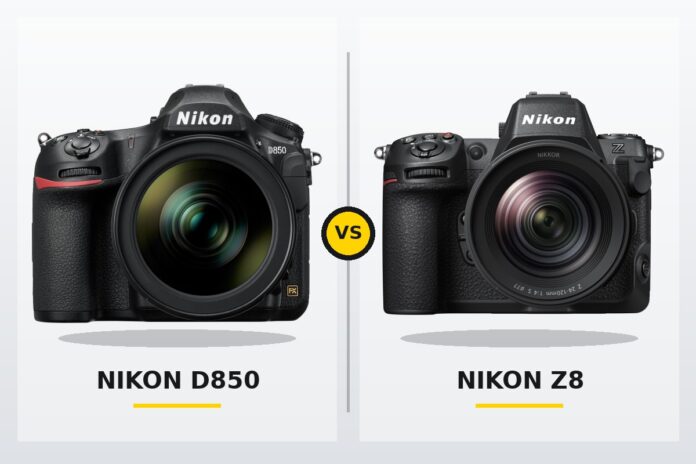
The Nikon D850 vs Z8 choice is straightforward: keep or buy the D850 for high-resolution stills, long battery life, an optical viewfinder, and maximum value from F-mount lenses. Move to the Z8 when subject-detection autofocus, silent shooting, in-body stabilization, or serious video will change what you can deliver. The Z8 is the better all-round camera, but it is not an automatic image-quality upgrade.
Nikon D850 vs Z8: the short answer
For birds, wildlife, sports, events, and hybrid work, I would choose the Z8. Its autofocus and speed produce a more meaningful gain than the shared 45.7MP headline suggests. It also opens Nikon’s current Z-mount lens system.
For landscapes, architecture, studio work, and photographers with a strong F-mount kit, the D850 remains a rational camera to keep. Buying one now makes most sense used or at a substantial new-stock discount. Starting a system from scratch is different: the Z8 costs more, but Z mount is Nikon’s development path.
Key specifications and what they mean
| Feature | Nikon D850 | Nikon Z8 |
|---|---|---|
| Sensor | 45.7MP full-frame BSI CMOS | 45.7MP full-frame stacked CMOS |
| Native ISO | 64–25,600 | 64–25,600 |
| Lens mount | Nikon F | Nikon Z; F lenses via FTZ/FTZ II |
| Stabilization | Lens VR only | 5-axis in-body VR |
| Autofocus | 153-point viewfinder AF | 493-point hybrid AF with subject detection |
| Maximum burst | 7 fps; 9 fps with grip setup | 20 fps RAW; 30/60/120 fps JPEG |
| Viewfinder | 0.75x optical | 3.69M-dot, 0.8x electronic |
| Shutter | Mechanical; 1/8,000 sec. | Electronic; 1/32,000 sec. |
| Video | 4K 30p | 8.3K 60p N-RAW; 4K 120p |
| Card slots | CFexpress B/XQD + UHS-II SD | CFexpress B/XQD + UHS-II SD |
| CIPA battery rating | Approx. 1,840 shots | Approx. 340–370 shots |
| Loaded weight | Approx. 1,005 g | Approx. 910 g |
The autofocus-point counts are not directly comparable. The important difference is that the Z8 can recognize and track specific subjects across far more of the frame. Nikon’s current Z8 specifications also confirm the all-electronic shutter and high-speed capture modes that define its shooting experience.
Image quality: resolution is effectively a tie
Both cameras record 8256 × 5504-pixel files and start at ISO 64. With the same lens, sound technique, and normal output sizes, neither body gives you a transformative detail advantage. A D850 owner should not spend Z8 money merely to get “better 45-megapixel files.”
The Z8’s gains are indirect but often more useful. In-body stabilization helps with non-VR lenses and static subjects. Better subject tracking raises the odds that fine detail lands where you intended. The stacked sensor reads quickly enough to make an electronic-only shutter practical for demanding work.
There is still a caveat. Electronic shutters can show banding under some LED lighting, and no anti-flicker system covers every fixture or shutter-speed combination. Test the Z8 in venues where color or brightness bands would ruin a delivery. For controlled tripod work, the D850’s excellent sensor remains hard to fault.
Autofocus, burst speed, and silent shooting
The D850’s 153-point phase-detect system is still dependable with predictable motion. Its 3D tracking and group-area modes can handle sport and wildlife in experienced hands. The weakness is coverage and subject recognition, not basic competence. Live-view autofocus is contrast-detect and feels dated for moving subjects or video.
The Z8 changes the job from repeatedly placing an AF point to telling the camera what subject matters. It detects people, animals, birds, vehicles, and aircraft, then continues tracking as composition changes. That is a real advantage for erratic birds, athletes approaching the camera, and events where expressions appear once.
Its 20 fps mode records full-resolution 14-bit RAW files. The headline 30, 60, and 120 fps modes are JPEG, and 120 fps drops to roughly 11MP. Pre-Release Capture also belongs to those high-speed JPEG modes. Those limits matter if a RAW workflow is non-negotiable.
Silent operation is another decisive gain. The Z8 has no mechanical shutter, so it can work discreetly without mirror or shutter vibration. The D850 offers silent electronic shooting only in live view, which is much less useful when following action through the optical finder.
Viewfinder, handling, and battery life
The D850’s optical finder gives an uninterrupted view with no display lag and almost no power cost. Some photographers simply compose better through it. The Z8’s electronic finder instead shows exposure, white balance, playback, magnification, and overlays without taking the camera from your eye.
Do not expect a dramatic weight reduction. With battery and card, the Z8 is about 95 g lighter, but both are substantial bodies built to balance professional lenses. The Z8 is slightly narrower and shorter, yet deeper. Grip comfort matters more than the numbers here.
Battery endurance is not close. Nikon rates the D850 at about 1,840 shots. The Z8’s official battery figures are about 340 shots through the finder or 370 on the rear screen with energy saving enabled. Burst-heavy real-world totals can be much higher, but the D850 remains easier for long days away from power.
The Z8 uses an EN-EL15c and accepts EN-EL15b or EN-EL15a batteries with reduced endurance. Older EN-EL15a packs will not charge in the camera. Budget for at least one spare EN-EL15c, especially for video.
F-mount lenses and the real switching cost
An FTZ or FTZ II adapter lets the Z8 use many F-mount lenses without adding glass, so the adapter itself does not reduce optical quality. Nikon lists full AF and auto-exposure support for more than 90 AF-S, AF-P, and AF-I lenses. Older screw-drive autofocus lenses generally become manual-focus lenses on the adapter, and specialized optics can have further restrictions. Check every important lens, not just the mount name, against Nikon’s FTZ compatibility guidance.
That caveat can decide the upgrade. A D850 drives many older AF-D lenses from the body and meters with a broad range of manual-focus Nikkors. The Z8 adds in-body stabilization to adapted lenses, but it cannot restore screw-drive autofocus. Z-mount lenses cannot be mounted on the D850.
Calculate the switch in stages. The body and adapter may be enough at first. Native Z lenses can follow when they offer a clear optical or handling benefit. Our Nikon D850 review and Nikon Z8 review go deeper on each system’s strengths.
Cards may not need replacing. Both bodies pair a CFexpress Type B/XQD slot with UHS-II SD. The D850 needs current firmware for CFexpress Type B support, so update it before assuming an existing card is faulty.
Video and hybrid workflow
For video, the Z8 wins by a wide margin. It records 8.3K 60p N-RAW, 4K 120p, 10-bit H.265, and ProRes options internally. It also provides waveform monitoring, full-size HDMI, headphone and microphone ports, and two USB-C connectors. One USB-C port can handle power while the other carries data.
The D850’s full-width 4K 30p can still produce good footage, but its contrast-detect live-view autofocus is the limiting factor. It is best treated as a manually focused stills camera that can record useful 4K, not as a modern hybrid body.
The Z8’s video specifications create costs beyond the camera. High-data-rate modes require approved fast CFexpress cards, substantial storage, and a computer that can decode the files. Maximum recording times also depend on temperature, power, media, and settings. If you only shoot short clips for the web, the Z8’s highest modes may never repay those workflow costs.
Which camera fits your photography?
Choose or keep the D850 if
- You mainly photograph landscapes, architecture, products, or studio portraits.
- Your F-mount lenses include screw-drive AF models you still rely on.
- You prefer an optical viewfinder and want exceptional battery endurance.
- Your current autofocus hit rate is already good enough.
- A used body leaves more budget for a lens, travel, lighting, or printing.
Choose the Z8 if
- You photograph birds, wildlife, sport, events, or unpredictable people.
- Eye and subject tracking would reduce missed frames or mental load.
- You need genuinely silent shooting without moving to rear-screen live view.
- You use non-VR lenses handheld and will benefit from in-body stabilization.
- Video is a paid deliverable or an important part of your creative work.
Alternatives that may be more sensible
The Z8 is easy to overbuy. For high-resolution landscapes and portraits, a used Nikon Z7 II gives you 45.7MP files, IBIS, and Z-mount access for less money. Its autofocus and burst performance are well below the Z8, so it is not the substitute for fast action.
If 24.5MP is enough, the Nikon Z6 III is the more compact hybrid choice. It offers strong autofocus and video without the Z8’s 45MP file burden. At the other extreme, photographers who need an integrated vertical grip and longer battery life should compare the Nikon Z9 vs Z8.
Final verdict
The Z8 is Nikon’s more capable camera and the upgrade I would recommend for action, events, silent work, or hybrid production. It improves the probability of getting the frame, not merely the specifications of a file you already captured. That is worth paying for when missed moments are the problem.
The D850 remains the better value for deliberate stills and for photographers whose F-mount system already does the job. Keep it if the Z8 does not solve a repeated limitation. Buy one today only when the used price and lens savings matter more than mirrorless autofocus, video, and future Z-mount access.
Frequently asked questions
Does the Nikon Z8 have better image quality than the D850?
Not in a simple resolution sense. Both produce 45.7MP files with the same maximum pixel dimensions. The Z8 more often improves results through subject tracking, in-body stabilization, and silent shooting. The D850 still delivers excellent files at base ISO.
Will all D850 lenses autofocus on the Z8?
No. Many AF-S, AF-P, and AF-I lenses retain autofocus and exposure control through the FTZ or FTZ II. Older screw-drive AF lenses generally require manual focus, while some specialized lenses have additional restrictions.
Can the D850 and Z8 share batteries and memory cards?
Partly. The Z8 can use EN-EL15a and EN-EL15b batteries, but endurance is lower and EN-EL15a packs cannot charge in-camera. Both cameras support UHS-II SD and CFexpress Type B/XQD, although the D850 requires updated firmware for CFexpress.
Is the Nikon D850 still worth buying?
Yes, when bought at the right price for high-resolution stills, long battery life, and an existing F-mount kit. For a new system, the Z8 or a less expensive Z body is usually the safer long-term purchase.