

View full specs
This Nikon D6 review has to start with a reality check: the D6 is not the future of Nikon action photography. The Z9 and Z8 have taken that role. But the D6 is still one of the toughest, most reliable professional DSLRs ever made, and for the right photographer it remains a brutally effective tool.
I would not recommend the D6 to someone building a Nikon system from scratch in 2026. I would absolutely understand a sports, wildlife, or agency photographer buying one if they already own serious F-mount glass, prefer an optical viewfinder, and want a camera that runs all day with very little drama.
Who the Nikon D6 is really for
The Nikon D6 is for photographers who value certainty over novelty. It was built for sidelines, press pits, freezing wildlife mornings, dust, rain, long lenses, and deadlines. This is not a lifestyle camera, and it is not a hybrid creator body. It is a professional DSLR designed to make pictures when missing the frame is expensive.
The strongest D6 buyers are already invested in Nikon F-mount. If you own AF-S super-telephotos, fast F-mount zooms, and a DSLR workflow, the D6 lets you keep working without adapters or a total system reset. If you are starting fresh, our Nikon Z9 review and Nikon Z8 review are the more logical places to look.
The D6 also makes sense for photographers who still prefer an optical viewfinder. That preference is not nostalgia. For some action shooters, seeing the scene directly through the lens, without EVF behavior, blackout style, refresh rate, or exposure preview, remains valuable. Mirrorless has many advantages, but optical viewing still has its own rhythm.
Build quality and handling
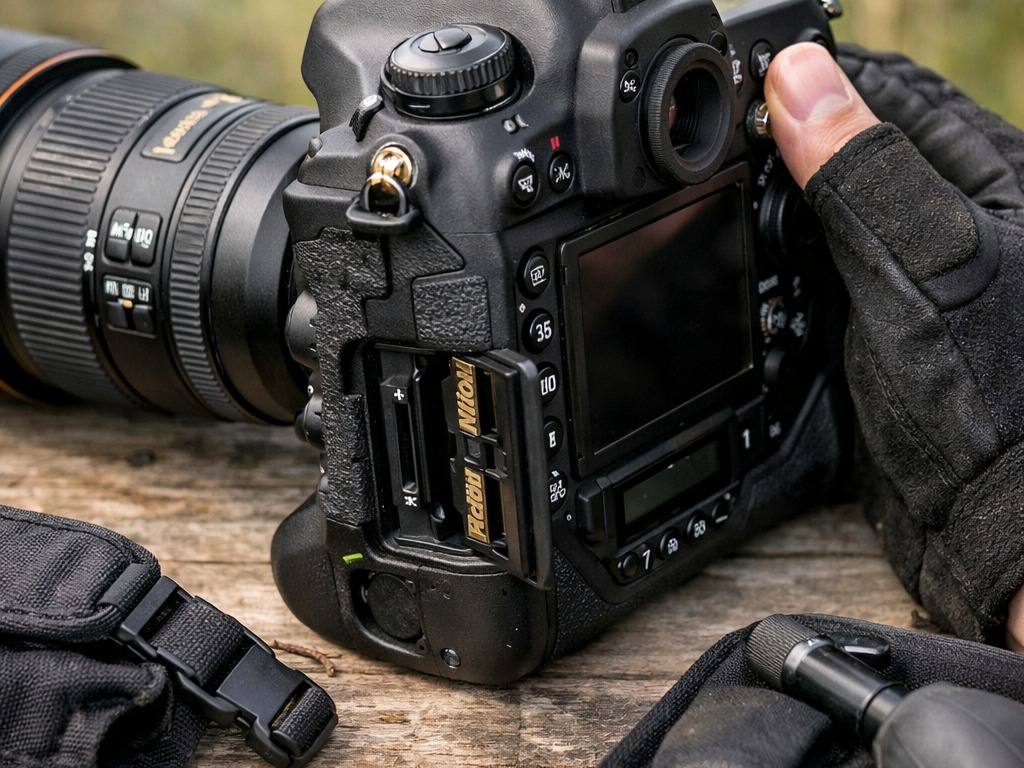
The D6 feels like a tool made for people who work with cameras, not people who admire them on a desk. The integrated vertical grip, deep handgrip, large controls, and weather-sealed magnesium-alloy body all make sense when you are wearing gloves, carrying a 400mm or 600mm lens, or working in ugly weather.
It is heavy, and there is no pretending otherwise. At roughly 1450 g with battery and cards, the D6 is a commitment. But with large F-mount telephotos, that weight is part of the balance. A small body can feel awkward behind big glass. The D6 feels planted.
The controls are classic Nikon pro-body logic. AF-ON, joystick, mode controls, drive settings, and custom buttons are placed for muscle memory. After enough time with a body like this, you stop looking at it. That matters more than spec-sheet readers sometimes realize.
Autofocus for sports and wildlife
The D6 uses Nikon’s Multi-CAM 37K autofocus module with 105 all-cross-type focus points. Nikon’s official D6 specifications list the core system clearly: full-frame DSLR, 20.8MP, EXPEED 6, 105-point AF, and 14 fps shooting.
In the real world, the D6 autofocus is less about flashy subject recognition and more about predictability. It does not identify animals and vehicles the way modern mirrorless bodies do. It does not cover the frame like a Z9. But inside its AF area, with the right settings and a photographer who knows the system, it is very consistent.
That is why the D6 still has a place for sports and wildlife specialists. It tracks through clutter, handles telephoto lenses well, and gives experienced Nikon DSLR users a familiar set of AF-area modes. The 17 custom Group-Area AF options are not glamorous, but they are useful when you are trying to keep focus through nets, players, branches, or messy backgrounds.
Speed, buffer, and battery life
The D6 shoots up to 14 fps with full AF and exposure tracking. That sounds ordinary next to the fastest mirrorless cameras, but it is still plenty for most real sports sequences. More importantly, it does it with a stable optical viewfinder experience and a shutter that feels built for punishment.
The buffer is deep, especially with fast CFexpress Type B or XQD cards. For action work, that means you can stay on a play, a sprint, a jump, or a wildlife behavior sequence without worrying that the camera will choke at the worst moment.
Battery life is one of the D6’s great remaining advantages. The EN-EL18c can run through long assignments in a way that most mirrorless bodies cannot match. If you are working remote wildlife, cold weather, or a tournament day with limited charging access, that endurance is not a minor convenience. It is part of the camera’s professional value.
Image quality and high ISO files
The D6 uses a 20.8MP full-frame CMOS sensor. That resolution looks modest today, but it was never meant to win a megapixel race. It was designed for speed, low-light work, file transfer, agency deadlines, and high ISO reliability.
For sports and wildlife, 20.8MP can be enough if your framing is disciplined. The files are clean, colors are stable, and JPEG output is strong when you need fast delivery. At ISO 6400 and 12,800, the D6 still produces professional results if the exposure is right.
The limitation is cropping. If you regularly need heavy crops from distant wildlife, a D850, Z8, or Z9 gives you more room. The D6 rewards photographers who can fill the frame. It is less forgiving when you rely on cropping to compensate for distance.
Video, connectivity, and pro workflow
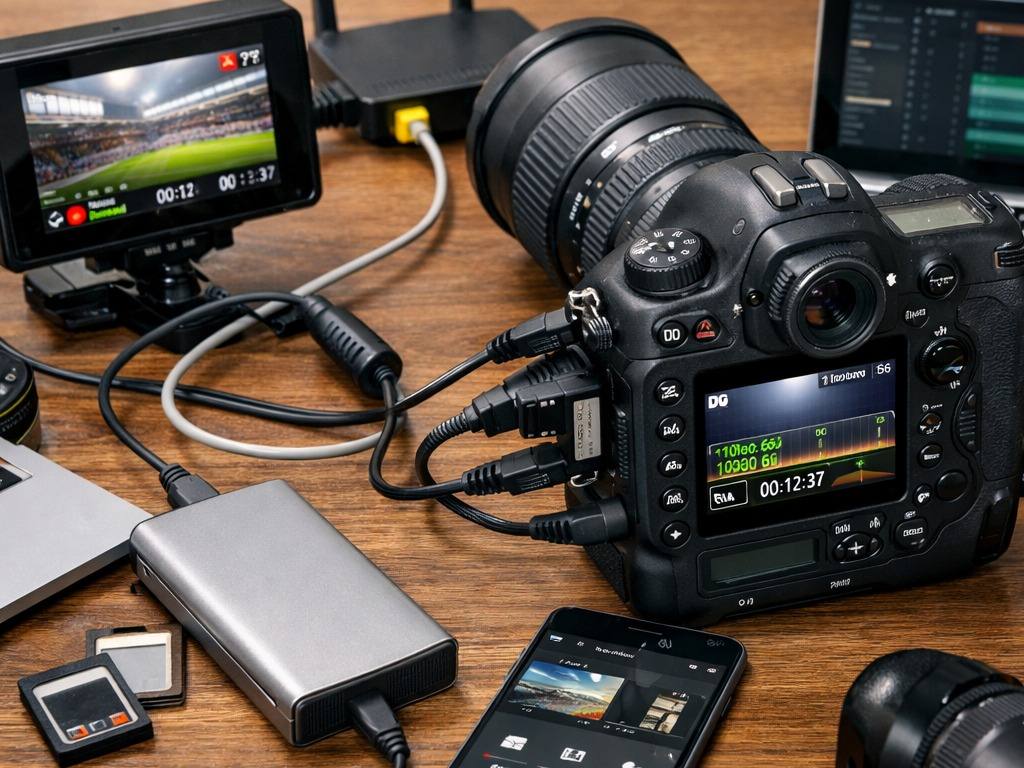
The D6 records 4K UHD up to 30p, but video is not the reason to buy it. The footage is useful for basic clips, news context, or behind-the-scenes work. For serious hybrid shooting, a Z6 III, Z8, or Z9 is the better Nikon path.
Workflow is different. This is where the D6 still feels like a professional assignment camera. Built-in 1000BASE-T Ethernet, Wi-Fi, Bluetooth, GPS, FTP transfer, IPTC handling, voice memos, rating controls, and file-priority tools are built around deadline shooting. That matters to agencies and field photographers who need images moving quickly.
Dual CFexpress Type B/XQD slots also fit the professional brief. They are fast, rugged, and appropriate for high-volume work. The D6 is not trying to be cheap to run. It is trying to be dependable.
The D6 advantage is workflow, not romance
The D6 is easy to underestimate if you only compare spec sheets against the Z9. The reason working photographers still respect it is workflow. The body wakes instantly, the optical finder has no lag, the battery runs forever, the grip is built for long lenses, and the control layout is designed for people who change settings without looking.
Its autofocus system is also deeply configurable. That matters for sports and wildlife photographers who know exactly how they want the camera to react when a subject crosses the frame, disappears behind another player, or moves against a messy background. A mirrorless body may be smarter, but a tuned D6 can still feel brutally dependable in the right hands.
Nikon D6 vs Z9 and Z8
The Z9 is the camera that effectively replaces the D6 for Nikon’s flagship action role. It gives you a stacked 45.7MP sensor, subject detection, silent shooting, no mechanical shutter, 8K video, and much broader AF coverage. If I were starting fresh today, I would choose the Z9 over the D6 for most action work.
The Z8 gives much of that Z9 capability in a smaller body. It is not as battery-enduring or integrated-grip tough, but it is more versatile for many photographers. Our Nikon Z9 vs Z8 comparison is the better read if you are deciding between Nikon’s modern mirrorless flagships.
So why choose the D6? F-mount investment, optical viewfinder preference, extreme battery life, DSLR handling, and proven pro reliability. Those are not small reasons. They are just specific reasons.
Buying a Nikon D6 used
The used market is where the D6 becomes more interesting. New pricing can be hard to justify next to the Z9, but a clean used D6 can be compelling for a photographer with existing F-mount telephotos.
Check shutter count, card slots, Ethernet and USB ports, battery health, sensor condition, grip rubber, hot shoe wear, and whether the camera has lived a hard agency life. A D6 can handle abuse, but professional bodies often see professional mileage.
I would rather buy a clean, well-documented D6 from a reputable used dealer than chase the cheapest body available. With flagship cameras, condition matters more than saving a few hundred dollars.
D6 vs D5, D850, and D500 used
The used Nikon DSLR question is wider than D6 vs Z9. Our Nikon D5 vs D6 comparison explains when the older flagship is the better value. A D850 is the better choice for resolution, landscapes, studio, and general high-end stills. A D500 is still a smart wildlife body if you want DX reach and a lower cost.
The D6 is the specialist. I would buy it for professional sports, news, events, and wildlife where durability, high-ISO consistency, autofocus customization, battery life, and familiar DSLR handling matter more than resolution. If that does not describe your use, Nikon has cheaper and more flexible options.
Final verdict
My Nikon D6 review verdict is that this is still a superb professional DSLR, but no longer the default Nikon action recommendation. For new buyers, mirrorless has moved ahead. For established F-mount shooters, the D6 remains a deeply trustworthy camera.
It is fast, rugged, familiar, and built around real professional workflow. The autofocus is dependable, the battery life is excellent, and the files hold up in the kind of poor light where sports and wildlife photographers often work.
Do not buy it because you want the newest technology. Buy it because you know exactly why a flagship DSLR still fits your work.
Nikon D6 alternatives
The main alternatives to the Nikon D6 are Nikon Z9, Nikon Z8, Canon EOS-1D X Mark III, Canon EOS R3, Sony A1/A9 III. Compare autofocus, stabilization, video limits, lens choice and current price before deciding which camera fits you best.
Frequently asked questions
Is the Nikon D6 still worth buying in 2026?
Yes, but mainly for photographers already invested in Nikon F-mount lenses or DSLR workflow. If you are starting fresh, the Nikon Z9 or Z8 is usually the better long-term choice.
Is the Nikon D6 good for wildlife photography?
Yes. The D6 is rugged, fast, and excellent with long F-mount telephoto lenses. Its main drawback for wildlife is 20.8MP resolution, which gives less cropping room than higher-resolution bodies.
Is the Nikon D6 better than the Nikon Z9?
For most buyers, no. The Z9 is more advanced and more versatile. The D6 still wins for photographers who strongly prefer an optical viewfinder, extreme DSLR battery life, and native F-mount handling.
What memory cards does the Nikon D6 use?
The Nikon D6 uses two CFexpress Type B / XQD card slots. Fast cards are recommended for high-volume sports and wildlife bursts.
Should I buy the Nikon D6 or Nikon D850?
Buy the D6 for speed, autofocus consistency, battery life, and professional sports workflow. Buy the D850 if you want higher resolution, more cropping room, and a more general-purpose DSLR.
Sports, wildlife, agencies, and F-mount professionals who want a rugged optical-viewfinder flagship.
You are starting fresh, need high-resolution cropping, want modern subject detection, or shoot serious video.
Very high; size, cost, controls, cards, and lens choices are professional-level.
Nikon Z9 for the modern flagship path, or Z8 for similar mirrorless performance in a smaller body.
4K is usable, but the D6 is clearly a stills-first DSLR and not a modern hybrid body.
Yes for committed F-mount pros at the right used price; no as a fresh-system purchase for most buyers.