

View full specs
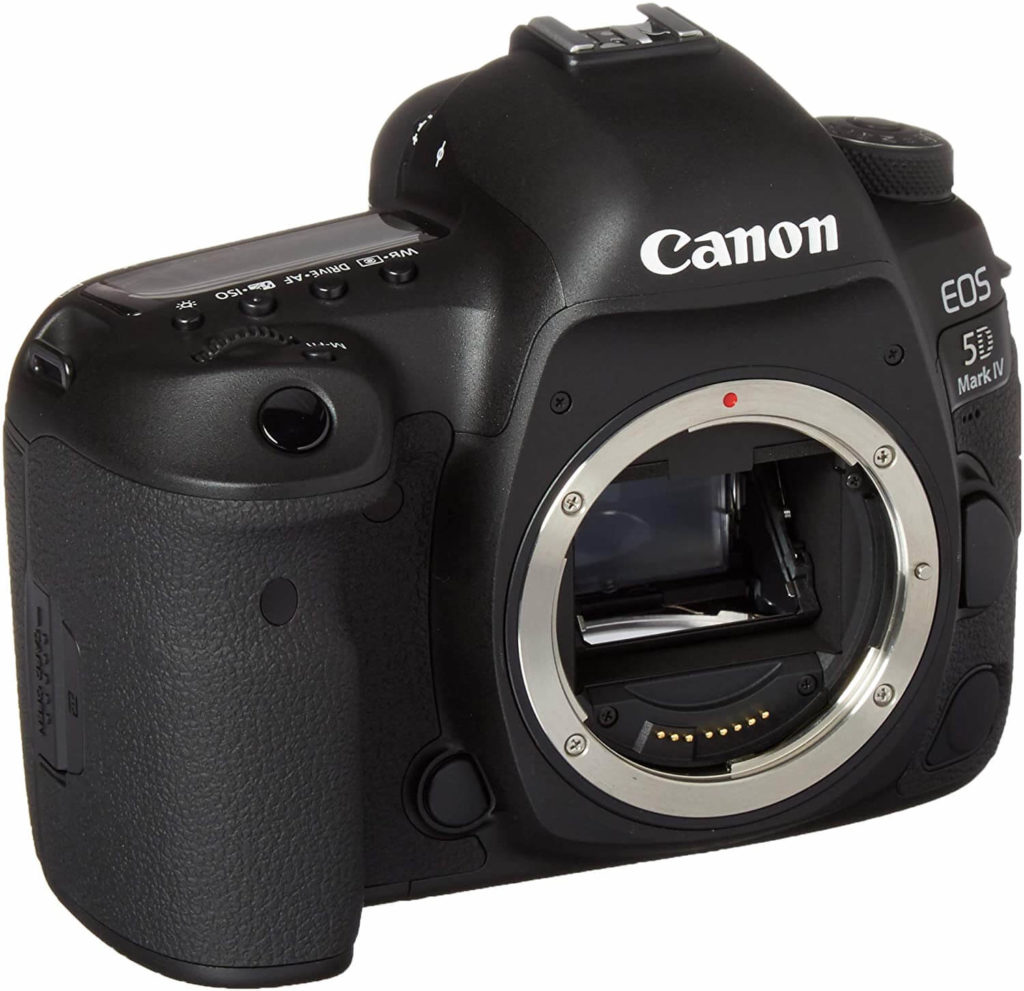
The Canon EOS 5D Mark IV has reached an unusual point in its life. Canon U.S.A. now lists it as discontinued, yet clean bodies remain relevant to photographers who own EF lenses and want a dependable full-frame DSLR. Its 30.4MP files, direct controls, optical viewfinder and dual card slots still fit wedding, portrait, event and editorial work.
The buying decision now depends more on condition and system cost than headline specifications. A well-kept body paired with good EF lenses can be excellent value. Starting from zero, or paying close to the cost of a used EOS R6 Mark II, makes mirrorless easier to justify.
Canon 5D Mark IV review: quick verdict
| Best for | Stills-first photographers with Canon EF lenses, especially for weddings, portraits, events and studio work |
|---|---|
| Main strengths | 30.4MP full-frame files, excellent controls, reliable viewfinder AF, dual card slots and strong battery life |
| Main limitations | No IBIS, fixed screen, narrow AF coverage, dated 4K workflow and no modern subject recognition |
| Buy new or used? | Used or professionally refurbished makes the most sense now |
| Short answer | Still worth buying when the body is healthy, EF lenses are part of the plan and still photography comes first |
Canon 5D Mark IV release date and current status
Canon announced the EOS 5D Mark IV on August 25, 2016, with U.S. sales beginning in September 2016. It replaced the 5D Mark III and became the final model in the main 5D DSLR line. There is no 5D Mark V.
Canon U.S.A.’s product page now marks the body as discontinued and no longer available from its online store. Its support page remains active with manuals, software and firmware. Used condition, seller protection and service history therefore matter more than old launch information.
Canon 5D Mark IV sample photos
Tap any sample to open the full-resolution file. All four photographs are licensed for reuse, credited to the photographer and identified as EOS 5D Mark IV files. The settings cover daylight detail, stadium action and demanding stage light.


What the 30.4MP files look like
The sensor still occupies a practical middle ground. A 6720 x 4480 RAW file leaves room for moderate cropping and large prints without the storage burden of a 45MP body. At low ISO, fine detail and color remain competitive for professional delivery. The city and seascape samples above show where the camera is strongest: controlled exposure, good lenses and enough light.
Event work is more revealing. The ISO 800 sports frame keeps convincing skin color under difficult artificial light. The ISO 3200 concert frame retains useful facial detail and saturated reds, with grain and reduced shadow cleanliness visible when opened full size. Exposing accurately is important because lifting a badly underexposed high-ISO frame makes noise much more obvious.
RAW flexibility improved substantially over the 5D Mark III, especially when recovering shadows. Current full-frame mirrorless sensors provide more processing latitude in extreme files, but ordinary portrait, wedding and editorial output will rarely expose a major gap.
Autofocus, speed and handling
The optical viewfinder uses 61 AF points, including 41 cross-type points. It is fast and predictable once AF cases and point selection are configured, but the points stay concentrated near the center. Off-center faces require a nearby point, careful recomposition or Live View.
Live View uses Dual Pixel CMOS AF across a much larger area and supports touch focus. It is useful for tripod work, products and precise portraits, though the fixed rear screen limits low and high angles. Mirrorless bodies remain much easier for eye detection, animals and subjects moving unpredictably across the frame.
Seven frames per second is enough for ceremonies, expressions, stage work and moderate action. The body also offers anti-flicker shooting, which helps under cycling indoor lights. At about 890g with battery and cards, it balances large EF zooms well but creates a heavy all-day kit.
Used Canon 5D Mark IV buying checklist
A used 5D Mark IV can look tidy after a hard professional life, so inspect function rather than judging only the rubber and paint.
- Ask for the shutter count. Canon tested the shutter unit to approximately 150,000 cycles. That figure is a durability benchmark, not an expiry date. A high count should affect the price and leave room for a future shutter repair.
- Test both card slots. Record, review and format with a known CompactFlash card and a known SD card. The CF slot accepts Type I UDMA 7 cards, not CFast. The SD slot supports UHS-I, not UHS-II speed.
- Check the sensor. Photograph an evenly lit wall or clear sky at f/16, then inspect the frame for stubborn marks. Ordinary dust is serviceable; scratches or residue are a different problem.
- Exercise every control. Test both command dials, joystick, AF-ON, touchscreen, mode dial, hot shoe, PC sync, USB, HDMI, microphone and headphone ports.
- Test autofocus two ways. Use viewfinder AF across several points, then compare it with Live View focus. A consistent viewfinder error with one lens may require AF microadjustment. Erratic behavior across lenses deserves caution.
- Inspect the body seals and card door. Heavy wear around doors and ports can reveal a working life that a clean front plate hides. Weather resistance reduces risk but never makes the camera waterproof.
- Check the battery and charger. Confirm that the LP-E6N is not swollen and that the camera reports sensible recharge performance. Budget for a replacement when buying an older body.
- Request recent RAW files. A fresh sequence at several shutter speeds can reveal banding, intermittent shutter problems, dead pixels or file corruption before money changes hands.
EF lenses: the strongest reason to buy one
The 5D Mark IV accepts Canon EF lenses directly. It does not accept EF-S or EF-M lenses. This catches owners moving up from a Rebel, 80D or 90D because their EF-S zooms cannot be mounted on the full-frame body.
Existing EF glass changes the economics. A 24-70mm f/2.8L, 70-200mm f/2.8L, 85mm prime or 100mm macro works natively, with familiar balance and no adapter. Our Canon EF lens guide covers the most useful used options. The broader Canon DSLR lineup places the 5D IV beside the 6D and 1D families.
Canon 5D Mark IV vs mirrorless
| Camera | Choose it for | Main tradeoff |
|---|---|---|
| Canon 5D Mark IV | Native EF lenses, optical viewfinder, long battery life and DSLR controls | No IBIS or modern subject detection |
| Canon R6 Mark II | Eye AF, action, silent shooting, IBIS and stronger hybrid use | Lower 24MP resolution and an adapter for EF lenses |
| Canon R5 Mark II | High resolution, advanced tracking and serious video | Far higher total system cost |
EF lenses work well on EOS R bodies through Canon’s EF-EOS R adapter, often with better frame coverage for autofocus than they had on a DSLR. That makes an R6 Mark II especially important to price-check. The 5D IV wins when the optical viewfinder and lower total cost are genuine preferences, rather than habits left unexamined.
Video remains the weak point
The 5D Mark IV records DCI 4K up to 30p and uses Dual Pixel AF, but 4K applies a substantial crop and records large Motion JPEG files. Wide framing becomes harder, storage disappears quickly and the fixed screen slows solo work. There is no IBIS.
Full HD is easier to handle for interviews, behind-the-scenes clips and occasional work. A buyer whose income or creative plans depend heavily on video should choose a newer mirrorless body. The 5D IV’s strongest case remains still photography.
Canon 5D Mark IV pros and cons
| Pros | Cons |
|---|---|
| Detailed 30.4MP full-frame files | No in-body stabilization |
| Reliable controls and optical viewfinder | AF points cluster near the center |
| Dual card recording for paid work | Fixed rear screen |
| Strong battery life | Dated 4K crop and file format |
| Large used EF lens selection | Heavy body and discontinued system |
Should you buy a used Canon 5D Mark IV?
Yes, for a healthy body at a sensible price when stills and EF lenses drive the decision. It remains particularly convincing for weddings, portraits, events, studio work and photographers who prefer an optical viewfinder. Its files and controls have aged better than its video features.
Choose mirrorless when starting a new system, tracking fast subjects across the frame, shooting video regularly or working handheld in low light with unstabilized lenses. Compare the complete kit, including lenses and adapter, rather than comparing body prices alone.
Canon EOS 5D Mark IV alternatives
The main alternatives to the Canon EOS 5D Mark IV are Canon EOS R6 Mark II, Canon EOS R5 Mark II, Nikon D850, Sony a7 IV. Compare autofocus, stabilization, video limits, lens choice and current price before deciding which camera fits you best.
Frequently asked questions
When was the Canon 5D Mark IV released?
Canon announced it on August 25, 2016, and sales began in September 2016. Canon U.S.A. now lists the model as discontinued.
Is the Canon 5D Mark IV still worth buying in 2026?
Yes, mainly as a used stills camera for photographers with EF lenses. Condition, shutter count and the price difference versus an EOS R6 Mark II matter more than age alone.
What is the Canon 5D Mark IV shutter life?
Canon tested the shutter for approximately 150,000 cycles. Some shutters fail earlier and others run far longer, so use the count as a wear indicator rather than a deadline.
Can the Canon 5D Mark IV use EF-S lenses?
No. It accepts Canon EF lenses but excludes EF-S and EF-M lenses.
Does the Canon 5D Mark IV have image stabilization?
The body has no IBIS. Stabilization is available only when the attached EF lens includes optical IS.
Does the Canon 5D Mark IV shoot 4K?
Yes. It records DCI 4K up to 30p, with a substantial crop and large Motion JPEG files.
Wedding, portrait, event, editorial, and landscape photographers who want a proven full-frame Canon DSLR.
You need modern subject tracking, silent shooting, IBIS, or serious 4K video workflow.
Moderate to high; controls are professional but logical for Canon DSLR users.
Canon EOS R6 Mark II for general mirrorless, or EOS R5 Mark II for high-resolution Canon RF work.
Good Dual Pixel AF, but 4K crop and Motion JPEG files make video feel dated.
Yes for EF lens owners and stills-first photographers at the right used price.