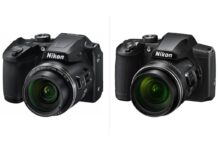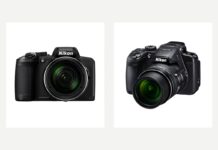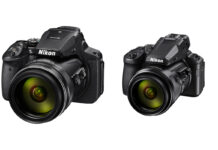

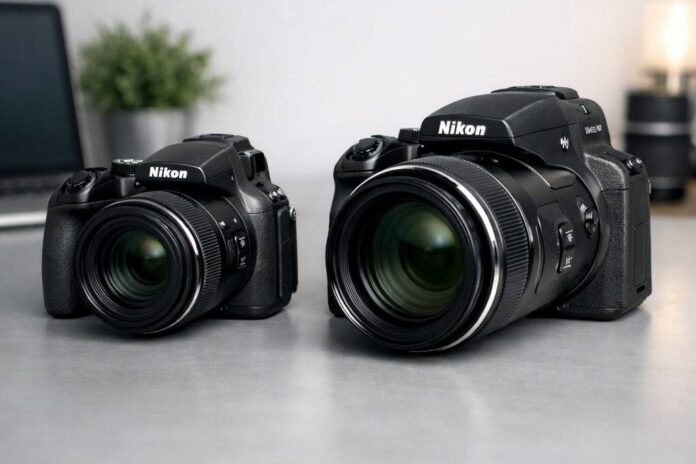
Nikon P950 vs P1000 is really a choice between a manageable 2000mm-equivalent superzoom and a much heavier 3000mm-equivalent specialist. The P950 is the better fit for most birders and traveling photographers. Choose the P1000 only when that last 1000mm of optical reach is central to what you shoot—and you accept the extra weight, smaller buffer, and used-market buying risk.
If the newer 3000mm body is your alternative, compare the two current buying paths in our Nikon P950 vs P1100 guide.
Short answer: get the P950 for long walks, handheld work, and general wildlife. Hunt down a P1000 for moon photography, distant perched birds, aircraft, or observation from a fixed position. Since Nikon now calls the P1100 the P1000’s successor, a P1000 should cost meaningfully less than the newer model.
Nikon P950 vs P1000: key differences at a glance
These cameras have more in common than their bodies suggest. Both use a 16MP 1/2.3-inch CMOS sensor, contrast-detect autofocus, optical stabilization, NRW RAW capture, and the same EN-EL20a battery. Both also record 4K UHD at up to 30p. The P1000 does not buy you a larger sensor or a newer autofocus system. It buys reach.
| Feature | Nikon P950 | Nikon P1000 |
|---|---|---|
| Optical zoom | 83x; 24–2000mm equivalent | 125x; 24–3000mm equivalent |
| Maximum aperture | f/2.8–6.5 | f/2.8–8 |
| Sensor | 16MP 1/2.3-inch CMOS | 16MP 1/2.3-inch CMOS |
| Weight | 35.5 oz / 1005 g | 49.9 oz / 1415 g |
| Dimensions | 5.6 × 4.4 × 5.9 in. | 5.8 × 4.7 × 7.2 in. |
| Full-resolution burst | About 7 fps for 10 frames | About 7 fps for 7 frames |
| Battery rating | About 290 shots | About 250 shots |
| Viewfinder | 2.36M-dot OLED EVF | 2.36M-dot OLED EVF |
| Rear screen | 3.2-inch vari-angle; 921k dots | 3.2-inch vari-angle; 921k dots |
| Video | 4K UHD 30p; Full HD 60p | 4K UHD 30p; Full HD 60p |
Nikon’s official P950 specifications and P1000 specifications confirm the important differences. The P1000 adds 50% more maximum focal length, but weighs 14.4 ounces more. That weight penalty affects every outing, not just shots taken beyond 2000mm.
Reach and image quality: what 3000mm actually buys
The P1000’s 3000mm-equivalent endpoint is not a small marketing bump. At the same distance, a subject framed at 3000mm is 1.5 times taller and wider than it is at 2000mm. That can put roughly 2.25 times as many pixels across the subject area before any crop. For a moon filling the frame or a static bird across water, the advantage is real.
Yet more magnification does not automatically produce more detail. The P1000 is only f/8 at maximum zoom. Heat shimmer, haze, vibration, missed focus, and subject movement all become more visible. A clean P950 frame at 1500–2000mm can beat a shaky or atmosphere-softened P1000 frame at 3000mm.

At shared focal lengths, expect broadly similar image quality rather than a decisive winner. The sensor format and resolution are the same, although the lenses are not identical. Both look best in clear daylight at modest ISO settings. Neither is a strong low-light camera, and neither offers the dynamic range or fine detail of a current APS-C mirrorless body.
I prefer judging distant detail early in the morning, before sun-warmed ground starts moving the air. If a nearer subject looks crisp while a remote one shimmers, the atmosphere is the limit. No amount of extra zoom fixes that.
Handling and portability decide more shots than specs
The P950 is not small, but the P1000 is in another weight class. The 14.4-ounce difference is almost the weight of a small mirrorless body. The P1000 is also longer and more front-heavy as its lens extends. It demands a larger bag, a stronger strap, and more deliberate support.
That makes the P950 easier to recommend for trail walks, travel, and opportunistic birding. It is quicker to raise, easier to hold while waiting, and less likely to stay home. Read our full Nikon P950 review if 2000mm already sounds like enough reach.
The P1000 makes more sense from a hide, backyard, vehicle, shoreline, or fixed observation point. A monopod reduces arm fatigue without slowing repositioning. For the moon and distant static subjects, a sturdy tripod and a smooth head make framing much easier. Our Nikon P1000 review goes deeper into that camera’s handling demands.
Do not assume stabilization turns 3000mm into casual point-and-shoot territory. It helps with camera shake, but it cannot freeze a moving bird or steady a flexible tripod. Start wider to acquire the subject, then zoom in. That habit improves keeper rate with either camera.
Birding, wildlife, aircraft, and moon photography
For birding and wildlife
The P950 is the smarter default for casual birding. Its 2000mm endpoint is already extreme, and the lighter body is easier to track with. It also holds a 10-frame burst at about 7 fps, compared with seven frames from the P1000. Neither buffer is generous, but the extra three frames can matter when a perched bird takes off.
The P1000 wins when the subject is tiny, distant, and predictable. Think shorebirds across mudflats, raptors on a remote perch, or wildlife watched from a fixed blind. It is less convincing for erratic birds in flight. Both cameras use contrast-detect AF without modern bird-eye recognition, so busy backgrounds and rapid direction changes can defeat them.
For the moon, aircraft, and distant detail
This is where the P1000 earns its size. The 3000mm view gives more lunar detail in-camera and larger framing of high aircraft or remote structures. It can reduce the crop required for a final image. Use a stable support, a short self-timer or remote release, and manual exposure when an automatic mode clips lunar highlights.
The P950 remains excellent for the moon. Pulling back from maximum zoom often makes composition and focusing easier, especially on a modest tripod head. If you want a camera for mixed subjects rather than maximum lunar scale, its balance is better.
Autofocus, burst shooting, and video workflow
Neither model should be mistaken for a modern action camera. Contrast-detect AF is adequate for perched birds, slow wildlife, ships, and the moon in good light. It can hesitate on low-contrast subjects or jump to branches in front of an animal. Pre-focus near the expected distance and use a smaller focus area when the background is cluttered.
Both cameras shoot at about 7 fps at full resolution, then stop after a short burst. That pause changes how you work. Instead of holding the shutter, time brief bursts around takeoff, wing position, or a predictable movement. The P950’s 10-frame limit is useful, but it still fills in roughly 1.4 seconds.
Video specifications are effectively tied: 4K up to 30p and Full HD up to 60p. The lens creates unusual options for wildlife clips, but every small movement becomes visible at extreme focal lengths. Support is more important than resolution. Both cameras also use Micro-USB rather than USB-C, which is worth remembering when packing cables.
If USB-C or new-camera support matters, compare the Nikon P1100 and P1000. The P1100 keeps the P1000’s core lens and sensor while updating connectivity and several controls.
Buying a P950 or P1000 now
Live price and condition matter more than the original list prices. The P1000 has been superseded, so most examples are used, refurbished, or old stock. A P1000 priced close to a new P1100 is a poor bet unless its condition and warranty are unusually strong. The newer camera offers the same 24–3000mm range with easier current support.
The P950 is worth considering when its price reflects its age and shorter zoom. Do not overpay simply because stock is scarce. Compare several established camera dealers, check return terms, and be skeptical of marketplace bundles padded with low-grade accessories.
What to inspect on a used superzoom
- Run the lens slowly through its full range and listen for grinding or uneven movement.
- Check that autofocus and stabilization behave consistently at wide, middle, and telephoto settings.
- Inspect the front element, EVF, vari-angle screen, battery compartment, and tripod socket.
- Shoot a detailed subject at several focal lengths, then review the files at 100%.
- Confirm the EN-EL20a battery, charger or charging cable, hood, and lens cap are included.
A mirrorless camera is the better long-term path if you want faster subject detection, stronger low-light files, weather-resistant options, and room to upgrade lenses. You will spend more to approach this reach, and the kit may be heavier. A larger-sensor bridge camera can improve image quality and autofocus too, but it will stop far short of 2000mm. Browse our Nikon Coolpix guide before paying a scarcity premium.
Verdict: the P950 is the better choice for most people
Choose the Nikon P950 if you walk with your camera, shoot a mix of birds and distant subjects, or expect to work handheld. It gives up the P1000’s final 1000mm, but the lower weight and slightly longer burst make it the more usable field camera. For most photographers, those advantages affect more pictures than 3000mm does.
Choose the Nikon P1000 when maximum optical framing is the assignment. It remains compelling for the moon, distant perched birds, aircraft, ships, and observation from a stable position. Buy it only in excellent condition and at a real discount to the P1100.
Skip both if you mainly shoot fast birds in flight, dim woodland, indoor sports, or large exhibition prints. Their small sensor, short buffer, and contrast-detect AF impose harder limits than their extraordinary lenses first suggest.
Frequently asked questions
Is the Nikon P1000 image quality better than the P950?
Not generally. They use the same sensor size and resolution, while their lenses differ. The P1000 can put more pixels on a distant subject at 3000mm, but it does not provide a broader image-quality upgrade.
How much heavier is the P1000?
The P1000 weighs 49.9 ounces, while the P950 weighs 35.5 ounces. The difference is 14.4 ounces, or about 410 grams. You will feel it during long handheld sessions and hikes.
Which is better for bird photography?
The P950 is better for most birders because it is lighter and easier to track with. The P1000 is better for very distant, mostly static birds when maximum framing matters more than portability.
Should I buy a used P1000 or a new P1100?
Buy the P1000 only when it is in excellent condition and meaningfully cheaper. The P1100 is the safer choice when prices are close because it is the current successor and adds USB-C plus modest control updates.
Can either camera replace a mirrorless wildlife setup?
They can replace one for reach and convenience, but not for autofocus, low-light quality, dynamic range, or upgrade flexibility. They suit observation and daylight superzoom work better than demanding action photography.