
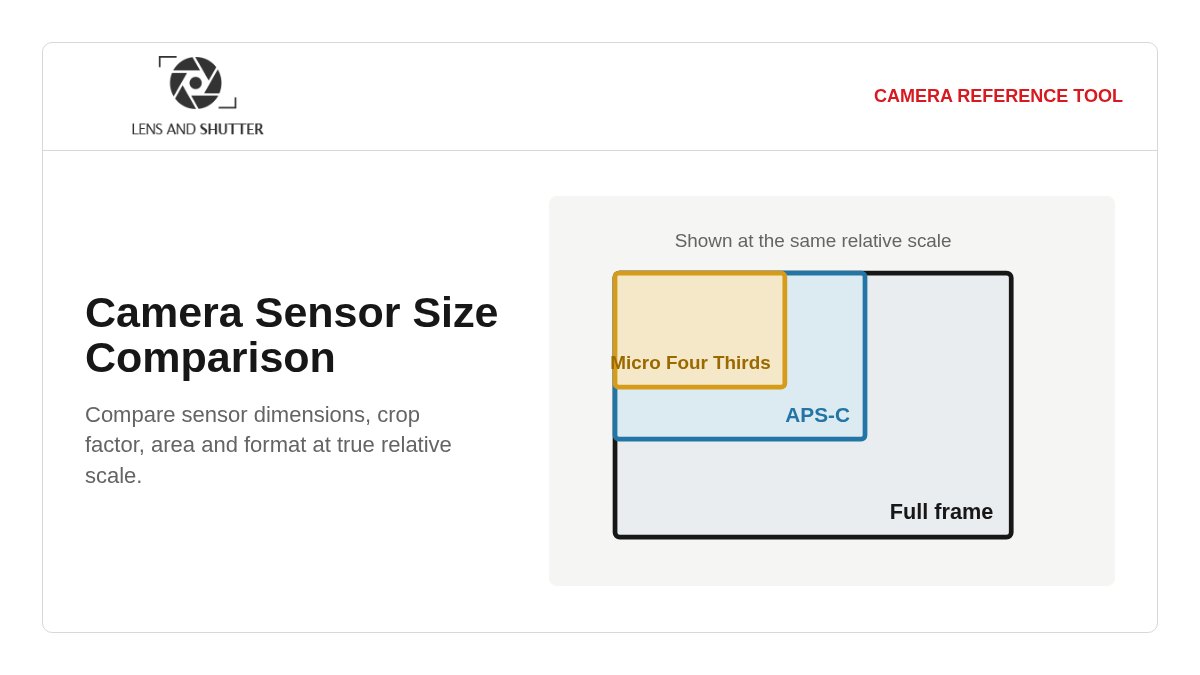
Camera sensor size chart
Use this chart for a quick physical comparison, then select any two formats in the tool above for a true-to-scale overlay and lens equivalence. Dimensions are common reference values; a specific camera's active imaging area can vary slightly.
| Sensor format | Reference dimensions | Area | Crop factor |
|---|---|---|---|
| Digital 645 | 53.4 x 40mm | 2,136 mm² | 0.65x |
| 44 x 33 medium format | 43.8 x 32.9mm | 1,441 mm² | 0.79x |
| Full frame | 36 x 24mm | 864 mm² | 1.00x |
| APS-H | 27.9 x 18.6mm | 518.9 mm² | 1.29x |
| APS-C, Nikon / Sony / Fujifilm | 23.5 x 15.6mm | 366.6 mm² | 1.53x |
| APS-C, Canon | 22.3 x 14.9mm | 332.3 mm² | 1.61x |
| Micro Four Thirds | 17.3 x 13mm | 224.9 mm² | 2.00x |
| 1-inch type | 13.2 x 8.8mm | 116.2 mm² | 2.73x |
| 1/1.3-inch type | 9.6 x 7.2mm | 69.1 mm² | 3.61x |
| 2/3-inch type | 8.8 x 6.6mm | 58.1 mm² | 3.93x |
| 1/1.7-inch type | 7.6 x 5.7mm | 43.3 mm² | 4.55x |
| 1/2.3-inch type | 6.17 x 4.55mm | 28.1 mm² | 5.64x |
Crop factor uses the sensor diagonal relative to 36 x 24mm full frame. Inch-type names are format classes, not physical measurements.
Sensor sizes in real cameras
Format labels become easier to judge beside familiar cameras. These are nominal still-image dimensions, and a video mode may use a smaller crop.
| Camera | Sensor class | Nominal dimensions |
|---|---|---|
| Nikon Z6 III | Full frame | 35.9 x 23.9mm |
| Sony a6700 | APS-C | 23.3 x 15.5mm |
| Canon EOS R10 | Canon APS-C | 22.3 x 14.9mm |
| OM System OM-5 Mark II | Micro Four Thirds | 17.4 x 13mm |
| Sony RX100 VII | 1-inch type | 13.2 x 8.8mm |
| Kodak PIXPRO FZ55 | 1/2.3-inch type | 6.17 x 4.55mm |
Use Custom dimensions in the calculator when a manufacturer lists a different active area for the exact camera or recording mode.
How to compare camera sensor sizes
Width and height show the physical active imaging area. Multiplying them gives area; the diagonal is used for the conventional crop-factor comparison. The overlay preserves physical proportions, so differences in both size and aspect ratio remain visible.
Sensor format names are categories rather than exact manufacturing standards. Individual cameras can use dimensions that differ slightly from these references, and video modes often crop a sensor further. Use Custom dimensions when exact camera specifications matter.
What each result means
Area ratio
Area measures the light-sensitive surface available to the complete image. The stops result is log base 2 of the area ratio. It is a geometric comparison, not a promised noise or dynamic-range advantage.
Crop factor
Crop factor compares sensor diagonals with the 43.27mm diagonal of 36 x 24mm full frame. It is useful for diagonal angle-of-view equivalence, but different aspect ratios prevent one multiplier from matching every edge of the frame.
Lens equivalence
A lens does not change focal length when mounted on another format. The matched-lens result calculates a different focal length that gives the selected horizontal, vertical or diagonal angle of view on Sensor B.
Pixel pitch
Approximate pitch is calculated from sensor area and megapixels assuming square pixels across the active area. Real effective dimensions, masked pixels and rounded megapixel specifications can shift the result.
Sensor area is not an image-quality score
Larger area can collect more total light when framing, exposure time, scene luminance and sensor efficiency are controlled. Actual files also depend on pixel architecture, read noise, quantum efficiency, resolution, processing, lens transmission and the output size used for comparison.
Depth of field comparisons require matched framing and a defined viewing condition. The equivalent aperture shown by the tool preserves the entrance-pupil relationship after focal length is changed for matching framing. It is not the f-number to use for equal exposure brightness.
Why inch-type sensor names are not measurements
Labels such as 1-inch type and 1/2.3-inch type are historical format classes, not the width or diagonal of the active imaging area. A common 1-inch-type still-camera sensor is approximately 13.2 x 8.8mm, with a 15.86mm diagonal.
The iPhone 17 Pro main-camera preset is an explicit approximation based on its reported Type 1/1.28, approximately 71.5 mm² sensor class. Apple publishes its 48MP resolution, 24mm-equivalent view and f/1.78 aperture, but not the physical active dimensions.
Phone and compact-camera sensors within the same nominal class can vary. Treat the smaller-format presets as useful references and enter manufacturer dimensions when comparing a specific model.
Camera sensor size comparison FAQ
How are camera sensor sizes compared?
Compare physical width, height, area and diagonal. Area shows the difference in total imaging surface, while diagonal is conventionally used for crop factor and approximate angle-of-view equivalence.
What is camera crop factor?
Crop factor is the 43.27mm diagonal of a 36 x 24mm full-frame sensor divided by the compared sensor diagonal. A 1.5x crop factor means a lens gives approximately the same diagonal angle of view as a lens 1.5 times longer on full frame.
Does focal length change with sensor size?
No. A 50mm lens remains a 50mm lens. A smaller sensor records a smaller section of its image circle, producing a narrower angle of view. Equivalent focal length is a framing comparison, not a change to the lens.
Is a 1-inch sensor actually one inch wide?
No. The name comes from historical video camera tube classes. A common 1-inch-type sensor is about 13.2 x 8.8mm, although exact active dimensions should be checked for the specific camera.