
View full specs
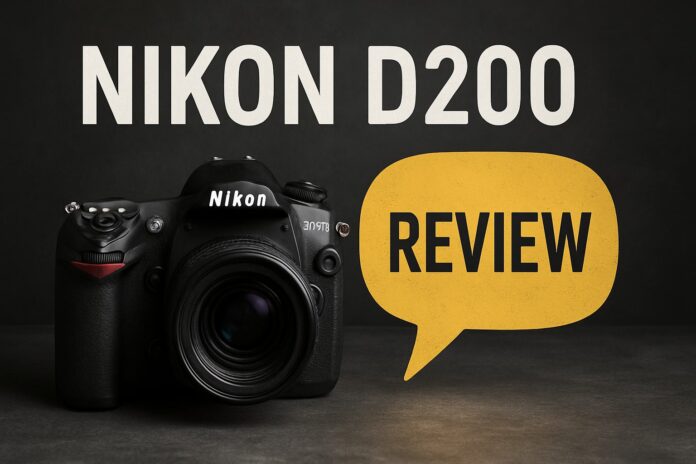
This Nikon D200 review looks at the 10.2MP DX-format CCD DSLR as a used camera in 2026. It can still make rewarding photographs at low ISO, and its controls feel more serious than its price suggests. It is also slow, heavy and demanding beside a modern camera. Buy it for the shooting experience and the files, not because nostalgia has hidden the practical limitations.
Quick verdict: the D200 is still a good character camera for daylight portraits, street work and deliberate landscape photography. Its tough body, screw-drive autofocus motor and broad F-mount compatibility are real advantages. High-ISO quality, the small rear screen, CompactFlash storage and the complete absence of live view and video are the price of entry.
Nikon D200 release date and key specs
Nikon announced the D200 on November 1, 2005, and it reached the US market in December 2005. It sat below Nikon’s professional D2 bodies but brought much of their physical seriousness to an enthusiast DSLR. The original US body-only price was $1,699.95.
| Specification | Nikon D200 |
|---|---|
| Sensor | 10.2MP Nikon DX-format CCD, 23.6 x 15.8mm |
| Image size | 3,872 x 2,592 pixels |
| ISO range | ISO 100-1600, plus boosted settings |
| Autofocus | 11-area Multi-CAM 1000 |
| Continuous shooting | Up to 5fps |
| Shutter | 1/8,000 sec maximum; 1/250 sec flash sync |
| Viewfinder | Optical pentaprism, about 95% coverage |
| Rear screen | 2.5-inch LCD, 230,000 dots |
| Storage | CompactFlash Type I/II or Microdrive; no SD slot |
| Battery | Nikon EN-EL3e |
| Weight | About 830g body only |
| Video / live view | Neither |
Those figures are easy to verify in Nikon’s official D200 specifications. What they do not explain is why photographers are searching for this camera again.
Why the D200 is interesting again in 2026
The D200 occupies an appealing part of the used market. It costs less than many accessories, yet it has a magnesium-alloy chassis, dedicated controls, a top LCD and a bright pentaprism finder. Pick one up after using an entry-level DSLR and the hierarchy is obvious. The D200 was designed as a tool that you operate by touch.
The renewed interest also comes from its CCD sensor. “CCD look” is often discussed as if every file leaves the camera with a magical film preset. It does not. Light, white balance, Picture Control choices and RAW processing still matter more than the sensor label. What the D200 does offer is a distinctive low-ISO starting point: confident color, crisp detail without excessive resolution and tonal behavior that responds well to careful exposure.
There is a useful discipline to it. With a modern camera, I may let Auto ISO climb while I concentrate on timing. With the D200, I watch the meter, protect the highlights and decide whether the light is worth the frame. That slower conversation is part of its charm, but it should not be confused with superior technology.
Build, controls and handling
The body remains the D200’s strongest argument. At 830g before adding a lens, it is not a casual carry. Pair it with a compact 35mm or 50mm prime and the balance makes sense; add a large f/2.8 zoom and the kit becomes substantial. The grip is deep, the front and rear command dials fall naturally under the fingers, and important settings have direct controls.
Nikon gave the camera sealing against dust and moisture, but a two-decade-old body should never be treated as weatherproof. Gaskets age. Rubber grips lift. Port covers harden. The underlying construction is excellent; the condition of the individual sample matters more than the original brochure.
The optical viewfinder is still pleasant for general photography. Its 95% coverage means the final image includes a little more around the edges than you saw while composing. The 2.5-inch rear LCD is the bigger adjustment. It is adequate for histograms, highlight warnings and a rough focus check, but poor for judging subtle sharpness. The D200 rewards photographers who trust the viewfinder and inspect files later.
Image quality: what the 10.2MP CCD does well
At ISO 100 and 200, the D200 can produce detailed, attractive files with enough resolution for strong prints and normal web use. Ten megapixels sounds modest now, but it is not a barrier to a good photograph. It does reduce cropping freedom, so composition and lens choice matter.
The sensor’s weakness is exposure latitude. Highlights do not recover like files from a newer CMOS Nikon, and deep shadow lifting reveals noise quickly. I expose the D200 more like an older digital camera: check the histogram, avoid casually clipping bright areas and get close in camera. The reward is a file that needs less rescuing.
ISO 400 remains practical. ISO 800 can work when exposure is accurate and some grain suits the subject. ISO 1600 is an emergency setting rather than a clean everyday option. Modern noise reduction can improve a D200 RAW file, but it cannot create detail that the sensor never recorded.
JPEG color can be lively, sometimes too lively. RAW is the better route if you want to understand the camera rather than inherit someone else’s saturated preset. Skin tones, foliage and blue skies can look excellent, but there is no universal CCD recipe. A neutral conversion and small, deliberate adjustments usually produce a more convincing result than pushing the supposed “CCD look.”
Autofocus, metering and speed
The 11-point Multi-CAM 1000 system is capable in good light. The center area is the safest choice when contrast drops, and single-point AF keeps the camera predictable for portraits and static subjects. The D200 also has an in-body focus motor, so older AF and AF-D screw-drive lenses retain autofocus. That is a meaningful advantage over many cheaper Nikon DSLRs.
Five frames per second was fast in 2005 and remains useful for short sequences. The limitation is not just frame rate. The buffer, card speed and old tracking logic require anticipation. For sport or wildlife, pre-focus where possible, use short bursts and do not expect modern subject recognition. The D200 can photograph action; it will not solve the action for you.
Its 1,005-pixel RGB metering system is generally dependable, while the 1/8,000-second shutter and 1/250-second sync speed are unusually useful at this price. Nikon stated that the shutter was tested beyond 100,000 cycles. That is a design target, not a guarantee for any used body.
Nikon D200 lens mount and compatibility
The Nikon D200 uses the Nikon F mount and applies a 1.5x field-of-view crop. A 35mm lens frames roughly like a 52.5mm lens on full frame, while a 50mm behaves like a short 75mm-equivalent portrait lens.
| Lens type | What works on the D200 |
|---|---|
| AF-S and AF-I Nikkor | Autofocus and metering with compatible lenses |
| AF and AF-D screw-drive lenses | Autofocus and metering through the camera’s focus motor |
| DX Nikkor | Fully appropriate for the D200’s DX sensor |
| AI, AI-S and AI-modified manual lenses | Manual focus; metering is available in aperture-priority and manual modes after entering lens data |
| VR lenses | Lens-based Vibration Reduction works on compatible lenses |
| E-type electronic-aperture lenses | Not compatible |
This is broad compatibility, not universal compatibility. Nikon introduced several lens technologies after the D200, so check the exact lens rather than assuming that any F-mount optic will provide every function. For a compact everyday kit, the AF-S DX 35mm f/1.8G is an obvious normal prime. The AF 50mm f/1.8D is inexpensive and makes use of the D200’s screw-drive motor. The period-correct AF-S DX 18-70mm f/3.5-4.5G is also a balanced walk-around zoom.
If you are comparing the D200 with other generations, our Nikon DSLR models guide puts the body in the wider lineup.
CompactFlash, battery and modern workflow
The D200 records to CompactFlash, not SD. It accepts Type I and Type II CF cards as well as Microdrives. Buy a conventional card from a known brand and inspect the camera’s CF slot carefully. Bent connector pins can turn a cheap body into an uneconomical repair.
Power comes from the EN-EL3e battery. Nikon originally quoted up to about 1,800 shots, but an original battery is now old enough that its condition matters far more than the historical rating. Confirm that the sale includes a working charger, budget for a replacement battery and avoid trusting an unknown cell for an important day.
There is USB data transfer, but no USB charging. A card reader is usually the cleaner workflow. Current software can still open the D200’s NEF files, and Nikon continues to host the manual and final A/B 2.01 firmware on its D200 download page.
Is the Nikon D200 still a good camera?
Yes, for the right job. The D200 makes sense as a low-cost second body, a route into older AF-D lenses, a classroom camera with direct controls or a deliberate CCD project camera. It is especially satisfying outdoors in decent light, where ISO 100-400, careful exposure and a small prime play to its strengths.
It is a poor choice for family video, low-light events, fast-moving children indoors, immediate wireless sharing or anyone who wants one effortless camera for everything. A newer body such as the Nikon D5600 gives cleaner high-ISO files, more resolution, a tilting screen and a much easier first-camera experience. The D300 is the more natural period upgrade if you want to retain the same style of controls.
Used US dealer listings currently place ordinary working bodies roughly in the $100-$190 range, depending on condition, shutter count and warranty. Private-sale examples can cost less. I would pay toward the top only for a clean body with a healthy battery, charger, intact grips, a clear finder and a return option. At this age, condition is worth more than a small difference in asking price.
What to check before buying a used D200
- CF slot: shine a light into it and reject bent or damaged pins.
- Battery and charger: confirm that an EN-EL3e charges, holds power and is not swollen.
- Shutter count: use it as context, then judge the whole camera. A low count does not rule out poor storage.
- Controls: test both command dials, the multi-selector, AF controls, card door and pop-up flash.
- Sensor and mirror box: photograph a plain bright surface at a small aperture and inspect for dust, marks or unusual banding.
- Body condition: check lifting rubber, corrosion in the battery compartment and signs of moisture around ports.
- Autofocus: test with a known AF-S lens and, if relevant, an AF-D lens to confirm the body motor works.
- Firmware: the final Nikon release is A 2.01 / B 2.01.
Final verdict
The Nikon D200 is not secretly a modern camera. That is precisely why it can be enjoyable. It offers a robust body, direct controls, useful F-mount compatibility and characterful low-ISO files for very little money. In return, it asks you to accept old storage, old batteries, limited high-ISO performance and a workflow without live view, video or wireless convenience.
Buy a good example because you want that experience. If you simply want the best image quality and autofocus per dollar, later Nikon DSLRs are easier recommendations. If you want a camera that slows the process down without reducing it to a novelty, the D200 still has a reason to exist.
Nikon D200 alternatives
The main alternatives to the Nikon D200 are Nikon D300, Nikon D90, Canon 40D, Pentax K10D. Compare autofocus, stabilization, video limits, lens choice and current price before deciding which camera fits you best.
Frequently asked questions
When was the Nikon D200 released?
Nikon announced the D200 on November 1, 2005. It went on sale in the United States in December 2005.
Is the Nikon D200 full frame?
No. It uses a 23.6 x 15.8mm Nikon DX sensor, commonly described as APS-C, with a 1.5x field-of-view crop.
What lens mount does the Nikon D200 use?
It uses the Nikon F mount. It autofocuses with compatible AF-S, AF-I, AF and AF-D lenses, and it can meter with many AI and AI-S manual-focus lenses. It is not compatible with E-type electronic-aperture lenses.
What memory card does the Nikon D200 use?
The D200 uses CompactFlash Type I or Type II cards. It does not have an SD card slot.
Does the Nikon D200 shoot video?
No. The D200 records still photographs only and does not offer live view.
Is the Nikon D200 worth buying in 2026?
It is worth buying as an inexpensive, rugged CCD DSLR for deliberate still photography in good light. It is not the sensible choice for video, high ISO, modern autofocus or wireless sharing.
Photographers who want a rugged CCD-era Nikon DSLR feel for very little money.
You need video, high ISO quality, modern autofocus, live view, or easy battery sourcing.
Medium-high; it is tactile and capable, but old storage, batteries, and menus slow beginners down.
Nikon D300/D300s for a similar DSLR feel, or Nikon D7500 for a much newer DX body.
No video at all; this is a stills-only DSLR.
Yes as a cheap character camera, not as a practical main system for most buyers.