
View full specs
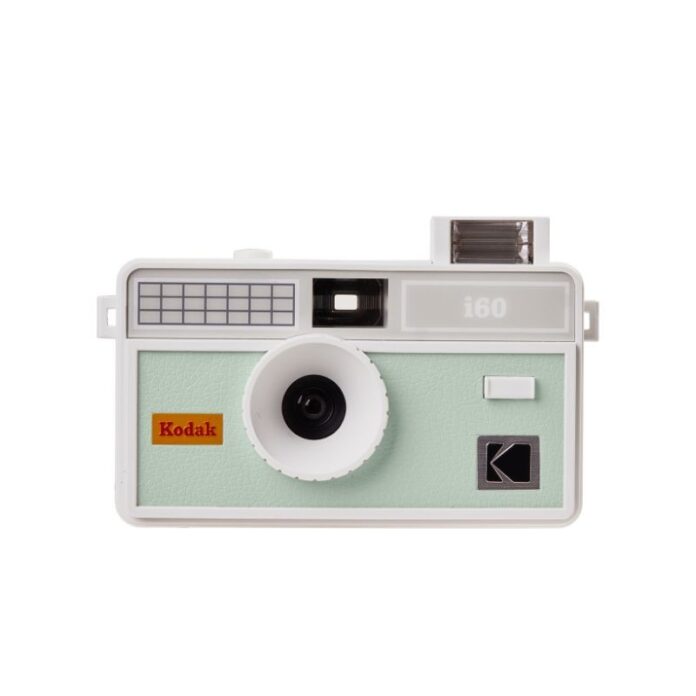
In this Kodak i60 review, I am revisiting a reusable 35mm camera that looks more sophisticated than it really is. The i60 has a 31mm f/10 lens, one fixed shutter speed, manual film transport, fixed focus, and a pop-up flash. It is simple enough for a first roll, but its stronger retro styling does not buy autofocus, automatic exposure, or a better-than-basic lens.
Check the price before buying: the camera-only package normally includes neither film nor the AA battery required for flash. I would cap the i60 at about $60 new. If the current listing is substantially higher, the newer EC35 is the more rational purchase unless you specifically want the i60 design.
That distinction matters more in 2026 because the newer Kodak EC35 now offers the same broad disposable-camera experience for $34.99. The i60 remains appealing if you prefer its Instamatic-inspired body, 31mm view, one-meter minimum focus, and pop-up flash. It is no longer the automatic recommendation among cheap Kodak film cameras.
Kodak i60 review: quick verdict
The Kodak i60 is best treated as a reusable disposable camera in a more distinctive body. Load a roll, keep the subject at least one meter away, use daylight whenever possible, raise the flash when the light falls, and accept that the lens will deliver atmosphere rather than fine detail.
| Buy the Kodak i60 if… | Skip it if… |
|---|---|
| You want a simple full-frame 35mm camera with strong retro styling. | You expect autofocus, automatic exposure, zoom, or manual control. |
| You like a natural 31mm view for groups, travel, and casual street photographs. | You want consistently sharp photographs or dependable low-light results. |
| You find it at a sensible price and prefer it to the plainer M35/M38. | The i60 costs much more than the newer EC35 or a tested used compact. |
| You enjoy manual winding and waiting for a roll to be developed. | You mainly want a retro look without the continuing cost of film and processing. |
My recommendation: the i60 is enjoyable at roughly $50 to $60, especially if the design makes you want to carry it. Above that, I would compare it carefully with the EC35, a half-frame Kodak Ektar H35, or a working used autofocus compact. Film and lab costs quickly become more important than a small difference in body price.
What the Kodak i60 actually is
The i60 is a reusable 35mm film camera introduced in 2022. Its shape takes inspiration from the Kodak Instamatic 100, but it uses ordinary 135 film and produces standard 24 x 36mm exposures. It is not an instant camera, a digital camera, or a half-frame model.
The Kodak name needs a little context. The i60 is a licensed Kodak-branded product rather than a camera manufactured by Eastman Kodak. Its 2022 documentation credits Sino Promise Holdings, while current retail support is handled through GT Company. That does not change how the camera works, but it explains why its design, support, and availability differ from newer Reto-made Kodak models such as the EC35.
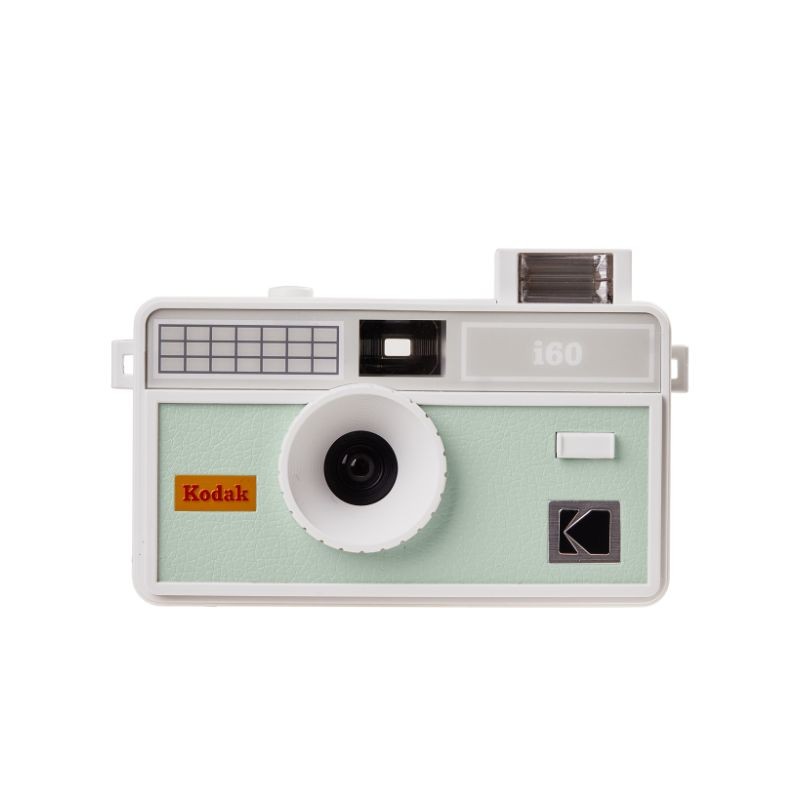
The top-mounted flash is its defining control. Press the release and the flash rises from the body; push it down when you do not need it. I like this arrangement because the camera visibly tells you whether flash is active. It also keeps the front cleaner than the usual small reusable-camera design. The tradeoff is that there is no automatic flash decision: the photographer must recognize weak light and raise it.
There are no focusing, aperture, or shutter-speed dials. After loading the film, the operating rhythm is simply frame, release the shutter, and turn the advance wheel for the next exposure. The AA battery powers the flash only. Film advance and rewind remain manual.
Two handling details deserve inspection as soon as the camera arrives. In a tested i60 sample, the battery cover was unusually difficult to remove while the rear film-door latch was easy to nudge. That may vary between copies, but an accidentally opened film door can fog a loaded roll. Check both parts before photographing anything important.
Kodak i60 specifications
| Specification | Kodak i60 |
|---|---|
| Film format | 135 film, 24 x 36mm exposures; ISO 200, 400, or 800 recommended |
| Licensed product | 2022 documentation credits Sino Promise Holdings; current support is through GT Company |
| Lens | 31mm f/10, single element |
| Focus | Fixed focus, 1m to infinity |
| Shutter | Fixed 1/125 second |
| Exposure control | None |
| Flash | Manually raised pop-up flash; approximately 15-second recycle time |
| Viewfinder | Optical finder, approximately 70% field coverage |
| Film transport | Manual wind and rewind |
| Battery | One AA alkaline battery for the flash |
| Dimensions | 112 x 64.6 x 46mm |
| Weight | 144.3g without film and battery |
| Material | ABS plastic |
These figures come from the Kodak i60 manual and specification sheet. Neither film nor the AA battery is normally included with the camera-only package, although retailer bundles may add film.
What the 31mm f/10 lens means in practice
A 31mm lens is a comfortable snapshot focal length. It is wider than the classic 35mm street-photography view without pushing faces toward the stretched look of an ultra-wide lens. For a camera intended for parties, vacations, friends, and family groups, I prefer this perspective to something tighter. You can include the surroundings without backing into the next room.
The important limitation is not the focal length but the one-element f/10 design. This is a cost-controlled plastic-camera optic. Expect the center to look more convincing than the edges, with modest contrast, visible softness, and occasional flare. Film stock, processing, and scanning contribute strongly to the final result, but they cannot turn the i60 into an autofocus compact with a multi-element glass lens.
Fixed focus covers subjects from one meter to infinity. That makes normal group photographs easy, but it does not make every distance equally sharp. Avoid close-up selfies, food at arm’s length, and small tabletop details. When I use a focus-free camera, I give the subject more room than the printed minimum suggests. A step backward costs nothing; an out-of-focus negative cannot be repaired later.
Exposure and image quality
Every frame is exposed at f/10 and 1/125 second. The i60 does not meter the scene. Your practical exposure controls are the film in the camera, the available light, and the decision to use flash.
In bright daylight, ISO 200 or 400 color-negative film gives the i60 its best chance. Negative film has useful exposure latitude, so small errors are usually less destructive than they would be with slide film. On an overcast day, in deep shade, or indoors, f/10 becomes restrictive quickly. Raise the flash rather than assuming the camera will compensate.
The flash is direct and relatively small. It works best for people at conversational distances, not a subject across a hall. It can create the hard-edged, bright-face party look that many buyers actively want from this type of camera. It is less flattering when used too close, and its roughly 15-second recycle time makes rapid sequences unrealistic.
I would not describe the output as reliably crisp. A good i60 frame combines decent light, sensible subject distance, steady handling, accurate film loading, and a competent lab. A poor frame can be dark, soft, or both. That uncertainty is either the charm or the deal-breaker.
Which film should you load?
ISO 400 color-negative film is the safest first choice. It offers more flexibility than ISO 200 when clouds arrive or a scene falls into shade, while remaining easy for labs to process. Kodak Ultramax 400 is an obvious pairing, but the camera accepts standard 35mm film from any brand.
- ISO 200 color film: best reserved for bright outdoor shooting.
- ISO 400 color film: the most versatile starting point for daylight, shade, and flash.
- ISO 800 film: useful in weaker light, although it does not remove the need for flash indoors.
- Black-and-white film: fully compatible; check that your chosen lab processes the film stock.
The camera has no DX reader and does not alter its settings for a faster roll. ISO choice changes the film’s sensitivity, not the fixed f/10 aperture or 1/125-second shutter.
Loading, winding, and avoiding a ruined roll
Most catastrophic failures with a simple film camera happen during loading, not exposure. Seat the cassette correctly, pull the leader across, engage the perforations with the take-up mechanism, and watch that the film advances when you turn the wheel. After closing the back, alternate winding and shutter releases until the counter reaches the first frame.
Do not open the back to check whether the film is moving. If the rewind crank rotates as you advance after the initial slack is taken up, that is a useful sign that the film is traveling. At the end of the roll, press the rewind release before turning the crank. Stop and investigate if either control requires force.
The viewfinder shows only about 70% of the recorded field, so the negative will include more around the edges than you saw while composing. This is forgiving for groups but imprecise for careful framing. It is another reason to treat the i60 as a spontaneous camera rather than a precision tool.
Kodak i60 vs Kodak EC35
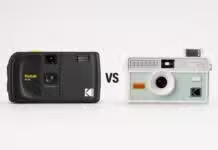
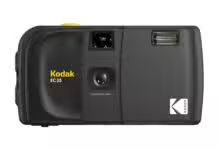
The new EC35 changes the i60’s value proposition. Both are reusable full-frame 35mm cameras with fixed exposure, fixed focus, built-in flash, and manual film transport. The EC35 is lighter and cheaper, with a wider 25mm two-element lens and a sliding cover that protects the lens and locks the shutter. The i60 uses a 31mm single-element lens, focuses from one meter rather than the EC35’s more conservative 1.5m guidance, and has a distinctive pop-up flash.
I would choose the EC35 for price, pocket weight, the protected lens, and wide group photographs. I would choose the i60 only if I preferred its narrower perspective, closer minimum subject distance, or Instamatic styling enough to pay more. Neither offers the autofocus or exposure control of a proper used compact. See the full Kodak EC35 vs i60 comparison for the side-by-side buying decision.
Other alternatives worth considering
The Kodak M35 and M38 deliver a very similar low-fi idea in simpler bodies. The Ilford Sprite 35-II is another reusable fixed-exposure option and makes particular sense if you plan to explore black-and-white film. The Kodak Ektar H35 is more economical per roll because it records two half-frame photographs in the space of one standard frame, although each negative is smaller.
A tested used autofocus point-and-shoot is the quality upgrade. It can add metering, autofocus, a better glass lens, and automatic film transport. The problem is condition: an old compact may fail without warning, and popular models are no longer cheap. The i60 is easier to understand and replace, but its photographic ceiling is lower.
Who should buy the Kodak i60?
Buy the i60 if you want the physical ritual of film and the body itself makes you smile. Design is not a frivolous advantage in a casual camera. A camera you enjoy carrying records more of your life than a technically better one left on a shelf.
It also suits social photography. Hand it to a friend, ask everyone to stay beyond one meter, raise the flash indoors, and accept that the developed roll will contain surprises. That is a coherent use of the i60.
Skip it if you are trying to learn exposure control or judge film stocks precisely. A basic 35mm SLR will teach more. Skip it as well if current US pricing rises far above simpler reusable cameras. The i60’s styling is attractive, but it does not justify paying autofocus-compact money.
Final verdict
The Kodak i60 is a charming reusable film camera with a useful 31mm view, a clear pop-up flash mechanism, and an Instamatic-inspired design. Its real photographic specification remains extremely basic: one lens element, fixed focus, f/10, and 1/125 second for every frame.
That makes the i60 fun rather than exceptional. At a reasonable price, it is a more characterful way to get disposable-style results without discarding the camera after every roll. In 2026, however, the cheaper EC35 is the stronger default recommendation. Choose the i60 because you specifically prefer how it frames, focuses, and feels as an object, not because the retro body promises more control than it delivers.
Frequently asked questions
Is the Kodak i60 digital?
No. It is a reusable 35mm film camera. It has no image sensor, screen, memory card, USB connection, or video mode.
Does the Kodak i60 autofocus?
No. Its 31mm lens is fixed focus from approximately one meter to infinity.
Does the Kodak i60 flash work automatically?
No. Press the flash release to raise it when needed. One AA alkaline battery powers the flash, which takes roughly 15 seconds to recycle.
What film does the Kodak i60 use?
It accepts standard 35mm film. The official specification recommends ISO 200, 400, or 800 film; ISO 400 color-negative film is the easiest general-purpose choice.
Is film included with the Kodak i60?
Not normally with the camera-only package. Some retailer kits include film, so check the exact listing rather than assuming it is in the box.
Is the Kodak i60 better than the EC35?
Not categorically. The i60 offers a 31mm view, one-meter fixed-focus range, and pop-up flash. The EC35 is cheaper and lighter, with a wider 25mm lens, two lens elements, and a protective sliding cover.
Casual film users who value the Instamatic-inspired design and simple 31mm view.
You expect autofocus, exposure control, sharp optics, or inexpensive US availability.
Film loading, manual winding, recognizing when flash is needed, and processing costs.